Think of the last time you asked ChatGPT or Perplexity a question. You got a neat, conversational answer, right? Now, what if that question was about your industry, or even your brand? What would the AI say?
That's the million-dollar question that AI brand visibility tools are built to answer. They're a new breed of platform designed to track how your brand shows up in the world of AI conversations. We're moving way beyond traditional SEO here—it's not just about rankings anymore. It's about the context, the sentiment, and the sources that AI assistants use to talk about you.
What Are AI Brand Visibility Tools

Imagine you had someone who could listen in on every single conversation an AI model has about your business. That's essentially what an AI brand visibility tool does. It’s your eyes and ears on a digital frontier where AI-driven chats are quickly shaping what people think about you.
Classic SEO tools are great for tracking keyword rankings on a Google results page. But these new platforms go deeper. They analyze how AI models are framing your business, the tone they use, and which of your web pages they trust enough to cite as a source. For any business that cares about its reputation, this isn't just nice to have—it's essential.
The Shift From Search To Conversation
The way customers get information is fundamentally changing. They aren't just sifting through ten blue links on a search page anymore. They're asking an AI for a direct answer, and they expect a good one. This shift from searching to conversing demands a whole new playbook.
This trend is also why smart marketers are pairing these tools with leading AI social listening tools to get a complete 360-degree view of their brand's digital footprint.
The stakes couldn't be higher. Some forecasts predict that traditional search engine traffic could drop by as much as 25% by 2026, all thanks to the rise of AI chatbots. Simply ignoring your brand's presence in AI is no longer an option.
Traditional SEO vs AI Brand Visibility Focus
The game has changed, and so have the metrics that matter. While traditional SEO focused on climbing the search rankings, AI brand visibility is about becoming a trusted source for AI models. Here’s a quick breakdown of how the focus is shifting:
| Metric | Traditional SEO | AI Brand Visibility |
|---|---|---|
| Primary Goal | Rank #1 on SERP | Become a citable source |
| Core Metric | Keyword ranking position | Frequency & quality of mentions |
| Key Activity | Backlink building, on-page SEO | Creating definitive, factual content |
| Audience | Human searchers | AI models & human users |
| Success Indicator | High organic traffic | Positive, accurate AI-generated answers |
This table really highlights the pivot we're all making. It's less about technical tricks and more about establishing genuine authority that AI can recognize and trust.
A New Approach To Optimization
This new conversational ecosystem requires a completely different kind of optimization. It’s not just about sprinkling in keywords and building backlinks anymore. It’s about influencing the massive knowledge bases that these AI models are trained on.
This emerging discipline is often called Answer Engine Optimization. The whole point is to make your content the most reliable, accurate, and citable source on a given topic, so AI models turn to you for answers. We have a detailed guide that explains what Answer Engine Optimization is and why it matters if you want to go deeper.
An AI brand visibility tool is your brand's PR manager for the age of AI. It doesn't just check if you're in the directory; it listens to what's being said about you in every conversation and helps you shape the narrative.
Ultimately, these tools give you the intel you need to protect your brand where it matters most: inside the AI-powered dialogues that are happening right now. They help you get answers to the tough questions:
- Are AI models talking about my brand in a positive or negative light?
- Is my top competitor being recommended over me?
- Which of my blog posts or guides are actually influencing the AI's answers?
- What questions are people asking that lead to my brand being mentioned?
Why Your Business Needs to Monitor AI Visibility
Let's try a little thought experiment. Imagine your brand is at a huge party, but you're not allowed to speak. Instead, strangers are walking around telling everyone your story. You have absolutely no idea what they're saying—if it's true, if it's good, or if they're pointing people to your biggest competitor.
That's exactly what's happening right now if you're not monitoring your brand's presence in AI search. This isn't some far-off, futuristic problem. It's a reality unfolding in every single AI-generated answer, and it’s creating a massive blind spot for businesses. While you're busy fine-tuning your traditional SEO, an AI could be defining your brand based on a decade-old forum post or a single out-of-date review.
Customers are already turning to AI for quick, trusted answers. What they hear directly shapes their decisions.
Protecting Your Brand Reputation
Picture an e-commerce brand that sells premium, ethically sourced coffee beans. A potential customer asks an AI assistant for the "best eco-friendly coffee brands." The AI, pulling from a chaotic mix of old blog posts and unverified chatter, completely leaves them out. Instead, it enthusiastically recommends a competitor.
This isn't just a missed sale; it's the quiet, steady erosion of your brand's value. When an AI misrepresents your brand or, even worse, ignores it, trust is damaged. It allows competitors to write the story for your entire market.
Think of AI models as a global team of incredibly influential, but sometimes misinformed, researchers. If you're not actively feeding them the correct information and monitoring their output, you're leaving your brand's reputation to chance.
Without a dedicated strategy, you’re basically letting a black box algorithm run your public relations. That’s why it’s so critical to understand exactly how to monitor brand mentions in conversational AI like ChatGPT—it gives you back the control you've been missing.
Maintaining a Competitive Edge
The battle for customer attention has opened up on a new front. You can bet your competitors are already figuring out how to become the default recommendation in AI-powered search. Every time an AI mentions them instead of you, they don’t just win a potential customer; they solidify their place as an industry authority.
This is about more than just one-off mentions. It’s about claiming your "share of model"—the AI equivalent of share of voice. Monitoring your visibility lets you see the full battlefield.
- See Where Competitors Win: Find out which questions and topics your rivals are dominating.
- Spot the Gaps: Identify the questions where no one, including you, is giving the AI a good answer yet.
- Check the Vibe: Is the AI talking about your competitors more positively? Now you have the intel to adjust your own messaging.
This is the kind of strategic intelligence that SEO managers and growth teams need to prove their impact and deliver real results.
Driving Sustainable Growth
When it comes down to it, monitoring your brand’s AI visibility is about securing future growth. The market for tools that manage this is exploding because businesses are seeing a direct line to their bottom line. In fact, the AI in marketing market, which includes AI brand visibility tools, was valued at $47.32 billion in 2025 and is projected to hit $107.5 billion by 2028. You can dig deeper into this growth over on NeilPatel.com.
By actively managing how AI models see and talk about your brand, you’re doing more than just playing defense. You are building a durable pipeline for finding new customers. Becoming the brand that AI assistants consistently trust and recommend creates a powerful moat around your business, ensuring you stay relevant for the next generation of consumers.
Core Features of Leading AI Visibility Platforms

To really get what makes AI brand visibility tools tick, you have to look under the hood. These platforms are so much more than simple mention counters; they're sophisticated intelligence systems built to figure out how AI models see and talk about your brand. Each feature gives you a different lens to analyze, strategize, and act.
Think of it like a car's dashboard. You don’t just have a speedometer. You also get a fuel gauge, an engine temperature light, and other warnings. Every instrument tells you something different but essential about the car's health. In the same way, the features in these platforms paint a complete picture of your brand's performance in the AI world.
Let's break down the essential components that turn all that raw data into a clear roadmap for improving your brand’s standing with AI.
AI Mention Tracking
The most basic question an AI visibility tool has to answer is, "Is my brand even part of the conversation?" That's where AI Mention Tracking comes in. This feature is constantly scanning the outputs from models like ChatGPT, Perplexity, and Gemini to log every single time your brand, products, or key people are mentioned.
But it’s not just about counting. It’s about understanding the frequency and, more importantly, the context. A marketing manager might see their brand is mentioned a lot when users ask for "budget-friendly software" but is a complete ghost in conversations about "enterprise solutions." That insight immediately flags a huge gap in their content strategy.
Sentiment Analysis
Knowing you were mentioned is one thing. Knowing how you were mentioned is a whole different ballgame. Sentiment Analysis uses natural language processing (NLP) to figure out the emotional tone behind every mention, classifying the language as positive, negative, or neutral.
This feature is basically your brand's AI-powered reputation monitor. Imagine launching a new product and seeing that 80% of AI mentions are positive, with the AI using words like "innovative" and "reliable." On the flip side, a sudden spike in negative sentiment could be the first sign that an AI is pulling from old, critical reviews, giving you a heads-up to tackle the issue before it spreads.
Sentiment analysis acts as an early warning system. It helps you catch narrative problems within AI responses before they become widely accepted truths among your potential customers.
Source Citation Tracking
This might just be the most powerful feature of them all. Source Citation Tracking tells you why an AI mentioned you by showing the exact web pages, articles, or reports it used to formulate its answer. It's the ultimate feedback loop for your content marketing.
Think of it as the AI showing its work. If you notice a competitor is constantly cited when users ask a key industry question, you can dig into their content to figure out why it's considered so authoritative. You might discover their articles include things like:
- Structured Data: Clear headings, lists, and tables that are a piece of cake for an AI to read and understand.
- Original Research: Unique stats and data that make their content the primary source.
- Expert Quotes: Input from recognized authorities that adds a ton of credibility.
Once you know which sources the AIs trust, you can reverse-engineer your own content strategy to become a go-to citation. For a deeper look into these capabilities, it's worth exploring a detailed breakdown of the core components of AI visibility and how they all fit together.
Competitor Benchmarking
You don’t operate in a vacuum, and neither does your brand's visibility. Competitor Benchmarking features let you track your performance directly against your rivals. You can measure key metrics like "Share of Model"—the AI version of share of voice—to see who is really owning the conversation on important topics.
For example, an SEO manager could set up a dashboard comparing their brand against three competitors for a list of 20 high-value prompts. If they see a rival is capturing 60% of mentions for "best project management tools for remote teams," it gives them a crystal-clear, measurable goal for their next content push. Suddenly, a vague objective becomes a targeted, data-driven mission.
Key Features and Their Business Impact
To pull this all together, here’s a quick look at how these core features translate directly into business value.
| Feature | What It Does | Business Impact |
|---|---|---|
| AI Mention Tracking | Logs every time your brand is mentioned by AI models. | Provides a baseline for visibility and uncovers positioning gaps. |
| Sentiment Analysis | Gauges the emotional tone (positive, negative, neutral) of mentions. | Acts as a reputation monitor and an early warning system for narrative issues. |
| Source Citation Tracking | Identifies the specific content AI models use as sources. | Offers a clear roadmap for creating content that AI models will trust and cite. |
| Competitor Benchmarking | Compares your AI visibility metrics against key rivals. | Turns vague goals into specific, measurable targets for content and SEO strategies. |
Ultimately, each of these features provides a different piece of the puzzle. When used together, they give you a comprehensive toolkit to not just monitor but actively shape how your brand is perceived and represented by AI.
How to Choose the Right AI Visibility Tool
Picking the right AI visibility tool can feel like you're navigating a maze. A ton of new platforms are popping up, and every single one promises game-changing insights. The trick isn't just finding the one with the most bells and whistles; it's about finding the one that perfectly fits your team's skills, your budget, and what you're actually trying to achieve.
Think of it like buying a vehicle. If you're a solo entrepreneur, maybe you just need a reliable scooter to zip around the city—something simple, with an intuitive dashboard. But a big agency juggling dozens of clients? They need a freight truck—a beast of a platform with deep, exportable data and advanced analytics. Both get the job done, but only for the right person.
Define Your Core Needs First
Before you even think about watching a single demo, map out what you really need to accomplish. Is your main goal reputation management? Competitive intelligence? Or are you laser-focused on content strategy? Just answering that one question will slash your list of options.
You also have to be honest about your team's size and expertise. A small business owner needs a tool that's easy to set up and spits out clear, actionable advice. On the other hand, an enterprise SEO team will probably want raw data access, API integrations, and customizable reports that plug right into their existing workflows.
A classic mistake is getting wowed by a flashy feature list instead of focusing on the actual business problem you need to solve. Always start with your goals, not the software's capabilities.
This initial gut check is crucial. It stops you from overpaying for enterprise-level features you'll never touch, or worse, picking a tool that’s too basic to give you the insights you need to make a real difference.
Crucial Evaluation Criteria
Once you know what you're looking for, use these criteria to vet the ai brand visibility tools on your shortlist. This structured approach helps you compare platforms apples-to-apples and make a choice you won't regret.
- AI Model Coverage: The world of AI isn't just one thing. Does the tool only keep an eye on ChatGPT, or does it cover others like Gemini, Perplexity, and Claude? The broader the coverage, the more complete your view of the landscape.
- Data Accuracy and Depth: Can you actually trust the numbers? Ask potential vendors how they gather their data and verify its accuracy. Look for features that go beyond a simple mention count, like sentiment analysis, source citation tracking, and prompt-level details.
- Integration Capabilities: A good tool should play nicely with your existing tech stack, not create more work. Check for integrations with Google Analytics, your CMS (like WordPress), and your project management software. That's how you turn insights into action without friction.
- User Experience (UX): Is the dashboard actually usable? Can you find what you need without a four-hour training session? A clean, user-friendly interface is non-negotiable for getting your team to actually use the tool.
Tailoring Your Choice to Your Role
Different people on the team will care about different things. Your specific role should be a major factor in the final decision, making sure the platform is a perfect match for your daily grind and strategic goals.
- For the Solo Founder: Look for affordability and simplicity. A tool with a clean dashboard that highlights top-level metrics like mention frequency and sentiment is your best bet. The goal is quick insights without a steep learning curve.
- For the SEO Manager: Your priorities are data accuracy and competitor benchmarking. You need a platform that can give you granular details on which sources AI models are citing and how your share of model stacks up against the competition. This is the kind of data that fuels a winning content strategy, similar to what you’d look for in the best SERP tracking tools, but built for the world of AI.
- For the Agency: Scalability and rock-solid reporting are everything. An agency needs a tool that can handle multiple client accounts, generate white-label reports, and export data for deeper dives in other platforms. Advanced features and API access are key.
By carefully matching your business needs and role to these evaluation points, you can confidently pick an AI brand visibility tool that will deliver real, measurable value.
Putting Your AI Visibility Strategy Into Action
Having raw data from AI brand visibility tools is one thing, but turning it into a real, working strategy is where the magic happens. It’s not enough to know what AI models are saying about you; you need to be able to actively shape that conversation. This isn't a one-and-done task—it's a continuous cycle of analyzing, creating, and tweaking to build your brand's authority in the eyes of AI.
Think of it like tending a garden. First, you have to check the soil and see what’s already growing (or what’s missing). After that, you plant the right seeds, give them everything they need to flourish, and keep the weeds out. Implementing an AI visibility strategy follows a very similar, methodical path from that initial assessment all the way to long-term growth.
Establish Your Baseline
You can't improve what you don't measure. The very first step is to run a comprehensive audit with your chosen tool to get a clear picture of where you stand right now. This is more than just counting mentions; it’s about creating a detailed snapshot of your current AI footprint.
Your initial audit needs to capture a few key metrics:
- Mention Frequency: For a core set of 20-30 relevant prompts, how often does your brand come up across different AI models?
- Sentiment Score: What’s the general vibe of these mentions? Are they positive, neutral, or negative?
- Share of Model: How do you stack up against your top three competitors for the same set of prompts?
- Key Citations: Which of your web pages are actually being cited as sources, if any?
This baseline is your starting line. From this point on, every single action you take should be aimed at moving these numbers in the right direction. It gives you a clear, data-backed way to track your progress and prove your efforts are paying off.
Identify Content Gaps and Opportunities
Once your baseline is set, it's time to dig in and analyze the data. This is where you hunt for low-hanging fruit and strategic gaps. Your main goal here is to pinpoint exactly where your competitors are winning and where no one is giving the kind of solid answer that an AI would want to use.
Look for patterns. For example, you might find that your biggest competitor is constantly cited for "how-to" guides, but your brand is nowhere to be found. That’s an immediate signal of a content gap you can fill.
This is where having the right tool is non-negotiable. Your ability to find these opportunities depends on a tool's coverage, accuracy, and integration.
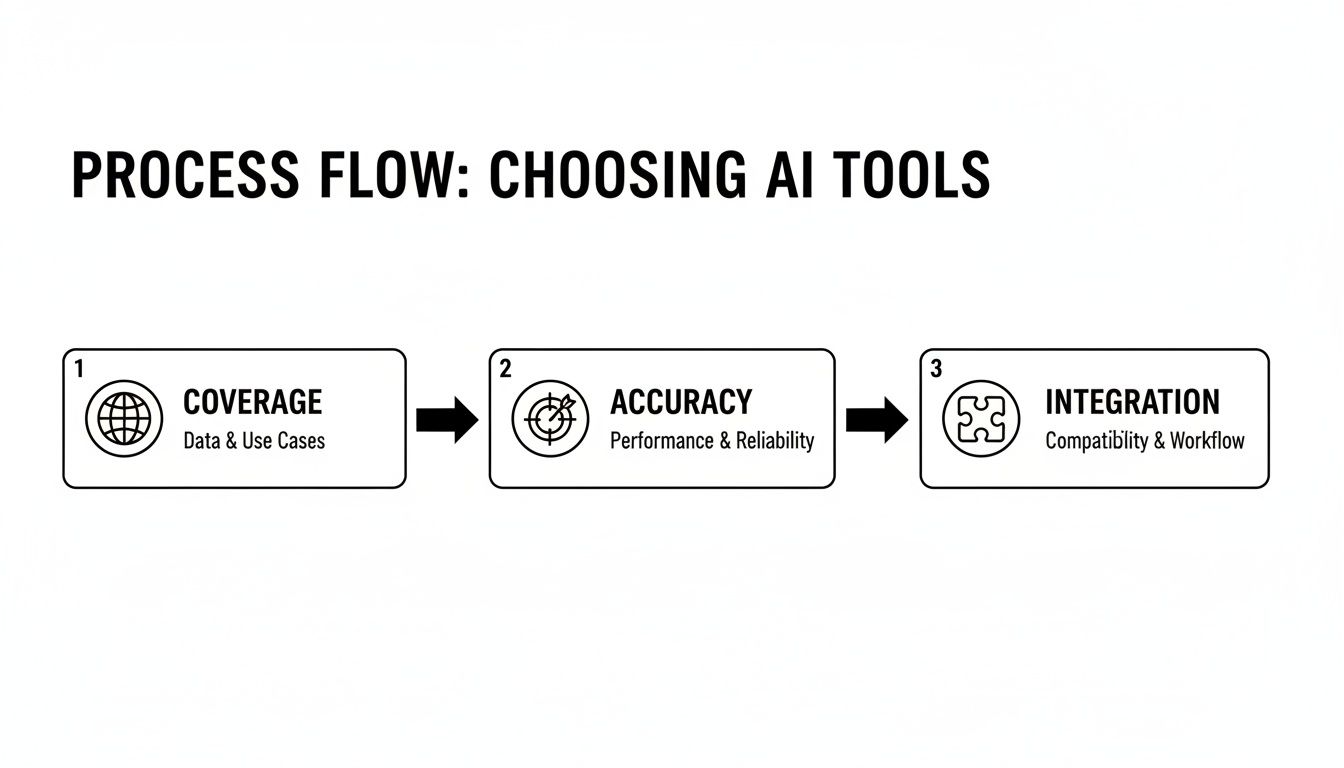
This process highlights a simple truth: a winning strategy starts with trustworthy data from a comprehensive tool.
Create and Optimize AI-Friendly Content
Now that you know which gaps to target, it’s time to create content specifically built to be understood and trusted by AI models. We know that AI often pulls from top-ranking search results, so strong SEO fundamentals are still absolutely essential. But AI-friendly content takes it a step further.
To make your content more appealing to AI, focus on these elements:
- Direct Answers First: Structure your articles to give a clear, concise answer to the target question right in the first paragraph.
- Use Structured Data: Make your content easy for an AI to parse by using clear headings (H2s, H3s), bullet points, and numbered lists.
- Incorporate Factual Data: Pack your content with statistics, data points, and quotes from experts. This builds authority and makes your page a citable source.
- Emphasize Key Terms: Use bold text for important concepts and definitions. It’s like a visual cue that tells the AI, "Hey, this part is important."
An AI model is like a very literal-minded researcher on a tight deadline. It will always prefer a well-organized, fact-filled document over a dense, narrative-heavy one. Make your content easy to skim and quote.
When you structure your content this way, you make it incredibly easy for an AI to lift information and cite your page as a source—which is exactly what you want.
Promote and Distribute Your Content
Creating amazing content is only half the battle. For AI models to see it, that content needs to be visible and authoritative. This means you have to get it in front of the trusted sources that AI models already lean on, like high-authority news sites, industry blogs, and publications.
A solid PR and link-building strategy is crucial here. When other credible websites link to or mention your AI-optimized content, it sends a powerful signal of trust. This doesn't just boost your traditional SEO; it dramatically increases the odds that AI will discover and use your content as a primary source.
After you publish, you also need to make sure your content gets indexed quickly. You can explore these automated indexing features for marketers to see how you can speed up the discovery process. A unified dashboard is the best way to track how all these efforts—content creation, promotion, and indexing—are impacting your visibility over time.
Measuring Success and ROI from Your Efforts
So, you’ve invested in an AI brand visibility tool. That’s a smart move, but now comes the real question: how do you prove it’s actually working? Just counting the number of times your brand gets mentioned won't cut it. To show real value, you have to connect those mentions to metrics that actually matter to the business and calculate a clear return on investment (ROI).
Think of it like a fitness journey. Stepping on the scale every day only tells you one part of the story. A better approach is to also track things like body fat percentage, endurance, and strength gains. In the same way, a solid measurement plan for AI visibility looks beyond the surface-level numbers to tell a complete story of your performance.
Moving Beyond Basic Mention Counts
The first step is to ditch the vanity metrics. Sure, a high mention count feels good, but real success is measured by the quality and impact of that visibility. Your performance dashboard needs to focus on more sophisticated metrics that give you a true picture of where your brand stands in AI-generated conversations.
Here are the key metrics you should be tracking:
- Share of Model (SoM): This is basically the AI version of Share of Voice. It tells you how often your brand shows up in AI-generated answers for specific prompts compared to your top competitors.
- Sentiment Score Shifts: Are AI models talking about you more positively over time? Seeing a shift from negative or neutral sentiment to positive is a massive win for any reputation management strategy.
- AI-Driven Citation Growth: Keep a close eye on how often AI models directly cite your website as a source. This is a direct indicator that your content is being seen as authoritative and trustworthy by the algorithms.
Connecting Visibility to Business Outcomes
Ultimately, the goal is to draw a straight line from these AI-specific KPIs to actual business results. This is how you prove the ROI of your strategy to anyone who asks. For example, you can integrate your AI visibility data with your web analytics to see if a spike in citations from Perplexity lines up with a jump in referral traffic from that platform.
Proving ROI isn't just about showing more mentions; it's about demonstrating that those mentions are driving higher quality leads, increasing organic traffic, and positively influencing customer perception before they even visit your website.
Accurately measuring success is a critical piece of the puzzle. You can find some fantastic, detailed methods in this resource: A Clear Guide to Measuring Social Media ROI. While it's focused on social media, the frameworks it offers are easily adaptable. By pulling these metrics into a simple dashboard, you can build a powerful narrative that justifies every penny spent on managing your brand’s presence in AI.
Frequently Asked Questions
Even with a solid plan, jumping into a new type of software like AI brand visibility tools is bound to bring up a few questions. Let's tackle some of the most common ones so you can move forward with total confidence.
How Is This Different From Traditional SEO?
Here’s the simplest way to think about it: traditional SEO gets you a spot on the list of search results. AI visibility helps you become part of the final answer itself.
SEO is all about ranking your own web pages for specific keywords. AI visibility, on the other hand, tracks whether language models like ChatGPT are actually mentioning your brand, citing your content as a source, and talking about you in a positive light within their conversational replies.
Can I Just Use My Existing SEO Tools?
Not really. Your trusty tools like SEMrush and Ahrefs are fantastic for keyword research and checking backlinks, but they weren't designed to peer inside AI-generated text. They can't tell you how your brand is being framed inside a response from Perplexity or Claude.
You need a tool built specifically for monitoring mentions, sentiment, and citations across these different AI models. It's a completely different challenge than just tracking your rank on a search results page.
An AI visibility tool doesn’t replace your SEO toolkit; it complements it. It adds a crucial layer of intelligence for the conversational web, giving you insights your traditional tools simply can't see.
How Do AI Models Find Information About My Brand?
AI models learn by consuming a massive amount of text from across the internet, and they definitely play favorites. They tend to rely on sources they deem authoritative and trustworthy. This usually includes a few key areas:
- High-Ranking Search Results: Our own research shows that AI models often pull information directly from the top 20 Google results. A strong SEO foundation isn't just nice to have; it's a prerequisite.
- Authoritative Publications: When your brand gets mentioned in major news outlets, respected industry blogs, or detailed research reports, the models take notice. These sources carry a lot of weight.
- Structured Data: Content on sites like Wikipedia or even your own well-organized product pages is much easier for an AI to understand, process, and trust.
At the end of the day, a strong public presence and high-quality, well-structured content are the best ways to positively influence what AI models learn about you.
How Quickly Can I See Results From These Efforts?
Improving your AI visibility is a long game, not an overnight fix. You can start tracking your baseline mentions and sentiment right away, which is great for getting a starting point.
But actually influencing an AI’s knowledge base takes consistent, dedicated effort. You might notice small shifts within a few weeks, but seeing significant improvements in your Share of Model or how often you're cited usually takes a few months of focused content creation and promotion. Think of it as a marathon, not a sprint—one that builds a lasting competitive advantage.
Ready to stop guessing what AI is saying about you? Sight AI provides a unified dashboard to monitor your brand across ChatGPT, Gemini, and Perplexity, turning visibility insights into a clear content strategy. Get discovered where it matters most. Learn more and get started at https://www.trysight.ai.