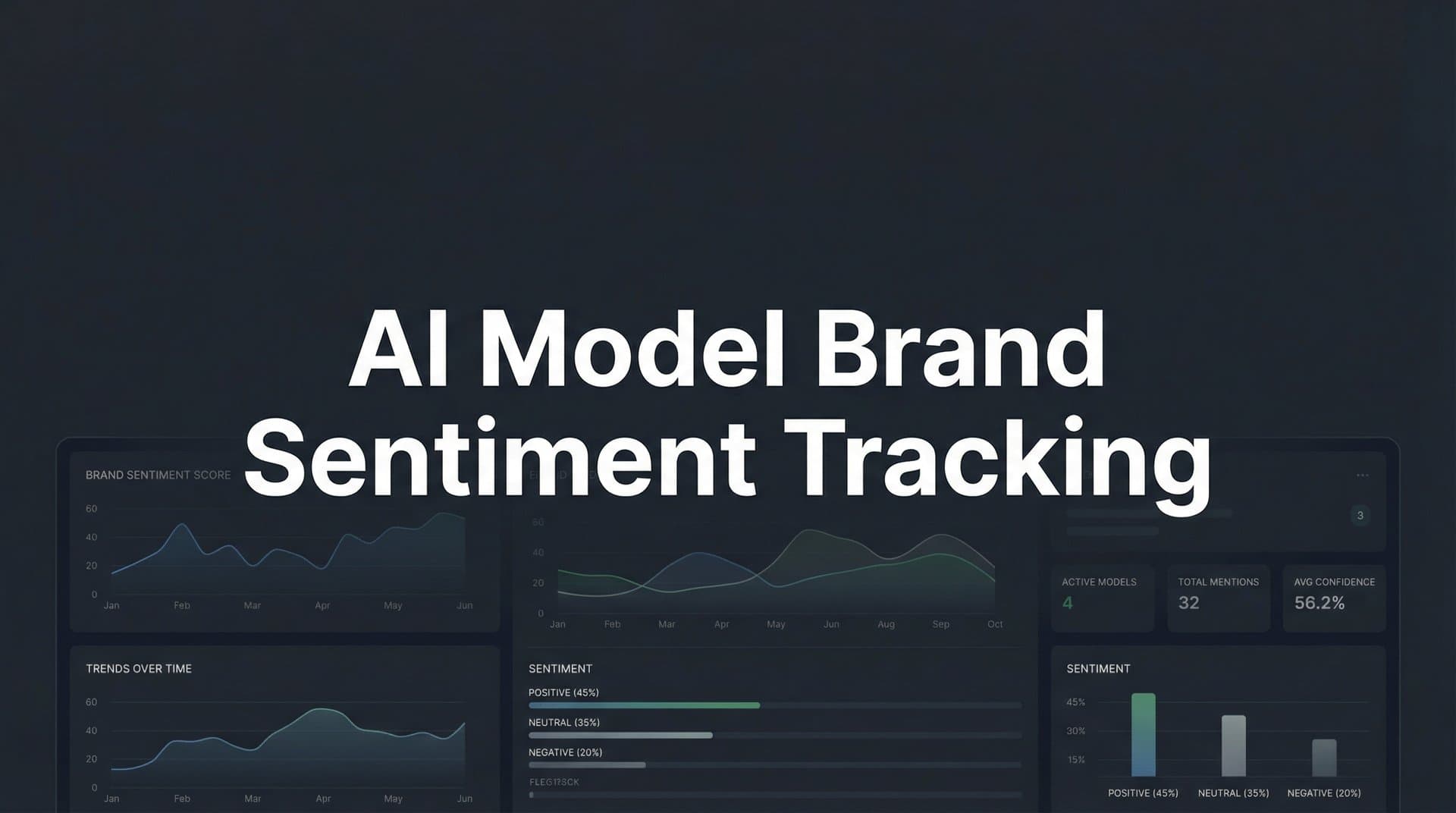
Most marketers have a reasonably clear picture of what customers say about their brand. Review monitoring tools, social listening dashboards, and NPS surveys capture the public conversation in real time. But there's a growing blind spot that very few teams are addressing: what AI models say about your brand when users ask them questions.
Picture this scenario. A potential buyer asks ChatGPT to recommend the best tools in your category. The model responds with a short list, describes each option in a sentence or two, and the buyer clicks away with a shortlist that shapes their next purchase decision. Was your brand on that list? Was it described accurately? Was the framing positive, cautious, or absent entirely? For most brands today, the honest answer is: we have no idea.
This is the gap that modern brand sentiment tracking is designed to close. The discipline has evolved well beyond its roots in social monitoring and review aggregation. Today, a complete sentiment tracking approach requires visibility into two distinct layers: the traditional human-generated conversation about your brand, and the AI-generated narratives that are increasingly shaping how buyers discover and evaluate their options.
In this article, you'll get a clear breakdown of what brand sentiment tracking actually means in the current landscape, why AI-era sentiment behaves so differently from the social and review data you're used to, how the tracking mechanics work in practice, and how to turn sentiment data into a content strategy that improves your brand's presence across AI platforms. Whether you're a marketer, founder, or agency lead, this is the framework you need to stop flying blind in AI-influenced search.
The Two Layers of Brand Sentiment Modern Marketers Must Understand
Brand sentiment tracking has always been about understanding how your brand is perceived by the people who matter most. But "the people who matter" now includes AI systems that mediate an increasing share of information discovery. To build a complete picture, you need to work across two distinct layers.
Layer one: traditional sentiment monitoring. This is the foundation most marketing teams already have some coverage on. Social listening tools track brand mentions across platforms and classify them as positive, neutral, or negative using natural language processing. Review monitoring aggregates ratings and written feedback from sites like G2, Trustpilot, and Google. NPS programs capture customer satisfaction at structured touchpoints. Together, these tools give you a real-time read on what humans are saying about your brand in public forums.
This layer is mature, well-tooled, and genuinely valuable. It surfaces customer complaints before they escalate, identifies product feedback patterns, and benchmarks your brand against competitors in the public conversation. Most teams have at least a basic setup here, even if it's just Google Alerts and a review aggregation tool.
Layer two: AI-generated sentiment. This is the emerging layer that most teams have no visibility into whatsoever. When a user queries ChatGPT, Claude, or Perplexity with a category-level question, the model synthesizes its training data and any retrieved sources to construct a response. That response often includes brand characterizations: which tools are recommended, which are positioned as budget options, which are flagged as complex to implement, and which are omitted entirely.
These characterizations are not random. They reflect the weight of content the model has absorbed, the authority of the sources it draws from, and the framing those sources used. The problem is that they can be outdated, inaccurate, or simply absent for brands that haven't built sufficient authoritative presence in the content ecosystem that AI models draw from.
The gap between these two layers is where real strategic risk lives. A brand can have excellent social sentiment and strong review scores while being completely invisible, or worse, negatively framed, in AI-generated responses. And because traditional sentiment tools are designed to monitor human-generated content, they cannot surface what's happening in AI model outputs. The two layers require fundamentally different monitoring approaches, and conflating them leaves a significant portion of modern brand perception untracked.
How Brand Sentiment Tracking Actually Works
Understanding what sentiment tracking does mechanically helps clarify why the AI-native version requires a different approach from traditional monitoring. The core principle is the same: use natural language processing to classify brand mentions along a sentiment spectrum. But the data source, the collection method, and the signals being analyzed differ considerably.
In traditional sentiment monitoring, the data comes to you. Social platforms, review sites, and news sources generate a continuous stream of brand mentions that tools can ingest, classify, and surface. The challenge is volume and noise filtering, not access. The content already exists in a structured, crawlable form.
In AI sentiment tracking, you have to actively generate the data. AI models don't publish their responses in a feed you can monitor. Instead, you need to systematically query AI platforms with targeted prompts and analyze the language the model uses in its responses. This is a fundamentally different collection model, and it requires deliberate design.
Prompt engineering is central to this process. The prompts you use to query AI models matter enormously because AI responses vary significantly based on how a question is framed. A well-designed prompt library for AI sentiment tracking typically covers several categories: buyer-intent queries ("what's the best tool for X?"), comparison questions ("how does Brand A compare to Brand B?"), category discovery prompts ("what are the leading options in X category?"), and problem-framing queries ("I'm struggling with X, what do you recommend?"). Running your brand through this range of prompt types gives a much more complete picture of your AI brand footprint than any single query could.
Key signals to track in AI responses include:
Tone and framing: Is your brand described as recommended, reliable, and effective, or is it framed with qualifiers like "complex," "expensive," or "better suited for advanced users"? The specific language models use to characterize your brand is the core sentiment signal.
Share of voice in category responses: When AI models answer category-level questions, which brands appear most frequently? How often is your brand included versus omitted? Consistent omission is itself a sentiment signal, indicating insufficient presence in the content sources models draw from.
Presence in comparison queries: Being named in a head-to-head comparison is a strong signal of brand authority in a category. Absence from comparison responses, even when your brand is directly relevant, points to a content gap.
Cross-platform consistency: Sentiment can vary meaningfully between ChatGPT, Claude, Perplexity, and other AI platforms because each model has different training data, retrieval mechanisms, and response tendencies. Tracking sentiment across platforms reveals where you have strong presence and where gaps exist.
Analyzing these signals systematically, across a structured prompt library and multiple platforms, is what transforms AI sentiment tracking from a curiosity into an actionable intelligence layer.
Why AI Sentiment Diverges From Social and Review Data
If you've ever noticed that your brand's AI-generated characterizations don't quite match your review scores or social sentiment, you're not imagining things. AI sentiment operates by different rules, and understanding those rules is essential for interpreting the data correctly.
Training data lag creates a time gap. Large language models are trained on data with a cutoff date, meaning the brand narratives embedded in a model's weights may reflect your reputation from months or even years ago. If your brand went through a difficult period, launched a major product improvement, or repositioned entirely, those changes may not yet be reflected in AI responses. The model is, in a sense, working from an older version of your brand story. This is a documented characteristic of how LLMs work, not a quirk you can easily work around, which makes ongoing monitoring rather than one-time auditing essential.
Source weighting differs from social volume. Traditional sentiment monitoring is partly a numbers game: more mentions generally mean more signal. AI models don't work this way. They tend to weight authoritative, structured content more heavily than raw mention volume. A brand with a smaller but higher-quality footprint in respected publications, well-structured product pages, and authoritative how-to content may be characterized more favorably by AI models than a brand with high social buzz but thin, low-authority content. This is consistent with how retrieval-augmented generation systems work, where source quality influences what gets surfaced and cited.
The implication is significant: your social listening data and your AI sentiment data can point in opposite directions, and both can be correct within their respective contexts. A brand that dominates social conversation but lacks authoritative long-form content may have strong social sentiment and weak AI sentiment simultaneously.
Hallucination introduces a unique risk category. AI models can generate plausible-sounding but factually incorrect information about brands. This isn't malicious; it's a known behavior of large language models where the model fills gaps in its knowledge with statistically likely but unverified content. In brand contexts, this can manifest as misattributed product features, incorrect pricing characterizations, or even fabricated comparisons to competitors. This type of error has no equivalent in traditional sentiment monitoring, where a human-generated review, however unfair, at least reflects a real person's real experience. Hallucinated brand characterizations require dedicated monitoring because they represent a category of reputational risk that no other tool is designed to catch.
Turning Sentiment Data Into a Content and Visibility Strategy
Sentiment data only earns its place in your workflow when it drives action. The good news is that AI sentiment signals map directly to content strategy decisions, creating a clear path from monitoring to measurable improvement.
Negative or absent AI sentiment is a content gap signal. If AI models consistently omit your brand from category responses, describe you in neutral terms that lack specificity, or frame you with qualifiers that undercut your positioning, that's diagnostic information. It tells you that the authoritative content ecosystem AI models draw from doesn't yet contain enough strong, clear signals about your brand's value and positioning. The response is to create that content: explainer articles that establish your brand's expertise in the category, comparison guides that position your brand against alternatives, and use-case articles that demonstrate specific applications. These are the content types that tend to carry weight with AI models because they answer the kinds of questions users actually ask.
Positive sentiment signals where to double down. AI sentiment tracking isn't only useful for identifying problems. When models consistently frame your brand positively in specific topic areas or around specific product features, that's a signal that your content strategy is working in those areas. The strategic response is reinforcement: create more content that builds on those strengths, add structured data that makes those attributes easier for models to parse and cite, and ensure that your strongest content is well-indexed and accessible to retrieval systems.
The content gap to publication workflow is where ROI is generated. Identifying a sentiment gap is only valuable if you can act on it quickly. This is where the connection between sentiment tracking and content production becomes critical. A sentiment insight that sits in a dashboard for weeks while content gets planned, written, reviewed, and eventually published loses most of its strategic value. The most effective setups connect sentiment data directly to a content workflow that can move from insight to published, indexed article in a compressed timeframe.
This is where Generative Engine Optimization, or GEO, enters the picture. GEO is the practice of creating and structuring content specifically so that AI models are more likely to cite, surface, and positively characterize your brand in their responses. GEO-optimized articles tend to be clear, authoritative, and structured around the specific questions and prompts that buyers use when exploring a category. When sentiment tracking reveals a gap, GEO-focused content creation is the mechanism for closing it.
Equally important is ensuring that new content is indexed quickly. A well-written article that search engines and AI retrieval systems haven't yet discovered doesn't improve your AI sentiment. Fast indexing, through tools like IndexNow integration and automated sitemap updates, is the operational piece that completes the loop between content creation and visibility improvement.
What to Look for in a Brand Sentiment Tracking Setup
Not all sentiment tracking setups are created equal, and the differences matter significantly when it comes to AI-native monitoring. Here's what separates a genuinely useful setup from one that gives you a false sense of coverage.
Multi-platform coverage is non-negotiable. AI sentiment can vary considerably between platforms. ChatGPT, Claude, and Perplexity each have different training data, different retrieval mechanisms, and different response tendencies. A brand that appears prominently and positively in ChatGPT responses may be characterized very differently in Perplexity, or absent from Claude responses entirely. A tracking setup that monitors only one platform gives you an incomplete and potentially misleading picture of your overall AI brand presence. Effective AI sentiment tracking requires systematic querying and analysis across all major platforms where your buyers are likely to be searching.
Sentiment scoring needs context, not just labels. A tool that returns a positive/neutral/negative label without showing you the actual AI-generated text that triggered the classification is of limited value. To act on sentiment data, you need to see the specific language the model used, the prompt that generated the response, and how your brand was framed relative to alternatives in the same response. Raw labels without context tell you that a problem exists but not what the problem actually is or how to address it. The most actionable setups surface the full response text alongside the sentiment classification so you can understand exactly what narrative is being constructed about your brand.
Prompt library depth determines coverage quality. As discussed earlier, AI responses vary significantly by prompt phrasing. A tracking setup built on a shallow prompt library, one that only queries a handful of generic category questions, will miss the nuanced sentiment signals that emerge from buyer-intent queries, comparison prompts, and problem-framing questions. Look for setups that include a diverse, regularly updated prompt library that reflects the actual ways buyers query AI models when exploring your category.
Integration with content workflows is what makes data actionable. The most strategically valuable sentiment tracking setups don't just report on what AI models are saying; they connect those insights to content planning and production. When a sentiment gap is identified, the natural next step is to create content that addresses it. A setup that surfaces gaps and then requires you to manually export data, brief a writer, manage a publishing workflow, and separately handle indexing creates friction that slows your response time and reduces the ROI of your monitoring investment. Platforms that connect sentiment tracking to content generation and indexing in a single workflow compress that cycle significantly.
Sight AI is built specifically around this integrated model: tracking AI sentiment across six or more platforms, surfacing content opportunities based on what models are saying (and not saying) about your brand, enabling GEO-optimized content creation through specialized AI agents, and handling indexing automatically so that new content reaches AI retrieval systems as quickly as possible.
Putting It All Together: From Tracking to Measurable Brand Presence
Brand sentiment tracking in the AI era is not a one-time audit. It's an ongoing cycle: monitor what AI models are saying about your brand, analyze the sentiment signals and gaps, create content that addresses those gaps, ensure that content is indexed quickly, and then re-measure to see how your AI brand presence has shifted. Each iteration of that cycle builds on the last, compounding your brand's visibility and improving the accuracy and favorability of AI-generated characterizations over time.
The convergence of traditional SEO and AI visibility is already underway. As more buyers begin their research by querying AI models rather than typing keywords into a search engine, the brands that have invested in understanding and improving their AI sentiment will hold a meaningful competitive advantage. The content that performs well in AI-generated responses tends to be authoritative, clearly structured, and directly relevant to the questions buyers actually ask. That's also the content that performs well in traditional search. The two disciplines are reinforcing each other, and brands that optimize for both simultaneously are building the most durable organic visibility.
The marketers and founders who treat AI sentiment tracking as a core part of their visibility strategy now are not chasing a trend. They're building an infrastructure for brand presence that will compound in value as AI-driven search continues to grow.
Stop guessing how AI models like ChatGPT and Claude talk about your brand. Start tracking your AI visibility today and see exactly where your brand appears across top AI platforms, uncover the content gaps that are costing you mentions, and automate your path to organic traffic growth with GEO-optimized content that gets your brand into the conversation.