Picture this: you're managing SEO for a dozen clients, each with hundreds of target keywords across multiple locations. Every Monday morning, someone on your team is manually checking rankings in a browser, copying numbers into a spreadsheet, and trying to make sense of data that's already outdated by the time it's compiled. Sound familiar? This is the reality for most agencies and in-house SEO teams that haven't yet made the leap to programmatic rank tracking.
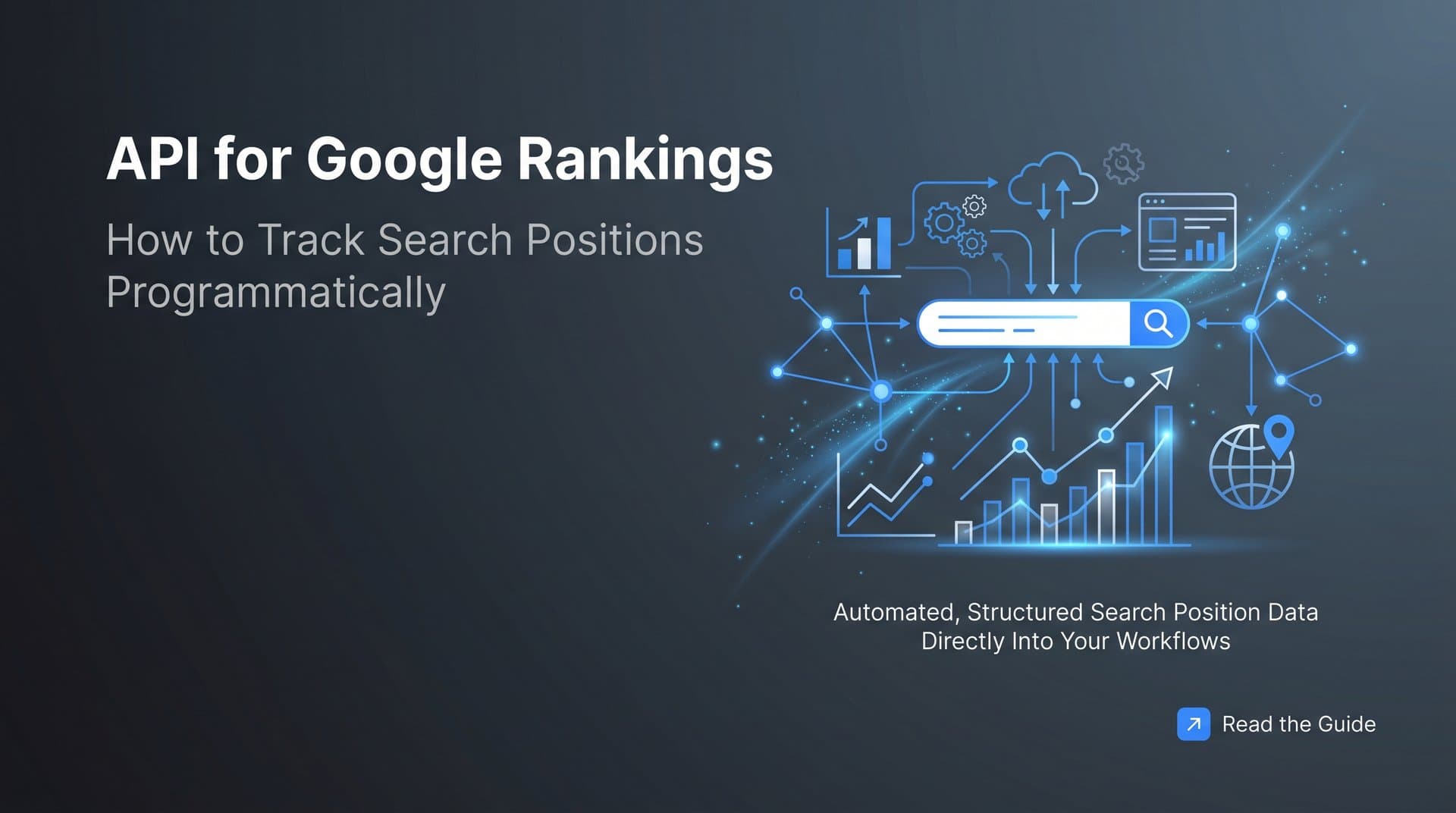
An API for Google rankings changes that equation entirely. Instead of manual spot-checks, you get automated, structured position data delivered directly to your dashboards, reporting tools, and decision-making workflows. You can track thousands of keywords across dozens of locations, monitor competitor positions in real time, and detect algorithm shifts the moment they happen rather than days later.
This guide is written for marketers, founders, and agencies who are ready to move beyond manual rank checking. We'll cover how ranking APIs actually work, what types exist, how to build your first integration, and how to connect ranking data with the broader search visibility picture, including the increasingly important layer of AI-powered search.
Why Manual Rank Checking Breaks Down at Scale
Manual rank checking seems reasonable when you're tracking twenty keywords for a single site. But the moment you scale up, the cracks appear fast. The first problem is personalization. Google tailors search results based on your search history, location, device, and account activity. When someone on your team Googles a target keyword, they're almost certainly not seeing the same results your target audience sees. The data is skewed before it's even recorded.
Localization compounds this further. If you're tracking rankings for a client with locations in five cities, you'd need to manually simulate searches from each of those locations to get accurate local data. That's not a workflow, that's a full-time job. And even then, browser-based checks trigger Google's rate limiting and bot detection, making frequent manual checks unreliable or outright blocked.
Google Search Console offers some relief, but it has significant limitations for competitive rank tracking. GSC shows you impression and average position data for your own verified properties, and it does so with a 24 to 48 hour delay. You cannot use it to track competitor rankings, benchmark against industry peers, or monitor any domain you don't own. For agencies managing multiple clients or teams doing competitive analysis, this is a fundamental gap. If you want a deeper look at what GSC position data can and can't tell you, our guide on how to check your position in Google search covers the nuances.
The business case for programmatic rank data goes beyond convenience. When ranking data flows automatically into your reporting systems, you can detect algorithm fluctuations the moment they affect your positions, not a week later when a client calls asking why traffic dropped. You can set up alerts for significant position changes, automate weekly performance reports, and identify trends across large keyword sets that would be invisible when checking manually.
Agencies that move to API-based rank tracking typically find they can monitor far more keywords per client, respond to ranking changes faster, and spend less time on data collection and more time on actual strategy. The operational efficiency alone makes the case, but the strategic advantage of real-time, accurate data is what truly separates programmatic rank tracking from the manual alternative.
How a Google Rankings API Actually Works
At its core, a Google rankings API works by querying search engine results pages on your behalf and returning structured data about what appeared and where. Instead of you opening a browser and reading a results page, the API sends a request to Google's search infrastructure (or a proxy layer, depending on the provider), parses the HTML response, and delivers clean, structured data back to your application.
A typical API request includes the keyword you want to track, the geographic location you want to simulate the search from, the device type (desktop or mobile), and sometimes the language and search engine domain. The API then returns a JSON response containing the ranked results for that query.
The data returned is richer than most people expect. A well-structured SERP API response typically includes the organic position of each result, the URL and domain ranking there, the page title and meta description, and critically, information about SERP features present on that page. That last category matters a lot. Whether a featured snippet is present, whether there's a local pack, a knowledge panel, People Also Ask boxes, or image carousels all affects how much visibility a given organic position actually delivers. Ranking third behind a featured snippet and a local pack is very different from ranking third on a clean results page.
Device-type variations are another important data dimension. Mobile and desktop rankings can differ significantly for many queries, particularly those with local intent. A good rankings API lets you track both separately so you understand your visibility across the full range of how users actually search. Teams looking to act on this data should also understand the fundamentals of how to improve search engine rankings once they have accurate position data in hand.
Authentication for most third-party SERP APIs is handled via API keys passed in request headers. Rate limits and quota management are where things get operationally interesting. Most providers charge per query or per keyword tracked per month, and they enforce limits on how many requests you can send per second or per day. Before building an integration, you need to understand your expected query volume, how often you want to refresh data, and how that maps to the provider's pricing tiers.
One important compliance note: Google's Terms of Service technically prohibit automated scraping of search results directly. This is precisely why third-party SERP API providers exist as a category. They handle the infrastructure, proxy management, and compliance layer so that you as the API consumer are working within an established service relationship rather than scraping directly. Understanding this distinction matters when evaluating providers and explaining your data sourcing to clients or stakeholders.
Types of Ranking APIs and What Sets Them Apart
Not all ranking APIs are built the same, and choosing the wrong type for your use case creates friction later. The fundamental split is between the Google Search Console API and third-party SERP APIs, and they serve genuinely different purposes.
Google Search Console API: This is Google's own API for accessing the data within your GSC account. It's free, reliable, and provides impression, click, CTR, and average position data for your verified properties. The data is authoritative because it comes directly from Google's index. The limitations are significant, though: you can only access data for domains you've verified, the data has a 24 to 48 hour delay, and you cannot use it to track competitor rankings or arbitrary keywords. For monitoring your own portfolio of sites, it's a strong foundation. For competitive intelligence, it's insufficient on its own. If you're interested in the developer side of working with Google's own APIs, our breakdown of the Google Indexing API covers a complementary integration.
Third-party SERP APIs: Providers in this category query Google's search results programmatically and return structured position data for any keyword or domain you specify. This is what enables competitor tracking, market-wide keyword monitoring, and the kind of large-scale rank tracking that agencies need. The tradeoff is cost and complexity. These APIs are paid services with pricing that scales with query volume, and their data accuracy depends on the quality of their proxy infrastructure and parsing logic.
Within the third-party category, there's a further distinction worth understanding: real-time SERP scraping APIs versus scheduled rank tracking APIs. Real-time APIs query Google on demand, returning fresh results within seconds of your request. These are ideal when you need current data for specific queries, such as monitoring a breaking news situation or checking rankings immediately after publishing new content. Scheduled rank tracking APIs batch your keyword lists and run them on a defined cadence, typically daily or weekly. These are more cost-efficient for large keyword sets where you don't need minute-by-minute freshness.
When evaluating providers, the key criteria to assess include geographic coverage (can they accurately simulate searches from your target locations?), SERP feature detection (do they capture featured snippets, local packs, and AI Overviews?), pricing models (per-query vs. per-keyword-per-month can make a significant cost difference at scale), and their approach to compliance and data accuracy. Knowing what to look for in SEO tools more broadly can help you evaluate these providers against your full tech stack. Some providers offer free tiers that are useful for testing, but production-scale integrations typically require paid plans.
The right choice often involves using both: the GSC API for your own property data and a third-party SERP API for competitive intelligence and keyword-level position tracking across domains you don't own.
Practical Use Cases: From Dashboards to AI Visibility
The real value of a rankings API emerges when you connect it to the workflows where decisions actually happen. Here's where programmatic rank data creates the most leverage.
Automated SEO Performance Dashboards: The most common use case is building dashboards that pull rank data automatically alongside traffic and indexing metrics. Instead of manually compiling weekly reports, your dashboard refreshes with current position data for every tracked keyword, surfaces movers and shakers (keywords that jumped or dropped significantly), and gives clients or stakeholders a real-time view of SEO performance. An SEO content platform with analytics can serve as the foundation for this kind of integrated reporting. Tools like Looker Studio, Tableau, and even Google Sheets can connect to ranking APIs via webhooks or scheduled scripts, making this accessible without heavy engineering resources.
Competitive Monitoring: Tracking competitor positions for your target keywords is one of the highest-value applications of a SERP API. When a competitor suddenly jumps from position eight to position two for a keyword you're targeting, that's a signal worth investigating immediately. Did they publish new content? Earn significant backlinks? Understanding competitor movement helps you identify content gaps, prioritize optimization efforts, and anticipate where you need to defend your positions.
Algorithm Shift Detection: Large-scale rank tracking across hundreds of keywords creates a data set that makes algorithm updates visible in near real-time. When you see widespread position changes across unrelated keywords on the same day, you're likely looking at a Google algorithm update. Teams with programmatic rank tracking can identify these shifts and begin analyzing impact within hours rather than days.
Connecting Rankings to AI Visibility: This is where modern search visibility strategy gets genuinely interesting. Traditional rank tracking covers classic blue-link organic results, but an increasing share of search queries now trigger AI Overviews in Google, and users increasingly turn to AI chatbots like ChatGPT, Claude, and Perplexity for information retrieval. A brand can rank in position one on Google's organic results and still be completely absent from AI-generated answers to the same query. Understanding how to approach optimizing content for AI search is becoming essential alongside traditional rank tracking.
Connecting your ranking data with AI visibility tracking gives you a more complete picture of where your brand actually appears in the modern search landscape. Platforms like Sight AI track brand mentions across AI models, allowing you to see how your traditional search positions correlate with your presence in AI-powered search experiences. This correlation is increasingly important as the two channels influence each other in ways that are still being understood.
Setting Up Your First Rankings API Integration
Getting your first rankings API integration running doesn't require a dedicated engineering team, but it does benefit from a clear workflow before you write a single line of code or configure a single connection.
1. Select an API provider and plan. Start by mapping your requirements: how many keywords do you need to track, across how many locations, at what refresh frequency? This determines whether a real-time scraping API or a scheduled tracking API fits better, and which pricing tier makes sense. Most providers offer free trials or limited free tiers, so test accuracy with a sample keyword set before committing.
2. Configure your keyword lists with location and device targeting. This is the step most people underinvest in. Keyword lists without location context produce data that may not reflect actual user experience in your target markets. Define your tracking lists with explicit location parameters (city, region, or country depending on your needs) and specify desktop and mobile separately if both matter for your audience. For guidance on building effective keyword lists, our article on keyword research for organic SEO walks through the strategic foundations.
3. Schedule data pulls and define storage. Decide how frequently you need fresh data and configure your API calls accordingly. Daily pulls are standard for most use cases. Store results in a database or structured format that preserves historical data, because rank tracking value compounds over time as you build trend data.
4. Connect to your reporting layer. Common integration patterns include pushing data to Google Sheets via the Sheets API for lightweight reporting, connecting to Looker Studio or Tableau for richer visualization, or feeding into custom internal dashboards via webhooks. The right choice depends on your team's existing tools and technical capabilities.
Common Pitfalls to Avoid:
SERP volatility in data: Rankings fluctuate naturally, sometimes by several positions day to day without any meaningful trend. Avoid making strategic decisions based on single-day snapshots. Use rolling averages and look for sustained trends rather than reacting to every daily movement.
API cost management at scale: Query costs add up quickly when you're tracking thousands of keywords daily. Audit your keyword lists regularly and remove terms that are no longer strategically relevant. Consider tracking high-priority keywords daily and lower-priority terms weekly to manage costs without sacrificing coverage.
Location and device targeting accuracy: Inaccurate location targeting is one of the most common sources of misleading rank data. Verify that your API provider's location simulation is accurate for your target geographies, particularly for local search queries where results can vary significantly even between nearby cities.
Building a Complete Search Visibility Stack
Rank tracking is a foundational capability, but it's not the whole picture. Teams that treat position data in isolation often miss critical context that explains why rankings are moving and what to do about it.
A complete search visibility stack pairs ranking data with indexing health monitoring. If Google isn't crawling and indexing your content efficiently, your rankings will suffer regardless of content quality. Knowing which pages are indexed, how quickly new content gets discovered, and whether there are crawl errors affecting specific sections of your site gives you the operational layer that rank data alone can't provide. For teams struggling with discovery speed, understanding faster Google indexing for new content is a critical complement to rank tracking.
Content performance data adds another dimension. Understanding which content is driving ranking improvements, which pages are losing positions, and where new content opportunities exist based on keyword gaps requires connecting your rank data to content analytics. This is where AI content tools for SEO teams become part of the stack rather than separate tools, enabling content generation that's optimized for both SEO and AI search visibility.
The most significant evolution in search visibility right now is the expansion beyond traditional SERPs. AI Overviews in Google, and the growing use of AI chatbots as primary information sources, mean that a brand's effective search visibility is no longer fully captured by organic rankings alone. Users asking ChatGPT or Perplexity for a recommendation in your category may never see your Google ranking at all.
Sight AI is built around this expanded definition of search visibility. The platform combines AI visibility tracking across six or more AI platforms (including ChatGPT, Claude, and Perplexity), SEO and GEO-optimized content generation through 13 specialized AI agents, and website indexing tools with IndexNow integration for faster content discovery. This means you're not just tracking where you rank on Google, but where your brand appears across the full landscape of how people actually find information today.
The teams winning at search visibility in the current environment are those treating traditional rankings and AI visibility as complementary signals rather than separate concerns. An API for Google rankings gives you the traditional layer. Adding AI visibility tracking gives you the complete picture.
Putting It All Together
An API for Google rankings is no longer a nice-to-have for data-driven SEO teams. It's the infrastructure that makes scalable, accurate, and timely rank tracking possible. Manual checking doesn't survive contact with real-world complexity: personalization, localization, competitor monitoring, and the sheer volume of keywords that matter to any serious SEO program.
The path forward is clear. Start by understanding the difference between the Google Search Console API and third-party SERP APIs, choose the right combination for your use case, and build integrations that connect ranking data to the places where decisions actually happen. Then extend that foundation by connecting ranking data with indexing health, content performance, and the increasingly important layer of AI search visibility.
The brands that will dominate search visibility over the next few years are those that treat traditional rankings and AI-powered search as parts of the same system, not separate channels managed in silos.
Start tracking your AI visibility today and see exactly where your brand appears across top AI platforms. Stop guessing how AI models like ChatGPT and Claude talk about your brand. Get visibility into every mention, uncover content opportunities, and automate your path to organic traffic growth with Sight AI's all-in-one platform for both traditional search rankings and AI visibility.