When we talk about optimizing for AI search, we’re really talking about a fundamental shift in how we create content. It’s about crafting clear, well-structured, and authoritative material that large language models (LLMs) can easily digest, understand, and most importantly, cite in their answers. This goes way beyond old-school keyword stuffing. The new game is about building semantically rich content that directly answers conversational questions, making your brand the trusted source for both people and the AI they use.
Why AI Search Is The New Frontier of Discovery

The way people find information is changing right under our noses. For years, SEO felt like a predictable game of keywords and rankings. Now, a whole new layer is emerging. Millions of people are turning to conversational AI for discovery, asking complex questions and expecting neatly synthesized answers.
This isn't some far-off trend; it's happening today and demands a completely new approach to our content strategy. This guide is your practical playbook for capturing this new, high-intent audience. We're cutting through the hype to give you a clear framework for making your content the go-to source for the AI-powered search engines of now and the future.
The Undeniable Growth of AI-Powered Discovery
The move to AI search isn't just a niche behavior for tech enthusiasts—it’s going mainstream, fast. We're seeing a massive migration toward conversational discovery, where users engage directly with an AI to get answers instead of clicking through a list of blue links.
Just look at the trajectory: in 2023, around 13 million American adults were using AI for search. By 2027, that number is expected to explode to 90 million. That's a nearly 7x increase in just four years. This isn't a small shift; it reflects a core change in how people behave online. In fact, generative AI usage for content discovery shot up 156% year-over-year as users got more comfortable moving from short keywords to detailed, conversational prompts.
Now, this shift isn't about replacing traditional SEO. With over 93.57% market share, Google isn't going anywhere, and its search volume is still growing. Instead, think of AI search as an essential parallel track. Your content now has to serve two masters: the classic search algorithm and the new AI answer engine.
Adapting Your Strategy for a Conversational World
So, what does this actually mean for your content team? It means that optimizing for AI search is no longer some optional, "nice-to-have" future-proofing. It’s a core business need, right now.
The audience using AI for discovery is often highly motivated and further down the buying funnel. They ask specific, nuanced questions, and the brands that provide the clearest, most direct answers are the ones that will win their trust—and ultimately, their business.
This new reality requires a more sophisticated playbook. Success is no longer just about ranking for a keyword. It’s about becoming a citable authority that an LLM can confidently reference. This really boils down to three things:
- Anticipating conversational queries: You have to start thinking in terms of full questions, not just fragmented keywords. What would a real person ask?
- Structuring for clarity: Your information needs to be incredibly easy for both humans and machines to pull apart and understand.
- Building topical authority: You need to cover subjects so comprehensively that AI models see your brand as the definitive source.
The goal is to create content that fits perfectly into an AI-generated answer. This is the core idea behind what’s now being called Answer Engine Optimization—a critical skill for any modern marketer. By systematically finding and filling the gaps in your content, you can position your brand to be the trusted voice in this new era of discovery.
Building Your AI Content Framework
Creating content that actually performs in AI search isn't about just writing articles anymore. It requires a more deliberate, architectural approach. You're not just a writer; you're building an information system that AI can easily understand, process, and—most importantly—trust. This is a fundamental shift from the old keyword-first mindset to one that’s laser-focused on solving user problems with clear, interconnected pieces of content.
The cornerstone of this whole framework is something I call AI-driven intent mapping. This goes way beyond figuring out what a user types into a search bar. It's about anticipating the entire conversational path they're on. A single prompt often hides several nested questions, and your content has to be ready to field every single one.
For example, a user rarely just searches for "best project management tool." Their real, unspoken prompt is much more specific: "What's the best project management tool for a remote team of 10 with a $50 per month budget?" To win in AI search, you need to build a resource that can satisfy that entire, multi-layered query.
From User Problems to Content Modules
The first thing you need to do is break down the core problems your audience is trying to solve. Forget starting with a keyword. Start with a high-level user challenge. From there, you can map out all the related questions and sub-topics an LLM would need to pull from to give a complete answer.
I like to think of it like building with LEGOs. Every piece of information—a definition, a how-to guide, a comparison chart—is a distinct module. Your job is to create these individual modules and then assemble them in a logical way. It's this modular approach that’s the secret to "prompt-proofing" your content.
Here’s a simple way to start mapping this out:
- Identify the Core Problem: What’s the main thing the user is struggling with? (e.g., "Choosing the right dishwasher for an open-plan living space.")
- List Primary Questions: What are the absolute must-know questions they have? (e.g., "What decibel level is considered quiet?" "Which brands are most reliable?")
- Map out Secondary Questions: What follow-up questions will naturally pop into their head? (e.g., "How does energy efficiency affect cost?" "What smart features are actually useful?")
Following this process helps you build a content structure that flows like a natural conversation. That makes it incredibly valuable to an AI trying to piece together a comprehensive answer. A truly effective SEO content strategy in this new era is built on this very idea of anticipating and answering the full spectrum of user questions.
Key Takeaway: A prompt-proofed article isn't a single, linear story. It's a collection of well-organized, self-contained answer modules that, when put together, create the definitive resource on a topic.
Prompt-Proofing in Action: A Real-World Scenario
Let's take a standard blog post and turn it into a prompt-proofed asset. Imagine a generic article called "Guide to Quiet Dishwashers." It’s probably fine, but it’s not built for a complex AI query.
To prompt-proof it, we need to completely restructure it to meet conversational needs head-on.
Original Structure (Generic):
- Introduction to Dishwashers
- Why Noise Level Matters
- Features to Look For
- Top 5 Models
- Conclusion
Prompt-Proofed Structure (AI-Optimized):
- What Is a Good Decibel Rating for a Quiet Dishwasher? (This gives a direct, snippet-ready answer right at the top).
- Comparison Table: Top Quiet Dishwasher Models by Feature (This presents structured data that an AI can easily parse and present).
- How to Choose the Right Dishwasher for Your Open-Concept Kitchen (This is a step-by-step guide answering a very specific use case).
- Frequently Asked Questions About Dishwasher Installation and Energy Use (This tackles common follow-up questions in a clean Q&A format).
See the difference? The new structure doesn't just list information; it organizes it into discrete, answer-first sections. Every heading is a question, and the content directly below is the answer. This modular format allows an LLM to grab the exact piece of information it needs to satisfy a user's prompt, making your content a top candidate for being cited.
To get a better handle on this changing environment, it's worth looking at how AI-driven SEO tools like Seomatic AI are influencing web design and content discovery. When you adopt this framework, you stop just publishing content and start building a knowledge base that both people and AI systems can rely on.
Get Technical with Semantic SEO and Entity Optimization
If you really want to win in this new era of AI-driven search, you have to go deeper than just formatting. It's time to get a bit more technical and focus on making your content not just human-readable, but machine-interpretable. This means shifting your mindset from a purely keyword-driven strategy to one built around semantic SEO and entity optimization.
What does that actually mean? It’s all about teaching AI models what your content is truly about. You do this by defining the core concepts—the "entities"—within your content and clearly mapping out how they relate to one another.
Entities are just the real-world objects, people, places, and ideas you're writing about. When an AI understands that "Apple Inc." is a "technology company" founded by "Steve Jobs," it can answer incredibly complex questions with confidence. Your job is to build that knowledge graph right into your content.
To make this happen, you need a solid framework. It starts with mapping user intent, moves to structuring your content logically, and finishes with building it specifically for AI consumption.
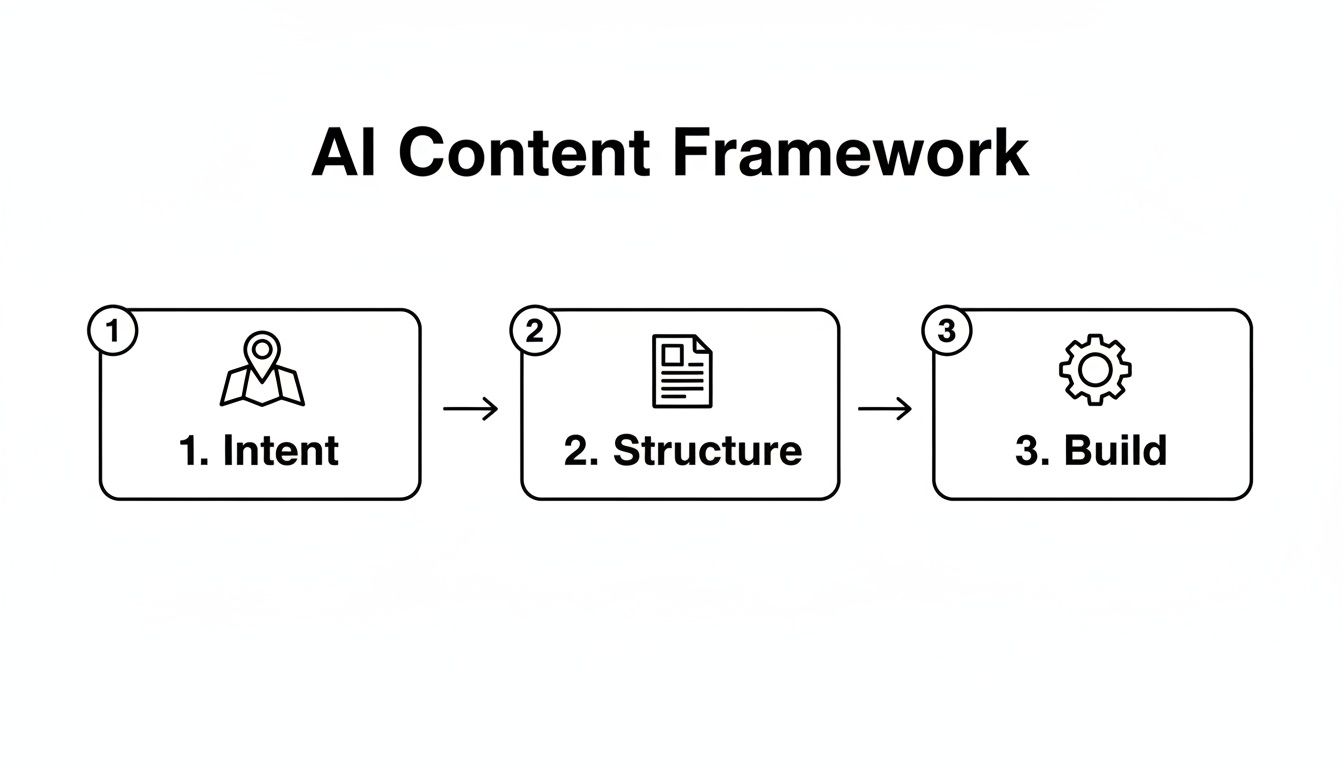
This workflow shows how to get from understanding what a user wants to creating perfectly structured, AI-ready content. It’s the foundation of modern content optimization.
Build Context by Defining Your Entities
First things first: you need to meticulously identify the main entities tied to your topic. Think of it like a librarian cataloging information. If you're writing an article about electric vehicles, your key entities would be things like "Tesla," "lithium-ion battery," "charging station," and "Elon Musk."
Once you have your list, your content needs to explicitly define these entities and spell out their connections. Don't ever assume the AI will just connect the dots on its own.
Here's how you can do that:
- Write Clear Definitions: Use simple, direct language to explain what each entity is. For example, "A lithium-ion battery is a type of rechargeable battery technology commonly used in electric vehicles."
- Link Entities Together: Weave sentences into your writing that show relationships. For instance, "Tesla, a company led by CEO Elon Musk, primarily uses lithium-ion battery technology in its electric vehicles."
This simple practice transforms your article from a flat collection of words into a rich, interconnected resource. And while you're focused on AI, don't forget that fundamental SEO practices like knowing how to improve Google search rankings are still critical. These principles support discovery on both traditional and AI-powered platforms.
Want to go deeper? Our complete guide on what is semantic SEO is the perfect next step for creating content that search engines and AI can truly understand.
Use Structured Data to "Speak" AI's Language
While well-written prose is a great start, the most direct way to communicate with machines is through structured data—specifically, Schema.org markup. This code acts like a set of labels you add to your content, explicitly telling AI crawlers what each piece of information represents.
For example, adding Article schema tells an AI, "This is a blog post." Using FAQPage schema clearly marks a section as a series of questions and answers. This simple step removes all ambiguity and makes your content far more likely to be pulled into AI-generated summaries, comparisons, and direct answers.
A Practical Schema Example: A Product Review
Let’s say you just wrote a killer review of a new smartphone. Without schema, it's just a wall of text to a machine. With schema, it becomes a structured, machine-readable dataset.
Here’s how you could layer different schema types to make that review incredibly useful for an AI:
- Article Schema: You'd wrap the entire post in
Articleschema, defining the author, publication date, and headline. This immediately establishes context and credibility. - Product Schema: Within the article, you'd use
Productschema to label the phone's name, brand, and key specs like screen size or battery capacity. This is a goldmine for AI-powered product comparisons. - Review Schema: You would then add
Reviewschema to specify the rating you gave the phone (e.g., 4.5 out of 5 stars) and include a snippet of your overall opinion. - FAQPage Schema: If you included a Q&A section, you'd mark it up with
FAQPageschema. This makes those direct question-answer pairs easily "snippable" for LLMs.
By layering these schema types, you create an incredibly rich source of information. An LLM can now easily pull the phone's price, your expert rating, and answers to common questions without having to guess. This structured approach is a cornerstone of optimizing for AI search, ensuring your expertise is represented accurately as search continues to evolve.
Structuring Content for AI Answerability

Once you've nailed semantic SEO, the next critical layer is tactical formatting. How you structure your content is just as important as what you write, because it directly impacts how easily an AI model can parse, understand, and ultimately cite your information.
The goal here is to create "answer-ready" content that can be lifted cleanly into AI Overviews or a chatbot response. This means moving away from long, winding paragraphs and embracing scannable, modular formats. AI systems don't read a page like a person; they break it down into logical chunks. Your job is to make those chunks as clear and self-contained as possible.
Designing Content for Direct Answers
The most straightforward way to make your content answerable is to build it around the questions your audience is actually asking. Think about using descriptive H2 and H3 headings that sound like real, conversational queries. This sends an immediate signal to both users and AI, clarifying exactly what information each section holds.
Right below each of those headings, give a concise, self-contained answer. This front-loading technique is a game-changer because AI models are always looking for the most efficient path to a credible answer. A sharp definition or a quick summary at the very beginning of a section makes your content a prime candidate for getting picked up.
For example, ditch a generic heading like "Key Features." Instead, frame it as a question: "What Features Define a Quiet Dishwasher?" Then, immediately follow it with a direct, one-sentence answer before you dive into the details.
This approach isn't just for the bots—it dramatically improves the experience for your human readers, too. People can scan and find what they need in seconds, which helps lower bounce rates and boost engagement. Those are signals that still carry a lot of weight for your overall visibility.
Using Scannable Formats AI Can Easily Parse
Beyond smart headings, certain formatting elements act like signposts for AI, helping them categorize and pull out information with much greater accuracy. If you're serious about optimizing for AI search, integrating these formats is non-negotiable.
Here are a few practical ways to break down your content for AI.
Effective Content Formatting for AI Answerability
| Formatting Technique | Purpose for AI Optimization | Practical Example |
|---|---|---|
| Bulleted/Numbered Lists | Breaks down processes, features, or steps into easily digestible points. AI models love lifting lists for "how-to" or "what are" style queries. | A list of "Top 5 Benefits of..." or a numbered guide for "How to Set Up..." |
| Tables | Organizes complex data, comparisons, or specifications in a structured format. Machines can interpret this far more accurately than a dense paragraph. | A feature comparison table for different software products or a pricing breakdown. |
| Blockquotes | Visually separates key takeaways, expert quotes, or important statistics. This highlights citable, authoritative information for AI. | > "According to a recent study, **75%** of users prefer scannable content." |
These formatting choices essentially turn your article into a well-organized database that an LLM can query efficiently. As you can imagine, the overall structure in writing is paramount, and applying these principles consistently will give you a significant edge.
The Power of Comprehensive Content Depth
Optimizing for answerability also means going deep. Short, thin articles rarely provide enough context or authority for an AI to see them as a trustworthy source. Instead, AI systems are showing a clear preference for comprehensive, long-form content that explores a topic from multiple angles and addresses all the related sub-questions.
The data backs this up. The average word count for pages that rank in voice search is a hefty 2,312 words, and content that stretches over 3,000 words can pull in 3x more traffic.
We're seeing a similar pattern with AI Overviews, which now show up in 47% of Google search results. The pages that perform well are typically deep-dive guides that provide background, examples, and plenty of answer-ready snippets. Much like with traditional featured snippets, which boast a click-through rate of 42.9%, AI systems extract concise answers from these deeply informative pages, creating a direct line to more traffic.
This all points to a strategic shift away from single-intent blog posts and toward building robust, pillar-style resources. A well-structured, in-depth article that uses clear formatting is seen by AI as a more reliable and authoritative source, massively increasing your chances of becoming the definitive answer.
How to Measure Your AI Content Strategy
So, you’ve put in the work and carefully optimized your content for AI. Now for the million-dollar question: is it actually working? Proving the ROI of an AI-focused content strategy means we need to look beyond the usual suspects like keyword rankings and organic traffic. It’s time to adopt a new set of KPIs that reflect this new world of search and discovery.
The game has shifted from chasing sheer volume to earning visibility and demonstrating value. Are you getting cited in AI Overviews? Is your brand popping up in AI chat responses? And, crucially, what’s the quality of the traffic that does click through from an AI-generated answer? This is all about creating a feedback loop where performance data directly informs your next content move.
Rethinking Traffic Value and Conversions
One of the biggest mental shifts is how we value traffic. A quick glance at your analytics might show that the raw number of visitors from AI-powered results is low, but don't be fooled. Their value is often disproportionately high.
Think about it: these users have already received a synthesized answer to a complex, high-intent question. The fact that they clicked through means they're hungry for more in-depth information. They are, in essence, highly qualified.
This isn't just a hunch; the early data is compelling. Traffic coming from AI-powered results converts at a staggering 4.4× the rate of traditional search traffic. Even Google has pointed out that users clicking through from AI Overviews tend to be more engaged—staying longer and interacting more deeply with the content. For a deeper dive into this, the team at Beebyclarkmeyler has some great 2025 AI search guidance.
This completely changes how we calculate ROI. A single, well-qualified lead from an AI Overview could easily be worth more than dozens of low-intent visits from a broad, traditional search query. That's a powerful story to tell when you're making the case for your AI content efforts to stakeholders.
Key Metrics for Your AI Performance Dashboard
To really see what's working, you need a dashboard that captures these new visibility signals. While the big analytics platforms are still playing catch-up, you can start tracking these essential metrics right now.
Here are the new KPIs that truly matter:
- Brand Mentions in AI Chats: Keep an eye on how often your brand, products, or key people are mentioned in responses from models like ChatGPT or Gemini. A rise in mentions is a strong signal of growing authority.
- Citation Frequency: This is the gold standard. How many times does an AI model explicitly cite your content as a source? It’s the ultimate proof that your content is seen as credible and useful.
- AI-Referred Traffic Conversions: As we've seen, this is a killer metric. Isolate the traffic coming from AI platforms and watch its conversion rate. This is how you demonstrate tangible business impact.
- Share of Voice in Key Prompts: Figure out the most important conversational prompts in your niche. Then, track how often your brand appears in the answers compared to your competitors.
Getting this data requires a hands-on approach. You'll need to develop a workflow for actively testing prompts and documenting the results, either manually or with the help of specialized tools. This is currently the most reliable way to spot where your competitors are being cited for topics you know you should own.
By uncovering these content gaps, you can build a data-backed plan to either beef up existing articles or create new ones from scratch. If you're looking for more ways to connect these activities to the bottom line, our guide on measuring content marketing ROI is a great place to start.
Ultimately, measuring your AI content strategy isn't just about pulling numbers for a report. It's about building a proactive growth engine. The insights you gather should directly fuel your content calendar, turning what was once a reactive process into a continuous cycle of improvement.
Common Questions About AI Content Optimization
Even with a solid framework, putting AI content optimization into practice brings up a lot of questions. As teams start weaving these new habits into their workflow, a few common uncertainties always seem to pop up. Let's tackle some of the most frequent ones we hear from SEO managers and content marketers building out their strategies.
Think of this as the practical cheat sheet to bridge the gap between theory and your day-to-day execution.
Is AI SEO a Complete Replacement for Traditional SEO?
This is probably the question I get most often, and the answer is a hard no. Optimizing for AI search isn't about throwing out your traditional SEO playbook; it’s an essential new layer you build right on top of it. It’s an expansion of your strategy, not a ground-up rebuild.
All the fundamentals you’ve spent years mastering still matter. A lot. Technical health, crawlability, mobile experience, page speed, and a trustworthy backlink profile are still the price of entry. An AI model can't cite your content if it can't find, access, or trust your site in the first place. These are the things that get you in the game.
Where AI optimization adds a new dimension is in that final mile—the selection process. While traditional SEO gets your page indexed and ranked on the SERP, AI SEO is all about making specific passages inside that page "citable" for a generated answer. It's the difference between being a book on the library shelf and being the exact quote the librarian pulls for a curious visitor.
Key Takeaway: Don't ditch your current SEO practices. Instead, level them up by focusing on the clarity, structure, and semantic richness that AI models need to cherry-pick your content for their answers.
How Should We Prioritize Our Optimization Efforts?
With limited time and resources, you can't just overhaul your entire content library overnight. A smart, phased approach is the only way to make a real impact without completely burning out your team. The key is to focus your energy where it will deliver the biggest bang for your buck.
Start by zeroing in on your highest-value content. These are usually the pages that target high-intent keywords, support your core products or services, or are already your top performers in traditional search. Giving these assets an AI-optimization pass first gives you the best shot at seeing a measurable return, fast.
Here’s a practical workflow for prioritization:
- Start with Your "Money" Pages: Go straight for the jugular—product pages, service pages, and any top-of-funnel articles that are proven to drive conversions.
- Target "Near Miss" Content: Dive into your analytics and find pages that are stuck on the bottom of page one or top of page two. A quick structural and semantic refresh might be all they need to get picked up by AI Overviews and other generative features.
- Analyze Competitor Citations: Get in the habit of asking AI chatbots key questions in your industry. When you see a competitor getting cited, go analyze their page. Look at its structure, depth, and formatting. This gives you a ready-made blueprint for creating a resource that's even better.
This targeted approach ensures you’re being strategic instead of just trying to boil the ocean.
What Is the Role of Tools in This Process?
While the heart of AI optimization is still great strategy and expert writing, the right tools can be a massive force multiplier. They help you scale your efforts, spot opportunities you’d otherwise miss, and actually measure what’s working in this new world.
Tools in this space generally fall into a few key buckets:
- AI Monitoring Platforms: These are built to track your brand’s visibility inside AI chat answers and search overviews. They'll monitor your brand mentions, how often you're cited, and even the sentiment, giving you a real dashboard for your AI performance.
- Content Optimization Software: Many of the SEO platforms you already use are rolling out features to help with semantic analysis, entity recognition, and structural suggestions to make content more AI-friendly.
- Schema Markup Generators: These tools are lifesavers. They take the pain out of creating structured data, letting you generate the JSON-LD code you need without having to become a developer.
Using a mix of these tools helps automate the technical and data-heavy parts of AI optimization. That frees up your team to do what humans do best: create genuinely helpful, expert-driven content.
At Sight AI, we turn these complex challenges into a streamlined workflow. Our platform monitors your brand's visibility across all major AI models, surfaces high-value content gaps, and uses specialized AI agents to produce expert-level articles that are optimized for both AI and search. https://www.trysight.ai