AI writing agents have fundamentally changed how marketing teams approach content production. Where teams once spent days drafting, editing, and publishing a single piece, specialized AI agents can now handle discrete tasks across the entire content workflow: keyword research, outline generation, SEO optimization, and CMS publishing.
For marketers, founders, and agencies focused on organic traffic and AI visibility, this shift isn't just about speed. It's about building a scalable content engine that consistently surfaces your brand in both traditional search and AI-powered discovery platforms like ChatGPT, Claude, and Perplexity.
The challenge most teams face isn't access to AI writing tools. It's knowing which strategies actually move the needle. Using a generic AI agent to "write a blog post" produces generic results. The teams seeing real traction are those deploying purpose-built agents for specific marketing functions, connecting outputs across a coordinated workflow, and optimizing content not just for Google but for the AI models that increasingly shape buyer research.
This guide covers seven concrete strategies for deploying AI writing agents in your marketing operation, each focused on a distinct function with implementation steps you can act on immediately.
1. Assign Specialized Agents to Distinct Content Roles
The Challenge It Solves
Most teams make the mistake of routing every content task through a single general-purpose AI agent. The result is inconsistent output quality, bloated editing cycles, and content that feels stitched together rather than purposefully crafted. When one agent is responsible for everything from keyword research to final copy, none of those jobs get done particularly well.
The Strategy Explained
Think of this like building a specialized marketing team rather than hiring one generalist. Each agent should own a specific stage of the workflow and be configured with the context, constraints, and output format that stage requires.
A well-structured agent stack might include: an outline builder that maps heading hierarchies against target keywords, an SEO writing agent that drafts body content with entity coverage and natural keyword integration, a meta optimizer that generates title tags and descriptions within character limits, and an internal linking agent that identifies and inserts relevant cross-links from your existing content library.
When agents are scoped narrowly, their outputs become predictable and consistent. Editing time drops because each agent is producing a specific deliverable with defined quality criteria rather than a loose interpretation of "write me an article." Teams exploring AI agents for content creation consistently find that role-based configurations outperform single-agent setups on both quality and efficiency.
Implementation Steps
1. Audit your current content workflow and list every distinct task from brief to publish.
2. Group tasks into logical agent roles: research, outlining, drafting, optimization, and distribution.
3. Write a dedicated system prompt for each agent role that defines its task, output format, tone constraints, and any domain-specific rules.
4. Run parallel tests: produce one piece using your current single-agent approach and another using the specialized stack, then compare editing time and output quality.
Pro Tips
Keep each agent's system prompt focused on a single deliverable. The moment you ask an agent to "also do X while you're at it," output quality degrades. Discipline in scoping is what separates a functional agent stack from a chaotic one. Platforms like Sight AI offer 13+ specialized AI agents built precisely for this kind of role-based content architecture.
2. Build a GEO-First Content Brief Before Any Agent Writes
The Challenge It Solves
Traditional content briefs are built around keywords and word counts. That approach was designed for a world where Google's crawlers were your primary audience. Today, AI models like ChatGPT, Claude, and Perplexity also consume your content and synthesize it into answers for millions of users. Content that isn't structured for AI retrieval simply doesn't surface in those answers.
The Strategy Explained
Generative Engine Optimization (GEO) is an emerging discipline focused on making content citation-worthy for AI-generated answers. The core principle is that AI models tend to surface content that is factually dense, entity-rich, and clearly structured. That means your briefs need to go beyond "target keyword: X, word count: Y."
A GEO-first brief explicitly instructs your writing agent to: define key terms and concepts clearly (entity clarity), include factual claims that can be verified and cited, use structured formatting that AI models can parse easily, and answer specific questions your audience is likely to ask AI platforms directly.
When your agent writes from a GEO-first brief, the resulting content is better for both traditional SEO and AI visibility. The two goals are more aligned than most marketers realize. Understanding content writing for organic SEO is a strong foundation before layering GEO principles on top.
Implementation Steps
1. Identify the specific questions your target audience asks AI platforms about your topic area.
2. Build a brief template that includes: target entities, key definitions to include, factual claims to substantiate, and question-answer pairs to address directly.
3. Add a GEO checklist to your agent's output criteria: does the content define its core entities? Does it include verifiable claims? Is it formatted for scannability?
4. Feed this brief to your drafting agent before any writing begins, not as an afterthought.
Pro Tips
Research what AI models currently say about your topic area before writing your brief. If ChatGPT or Perplexity consistently surfaces certain sources or phrasings when answering questions in your niche, that tells you exactly what kind of content those models reward. Use that intelligence to inform your brief structure.
3. Use Agents to Scale Topical Authority Clusters
The Challenge It Solves
Publishing isolated articles on loosely related topics rarely builds meaningful search visibility. Search engines and AI models alike favor sources that demonstrate comprehensive expertise across a subject area. Most marketing teams understand the concept of topical authority but lack the production capacity to execute the volume of interlinked content it requires.
The Strategy Explained
Topical authority clusters work by pairing a comprehensive pillar page on a broad topic with a network of supporting articles that cover specific subtopics in depth. Each supporting article links back to the pillar, and the pillar links out to supporting content, creating a tightly interlinked web that signals subject-matter depth to search engines.
AI writing agents are particularly well-suited to this task because cluster content follows predictable structural patterns. Once you define the pillar topic and map the supporting subtopics, agents can produce supporting articles at a pace no human team can match. The key is building the cluster architecture first, then deploying agents to populate it systematically rather than producing content randomly. AI content automation for marketing teams makes this kind of systematic cluster production achievable even for lean teams.
Implementation Steps
1. Choose a core topic where you want to build authority and write a comprehensive pillar page brief.
2. Use a research or mapping agent to generate a list of supporting subtopics, framed as specific questions or long-tail keyword targets.
3. Produce supporting articles using your specialized drafting agent, ensuring each brief includes an instruction to link back to the pillar page.
4. Build internal links from the pillar to each supporting article as they publish, completing the cluster architecture.
Pro Tips
Prioritize depth over breadth when starting your first cluster. A tight cluster of ten well-optimized supporting articles on a single topic will outperform fifty scattered articles across ten topics. Let agents handle the volume once the architecture is defined, but invest human judgment in designing that architecture carefully.
4. Automate Content Refreshes With Update-Focused Agents
The Challenge It Solves
Content decay is one of the most overlooked drains on organic traffic. Articles that once ranked well lose position as fresher, more comprehensive content from competitors displaces them. Most teams don't have the bandwidth to systematically audit and update their existing library, so valuable pages sit underperforming while the team focuses entirely on new production.
The Strategy Explained
Update-focused agents are configured specifically to audit and improve existing content rather than produce new pieces. This is a meaningfully different task from drafting, and it requires a different agent configuration. An update agent should be prompted to identify outdated statistics or claims, expand thin sections that lack sufficient depth, improve heading structure and internal linking, and strengthen on-page SEO signals like meta descriptions and semantic keyword coverage.
SEO practitioners widely recognize that refreshing existing content can recover rankings on pages that have decayed over time. The logic is straightforward: a page that already has backlinks and historical authority just needs its content quality restored to reclaim its position. An update agent can process a backlog of decayed pages far faster than a human editorial team. Teams running automated blog writing for SEO often find that refresh workflows deliver faster ranking recoveries than new content production alone.
Implementation Steps
1. Pull a list of pages that have experienced ranking or traffic decline over the past six to twelve months using your analytics and search console data.
2. Configure an audit agent to review each page against a checklist: content freshness, section depth, internal link coverage, and meta optimization.
3. Brief an update agent with the audit output and instruct it to produce specific improvements rather than a complete rewrite.
4. Connect the update workflow to your indexing pipeline so refreshed pages are submitted via IndexNow immediately upon publication.
Pro Tips
Preserve what's working. Update agents should be explicitly instructed to retain sections that are performing well, identified by scroll depth or engagement data if available. The goal is surgical improvement, not wholesale replacement. Rewriting a page that already has strong signals can sometimes do more harm than good.
5. Integrate Agents Into a Publish-and-Index Pipeline
The Challenge It Solves
There's a frustrating gap in most content workflows: the time between when content is ready and when search engines actually discover and index it. Relying on standard crawl cycles means new content can sit unindexed for days or weeks, delaying any chance of ranking. For teams producing content at volume, this lag compounds into a significant competitive disadvantage.
The Strategy Explained
A publish-and-index pipeline connects your AI writing agent outputs directly to two downstream systems: your CMS for automatic publishing and IndexNow for immediate search engine notification. IndexNow is a publicly documented protocol supported by Microsoft Bing, Yandex, and other search engines that allows websites to instantly notify search engines when new or updated content is available. Instead of waiting for a crawler to find your page, you're actively pushing a notification the moment content goes live.
When this pipeline is fully connected, the workflow becomes: agent produces content, content is reviewed and approved, CMS auto-publishes the piece, and IndexNow submission fires automatically. The human steps are reduced to review and approval. Everything else is automated. The right SEO software for marketing teams will support this kind of end-to-end pipeline integration natively.
Implementation Steps
1. Configure your CMS to accept content via API or direct integration from your agent workflow, enabling automated publishing upon approval.
2. Implement IndexNow on your website and verify the protocol is correctly configured with your API key.
3. Set up an automated trigger that submits the URL to IndexNow immediately when a page is published or updated.
4. Maintain an updated XML sitemap that reflects your full content library, as this supports both IndexNow submissions and standard crawl discovery.
Pro Tips
Don't skip the human review step in the interest of full automation. A publish-and-index pipeline is only as good as the content it accelerates into the index. Build a lightweight approval checkpoint into the workflow that takes minutes rather than hours, so you maintain quality control without sacrificing the speed advantage the pipeline creates.
6. Deploy Sentiment-Aware Agents for Brand Narrative Control
The Challenge It Solves
Most marketing teams focus entirely on what they publish, with no visibility into how AI models are actually describing their brand to users. When someone asks ChatGPT or Perplexity about your product category, the answer they receive is shaped by whatever content those models have retrieved and synthesized. If that content is thin, outdated, or skewed toward competitors, your brand narrative is being defined by sources you haven't intentionally influenced.
The Strategy Explained
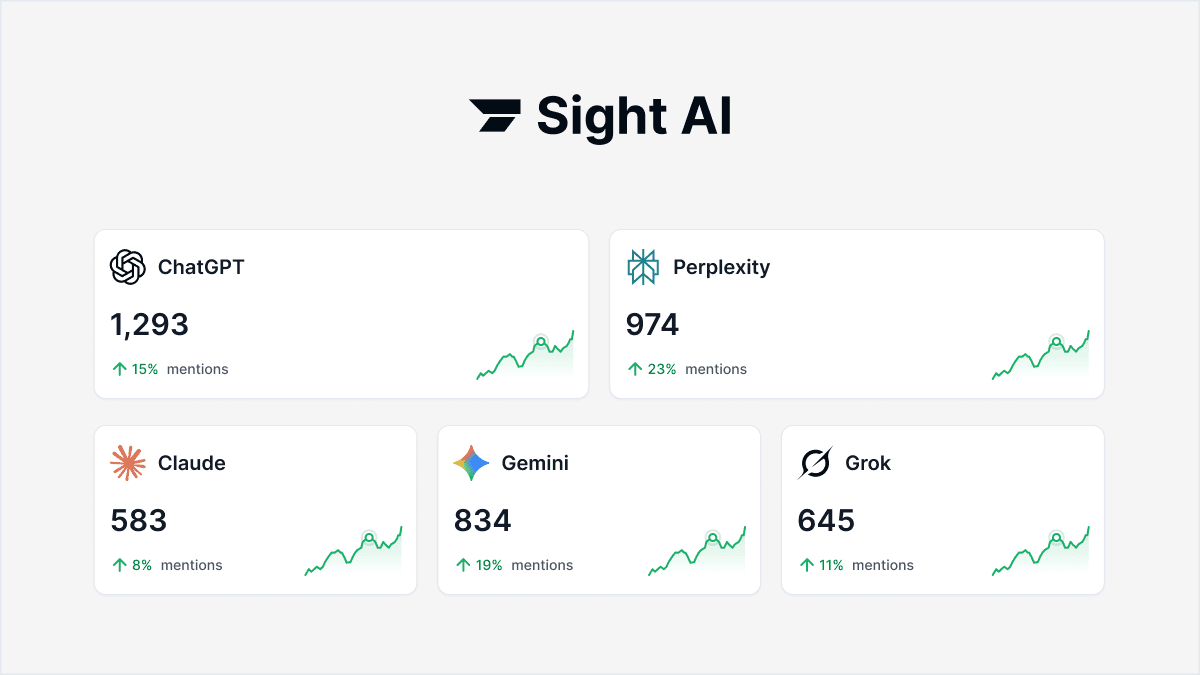
Sentiment-aware content production starts with AI visibility tracking: monitoring how AI models describe your brand across platforms like ChatGPT, Claude, and Perplexity. Once you understand the current narrative, including which attributes are associated with your brand, which competitors are mentioned alongside you, and where gaps or inaccuracies exist, you can brief agents to produce authoritative content that directly addresses and shapes that narrative.
This is a fundamentally different briefing approach. Instead of starting from a keyword and writing toward it, you're starting from a known narrative gap and writing to fill it with content that AI models will retrieve and cite. The content needs to be factually dense, clearly attributed, and structured in a way that makes it easy for AI systems to surface specific claims about your brand. Applying AI sentiment analysis for marketing gives teams the data layer needed to identify exactly which narrative gaps to target first.
Implementation Steps
1. Use an AI visibility tracking tool to run prompts related to your product category across multiple AI platforms and document how your brand is described.
2. Identify specific narrative gaps: attributes you want associated with your brand that aren't appearing, or inaccuracies that need to be corrected through authoritative content.
3. Brief your writing agents with explicit narrative objectives alongside standard SEO criteria, specifying which claims, comparisons, and positioning statements the content should establish.
4. Publish the content, submit via IndexNow, and re-run your AI visibility tracking prompts after a few weeks to measure narrative shift.
Pro Tips
Track competitor mentions alongside your own. Understanding how AI models describe your competitors relative to your brand often reveals the most actionable content opportunities. If a competitor is consistently cited for an attribute you also possess, producing more authoritative content on that attribute is a direct path to improving your comparative AI visibility.
7. Measure Agent Output Against SEO and AI Visibility KPIs
The Challenge It Solves
Without a measurement framework, AI writing agent deployments quickly become a volume exercise rather than a performance exercise. Teams produce more content, but without closed-loop feedback, they have no way of knowing which agent configurations, content types, or topic areas are actually driving results. The workflow scales, but the strategy doesn't improve.
The Strategy Explained
Closing the feedback loop requires tracking two distinct sets of metrics: traditional SEO KPIs and AI visibility KPIs. Traditional SEO metrics, including organic traffic, keyword ranking changes, and page-level engagement, tell you how your content is performing in Google and other standard search engines. AI visibility metrics, including brand mention frequency across AI platforms, sentiment scores, and the specific prompts that surface your brand, tell you how your content is performing in AI-powered discovery.
These two measurement tracks are complementary, not redundant. A piece of content might rank well in Google but fail to surface in AI-generated answers, or vice versa. Understanding both dimensions gives you a complete picture of content performance and tells you precisely where to adjust your agent briefs, topic selection, and content structure. The intersection of AI agents for SEO and marketing is where teams that measure both dimensions consistently pull ahead of competitors tracking only one.
Implementation Steps
1. Define your core SEO KPIs for agent-produced content: organic traffic growth, ranking changes for target keywords, and engagement metrics like time on page.
2. Define your AI visibility KPIs: brand mention frequency across tracked AI platforms, sentiment scores, and which competitor prompts your brand does or doesn't appear in.
3. Set a regular review cadence, monthly at minimum, where you assess both metric sets against your content production output.
4. Feed insights directly back into your agent briefs: update topic priorities, refine GEO-first brief templates, and adjust agent configurations based on what the data shows is working.
Pro Tips
Resist the temptation to optimize exclusively for the metrics that are easiest to track. Organic traffic is visible and familiar. AI visibility is newer and requires dedicated tooling to monitor. Teams that measure only traditional SEO are operating with an incomplete picture of how their content is actually influencing buyer research in 2026.
Your Implementation Roadmap
Implementing all seven strategies simultaneously isn't realistic, and it isn't necessary. The highest-leverage starting point for most marketing teams is strategy one (agent specialization) combined with strategy five (publish-and-index pipeline). These two changes immediately improve both content quality and discovery speed, creating a foundation everything else builds on.
Once that foundation is in place, layer in GEO-first briefs and topical cluster automation to build long-term authority. For teams already producing content at volume, the content refresh and brand narrative strategies often deliver the fastest measurable returns because they work with existing assets rather than requiring net-new production.
Throughout all of this, measurement is what separates teams that scale from teams that spin. Tracking AI visibility alongside traditional SEO metrics gives you a complete picture of how your content is performing: not just in Google, but in the AI-powered search experiences your audience increasingly relies on when researching purchasing decisions.
Platforms like Sight AI are built specifically to close this loop. Generate SEO/GEO-optimized content with specialized AI agents, publish and index automatically via IndexNow integration, and track how AI models respond to your brand across six or more platforms. The future of content marketing isn't writing more. It's deploying smarter agents, measuring what matters, and iterating faster than your competition.
Start tracking your AI visibility today and see exactly where your brand appears across top AI platforms, so every agent-produced piece of content you publish moves you closer to the narrative you want to own.