AI generated content detection has become one of the most pressing challenges in modern content marketing. As AI writing tools grow more sophisticated, search engines, academic institutions, and editorial teams have responded with increasingly advanced detection systems, creating a complex landscape for marketers and agencies who rely on AI-assisted workflows.
The stakes are real. Content flagged as AI-generated can face reduced search visibility, editorial rejection, or reputational risk. But the solution isn't to abandon AI content production entirely. It's to understand how detection works and build smarter, more human-centered workflows around it.
This guide breaks down seven actionable strategies for marketers, founders, and agencies who want to produce AI-assisted content that is high-quality, authentic, and built to perform in both traditional search and AI-powered discovery environments. Whether you're scaling a content operation or managing brand visibility across AI platforms, these strategies will help you produce work that stands up to scrutiny and stands out in search results.
1. Understand How AI Content Detection Actually Works
The Challenge It Solves
You can't navigate a system you don't understand. Many content teams run AI drafts through detection tools, see a high-risk score, and have no idea which passages triggered it or why. Without understanding the underlying mechanics, every revision becomes guesswork rather than targeted improvement.
The Strategy Explained
Most AI detection tools analyze two core linguistic signals. The first is perplexity: how predictable each word choice is given the surrounding context. AI models tend to select high-probability, statistically "safe" words, which results in low perplexity scores. Human writers, by contrast, make more unexpected word choices, producing higher perplexity.
The second signal is burstiness: the variation in sentence length and structural complexity across a piece of writing. Human writing naturally alternates between short punchy sentences and longer, more complex ones. AI writing tends toward uniform sentence length, which is a detectable pattern even when individual sentences read naturally.
Understanding these two mechanics tells you exactly where to focus your editing efforts: sentence variety, vocabulary range, and the introduction of unexpected phrasing.
Implementation Steps
1. Run a sample of your recent AI-assisted content through a detection tool and note which passages receive the highest risk scores.
2. Examine those passages specifically for uniform sentence length and predictable vocabulary. These are your primary editing targets.
3. Brief your editorial team on perplexity and burstiness so they can apply targeted revisions rather than wholesale rewrites.
Pro Tips
Detection tools are not infallible. Many practitioners note high false-positive rates, particularly for technical writing and content produced by non-native English speakers. Use detection scores as a diagnostic signal, not an absolute verdict. The goal is to understand the pattern, not to achieve a perfect score at any cost.
2. Build a Human-in-the-Loop Editing Workflow
The Challenge It Solves
The biggest vulnerability in most AI content operations isn't the AI itself — it's the absence of structured human oversight. When AI drafts go straight from generation to publication with minimal review, the result is content that carries all the detectable patterns of machine writing and none of the originality that makes content genuinely useful.
The Strategy Explained
A human-in-the-loop workflow doesn't mean rewriting every AI draft from scratch. It means establishing clear editorial checkpoints where human judgment is applied at the moments that matter most: structural review, voice alignment, fact verification, and final polish.
Think of the AI as a capable first-draft engine. It handles the scaffolding efficiently. The human editor's job is to tear out the scaffolding and replace it with authentic perspective, brand-specific language, and the kind of nuanced reasoning that detection systems can't replicate because it doesn't exist in training data.
This workflow also has a compounding benefit: editors who regularly revise AI drafts develop a sharper instinct for what "sounds AI-generated" and can provide better prompts over time, improving draft quality upstream.
Implementation Steps
1. Define three editorial gates: structural review (does this outline serve the reader?), voice review (does this sound like our brand?), and accuracy review (are all claims verifiable?).
2. Assign specific editors to specific content types rather than routing all AI drafts to a single reviewer. Specialization produces better output.
3. Create a revision brief template that editors complete for each piece, documenting what was changed and why. This creates institutional knowledge that improves future prompts.
Pro Tips
Velocity matters, but it shouldn't come at the cost of editorial integrity. Many content teams find that a well-structured human-in-the-loop process actually increases overall output quality without significantly reducing publishing speed, because AI handles the time-consuming first draft while humans focus only on the highest-value edits.
3. Use AI for Research and Outlining, Not Just Drafting
The Challenge It Solves
When AI is used exclusively as a prose generator, you get content that is structurally complete but linguistically flat. The writing covers the topic but lacks the specific insights, real-world examples, and original framing that make content genuinely authoritative. This is both a detection risk and a content quality problem.
The Strategy Explained
Reposition AI as a research and structural tool rather than a drafting engine. Use it to synthesize background information, identify subtopics, generate outline structures, and surface related questions your audience might have. Then hand the actual prose writing to a human.
This approach produces content with a fundamentally different linguistic signature. The writing originates from a human mind working from an AI-assisted research brief, which means word choices, sentence rhythms, and argumentative structures are genuinely human. The AI contribution is invisible in the final text because it never touched the prose.
This also tends to produce more accurate content. AI drafts can introduce subtle inaccuracies when generating prose at speed. When humans write from AI-generated research briefs, they naturally apply critical judgment to the source material before committing it to sentences.
Implementation Steps
1. Build a prompt library specifically for research and outline generation, separate from your drafting prompts. These should ask the AI to surface key questions, identify subtopics, and summarize background context.
2. Deliver AI-generated research briefs to writers as structured documents, not as prose drafts. This signals clearly that the writer's job is to create original prose, not to edit existing text.
3. Encourage writers to add their own research on top of the AI brief before drafting, so the final piece reflects genuine human synthesis.
Pro Tips
This approach works especially well for long-form content like guides, explainers, and listicles. AI can generate a comprehensive topic map in minutes; a skilled writer can then produce genuinely original prose in a fraction of the time it would take to research from scratch.
4. Inject Brand Voice, Proprietary Data, and Original Opinions
The Challenge It Solves
Generic AI prose is detectable precisely because it is generic. It covers topics competently but without perspective. It uses the most common phrasing for every concept. It avoids strong opinions because it has none. This creates content that reads as interchangeable with everything else on the internet — which is both a detection signal and a reader engagement problem.
The Strategy Explained
The most effective way to make AI-assisted content undetectable isn't to trick detection algorithms. It's to add layers of originality that no detection tool can flag because they are genuinely unique: your brand's specific voice, first-party data from your own research or customer base, and expert opinions that reflect real human judgment.
Brand voice operates at the level of word choice, sentence rhythm, and tonal register. When your content team has a documented voice guide and applies it consistently, AI drafts revised against that guide take on a distinctive character that is difficult to attribute to any single AI model.
Proprietary data is even more powerful. When your content includes statistics from your own surveys, platform data, or customer research, that information doesn't exist anywhere in an AI model's training data. It is, by definition, original.
Implementation Steps
1. Develop or update a brand voice guide that documents specific word preferences, sentence structure norms, and tonal characteristics. Make it concrete enough that editors can apply it mechanically.
2. Identify internal data sources your content team can draw from: product usage data, customer survey results, internal research reports. Build a habit of citing these in published content.
3. Add a "perspective paragraph" to every piece of content: a short section where a named expert or your brand states an opinion that isn't obvious from the topic itself.
Pro Tips
Original opinions are particularly valuable because they generate engagement. Readers respond to content that takes a position. Many content teams find that pieces with a clear point of view attract more backlinks, social shares, and return visits than comprehensive but neutral topic coverage.
5. Optimize for GEO (Generative Engine Optimization) Alongside SEO
The Challenge It Solves
Most content teams are still optimizing exclusively for traditional search rankings. But a growing share of information discovery now happens through AI-powered platforms: users ask ChatGPT, Perplexity, or Claude a question and receive a synthesized answer that may or may not cite your content. If your content isn't structured to be cited by these systems, you're invisible in an increasingly important discovery channel.
The Strategy Explained
Generative Engine Optimization (GEO) is an emerging discipline focused on structuring content so that AI-powered search engines surface and cite it in their responses. While traditional SEO optimizes for ranking position in a results list, GEO optimizes for inclusion in AI-generated answers.
The principles overlap significantly but aren't identical. GEO-optimized content tends to be structured around clear, direct answers to specific questions. It uses authoritative language, cites verifiable sources, and demonstrates subject matter expertise in ways that AI models can recognize and reference. It also benefits from strong brand authority signals across the web.
Importantly, the same content qualities that reduce AI detection risk — original perspective, specific data, clear structure — also improve GEO performance. The two goals are aligned, not competing. You can explore more about this approach in Sight AI's guide on how to improve GEO visibility.
Implementation Steps
1. Identify the specific questions your target audience asks AI platforms. These often differ from traditional search queries in their conversational phrasing and expectation of a direct answer.
2. Structure key sections of your content as direct answers to those questions, using clear headers and concise opening sentences that state the answer before elaborating.
3. Build topical authority by publishing comprehensive, interlinked content clusters rather than isolated articles. AI models tend to cite sources that demonstrate depth of expertise on a subject.
Pro Tips
GEO is still an emerging practice, which means early movers have a genuine advantage. Brands that invest in GEO-optimized content now are building citation authority before the discipline becomes standard practice. Think of it as the equivalent of investing in SEO in 2010.
6. Test Your Content Before Publishing
The Challenge It Solves
Publishing AI-assisted content without pre-publication testing is the equivalent of sending a campaign live without A/B testing the creative. You're committing to an outcome without any data on how the content will perform under scrutiny. Detection scores vary significantly by passage, by tool, and by content type — and without testing, you have no visibility into which parts of your workflow are producing the highest-risk output.
The Strategy Explained
Pre-publication detection testing serves two distinct purposes. The first is risk mitigation: identifying passages that score as high-probability AI-generated text before they reach an editor, a search crawler, or an academic review system. The second is workflow improvement: using detection scores as a feedback signal to identify which prompts, which content types, and which editors are producing the most human-sounding output.
Over time, a consistent testing practice builds a data-informed picture of your content operation's strengths and vulnerabilities. You'll begin to see patterns: certain topic categories consistently score higher, certain prompt structures produce more natural prose, certain editors reliably improve scores through their revision process.
This turns detection testing from a reactive quality check into a proactive workflow optimization tool.
Implementation Steps
1. Establish a pre-publication testing step as a formal part of your editorial workflow, positioned after AI drafting but before human review. This gives editors a baseline score to work against.
2. Document detection scores for each piece of content alongside other performance metrics. Over time, analyze whether detection scores correlate with organic performance, engagement, or editorial feedback.
3. Create a "high-risk passages" revision protocol: when a section scores above your acceptable threshold, apply targeted edits focused on sentence variety, vocabulary range, and the addition of specific examples or opinions.
Pro Tips
No single detection tool should be treated as authoritative. Many practitioners run content through multiple tools and look for consistent patterns across results rather than relying on any one score. Significant disagreement between tools often indicates content that sits in a gray zone — which is typically a sign that human editing has already done meaningful work.
7. Track AI Visibility to Measure Content Performance Beyond Search Rankings
The Challenge It Solves
Traditional SEO metrics tell you how your content performs in keyword rankings and organic traffic. But they don't tell you whether your content is being cited by AI platforms, whether your brand is being mentioned in AI-generated answers, or whether your GEO optimization efforts are actually translating into AI-era visibility. Without this data, you're flying blind on an increasingly important dimension of content performance.
The Strategy Explained
AI visibility tracking closes the loop between content production and brand authority in AI-powered discovery environments. It monitors how AI platforms like ChatGPT, Claude, and Perplexity reference your brand in response to relevant queries, giving you a real-time picture of whether your content is influencing AI-generated answers.
This data serves multiple strategic purposes. It tells you which content pieces are being cited by AI models, which topics your brand has established authority on in AI environments, and where gaps exist between your SEO performance and your AI visibility. It also helps you identify new content opportunities: topics where AI models are generating answers but not citing your brand, despite your expertise in the area.
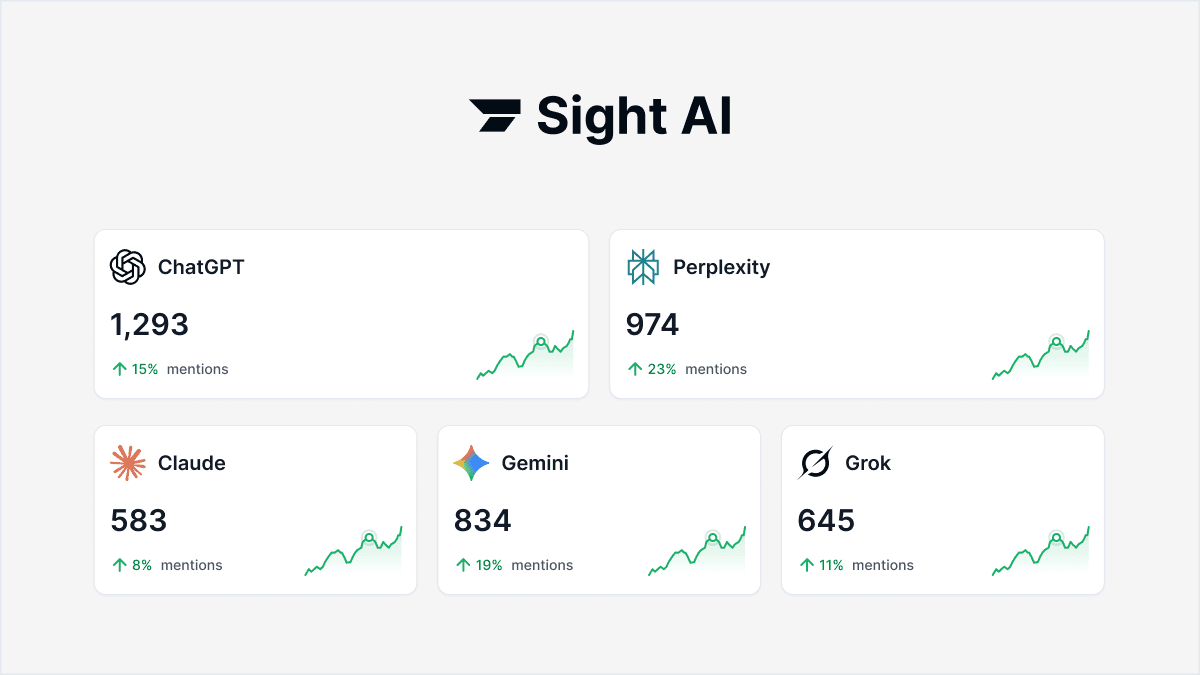
Platforms like Sight AI track brand mentions across six or more AI platforms, providing an AI Visibility Score alongside sentiment analysis and prompt tracking. This gives content teams a concrete, measurable metric for AI-era brand authority that complements traditional SEO reporting.
Implementation Steps
1. Define the set of queries most relevant to your brand and industry. These are the questions your target audience is most likely to ask AI platforms when looking for solutions you provide.
2. Set up AI visibility tracking to monitor how AI platforms respond to those queries and whether your brand appears in the answers. Review this data on a regular cadence alongside your SEO reporting.
3. Use AI visibility data to inform your content calendar: prioritize topics where you have strong SEO performance but low AI visibility, as these represent the highest-leverage content opportunities for GEO optimization.
Pro Tips
AI visibility tracking is most valuable when it's connected to your content production workflow rather than treated as a separate reporting function. When content teams can see directly how published pieces influence AI mentions, they develop a much sharper intuition for what kinds of content build AI-era authority — and that intuition compounds over time.
Putting It All Together
AI generated content detection isn't going away. It will continue to evolve alongside the AI writing tools it monitors, and the gap between sophisticated AI prose and human writing will remain a subject of ongoing scrutiny from search engines, editorial teams, and institutional review processes.
The brands and agencies that win in this environment won't be those who try to game detection systems. They'll be the ones who build content workflows that are genuinely high-quality, human-reviewed, and optimized for both traditional search and AI discovery platforms.
Start by auditing your current AI content process. Where is human oversight weakest? Where is brand voice being diluted by generic AI prose? From there, implement these strategies in order of impact: begin with editorial workflow improvements and detection mechanics, then move toward brand voice differentiation, GEO optimization, and AI visibility tracking.
Tools like Sight AI help you close the loop by generating SEO and GEO-optimized content through 13+ specialized AI agents while simultaneously tracking how your brand is mentioned across AI platforms like ChatGPT, Claude, and Perplexity. The goal isn't just to avoid detection. It's to produce content so authoritative and original that detection becomes irrelevant.
Start tracking your AI visibility today and see exactly where your brand appears across top AI platforms — so you can stop guessing and start building content that earns citations, drives organic traffic, and compounds into lasting brand authority.