AI can now produce a thousand articles before your morning coffee gets cold. That's not a hypothetical — it's the operational reality for marketing teams in 2026. But here's the tension that keeps SEO professionals up at night: the same AI revolution that makes content creation effortless has also made search engines and AI models dramatically better at evaluating what they read.
Volume used to be a defensible strategy. Publish more, rank more. That equation no longer holds. Google's quality signals have grown sophisticated enough to distinguish between content that genuinely informs and content that merely fills a page. Meanwhile, a new class of evaluators has emerged: AI models like ChatGPT, Claude, and Perplexity that increasingly serve as the first stop for user queries, and that only cite sources they deem authoritative and accurate.
So what does "quality" actually mean when AI is both the creator and the evaluator? The answer isn't a single metric or a checklist. It's a set of interconnected dimensions — topical depth, factual integrity, structural clarity, search intent alignment, and GEO optimization — that together determine whether your content ranks, gets cited, and drives compounding organic growth. This article breaks down each one.
How Google's Quality Standards Have Shifted
For years, SEO success was largely a technical exercise: hit the right keyword density, reach a target word count, earn enough backlinks. Those signals still matter, but they've been joined by something harder to game: genuine content quality assessed through increasingly sophisticated evaluation frameworks.
Google's Search Quality Rater Guidelines formalized this shift through the E-E-A-T framework: Experience, Expertise, Authoritativeness, and Trustworthiness. These four dimensions are now the lens through which quality raters assess whether a page deserves to rank. The addition of "Experience" to the original E-A-T framework was significant. It signals that Google values content created by someone who has actually done the thing being described, not just aggregated information about it.
This creates a specific challenge for AI-generated content. Large language models are trained on existing text. They can synthesize, summarize, and structure information effectively, but they cannot draw on first-hand experience. An AI writing about running a paid media campaign has never managed a budget. An AI explaining enterprise software implementation has never sat in a client kickoff meeting. That absence of lived experience is detectable, and it shows up as a ceiling on rankings.
The practical implication is that AI content without human editorial contribution tends to plateau. It can rank for lower-competition queries where the bar is lower. But for high-value, competitive keywords where the top results reflect genuine expertise, AI-only content frequently underperforms. The content that wins in those positions typically combines AI's efficiency in structure and coverage with human-added insight, original perspective, or proprietary data.
There's also a subtler dynamic at work. Search engines are increasingly good at identifying content that was produced to rank rather than produced to inform. When an article covers a topic at the exact depth that a keyword requires but no deeper, when it answers the surface question without anticipating follow-up questions, when it uses the right vocabulary without demonstrating real understanding of the subject, these patterns cluster into a recognizable signal. The content looks optimized but doesn't feel authoritative. And that distinction is exactly what modern quality evaluation is designed to catch.
The Five Dimensions of AI Content Quality That Drive Rankings
Quality isn't monolithic. It's useful to break it into specific dimensions that can be evaluated, improved, and tracked separately. For AI-generated SEO content, five dimensions consistently separate content that ranks from content that stalls.
Topical depth and coverage completeness: High-quality content doesn't just define a concept — it explores it from multiple angles, addresses adjacent questions, and anticipates what a reader needs to know next. Search engines assess topical depth partly by evaluating whether a page covers the semantic territory around its primary topic. Shallow content that answers the headline question and stops short leaves ranking potential on the table. The goal is to satisfy search intent completely, not minimally.
Factual accuracy and source integrity: This is the dimension where AI-generated content carries the most risk. Large language models hallucinate. They produce plausible-sounding claims that are factually incorrect, cite studies that don't exist, and state statistics with false precision. For SEO content, this isn't just an editorial problem — it's a trust signal problem. Content that contains verifiable errors erodes the credibility of the entire domain over time, and in sensitive categories like health, finance, and legal, it can trigger manual review. Every factual claim in AI-generated content requires human verification before publication.
Structural clarity: Logical heading hierarchy, scannable formatting, and internal coherence serve two audiences simultaneously: human readers who scan before they commit to reading, and crawlers that use structure to understand content relationships. An article with a clear H2/H3 hierarchy signals topical organization. Short paragraphs reduce cognitive load. Bold labels help readers navigate to the specific answer they need. These aren't aesthetic preferences — they're quality signals that affect both user engagement metrics and crawl efficiency.
Search intent alignment: Every keyword carries an implicit user intent: informational, navigational, transactional, or commercial. High-quality AI content correctly identifies which intent applies and structures the entire piece around serving it. A keyword like "best CRM software" signals commercial intent — the user wants a comparison, not a definition. A keyword like "what is a CRM" signals informational intent. Technically accurate content that answers the wrong intent for its target keyword rarely sustains rankings, regardless of how well it's written.
Unique value contribution: The final dimension is perhaps the hardest to systematize. Does this content add something that didn't exist before? A unique framework, an original perspective, a proprietary data point, a synthesis that no other page offers? Content that mirrors existing top-ranking pages without differentiation is competing on identical terms with established pages that already have authority. The quality ceiling for undifferentiated content is low, because there's no reason for a search engine to prefer it over what already ranks.
GEO Optimization: Getting Your Content Cited by AI Models
Traditional SEO targets search engine crawlers and ranking algorithms. Generative Engine Optimization, or GEO, targets something different: the retrieval and citation patterns of large language models. As of 2026, a growing share of user queries never reach a traditional search results page. They're answered directly by AI models that synthesize information from sources they've determined to be authoritative. If your content isn't one of those sources, you're invisible to that segment of your audience.
The way AI models evaluate content quality differs from how search engines do it, though there's significant overlap. AI models prioritize content that is clearly attributed, factually precise, well-structured, and quotable. They favor content that makes definitive, citable statements over content that hedges everything. They respond well to original frameworks, named methodologies, and expert definitions that can be referenced cleanly in a response.
Several practical quality signals increase the likelihood of AI citation. Clear brand attribution throughout the content, not just in the byline, helps models associate claims with a specific source. Structured definitions that state a concept precisely in a single sentence are more likely to be pulled into AI responses than definitions buried in paragraph prose. Quotable expert statements, framed as direct assertions rather than qualified observations, give models something concrete to cite. And original frameworks with distinct names give models a reason to reference your brand specifically rather than paraphrasing generic industry knowledge.
The discipline of GEO also intersects with content indexing. Content that isn't indexed can't be cited. Tools that integrate IndexNow and automate sitemap updates ensure that newly published content enters search indexes quickly, reducing the lag between publication and the point at which AI models can discover and evaluate it. Speed of indexing has become a meaningful competitive variable, particularly for content covering fast-moving topics where being early matters.
The brands that are building GEO into their content strategy now are establishing citation patterns before their competitors. When an AI model consistently responds to queries in your category by mentioning your brand, that represents a durable form of organic visibility that compounds over time. Tracking which prompts trigger mentions of your brand, and which don't, is the feedback loop that drives GEO improvement.
The Most Common Quality Failures in AI-Generated Content
Understanding what quality looks like is only half the picture. Equally important is recognizing the specific failure patterns that AI-generated content tends to produce, because they're different from the failure patterns of human-written content.
Generic filler content: AI models are trained to produce fluent, complete-sounding text. This makes them prone to padding: sentences that sound substantive but deliver no information the reader didn't already have. Phrases like "in today's digital landscape" or "it's important to note that" are symptomatic of this pattern. The result is high word count with low information density, a combination that search engines increasingly penalize and that readers abandon quickly. Information density, not word count, is the relevant metric.
Lack of differentiation: When an AI is given a keyword and asked to write an article, it typically produces content that resembles the average of what already exists on that topic. That's structurally logical given how language models work, but it's strategically problematic. Content that mirrors existing top-ranking pages adds nothing to the conversation. It competes on identical terms with pages that already have established authority, backlink profiles, and engagement history. Without a unique angle, a proprietary data point, or a perspective that no existing page offers, the content has no competitive basis for outranking what's already there.
Misaligned search intent: This failure is subtle and surprisingly common. AI-generated content can be technically accurate, well-structured, and factually sound while still answering the wrong question for its target keyword. A keyword targeting users who are ready to evaluate vendors gets an educational explainer. A keyword targeting beginners gets an advanced technical breakdown. The mismatch between what the content delivers and what the searcher actually needs at that moment in their journey is one of the most reliable predictors of poor ranking performance.
Building a Quality Control Workflow for AI Content
The gap between AI content that ranks and AI content that doesn't is rarely a function of the AI model used. It's almost always a function of the workflow around it. Quality control for AI-generated content operates at three stages: before generation, during generation, and after generation.
Before generation: The quality of the output is largely determined by the quality of the input. Pre-generation work should include keyword research that goes beyond search volume to identify the specific angle, depth, and unique value each article must deliver. Competitor gap analysis reveals what existing top-ranking content covers and, more importantly, what it doesn't. The goal is to define, before a single word is generated, what this specific article will offer that nothing else currently does. Without that definition, AI generation defaults to averaging existing content.
During generation: Specialized AI agents configured for specific content types maintain structural and tonal consistency in ways that general-purpose prompting doesn't. A listicle requires different structural logic than a technical guide, which requires different logic than a comparison article. Using agents designed for each format, rather than a single generalist prompt, produces output that is better aligned with the structural expectations readers and crawlers bring to each content type. Platforms that offer multiple specialized agents, each optimized for a distinct article format, operationalize this principle at scale.
After generation: Human editorial review remains non-negotiable for high-quality AI content. The focus of that review should be specific: factual accuracy verification, brand voice alignment, and internal linking. Internal links between semantically related articles reinforce topical authority signals and improve crawl efficiency. They also serve readers who want to go deeper on adjacent topics. A post-generation review that treats internal linking as a deliberate editorial decision, rather than an afterthought, compounds the authority value of every new piece published.
Measuring Whether Your AI Content Is Actually Performing
Publishing quality content is necessary but not sufficient. The feedback loop that separates improving content strategies from stagnating ones is measurement: understanding which content is working, why, and what that implies for what you should produce next.
On the traditional SEO side, the metrics that most reliably proxy for content quality satisfaction are organic impressions, click-through rate, average position, and time-on-page. Impressions indicate whether the content is being surfaced for relevant queries. Click-through rate reflects whether the title and meta description match searcher expectations. Average position tracks ranking trajectory over time. Time-on-page, interpreted carefully, suggests whether readers who arrive find what they came for. A piece with high impressions and low click-through rate has a relevance problem. A piece with high click-through rate and low time-on-page has a content delivery problem. Each pattern points to a different fix.
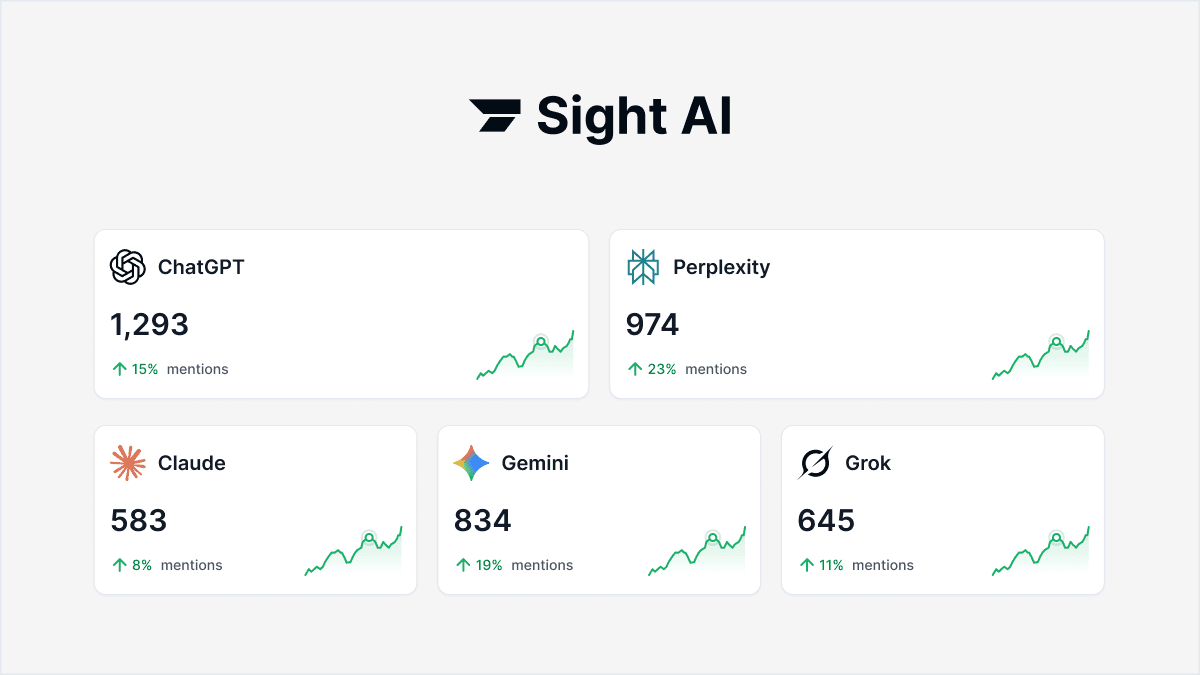
On the AI visibility side, the relevant metric is how often and how accurately AI models mention your brand when responding to queries in your category. This is a newer measurement discipline, but it's becoming increasingly important. A brand that appears consistently in AI model responses to relevant prompts has built a form of organic visibility that operates independently of traditional search rankings. Tracking this requires monitoring AI model outputs systematically, across multiple platforms, for the prompts that matter to your business.
The iterative improvement loop connects both measurement streams. When you identify which content types and quality patterns correlate with ranking gains, you feed those insights back into your pre-generation brief process. When you identify which content earns AI citations and which doesn't, you adjust your GEO optimization approach accordingly. The goal is a content strategy that gets smarter with every piece published, not one that repeats the same approach at higher volume.
Putting It All Together
The core principle running through every dimension covered here is the same: AI content quality for SEO is not about passing a checklist. It's about producing content that genuinely serves the reader, demonstrates real expertise, and earns citations from both search engines and AI models. Those three outcomes are not in tension with each other. They're achieved by the same underlying commitment to depth, accuracy, and differentiation.
If you're running AI content at scale, the most valuable thing you can do right now is audit what you have. Take your top-traffic articles and evaluate them against the five quality dimensions: topical depth, factual accuracy, structural clarity, search intent alignment, and unique value contribution. Identify where the gaps are. Then build a workflow that closes those gaps systematically before the next batch is published.
The brands winning in AI-era organic search are not the ones generating the most content. They're the ones generating content that AI models trust enough to cite, that readers stay on long enough to convert, and that search engines rank because nothing else serves the query better.
Stop guessing how AI models like ChatGPT and Claude talk about your brand. Start tracking your AI visibility today and see exactly where your brand appears across top AI platforms, uncover the content gaps your competitors haven't closed yet, and publish GEO-optimized articles that earn your brand a place in the responses that matter most.