AI content automation has moved from a nice-to-have experiment to a core pillar of modern marketing operations. But as the market matures, pricing models have become increasingly complex. Usage-based tiers, per-seat charges, credit systems, feature-gated plans, and hybrid models that blend several approaches at once have turned what should be a straightforward buying decision into a genuine research project.
For marketers, founders, and agencies trying to scale organic traffic and AI visibility, choosing the wrong pricing plan carries real consequences. You might overpay for capabilities you never use, or worse, hit invisible ceilings right when your content strategy gains momentum and you need to accelerate.
The challenge isn't just finding a tool that works. It's finding a plan that scales with your growth trajectory without punishing you for success. Many platforms look affordable at low volumes but become prohibitively expensive as your output needs increase. Others bundle features you'll never use while locking the ones you actually need behind higher tiers.
This guide breaks down seven battle-tested strategies for evaluating AI content automation pricing plans so you can match your investment to your actual growth trajectory. Whether you're comparing platforms for the first time or renegotiating an existing contract, these approaches will help you cut through marketing jargon and make a decision grounded in real ROI.
Let's start at the foundation: your own workflow.
1. Map Your Content Workflow Before Comparing Price Tags
The Challenge It Solves
Most buyers approach AI content automation pricing backwards. They look at plan comparison pages, pick a tier that sounds reasonable, and then try to fit their workflow into whatever features that plan includes. The result is often a mismatch between what you're paying for and what you actually need, leading to either overspend on unused capabilities or frustrating gaps in your process.
The Strategy Explained
Before opening a single pricing page, audit your full content pipeline end to end. Document every stage: ideation, keyword research, brief creation, drafting, editing, SEO optimization, internal linking, image sourcing, CMS publishing, indexing, and performance tracking. For each stage, note whether you currently handle it manually, with a separate tool, or if it remains a bottleneck.
This audit creates a feature requirements list that you can use as a scorecard when evaluating plans. You're not looking for the platform with the most features. You're looking for the one that covers your specific workflow gaps without charging you for everything else. A well-structured content production workflow makes it far easier to identify which pricing tier actually matches your needs.
Think of it like configuring a car. You don't need heated seats in a warm climate, no matter how much the salesperson emphasizes them. The same logic applies to AI writing features you'll never use.
Implementation Steps
1. List every step in your current content production process, from keyword selection to post-publish tracking.
2. Tag each step as: fully manual, partially automated, or already handled by an existing tool.
3. Identify your top three workflow bottlenecks that automation could realistically solve.
4. Create a must-have, nice-to-have, and don't-need feature list before reviewing any pricing pages.
Pro Tips
Include your team in the workflow audit. Editors, SEO specialists, and content managers often have bottlenecks that aren't visible from a management perspective. The features that save your editor two hours per article may be buried in a plan tier you wouldn't have considered otherwise.
2. Decode the Pricing Model Architecture
The Challenge It Solves
Not all pricing models create the same cost exposure. A plan that looks affordable on the surface can become expensive quickly depending on how your team works and how your output scales. Understanding the structural differences between pricing models helps you identify hidden costs before they appear on your invoice.
The Strategy Explained
There are four dominant pricing architectures in the AI content automation market, and each has distinct cost implications.
Per-seat pricing: You pay for each user who accesses the platform. This model works well for small, stable teams but becomes expensive for agencies managing multiple clients or growing marketing departments.
Credit-based pricing: You purchase a pool of credits that are consumed by different actions, such as generating an article, running an SEO audit, or indexing a page. The challenge here is that credit consumption rates aren't always intuitive, making monthly cost prediction difficult until you've used the platform for several cycles. For a deeper dive into how credit systems compare, explore our breakdown of AI content generation pricing models.
Usage-based pricing: You pay based on actual consumption, such as words generated or API calls made. This model is transparent but can create budget unpredictability during high-output months.
Flat-rate tiered pricing: You pay a fixed monthly fee for a defined set of features and output limits. Predictable, but watch for tier-jump cliffs where moving up one tier doubles your cost.
Implementation Steps
1. Identify which pricing model each platform uses, and whether it's a hybrid of two or more models.
2. Map your average monthly content output to each model to estimate realistic monthly costs.
3. Ask each vendor directly: "What happens to my costs if I double my output volume?"
4. Request a sample invoice or cost simulation based on your projected usage before committing.
Pro Tips
Credit systems deserve extra scrutiny. Ask vendors for a clear credit consumption table that shows exactly how many credits each action costs. If a vendor can't provide this upfront, treat it as a red flag for cost predictability.
3. Calculate True Cost-Per-Article, Not Just Subscription Price
The Challenge It Solves
Subscription price is the most visible number in any pricing comparison, but it's rarely the most meaningful one. The real cost of AI-generated content includes the human time required to take a raw AI draft to a publishable, optimized piece. Ignoring this variable leads to systematic underestimation of total content production costs.
The Strategy Explained
True cost-per-article is a composite metric that factors in subscription cost, human editing time, SEO optimization effort, revision cycles, and publishing overhead. Platforms that produce higher-quality first drafts may carry a higher subscription price but dramatically reduce the human hours required per article, resulting in a lower true cost per publishable piece. Understanding the full content automation platform cost picture is essential for accurate budgeting.
To calculate this, track the time your team spends on each stage of post-generation editing for a representative sample of articles. Multiply that time by your team's effective hourly cost. Add that figure to the pro-rated subscription cost per article. The result is your true cost-per-article, which is the number that actually matters for ROI analysis.
Here's where it gets interesting: platforms that include built-in SEO optimization, internal linking suggestions, and GEO-optimized structuring, like the kind of integrated workflow Sight AI is designed to support, can significantly reduce post-generation editing time compared to platforms that produce raw text requiring extensive manual optimization.
Implementation Steps
1. Run a time-tracking exercise on five to ten articles produced with your current or trial tool, logging time at each editing stage.
2. Calculate your team's effective hourly cost for content editing and optimization work.
3. Compute: (Subscription cost ÷ monthly article volume) + (Average editing hours × hourly rate) = True cost-per-article.
4. Use this number to compare platforms, not the subscription price alone.
Pro Tips
Don't forget revision cycles. Articles that require multiple rounds of editing because the AI output is inconsistent or off-brief add compounding costs. Ask vendors about their quality consistency across different content types before committing.
4. Prioritize Plans That Bundle Indexing and Distribution
The Challenge It Solves
Publishing content is only half the battle. If your articles aren't indexed quickly and distributed through the right channels, the SEO value of your content investment is delayed or diminished. Many buyers evaluate AI writing capabilities without accounting for the downstream tools needed to get content discovered, leading to tool sprawl and compounding costs.
The Strategy Explained
A growing category of AI content platforms now includes indexing and distribution capabilities natively, rather than requiring you to bolt on separate tools. Features to look for include IndexNow integration for near-instant search engine notification, automated sitemap updates, and direct CMS publishing connections that eliminate manual copy-paste workflows. Our guide to content indexing automation tools covers the leading options in this space.
When you price a standalone AI writing tool, you need to add the cost of your SEO indexing tool, your CMS connector or automation layer, and the time your team spends managing handoffs between systems. An integrated platform that handles content generation, optimization, and indexing in a single workflow often has a higher headline price but a lower total cost of ownership when you account for the tools it replaces.
Sight AI's approach to this is worth understanding as a benchmark: the platform combines AI content generation with IndexNow integration and automated sitemap management, so content moves from draft to indexed without requiring a separate toolchain.
Implementation Steps
1. List every tool currently involved in your content-to-index workflow, including costs and integration maintenance time.
2. Identify which of those tools could be replaced by a more integrated AI content platform.
3. Compare the total cost of your current toolchain against integrated platform pricing.
4. Ask vendors specifically: "Does your platform include IndexNow integration and automated sitemap updates, or do those require a separate integration?"
Pro Tips
CMS auto-publishing is particularly valuable for agencies managing multiple client sites. Manual publishing is a time sink that compounds across clients. Prioritize platforms that support direct CMS integration for content automation rather than requiring manual export and upload workflows.
5. Stress-Test Scalability at Your Projected 6-Month Volume
The Challenge It Solves
Pricing plans are often designed to look attractive at entry-level volumes. The real test is what happens when your content operation scales. Tier-jump cost spikes, throughput limitations, and feature restrictions that only appear at higher volumes can turn a seemingly affordable plan into an expensive one right when your strategy starts working.
The Strategy Explained
Before committing to any plan, model your content volume trajectory over the next six months. If you're currently producing ten articles per month and your goal is fifty, you need to know exactly what that growth costs on each platform you're evaluating, not just what the current volume costs.
Map each platform's pricing tiers against your projected volume milestones. Look for two specific danger zones: tier-jump cliffs where a small increase in volume triggers a large price increase, and throughput limits that cap how much content you can generate in a given period regardless of what you're paying. Reviewing a detailed comparison of content automation tool plans can help you spot these cliffs before committing.
Some platforms also restrict access to advanced features like multi-agent workflows, autopilot content generation, or AI visibility tracking to higher tiers. If those capabilities are part of your six-month roadmap, factor their tier requirements into your cost modeling now rather than discovering the limitation after you've committed.
Implementation Steps
1. Project your content volume at 1 month, 3 months, and 6 months based on your growth goals.
2. Map those volume milestones against each platform's tier structure to calculate cost at each stage.
3. Identify any features locked behind higher tiers that you'll need as you scale.
4. Ask vendors: "Are there any throughput limits or rate caps that would affect production at [your projected volume]?"
Pro Tips
Pay attention to how platforms handle overage. Some charge significant per-unit fees when you exceed your plan limits, while others simply pause generation until the next billing cycle. Both scenarios can disrupt your content calendar, but in different ways. Understand the overage policy before you need it.
6. Evaluate AI Visibility and Performance Tracking as a Pricing Factor
The Challenge It Solves
Most content teams measure performance through traditional SEO metrics: organic traffic, keyword rankings, and backlinks. But as AI-powered search becomes a primary discovery channel, a growing portion of your audience may be finding your brand through ChatGPT, Claude, Perplexity, and similar platforms. If your AI content automation tool doesn't help you track this visibility, you're missing a significant portion of your content's actual impact.
The Strategy Explained
AI visibility tracking, the ability to monitor how and where AI models reference your brand, is transitioning from an emerging capability to a core requirement for content teams focused on organic growth. When evaluating pricing plans, treat AI visibility monitoring as a first-class feature requirement rather than an optional add-on.
Look for platforms that include brand mention tracking across multiple AI models, sentiment analysis for how your brand is being described, and prompt-level tracking that shows which queries surface your brand in AI responses. These capabilities directly inform your content strategy: they reveal gaps where competitors are being mentioned instead of you, and they validate whether your SEO content automation efforts are actually influencing AI model outputs.
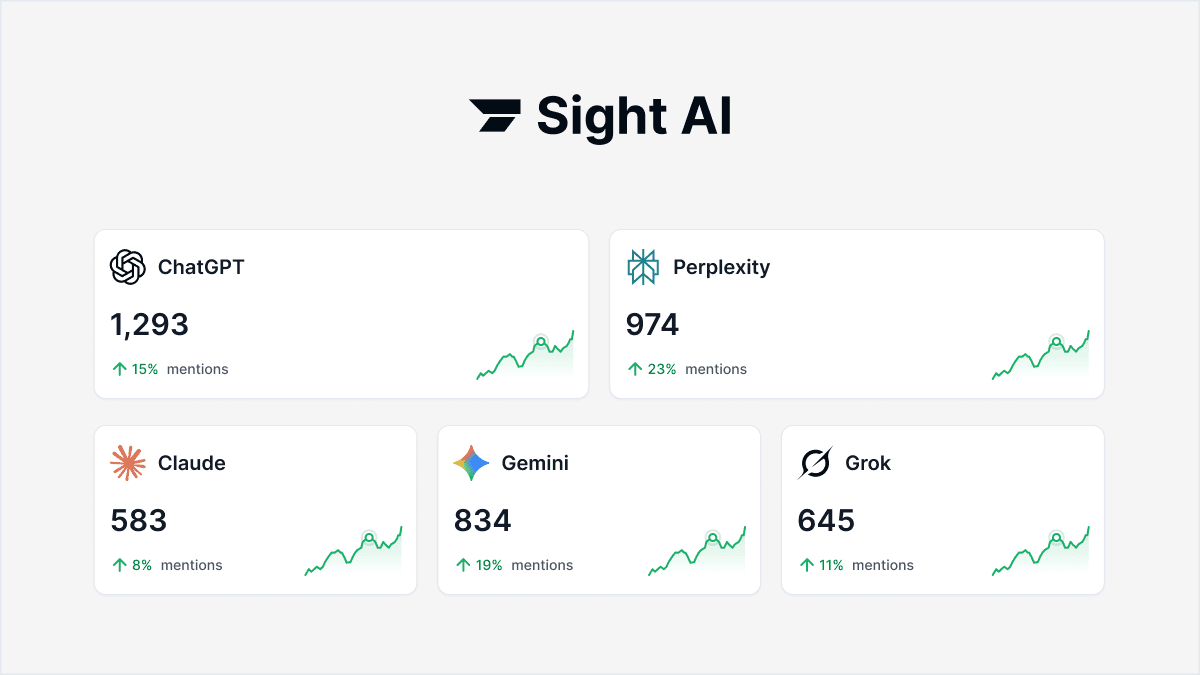
Sight AI's AI Visibility Score provides exactly this kind of monitoring, tracking brand mentions across six or more AI platforms with sentiment analysis and prompt tracking built in. When this capability is bundled into your content automation plan rather than priced separately, it changes the ROI calculation significantly.
Implementation Steps
1. Add AI visibility tracking to your must-have feature list when auditing platform capabilities.
2. Ask vendors which AI platforms they monitor and how frequently they update mention data.
3. Evaluate whether AI visibility tracking is included in your target tier or requires an upgrade.
4. Factor the cost of a standalone AI visibility tool into your comparison if a platform doesn't include it natively.
Pro Tips
Sentiment analysis matters as much as mention volume. A brand being mentioned frequently in a negative or cautionary context by AI models is worse than not being mentioned at all. Ensure any AI visibility tracking you evaluate includes qualitative context, not just mention counts.
7. Run a Paid Pilot Before Signing an Annual Contract
The Challenge It Solves
Free trials are designed to show you a platform at its best under ideal conditions. They rarely replicate the pressure, volume, and edge cases of real production workflows. Signing an annual contract based on a free trial is one of the most common and expensive mistakes in SaaS buying, and AI content automation platforms are no exception.
The Strategy Explained
A structured paid pilot at production volume gives you the data you need to make a confident long-term commitment. The goal is to run the platform through your actual content workflow, at realistic volume, with real briefs, real deadlines, and real quality standards, before locking into annual pricing.
Structure your pilot around clear KPIs established before you start. These should include true cost-per-article, average editing time per piece, content quality consistency scores, indexing speed, and any AI visibility metrics relevant to your strategy. Thirty days at production volume is typically enough to identify both the platform's strengths and its failure modes. Comparing results against a curated list of the best AI content automation tools can help you benchmark your pilot findings.
Most vendors will offer a monthly plan before you commit to annual pricing. The premium you pay for month-to-month access during a pilot period is almost always worth it compared to the cost of being locked into a year-long contract with a platform that doesn't fit your workflow.
Implementation Steps
1. Define your pilot KPIs in writing before starting: cost-per-article, editing time, quality score, indexing speed, and any platform-specific metrics.
2. Commit to producing your realistic monthly content volume during the pilot, not a reduced test volume.
3. Track your KPIs weekly and document any workflow friction, limitations, or unexpected costs.
4. At the end of the pilot, compare your actual results against your KPIs and use that data to negotiate annual pricing if you decide to commit.
Pro Tips
Use the pilot period to test customer support responsiveness, not just the product. How quickly does the team respond when something breaks or a feature doesn't work as expected? Support quality often predicts your long-term experience with a platform more accurately than any feature comparison.
Bringing It All Together: Your AI Content Automation Pricing Checklist
Evaluating AI content automation pricing plans isn't about finding the cheapest option. It's about finding the plan that delivers the strongest return on your content investment across your actual workflow, your actual volume, and your actual growth trajectory.
Here's a quick-reference framework built from the seven strategies above:
Start with your workflow audit. Document your full content pipeline before comparing a single pricing page. Your feature requirements list is the foundation of every other decision.
Decode the pricing architecture. Understand whether you're dealing with per-seat, credit-based, usage-based, or flat-rate pricing, and model realistic monthly costs at your current and projected volume.
Calculate true cost-per-article. Subscription price plus human editing time plus optimization overhead equals the number that actually matters for ROI.
Value integration over feature count. Platforms that bundle content generation, SEO and GEO optimization, IndexNow indexing, and AI visibility tracking typically reduce total cost of ownership compared to assembling a multi-tool stack.
Model six-month scalability. Identify tier-jump cliffs and throughput limits before they become operational problems.
Treat AI visibility as a core requirement. As AI-powered search becomes a primary discovery channel, monitoring how models like ChatGPT, Claude, and Perplexity reference your brand is no longer optional for serious content operations.
Pilot at production volume before committing annually. Thirty days of real-world testing with clear KPIs is worth the short-term premium over a free trial.
Looking ahead, AI content automation pricing will continue evolving as AI visibility tracking becomes a standard marketing metric. Platforms that help you create content, distribute it, index it, and measure its impact across both traditional search and AI-powered discovery channels will increasingly define the category.
The brands that win won't necessarily be the ones spending the most on content automation. They'll be the ones who chose platforms that give them full visibility into where and how their content performs across every discovery surface that matters.
Start tracking your AI visibility today and see exactly where your brand appears across top AI platforms, so every content investment you make is informed by real data on how AI models talk about you.