Billions of searches happen on Google every single day, yet most marketers treat them all the same. They chase keyword volume, stuff topics into blog posts, and wonder why their rankings plateau. The truth is, every query that lands in Google's search bar carries a specific intent, and that intent determines everything: which SERP features appear, what content format wins, and whether your page ever gets seen at all.
Understanding the different types of Google searches isn't a nice-to-have SEO concept. It's the strategic foundation that separates brands generating consistent organic traffic from those perpetually spinning their wheels. Get the intent wrong, and even a technically perfect, well-optimized page will struggle to rank.
The stakes have only grown higher in 2026. Google's AI Overviews now answer queries directly on the results page, and conversational AI platforms like ChatGPT, Claude, and Perplexity are fielding millions of search-like queries daily. The brands winning in this environment aren't just optimizing for keywords. They're creating content that precisely matches how people search, what they need at that moment, and how AI systems classify and surface information. This guide breaks down every major search type, explains how to align your content strategy accordingly, and shows you how to stay competitive as AI continues reshaping the search landscape.
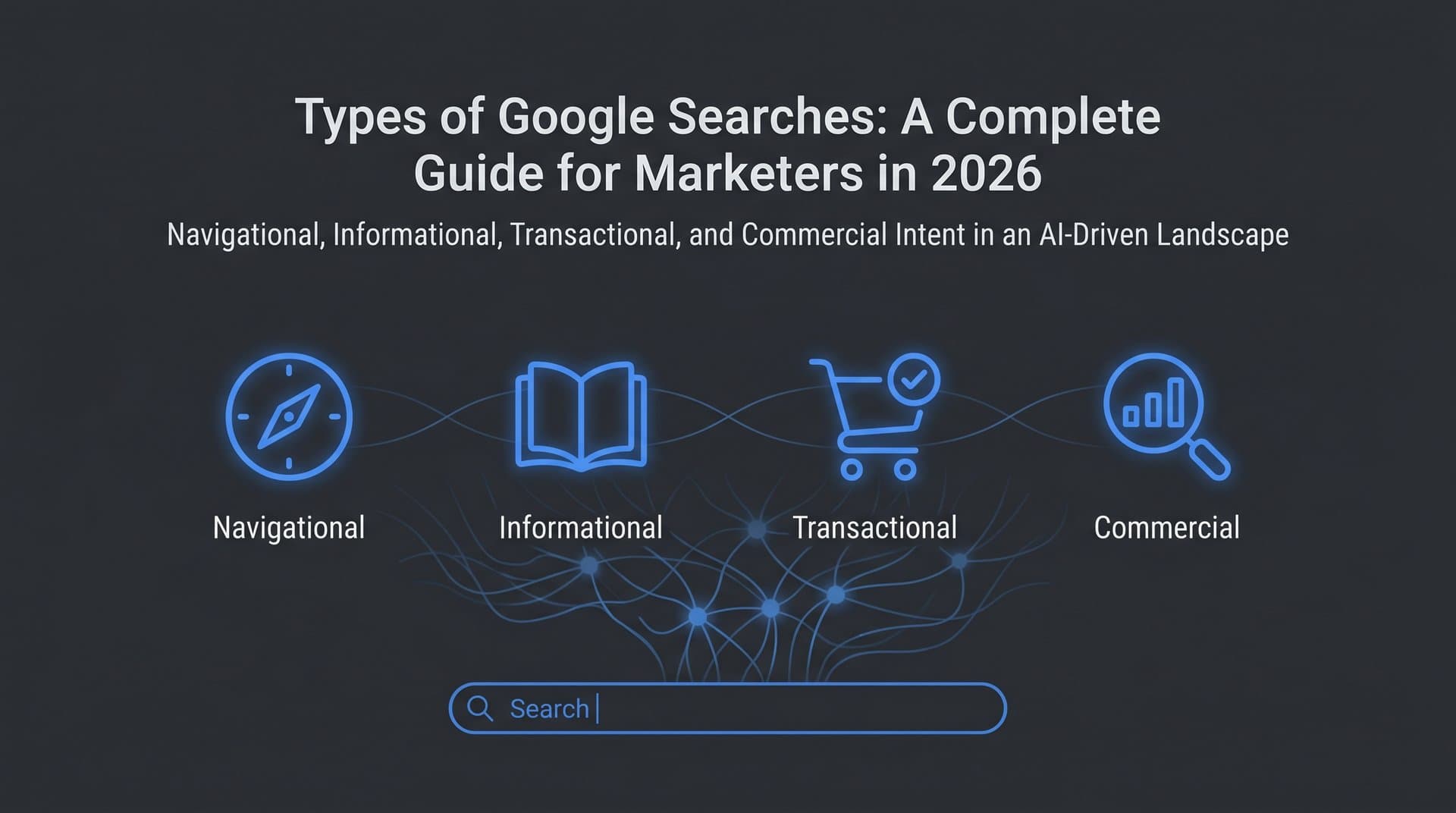
The Four Pillars of Search Intent Behind Every Query
Search intent is the "why" behind a query. When someone types something into Google, they're not just entering words. They're expressing a need, and Google's job is to figure out exactly what that need is and serve the most relevant result. To do this at scale, Google classifies queries into four core intent categories, each with distinct characteristics and corresponding SERP behaviors.
Informational intent covers queries where someone wants to learn something. Think "how does machine learning work," "what is a conversion rate," or "why does my website rank poorly." These searches dominate overall query volume and typically trigger features like featured snippets, People Also Ask boxes, knowledge panels, and increasingly, AI Overviews that synthesize answers directly on the page.
Navigational intent describes searches where someone already knows where they want to go. They're searching for a specific brand, product, or website. "Salesforce login," "Sight AI dashboard," or "HubSpot pricing page" are all navigational. The user isn't exploring options. They're heading somewhere specific.
Transactional intent signals readiness to act. The user wants to buy, sign up, download, or complete a specific action. Queries like "buy project management software," "sign up for SEO tool free trial," or "download content calendar template" fall here. Google responds with ads, shopping panels, and results that prioritize conversion-oriented pages.
Commercial investigation intent sits between informational and transactional. The searcher is actively evaluating options before making a decision. "Best CRM for small business 2026," "Ahrefs vs Semrush comparison," or "top AI writing tools for marketers" are classic examples. These queries are enormously valuable because the user is close to a purchase decision and looking for guidance.
Google's algorithms, including the AI systems powering AI Overviews, classify queries by intent before determining which SERP layout to serve. This is why the same page rarely ranks well for queries with different intents. A blog post explaining what a CRM is won't outrank a product page when someone searches "buy CRM software," and a pricing page won't satisfy someone asking "how does CRM software work."
Misaligning content type with search intent is one of the most common and costly SEO mistakes. You can have perfect on-page optimization, strong backlinks, and fast page speed, and still fail to rank if your content format doesn't match what Google expects to see for that query type. If your website isn't showing up on Google, intent mismatch may be a key factor. Intent alignment isn't optional. It's the prerequisite for everything else.
Informational Searches: Capturing the Top of the Funnel
Informational queries represent the largest category of Google searches by volume. People are constantly asking questions, seeking explanations, and looking for guidance. For marketers, this category is the primary gateway for building brand awareness, establishing authority, and entering the consideration set before a prospect ever thinks about buying.
These queries take many forms: "how to" tutorials, "what is" definitions, "why does" explanations, comparison guides, and long-form educational content. The searcher is in learning mode. They're not ready to buy, but they're open to being influenced by whoever provides the clearest, most useful answer.
Winning informational searches requires matching both the format and the depth of content to what Google determines is most helpful. Explainers, listicles, step-by-step tutorials, and comprehensive guides tend to perform well here. Thin, vague, or overly promotional content typically does not. Google's quality signals for informational queries prioritize demonstrated expertise, clear structure, and genuine usefulness. Content that fails these signals may find itself among AI content not ranking in Google despite being technically optimized.
The rise of AI Overviews has added a new dimension to informational search. When Google generates an AI Overview for a query, it pulls from pages it considers authoritative and well-structured. Getting cited in an AI Overview drives visibility even when a user doesn't click through to your page. This means your informational content needs to be optimized not just for traditional rankings but for how AI systems extract and attribute information.
This is where GEO (Generative Engine Optimization) becomes relevant. GEO-optimized content is structured to be easily parsed, cited, and recommended by AI models. Clear headings, direct answers early in the content, factual accuracy, and authoritative sourcing all increase the likelihood that your brand gets mentioned when an AI answers an informational query in your niche.
Practically speaking, building a strong informational content library means identifying the questions your target audience asks at the awareness stage, mapping those to specific content formats, and ensuring each piece is structured to win both featured snippets and AI citations. Tools that surface content gaps and track which informational topics AI models are currently attributing to competitors can give you a significant strategic advantage.
The payoff compounds over time. Brands that consistently answer informational queries well build topical authority, earn inbound links, and become the go-to reference that AI systems learn to cite. That authority then carries forward when those same users eventually move into commercial investigation or transactional searches.
Navigational and Branded Queries: Why Brand Visibility Matters
Navigational searches might seem like the simplest category to handle. If someone types your brand name into Google, they already know you exist and they're looking for you specifically. Job done, right? Not quite. In 2026, navigational search has become a strategic battleground with implications that extend far beyond your own branded SERP.
Owning your branded search results matters for several reasons. Competitors can bid on your brand name in paid search. Review sites, news articles, and third-party content can dominate your branded SERP if your own properties aren't optimized. And perhaps most importantly, what appears when someone searches your brand name shapes first impressions and trust signals for prospects who are checking you out before making a decision. You can check your position in Google search to see exactly how your branded results stack up.
The more significant shift, however, is happening across AI-powered platforms. When someone asks ChatGPT "what is Sight AI?" or asks Perplexity "what does [your brand] do?", those AI systems generate answers based on what they've learned from web content. If your brand isn't well-represented in the training data and current web content those AI models draw from, the answers they generate may be inaccurate, incomplete, or absent entirely.
This is why AI visibility tracking has moved from a niche concern to a core brand strategy priority. If your brand is not appearing in AI searches, you're missing a growing share of navigational discovery. Monitoring how AI models describe your brand, what they say about your products, and whether they recommend you in relevant contexts gives you actionable intelligence that traditional rank tracking simply doesn't provide.
Protecting and expanding branded search presence across both traditional and AI-powered search requires a deliberate approach. Publish authoritative content about your brand, products, and use cases on your own domain. Ensure your brand is mentioned accurately and positively across high-authority third-party sites. Monitor AI model outputs for your brand to catch inaccuracies early. And track sentiment trends over time to understand whether AI systems are portraying your brand in a way that supports or undermines your positioning.
Brands that invest in navigational and AI visibility now are building a compounding advantage. As AI-assisted search continues to grow, the brands that AI models know well, describe accurately, and recommend confidently will capture a disproportionate share of the attention that navigational queries generate.
Transactional and Commercial Searches: Where Revenue Lives
If informational searches fill the top of your funnel, transactional and commercial investigation searches are where revenue actually materializes. These two intent categories are closely related but distinct enough to require different content strategies and optimization approaches.
Commercial investigation queries signal active evaluation. The searcher knows they have a need and is now comparing solutions. "Best email marketing platforms for e-commerce," "Notion vs Asana for remote teams," or "top AI SEO tools 2026" are all commercial investigation searches. The user is building a shortlist, reading reviews, and looking for trusted recommendations. Content that performs well here includes comparison articles, roundup posts, in-depth reviews, and "best X for Y" guides that genuinely help users make informed decisions. Our roundup of the best AI-powered SEO tools is a strong example of content built for this intent type.
Transactional queries signal purchase readiness. "Buy SEO software," "Sight AI pricing," or "start free trial content marketing tool" indicate the user is ready to act. These queries should lead to optimized landing pages, product pages, or signup flows. The content here needs to be conversion-focused: clear value propositions, social proof, transparent pricing, and frictionless next steps.
The critical mistake many marketers make is publishing a blog post when a landing page is needed, or a thin product page when a detailed comparison guide would better serve the query. Google's intent classification will consistently surface the content format that best serves the query, so mismatching format to intent means competing against pages that are inherently better suited to rank.
AI-generated answers are increasingly influencing commercial investigation queries in ways that matter significantly for brands. When someone asks ChatGPT or Perplexity "what are the best project management tools for agencies?", the AI generates a recommendation list. The brands that appear on that list receive consideration from users who may never run a traditional Google search at all. Being included in AI recommendations for high-value commercial queries is quickly becoming as strategically important as ranking on page one of Google. Understanding how AI is replacing Google search traffic helps you prepare for this shift.
To appear in AI recommendations, your brand needs strong representation across the authoritative content those AI models draw from: review sites, industry publications, comparison pages, and your own well-structured content. An integrated approach that combines traditional SEO for transactional rankings with GEO optimization for AI recommendations covers both channels effectively.
How to Map Search Types to Your Content Strategy
Understanding the four search intent types is only valuable if you translate that understanding into a practical content strategy. The most effective approach starts with an audit of what you already have and where the gaps are.
Begin by pulling your current content inventory and categorizing each piece by the search intent it was designed to serve. You'll likely find that most content clusters around one or two intent types, leaving significant gaps. Many brands, for instance, have plenty of informational blog content but weak commercial investigation coverage, or strong product pages without the comparison and review content that supports commercial investigation queries.
The next step is building a keyword-to-content matrix. This is a structured mapping of your target keywords to intent type, content format, funnel stage, and conversion goal. The matrix makes it immediately visible when you're trying to rank a blog post for a transactional query or targeting an informational keyword with a product page. It also helps prioritize content creation by showing which intent categories have the most keyword opportunity relative to your existing coverage. Leveraging the right SEO content tools can streamline this mapping process significantly.
Informational keywords should map to explainers, how-to guides, tutorials, and listicles optimized for featured snippets and AI citations. The conversion goal is typically email capture, content downloads, or brand awareness.
Navigational keywords should map to well-optimized brand pages, product overview pages, and authoritative "about" content. The goal is to own your branded SERP and ensure AI models have accurate, positive information about your brand.
Commercial investigation keywords should map to comparison articles, review content, roundup posts, and use-case guides. The goal is to enter the consideration set and build preference before the transactional decision.
Transactional keywords should map to landing pages, product pages, pricing pages, and trial signup flows. The goal is direct conversion.
Measuring whether your content is actually matching the intent Google assigns requires ongoing SERP analysis. Search each target keyword and examine what types of pages currently rank. If the top results are all listicles and your page is a product page, the intent signal is clear. Understanding organic traffic in Google Analytics helps you track ranking positions over time alongside engagement metrics: high bounce rates and low time-on-page often indicate an intent mismatch even when a page manages to rank.
Optimizing for Search Types in the Age of AI-Powered Results
The search landscape in 2026 is fundamentally different from what it was just a few years ago. Google's AI Overviews now appear for a wide range of queries, synthesizing answers from multiple sources and reducing the need for users to click through to individual pages. Conversational AI platforms are handling queries that would previously have gone to Google. The intent categories haven't changed, but the channels through which search happens and the formats in which results are delivered have expanded significantly.
For informational queries, AI Overviews are now the dominant SERP feature for many question-based searches. Getting cited in an AI Overview requires content that is authoritative, well-structured, and clearly answers the query. Structured content with explicit answers near the top of the page, supported by clear subheadings and factual accuracy, tends to perform well in AI-generated summaries. Applying search engine indexing optimization best practices ensures your structured content is discoverable in the first place.
For commercial investigation queries, AI models on platforms like ChatGPT and Perplexity are generating recommendation lists that influence purchase decisions. Brands that appear consistently in these AI-generated lists have a meaningful advantage. This requires not just optimizing your own content but ensuring your brand is well-represented across the third-party sources those AI models draw from.
Indexing speed is a critical but often overlooked factor in this environment. When you publish new intent-aligned content, the faster search engines and AI platforms discover and index it, the sooner it can start driving traffic and appearing in AI-generated results. Tools that integrate IndexNow for instant indexing notifications and automate sitemap updates ensure your content enters the index quickly rather than waiting days or weeks to be discovered. If you're struggling with faster Google indexing for new content, addressing this bottleneck can dramatically improve your time-to-rank.
The most competitive brands are taking an integrated approach: tracking AI visibility to understand how AI models currently describe and recommend them, creating SEO and GEO-optimized content that aligns with specific search intent types, and ensuring that content gets indexed and surfaced quickly. Each of these elements reinforces the others. Fast indexing gets intent-aligned content into rankings sooner. AI visibility tracking reveals content gaps that, when filled, improve both traditional rankings and AI citations. GEO-optimized content earns mentions across AI platforms that drive brand awareness and navigational searches.
This integrated approach is what separates brands that are growing organically in 2026 from those that are watching their traffic stagnate while the search landscape shifts beneath them.
Putting It All Together
Understanding the types of Google searches isn't an academic exercise or a box to check in your SEO process. It's the strategic foundation for every piece of content your brand publishes. When you know whether a query is informational, navigational, commercial, or transactional, you know exactly what format to create, what the user needs, and what success looks like for that piece of content.
As AI continues reshaping how search results are generated and delivered, this foundation becomes even more important. The brands winning in AI-powered search aren't just creating more content. They're creating the right content for the right intent, optimizing it for both traditional rankings and AI citations, and ensuring it gets discovered quickly. That combination is what drives compounding organic growth.
Start by auditing your existing content against the four intent categories. Identify where you have gaps, where you're misaligning format with intent, and where your brand may be invisible in AI-generated results. Then build a content strategy that addresses each intent type systematically, with the right format, funnel alignment, and optimization approach for each.
The opportunity is significant for brands that get this right. Informational content builds authority and fills the top of your funnel. Commercial investigation content positions you for high-value purchase decisions. Transactional content converts that intent into revenue. And strong navigational and AI visibility ensures that as your brand grows, AI models represent you accurately and recommend you confidently.
Stop guessing how AI models like ChatGPT and Claude talk about your brand. Get visibility into every mention, track content opportunities across all search types, and automate your path to organic traffic growth. Start tracking your AI visibility today and see exactly where your brand appears across top AI platforms.