There's a tension at the heart of modern SaaS marketing that most teams feel but rarely name out loud. The demand for content has never been higher. You need SEO blog articles, comparison pages, feature explainers, use-case landing pages, and integration pages — all maintained, all optimized, all publishing on a consistent cadence. And now, on top of traditional search, you also need to show up in the AI-generated answers that your buyers are increasingly relying on for research and vendor discovery.
Meanwhile, your team is the same size it was six months ago. Maybe smaller.
This is the scaling wall that SaaS content teams keep running into, and it's why SaaS marketing content automation has moved from a nice-to-have experiment to a genuine strategic priority. At its core, content automation is the practice of using AI-powered tools and workflows to plan, produce, optimize, publish, and index content at scale — without requiring a proportional increase in headcount or hours.
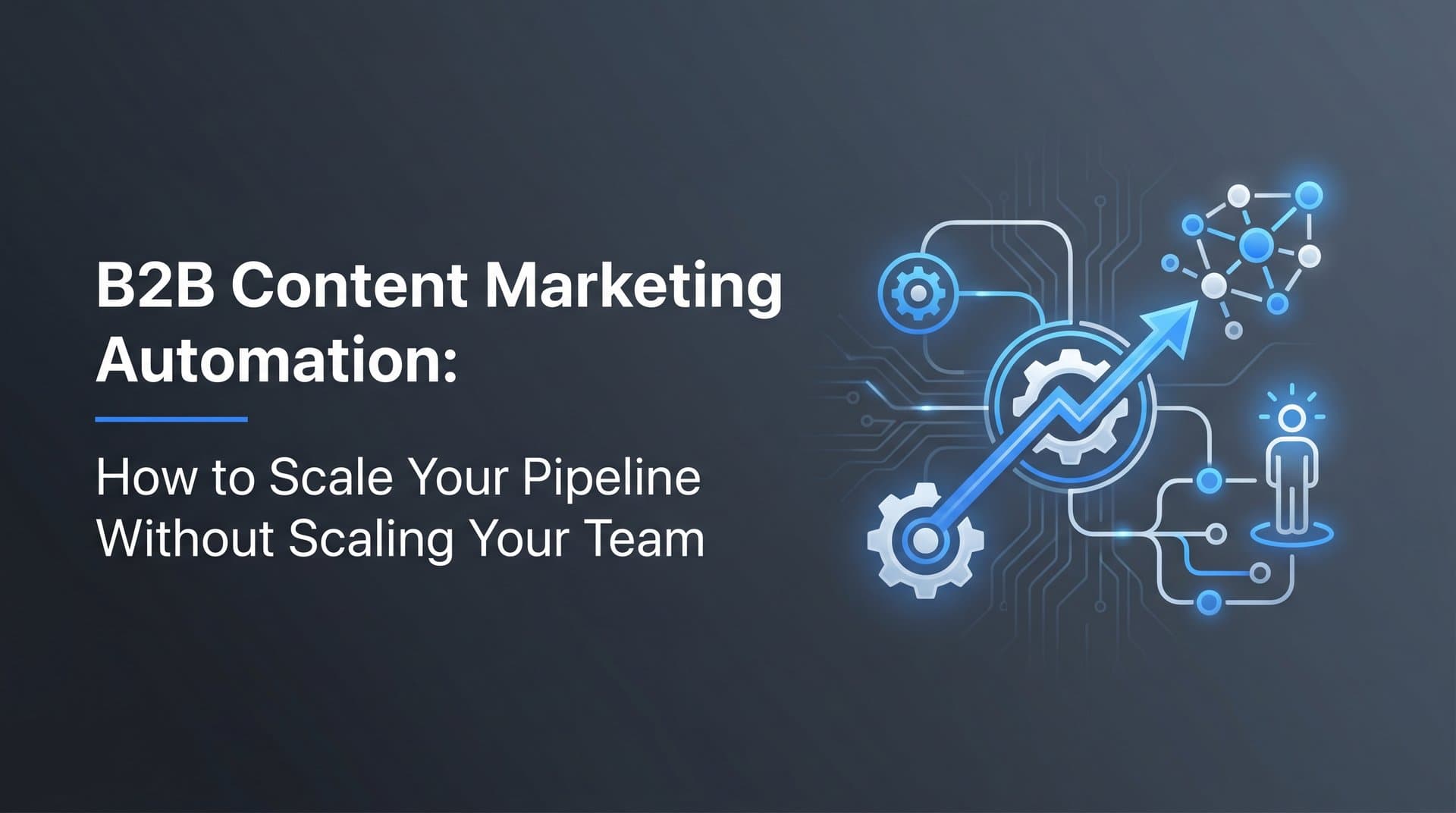
But here's the important framing: this is not a productivity hack. It's a capability shift. The teams that treat content automation as a way to "write more blog posts faster" will get marginal gains. The teams that treat it as a fundamental restructuring of how content strategy gets executed — connecting signal collection, AI-assisted creation, automated publishing, and AI visibility measurement into a closed loop — will build a compounding organic growth engine that their competitors will struggle to replicate.
This article breaks down exactly how that works. You'll learn why manual content workflows hit a ceiling, what a modern content automation stack actually looks like, how to serve both traditional SEO and Generative Engine Optimization simultaneously, and where human judgment remains irreplaceable. By the end, you'll have a clear picture of how to implement this without sacrificing the quality or brand voice that makes your content worth reading in the first place.
Why SaaS Content Teams Hit a Scaling Wall
The content surface area that a growth-stage SaaS company needs to cover is genuinely enormous. Think about what a complete content program actually requires: keyword-targeted blog articles across your entire topic cluster, comparison pages for every major competitor, alternative pages for branded search terms, feature explainers for every core use case, integration pages for every tool in your ecosystem, and now GEO-optimized content structured to surface in AI-generated answers. That's not a content calendar — that's a publishing operation.
Manual workflows simply cannot keep pace with that demand. A small content team might realistically produce four to eight well-researched articles per month. But building genuine topical authority in a competitive SaaS category often requires publishing dozens of related pieces across a topic cluster, maintaining freshness on existing pages, and continuously filling competitive gaps as rivals publish new content. The math doesn't work without automation.
The cost of inconsistency compounds quickly. When publishing frequency drops because the team is stretched, several things happen simultaneously. Search engines see lower crawl signals, which can slow ranking momentum. Topical authority erodes because the cluster of content that signals expertise to Google becomes incomplete. And perhaps most importantly in 2026: AI models like ChatGPT, Claude, and Perplexity have less of your content to reference when generating answers to questions in your category. If your brand isn't consistently publishing authoritative content, it's less likely to be cited. Visibility in AI-generated answers is increasingly a function of content volume and quality, and inconsistent publishing directly undermines both.
There's also a significant opportunity cost that rarely gets measured explicitly. Every hour a founder or senior marketer spends on manual content tasks — briefing writers, editing drafts, updating meta descriptions, manually submitting URLs for indexing — is an hour not spent on strategy, distribution, partnerships, or product. The activities that actually require human judgment get crowded out by execution work that automation can handle.
Content automation reclaims that time. Not by producing lower-quality output, but by handling the execution layer so that human attention can concentrate on the decisions that actually require it: setting the strategic narrative, identifying differentiation angles, and reviewing AI-generated drafts for brand alignment rather than writing from scratch. That's a fundamentally different use of a content team's capacity.
The Core Components of a Content Automation Stack
A mature SaaS marketing content automation system isn't a single tool — it's a connected stack of capabilities that covers three distinct layers. Understanding these layers separately helps you evaluate what you have, what you're missing, and where the biggest leverage points are.
The Content Intelligence Layer: This is the foundation, and it's where most teams underinvest. Content intelligence means automated keyword research, topic clustering, and competitive gap analysis that continuously surfaces what to write next. Instead of a marketer spending hours in spreadsheets identifying opportunities, an automated system monitors search trends, tracks competitor content, and generates a prioritized queue of content briefs. The output is a clear editorial roadmap driven by data rather than gut instinct or whoever had the last meeting with the CEO.
Good content intelligence also incorporates AI prompt data — tracking what questions users are actually asking AI assistants in your category, and identifying the gaps where your brand isn't appearing in the answers. This is a newer signal that most teams aren't yet capturing, but it's increasingly important for GEO strategy.
The AI Content Generation Layer: This is where the actual content gets produced, and the distinction between generic AI tools and specialized AI-powered content marketing tools matters enormously here. A general-purpose language model can produce text. Specialized AI agents trained for specific content formats — listicles, explainers, comparison guides, product-led articles — understand the structural logic, optimization rules, and intent signals that make each format perform.
A comparison page has completely different structural requirements than a how-to explainer. A listicle optimized for AI citation needs different formatting than a long-form technical guide. Agents that understand these distinctions produce output that requires substantially less human revision than generic AI drafts. Sight AI's platform, for example, deploys 13+ specialized AI agents, each designed for a specific content format, which is why the output integrates naturally into a review-and-publish workflow rather than requiring a full rewrite.
The Publishing and Indexing Layer: This is the most underappreciated component of the stack. You can produce excellent content and still lose ranking momentum if that content sits unindexed for days or weeks after publication. Automated CMS publishing, XML sitemap updates, and IndexNow integration close the gap between publish and rank.
IndexNow is an open-source protocol supported by Microsoft Bing, Yandex, and other search engines that allows websites to instantly notify search engines when content is published or updated. Rather than waiting for a crawler to discover new pages on its own schedule, IndexNow pushes a notification the moment content goes live. For high-volume publishers, this can meaningfully accelerate the time-to-rank window. Combined with automated sitemap updates and indexing strategies that keep your site architecture current, this layer ensures that every piece of content your system produces gets discovered and evaluated as quickly as possible.
SEO and GEO: Two Mandates, One Automation System
For most of the past decade, SaaS content teams optimized for one thing: ranking in Google. Keyword research, on-page optimization, internal linking, backlink acquisition — the entire discipline of SEO was oriented toward the ten blue links. That work still matters. Organic search remains a primary acquisition channel for most SaaS companies, and traditional SEO fundamentals haven't disappeared.
But in 2026, a growing share of your buyers' research happens in AI-generated answers. Someone asks ChatGPT to compare project management tools. Someone asks Claude to explain the difference between two analytics platforms. Someone asks Perplexity which marketing automation tools are worth evaluating. These queries don't return a list of links — they return synthesized answers that either mention your brand or don't. And the content that gets cited in those answers follows different rules than the content that ranks in Google.
Generative Engine Optimization, or GEO, is the emerging discipline of structuring content so AI models retrieve and cite it. The key structural elements are distinct from traditional SEO: clear entity definitions that help AI models understand what your product is and how it relates to a category, FAQ-style formatting that directly answers the questions AI retrieval systems are processing, authoritative sourcing that signals credibility to models trained to prefer high-quality references, and content that answers questions the way users actually phrase them to AI assistants.
Critically, GEO and SEO are not in conflict. A well-structured article that clearly defines entities, answers questions directly, and establishes topical authority will tend to perform well in both contexts. The automation challenge is producing SEO content writing at scale through automation that satisfies both sets of requirements simultaneously, rather than optimizing for one at the expense of the other.
A mature content automation system handles this by building GEO requirements directly into the content templates and agent instructions. Authoritative definitions, structured Q&A sections, and entity clarity become default outputs rather than manual additions. The result is content that ranks in Google and surfaces as brand mentions in AI-generated responses — and the performance on both dimensions becomes measurable through AI visibility tracking tools that monitor how often and how favorably your brand appears across AI platforms.
This dual optimization is where the strategic gap between SaaS teams using automation thoughtfully and those still running manual workflows is widening fastest. Teams that are only tracking Google rankings are missing half the picture of where their buyers are actually finding them.
Building an Automated Content Workflow: Stage by Stage
Understanding the components is useful. Knowing how they connect in practice is what makes implementation possible. A complete SaaS marketing content automation workflow moves through three stages, each feeding into the next in a continuous loop.
Stage 1: Signal Collection and Brief Generation
The workflow starts with data, not with writing. Automated systems monitor search trends, analyze competitor content gaps, track AI prompt data to identify what questions are being asked in your category, and generate a prioritized queue of content briefs. Each brief includes the target keyword, the recommended content format, the competitive context, and the GEO signals — the questions and entity relationships the content needs to address to perform in AI-generated answers.
This stage removes the most time-consuming part of manual content operations: research and planning. Instead of a marketer spending a day building a content calendar, the system surfaces a ranked list of opportunities with supporting data. Human judgment enters here to review priorities, adjust for strategic initiatives, and ensure the queue reflects brand positioning — but the raw research is automated.
Stage 2: AI-Assisted Creation and Human Review
With a brief in hand, the appropriate specialized AI agent drafts the content using format-specific templates and brand voice guidelines. The draft arrives structured, optimized, and ready for review — not as a rough starting point that needs to be rebuilt, but as a substantive first draft that a human reviewer can evaluate for strategic accuracy and brand alignment.
This changes the nature of the human role in content production. Instead of writing from scratch, reviewers are making editorial judgments: does this accurately represent our product? Does the tone match our brand? Are there strategic angles this draft missed? That's a fundamentally faster and higher-leverage use of time. Autopilot content marketing systems, available in platforms like Sight AI, take this further by allowing fully automated publishing for content types and formats where the team has established sufficient confidence in the output quality.
Stage 3: Auto-Publish, Index, and Measure
Once approved, content is pushed directly to the CMS, sitemaps are updated automatically, and IndexNow notifies search engines for immediate crawling. The content enters the index as quickly as technically possible, maximizing the window for ranking and AI citation.
Performance data then feeds back into Stage 1. Which topics drove traffic? Which articles are generating AI mentions? Which formats are earning backlinks? This feedback loop means the system improves over time — the content queue becomes more accurate, the briefs become more targeted, and the overall ROI of the automation stack compounds with each cycle.
Where Human Judgment Stays Essential
Content automation is a powerful execution layer. It is not a strategy layer. The distinction matters, and teams that blur it tend to produce high-volume, low-differentiation content that performs adequately but never breaks through. There are three areas where human involvement isn't optional — it's the source of competitive advantage.
Strategic Narrative and Brand Positioning: Automation executes the content strategy that humans define. The topical authority roadmap — which clusters to own, which competitive angles to emphasize, which narratives to build over time — requires human judgment about market positioning, competitive differentiation, and long-term brand perception. An AI agent can write an excellent comparison page, but it cannot decide whether competing on price, depth, or ease of use is the right strategic choice for your brand. That decision shapes every piece of content and has to come from people who understand the business.
Original Research and Proprietary Insights: AI-generated content that cites real, owned data — customer surveys, product usage trends, original analysis — earns meaningfully more backlinks and AI citations than generic content covering the same topic. This is a durable human-led advantage. Proprietary data is, by definition, something no automation system can generate on its own. Investing in original research, even at a modest scale, creates content assets that are both more credible and more likely to be cited by AI models looking for authoritative sources.
Relationship-Driven Content: Customer stories, expert interviews, thought leadership pieces, and co-created content require human trust, judgment, and editorial craft. These formats are not just stylistically different from automated content — they serve a different function. They build brand credibility, generate genuine backlinks, and create the kind of social proof that influences buyers at the consideration stage. No automation layer replicates this at quality. The goal is not to automate everything — it's to automate the execution work so that humans have more capacity for the relationship-driven content marketing strategies that automation cannot produce.
Measuring What Your Automation System Is Actually Delivering
A content automation system without measurement is just a content production machine. The closed loop — where performance data feeds back into the content queue — only works if you're tracking the right metrics across both the traditional SEO and AI visibility dimensions.
On the traditional SEO side, the core metrics remain familiar: organic traffic growth, keyword ranking velocity, indexed page count, and crawl frequency. The automation layer has a direct impact on several of these. Faster indexing through IndexNow and automated sitemap updates shortens the time between publication and ranking opportunity. Higher publishing frequency accelerates topical authority building. More comprehensive cluster coverage improves the internal linking structure that distributes page authority across the site.
The emerging measurement frontier is AI visibility. This means tracking how often your brand appears in AI-generated answers, which prompts and question types trigger your brand mentions, and how the sentiment of those mentions trends over time across different AI platforms. Most SaaS teams are not yet tracking this systematically, which means the teams that start now are building a measurement advantage that will matter more as AI search continues to grow.
Sight AI's AI Visibility Score provides exactly this kind of tracking — monitoring brand mentions across ChatGPT, Claude, Perplexity, and other AI platforms, with sentiment analysis and prompt-level data that shows not just whether you're mentioned, but how and in what context. This is the layer that closes the loop between your GEO-optimized content and actual AI citation performance.
The long-term ROI case for content automation rests on compounding. Unlike paid channels where value stops when spend stops, well-optimized content continues to drive traffic and AI mentions for months and years after publication. Each article in the system has a per-asset ROI that improves continuously over its lifetime. At scale, a content automation system built for measurable ROI that publishes consistently and optimizes for both SEO and GEO creates a compounding asset base that becomes increasingly difficult for competitors to replicate through manual effort alone.
The Strategic Shift Worth Making
SaaS marketing content automation is not about replacing marketers. It's about removing the manual bottlenecks that prevent great strategy from being executed at scale. The teams that understand this distinction will use automation to do more of what humans are actually good at — setting direction, building relationships, creating original insights — while the execution layer runs with far greater speed and consistency than any manual workflow can achieve.
The dual mandate of SEO and GEO is not going away. If anything, the pressure to perform in both traditional search and AI-generated answers will intensify as AI assistants become a more central part of how buyers research SaaS products. Building an automation system that serves both simultaneously is not a future consideration — it's a present competitive requirement.
The good news is that the infrastructure to do this exists now. Signal collection, specialized AI agents, automated publishing, IndexNow indexing, and AI visibility tracking can all be connected into the kind of closed-loop system described in this article. The question is whether your team builds that system intentionally or continues to operate a manual workflow that will fall further behind with every passing quarter.
Stop guessing how AI models like ChatGPT and Claude talk about your brand. Sight AI's all-in-one platform combines AI visibility tracking across 6+ AI platforms, 13+ specialized content agents for SEO and GEO-optimized content, and automated indexing with IndexNow integration — everything you need to run a scalable, AI-optimized content operation. Start tracking your AI visibility today and see exactly where your brand appears across top AI platforms.