Every SaaS marketer knows the feeling: Monday morning, the editorial calendar is staring back at you, and the gap between what needs to be published and what the team can realistically produce feels wider than ever. You need blog posts, landing pages, topic cluster articles, comparison pages, and explainers — all optimized, all indexed, all live yesterday. And yet the process of getting a single article from idea to indexed page can take days, sometimes weeks, when you factor in research, writing, SEO review, internal linking, formatting, CMS upload, and submission.
This is the content production ceiling that most SaaS teams hit eventually. And it's not a people problem. It's a systems problem.
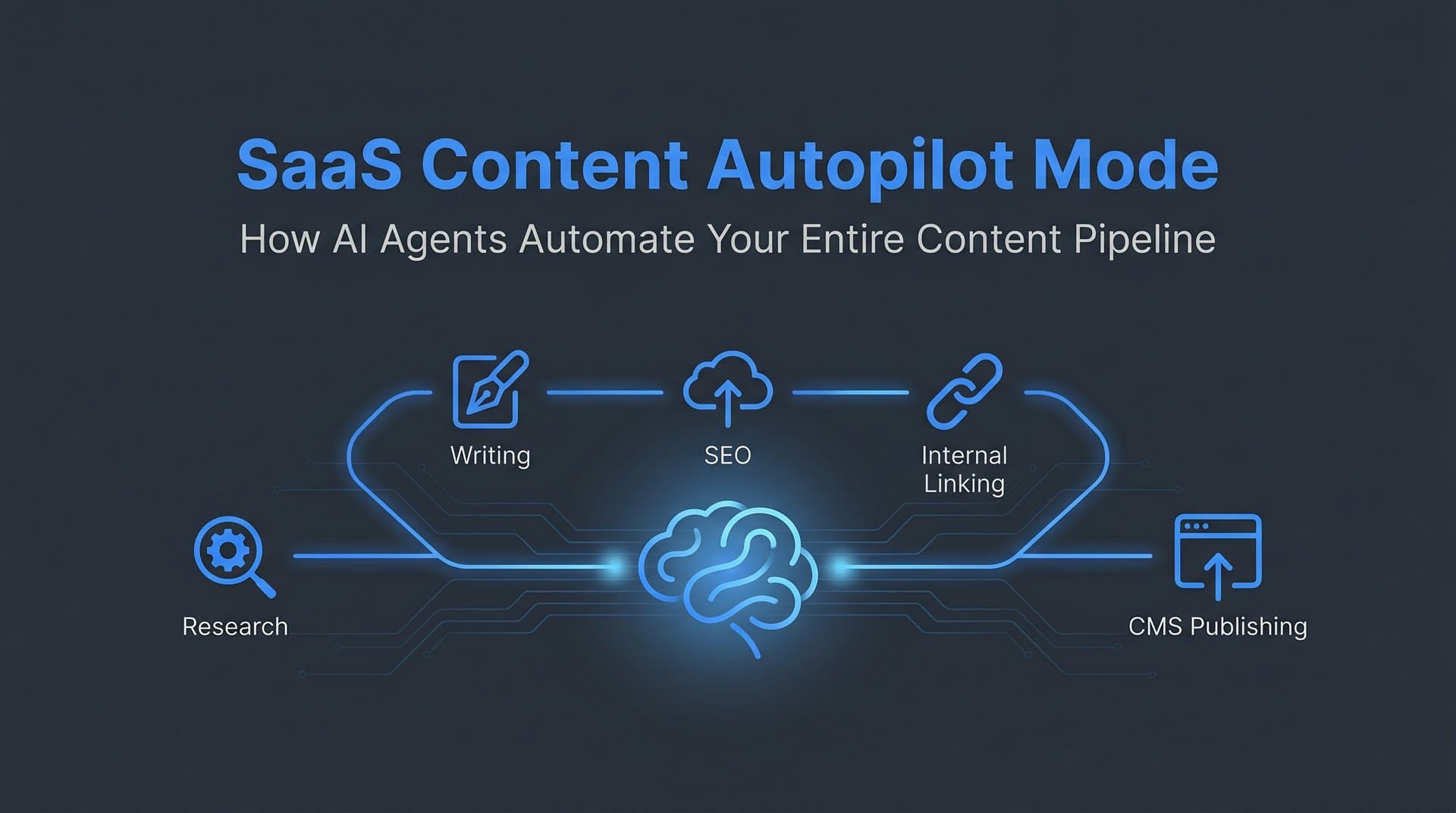
SaaS content autopilot mode is the answer to that systems problem. Rather than relying on a chain of humans (or a mix of humans and basic AI writing tools) to manually execute each step, autopilot mode deploys specialized AI agents that collaborate across the entire content pipeline: from topic discovery and keyword research through writing, optimization, CMS publishing, and automatic indexing. The result is a workflow that operates at machine speed without sacrificing the strategic intent behind your content.
This article breaks down exactly what SaaS content autopilot mode is, how the multi-agent pipeline works stage by stage, what the agents actually handle on the SEO and GEO side, how to measure impact, and how to get started without overwhelming your team. If you're serious about organic traffic growth and AI visibility in 2026, this is the operating model worth understanding.
Why Traditional Content Workflows Are Breaking Down
The volume problem is real and getting worse. To build topical authority in a competitive SaaS niche, you typically need consistent publishing across multiple content types: foundational pillar pages, supporting cluster articles, feature explainers, comparison posts, and use-case guides. Most content teams can realistically produce a handful of polished articles per week when working manually. But the threshold for meaningful topical authority often demands publishing cadences that far exceed what manual processes can sustain.
Every stage of the traditional workflow introduces a bottleneck. Keyword research requires a dedicated tool and someone who knows how to interpret the data. Outlining requires strategic thinking about structure and search intent. Writing requires time and skill. Optimization requires SEO knowledge that many writers don't have. Internal linking requires familiarity with the existing content library. Publishing requires CMS access and formatting discipline. Indexing often gets forgotten entirely, leaving new content invisible to search engines for days or weeks.
Then there's the optimization gap. Writing content is genuinely only half the battle. On-page SEO, generative engine optimization (GEO) for AI search platforms, metadata, schema markup, and technical indexing all require specialized knowledge that most generalist writers lack. And even when you have the expertise on the team, applying it consistently across every piece of content at scale is a different challenge altogether. Many teams turn to automated SEO content writing tools to close this gap.
The GEO dimension: In 2026, optimizing content for traditional search engines is no longer sufficient on its own. AI-powered platforms like ChatGPT, Claude, Perplexity, and Google AI Overviews increasingly shape how users discover brands and products. Content that isn't structured for AI model comprehension and citation is invisible in this growing discovery channel, regardless of how well it ranks on a traditional SERP.
The cost of delay: Every day a finished article sits in a Google Doc waiting for someone to upload it, format it, add metadata, and submit it for indexing is a day of lost organic traffic. Manual workflows routinely introduce days or weeks of lag between the moment a topic is identified and the moment it becomes live, crawlable content. In competitive categories, that lag has real consequences for keyword rankings and topical authority.
The traditional workflow wasn't designed for the volume, speed, or multi-channel optimization demands of modern SaaS content marketing. Autopilot mode is.
What Autopilot Mode Actually Means in a SaaS Content Context
The term "autopilot" gets thrown around loosely, so let's be precise. SaaS content autopilot mode refers to an end-to-end automated content workflow where multiple specialized AI agents collaborate to research topics, generate SEO and GEO-optimized articles, build internal links, and publish directly to a CMS — all triggered by a single prompt or a scheduled cadence. The human sets the strategy and the guardrails; the agents execute the production.
This is fundamentally different from basic AI writing tools, and the distinction matters. When you use a standard AI writing assistant, it generates a draft. You then manually edit that draft, run it through an SEO tool, add internal links, format it for your CMS, write the meta description, upload it, set the slug, and eventually submit it for indexing. The AI handled maybe thirty percent of the work. The rest is still on you.
Autopilot mode handles the entire pipeline, including the post-publication tasks that most teams consistently neglect. When an article is published in autopilot mode, it doesn't just appear in your CMS. It also triggers an IndexNow submission to notify search engines of the new content, updates your sitemap automatically, and logs the new URL in your content library so future internal linking agents can reference it. The workflow doesn't stop at "published." It runs all the way through to "discoverable." This is what distinguishes true autopilot content publishing from simple AI-assisted drafting.
The agent-based architecture: The key architectural insight behind autopilot mode is that it doesn't rely on a single monolithic AI model trying to do everything. Instead, it uses specialized agents, each purpose-built for one discrete task in the pipeline. Think of it like a software engineering microservices pattern applied to content production.
A keyword research agent analyzes search data and content gaps to identify high-priority topics. A content structuring agent builds an outline optimized for search intent and GEO readability. Specialized writing agents generate different content formats: listicles, guides, explainers, comparison pages. An SEO optimization agent reviews keyword placement, heading structure, and metadata. An internal linking agent scans the existing content library and inserts contextually relevant links. A publishing agent formats the content and pushes it to the CMS. An indexing agent submits the URL via IndexNow and updates the sitemap.
Each agent is good at its specific job in a way that a generalist model trying to do everything simultaneously typically isn't. The result is higher quality output at each stage of the pipeline, not just faster output.
Sight AI's Autopilot Mode is built on exactly this architecture, deploying 13+ specialized AI agents that collaborate across the content production pipeline to generate SEO and GEO-optimized articles at scale. The agents handle the execution; your team retains control over strategy, brand voice guidelines, and approval decisions.
Inside the Autopilot Pipeline: From Topic Discovery to Live Content
Understanding autopilot mode at a conceptual level is useful. Understanding what actually happens at each stage of the pipeline is what lets you evaluate whether it fits your workflow and trust the output it produces. Here's how a complete autopilot content run works from start to finish.
Stage 1: Topic and keyword identification. The pipeline begins with a research agent that analyzes your existing content library, identifies topical gaps, and surfaces keyword opportunities based on search intent and competitive landscape. In more sophisticated implementations, this stage also incorporates AI visibility data: insights into how AI models currently discuss your brand, what questions they answer about your category, and which topics would improve your brand's mention frequency across platforms like ChatGPT and Perplexity. This means autopilot mode doesn't just produce content for traditional SEO — it produces content strategically designed to improve your AI visibility score.
Stage 2: Outline generation. A structuring agent takes the identified topic and keyword and builds an article outline optimized for both search intent and GEO readability. This includes heading hierarchy, section sequencing, FAQ placement, and entity definitions that make the content easy for AI models to parse and cite. The outline stage is where the strategic shape of the content gets established before a single paragraph is written. Understanding how AI models select content sources directly informs how these outlines are structured.
Stage 3: Draft creation. Specialized writing agents generate the actual content based on the approved outline. Different agents handle different content formats: a listicle agent structures content differently than an explainer agent or a comparison guide agent. This format-specific specialization produces content that reads appropriately for its type rather than generic AI output that needs heavy editing.
Stage 4: Optimization pass. Before publishing, a dedicated SEO optimization agent reviews the draft for keyword placement, heading structure, meta description quality, internal link opportunities, and AI search readiness. This isn't a simple keyword density check — it's a structured review that applies optimization logic consistently across every piece of content, regardless of volume.
Stage 5: CMS publishing. A publishing agent formats the content with proper HTML structure, populates metadata fields, sets the canonical URL, and pushes the article directly to your CMS. No manual copy-paste, no formatting inconsistencies, no missed metadata fields. Teams evaluating their options can compare leading content publishing software to find the right fit for their stack.
Stage 6: Indexing and sitemap update. Immediately after publishing, an indexing agent submits the new URL via IndexNow, notifying Bing and other participating search engines of the new content. The sitemap is updated automatically so Google and other crawlers can discover the page during their next crawl cycle. New content becomes discoverable within hours rather than the days or weeks typical of manual workflows.
Quality controls and human-in-the-loop options: Autopilot doesn't mean zero oversight, and it shouldn't. Most implementations allow for review checkpoints at key stages: you might approve the topic list before writing begins, review the outline before the draft is generated, or set a post-draft approval gate before publishing. The goal is to remove the manual execution burden, not to remove human judgment from the strategic decisions that define your brand's content quality.
SEO and GEO Optimization on Autopilot: What the Agents Handle
Optimization is where the gap between basic AI writing tools and true autopilot mode becomes most visible. Writing a draft is relatively straightforward for any capable AI model. Consistently applying sophisticated SEO and GEO optimization logic across dozens of articles per week, without manual intervention, is a different challenge entirely.
On-page SEO automation: Dedicated optimization agents handle keyword placement within headings and body copy, heading hierarchy and H-tag structure, meta title and description generation, readability scoring, and schema markup suggestions. These tasks are applied consistently to every piece of content that moves through the pipeline. There's no version where an article gets published without a meta description because someone forgot to write one, or where keyword placement is inconsistent because different writers have different habits. The agents apply the same optimization logic every time. This level of consistency is what separates basic tools from purpose-built SEO content automation software.
GEO optimization for AI search: This is the dimension that most content workflows haven't yet systematized, and it's increasingly important. GEO (Generative Engine Optimization) refers to structuring content so that AI models can easily parse, cite, and recommend your brand in their responses. The optimization logic here is different from traditional SEO: it prioritizes clear entity definitions, FAQ-style formatting that maps directly to common user queries, authoritative sourcing patterns, and structured answers that AI models can extract and surface without ambiguity. For a deeper dive into the tactical side, explore how to optimize content for AI models effectively.
When an autopilot optimization agent applies GEO logic to a piece of content, it's not just making the article rank better on a traditional SERP. It's increasing the probability that when a user asks ChatGPT or Perplexity a question in your category, your brand gets mentioned in the response. That's a fundamentally different and increasingly valuable form of organic visibility.
Automated internal linking: One of the most consistently neglected aspects of on-page SEO is internal linking, and it's easy to understand why. Doing it well requires familiarity with your entire existing content library and the discipline to insert relevant links into every new article you publish. An internal linking agent solves this by scanning your content library at publish time and inserting contextually relevant links into the new article, as well as flagging opportunities to update existing articles to link to the new content. This builds topical authority through link architecture rather than leaving it to chance.
Technical indexing speed: The IndexNow protocol integration means new content isn't just published — it's immediately surfaced to participating search engines. Combined with automated sitemap updates, this compresses the time between "published" and "discoverable" from the multi-day or multi-week lag typical of manual workflows to a matter of hours. For SaaS brands publishing at high volume, this indexing speed advantage compounds significantly over time.
Measuring the Impact: KPIs That Matter for Autopilot Content
Adopting autopilot mode without a measurement framework is a missed opportunity. The performance of an automated content pipeline should be evaluated against specific KPIs that capture both the operational efficiency gains and the downstream impact on organic traffic and AI visibility.
Content velocity: The most immediate metric is how many optimized articles move from idea to indexed page per week or per month. Autopilot mode typically compresses this timeline dramatically compared to manual workflows, and tracking velocity over time shows whether the pipeline is operating efficiently and scaling as expected. This is your operational health metric. Teams looking to maximize this metric often evaluate dedicated content production platforms that integrate directly with their autopilot workflows.
Time-to-index: Track how long it takes from the moment an article is published to the moment it appears in search engine indexes. With IndexNow integration and automated sitemap updates, this should be measurable in hours. If it's still taking days, something in the technical pipeline needs attention. Faster indexing means faster ranking signals and faster organic traffic.
AI visibility score and sentiment tracking: This is a newer KPI that directly measures whether your content strategy is influencing AI-generated answers. An AI visibility score tracks how frequently and favorably AI models like ChatGPT, Claude, and Perplexity mention your brand in response to relevant prompts. As your autopilot-generated, GEO-optimized content accumulates, you should see this score improve over time. Sentiment tracking adds a qualitative dimension: not just whether you're mentioned, but how you're described.
Sight AI's platform provides exactly this kind of AI visibility tracking, monitoring brand mentions across six or more AI platforms and surfacing sentiment analysis and prompt tracking data that tells you where your content strategy is working and where gaps remain.
Organic traffic and keyword ranking trends: Standard SEO metrics remain essential. Track organic traffic growth for autopilot-generated content, keyword ranking improvements over time, and click-through rates from search results. The goal is to validate that automated content performs on par with or better than manually created content — and in most cases, the consistency of optimization applied by dedicated agents produces content that performs well precisely because it doesn't have the quality variation that manual workflows introduce. For a broader look at aligning content output with business goals, review modern content strategies for growth teams.
Getting Started with Content Autopilot
Autopilot mode is powerful, but jumping in without preparation leads to content that doesn't reflect your brand and metrics that don't tell you anything useful. A structured approach to getting started makes the difference between a successful deployment and a frustrating one.
The readiness checklist: Before enabling autopilot mode, your team needs a clear content strategy with defined topic clusters and target audiences, documented brand voice guidelines that the system can reference, a CMS integration that supports automated publishing, and baseline performance data to measure against. Without these inputs, the agents have no strategic context to work within, and you have no benchmark to evaluate results against.
Start with a focused pilot: Rather than automating your entire content operation immediately, begin with a specific content type and a defined topic cluster. Explainer articles and listicles are good starting points because they have clear structural patterns that agent-based systems handle well. Run the pilot for four to six weeks, evaluate quality against your brand standards, measure performance against your baseline, and then expand the scope based on what you learn. This iterative approach builds confidence in the system and gives you real data to justify broader adoption.
The competitive advantage of speed: In 2026, the SaaS brands winning organic traffic and AI visibility are those publishing optimized content fastest. Topical authority compounds: the more high-quality, well-optimized content you have indexed on a topic cluster, the stronger your ranking signals become, and the more likely AI models are to recognize you as an authoritative source in your category. Autopilot mode isn't about replacing human strategy. It's about executing that strategy at machine speed, without the bottlenecks, delays, and inconsistencies that manual workflows inevitably introduce.
The brands that adopt autopilot workflows now are building a compounding advantage that will be difficult for slower-moving competitors to close. Every week of optimized, indexed content is a week of ranking signals, backlink opportunities, and AI mention data that accumulates in your favor.
SaaS content autopilot mode represents a genuine shift in how content gets made: from a manual craft that scales linearly with headcount to a systematic, automated operation that scales with strategy. The human role doesn't disappear — it elevates. Your team focuses on the decisions that require judgment: which topics to prioritize, what positioning to take, how to evolve the strategy based on performance data. The agents handle the execution, consistently and at scale.
The brands that will dominate both traditional search rankings and AI model citations over the next few years are those that treat content production as a system rather than a series of individual creative acts. Autopilot mode is how you build that system.
Start tracking your AI visibility today and see exactly where your brand appears across top AI platforms — then use those insights to fuel an autopilot content strategy that compounds your organic presence week over week.