Your marketing team spent three hours yesterday researching competitors, two hours outlining a product guide, and another four hours drafting and optimizing it for search. By the time you hit publish, you're already behind on next week's content calendar. Meanwhile, your competitors are publishing daily, your keyword gaps keep growing, and your content backlog looks more like a graveyard than a pipeline.
This is the reality for most marketing teams: spending over 60% of their time on repetitive content tasks that follow predictable patterns. Research the topic. Build an outline. Draft the content. Optimize for SEO. Format for publishing. Repeat. The work isn't particularly creative—it's just relentlessly time-consuming.
Content generation autopilot mode changes this equation entirely. Instead of manually shepherding every article through each production stage, you configure an autonomous system that handles the entire pipeline—from identifying content opportunities to publishing optimized articles—while you focus on strategy, brand positioning, and high-stakes content that genuinely requires human insight. This isn't AI-assisted writing where you prompt and polish. This is autonomous content infrastructure that operates continuously, maintaining your publishing velocity even when your team is focused elsewhere.
How Autonomous Content Systems Actually Work
The difference between standard AI writing tools and content generation autopilot mode comes down to orchestration. When you use a typical AI writing assistant, you're essentially having a conversation: you provide a prompt, the AI generates text, you review and refine, then prompt again for the next section. It's collaborative, but it's still manual. You're the project manager for every single piece of content.
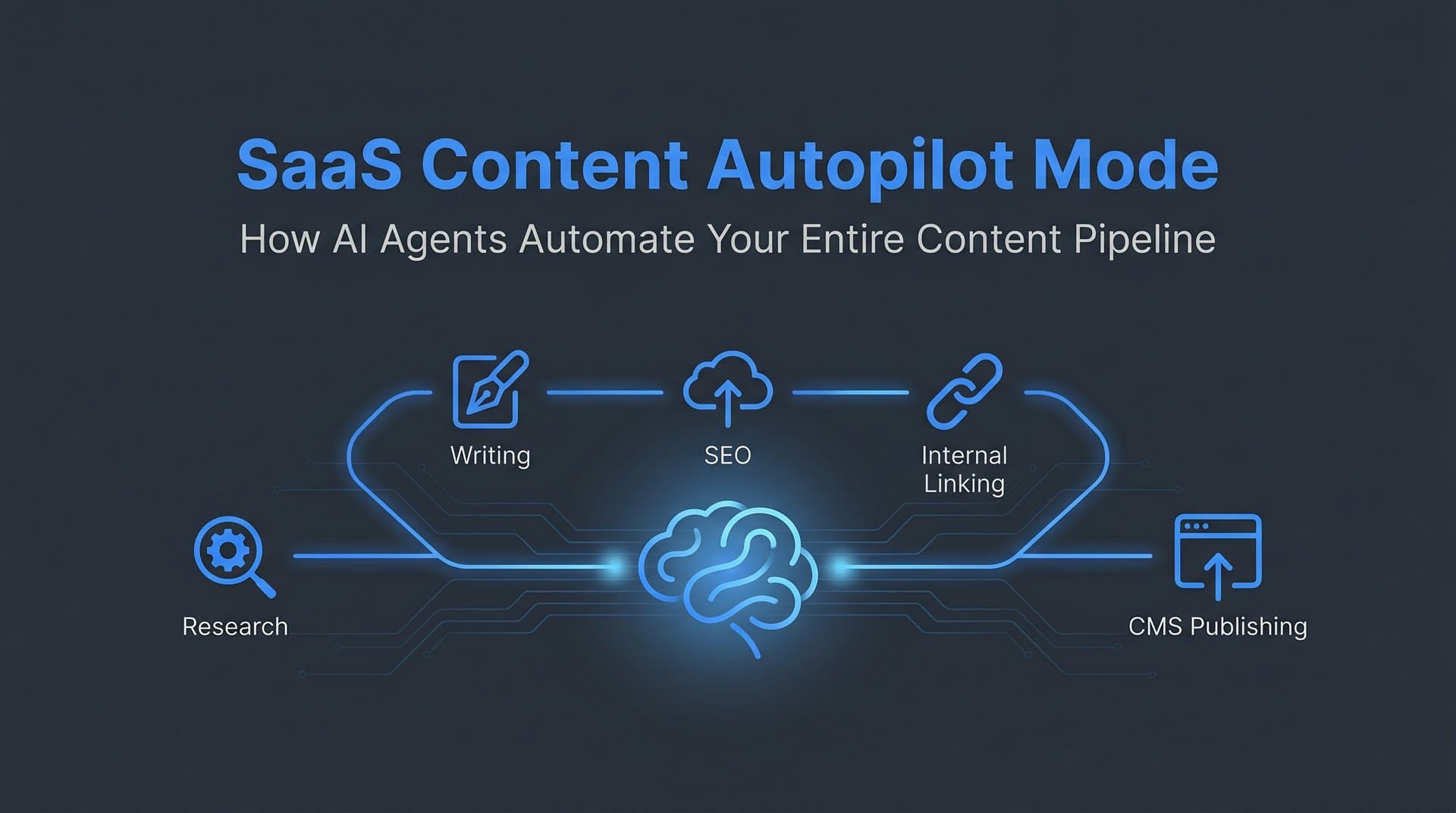
Autopilot systems flip this model. Instead of one generalized AI waiting for your instructions, you're working with multiple specialized agents that handle discrete workflow stages autonomously. One agent identifies content opportunities by analyzing keyword gaps and search trends. Another compiles research from authoritative sources. A third generates structurally sound outlines based on top-performing content patterns. A fourth drafts sections while maintaining brand voice consistency. A fifth optimizes for SEO and GEO discoverability. A sixth handles formatting and publishing logistics.
Each agent operates with specific parameters you've configured—your brand voice guidelines, target keyword lists, structural preferences, tone requirements—but executes its task without requiring prompt-by-prompt supervision. The system moves content through stages automatically, applying quality checks at each transition point. Understanding how SEO content generation with AI agents works helps clarify this multi-agent architecture.
Think of it like the difference between manually driving a car versus engaging cruise control with lane-keeping assistance. You're still responsible for the destination and major navigation decisions, but the system handles the continuous micro-adjustments that would otherwise demand constant attention.
The workflow typically progresses through six core stages. First, topic identification analyzes your keyword strategy and content gaps to determine what to write next. Second, research compilation gathers relevant information from credible sources without fabricating data. Third, outline generation structures the article based on search intent and content performance patterns. Fourth, draft creation produces complete sections with appropriate depth and examples. Fifth, SEO optimization ensures proper keyword integration, meta descriptions, and discoverability signals. Sixth, publishing automation handles formatting, CMS integration, and indexing protocols.
Where do humans fit into this pipeline? That depends on your content strategy and risk tolerance. Some teams configure fully automated workflows where content moves from topic identification to publication without human intervention—ideal for high-volume programmatic SEO where individual article stakes are relatively low. Other teams set review checkpoints at critical stages: approving topics before research begins, reviewing outlines before drafting, or conducting final quality checks before publication.
The key insight is that autopilot mode doesn't eliminate human judgment—it concentrates it at decision points that genuinely benefit from human expertise, rather than spreading it across every repetitive task in the content production process.
Identifying the Right Content for Automation
Not all content belongs in an autopilot pipeline. The decision isn't about whether AI can technically produce the content—it's about where automation creates strategic value versus where human involvement is non-negotiable.
Autopilot mode excels in scenarios where you need consistent, high-volume output following established patterns. Programmatic SEO campaigns targeting hundreds of related keywords are ideal candidates. If you're building content for every city where your service operates, or creating comparison guides for every product category you cover, autopilot systems can maintain quality while scaling far beyond what manual production allows. The content follows predictable structures, draws from similar research sources, and serves clear search intent.
Content scaling during resource constraints is another strong use case. When your team is focused on a product launch, major campaign, or strategic initiative, autopilot mode keeps your publishing velocity steady without pulling resources away from high-priority work. Teams exploring AI content generation at scale often start here before expanding to broader implementation.
Maintaining competitive publishing frequency also drives autopilot adoption. If competitors in your space publish daily and you're struggling to maintain a weekly schedule, the gap compounds quickly. Autopilot systems help you match or exceed competitor velocity without proportionally increasing headcount or budget.
But some content categories require human oversight from start to finish. Thought leadership pieces that define your brand's perspective on industry trends shouldn't be automated—they're strategic assets that demand original thinking and nuanced positioning. Content addressing sensitive topics, controversial issues, or complex ethical questions needs human judgment at every stage. Brand-defining content like your company's origin story, core value propositions, or major announcements should always involve direct human authorship.
The smartest approach for many teams is hybrid: using autopilot for first drafts while reserving human polish for high-stakes pieces. Let the system handle research, structure, and initial drafting for important content, then have your team refine messaging, add unique insights, and ensure the final piece meets your highest standards. Understanding the tradeoffs in AI content generation vs manual writing helps you make these allocation decisions strategically.
The question isn't whether to use autopilot mode—it's where in your content mix it creates the most value. Map your content types by volume requirements and strategic importance, then allocate automation accordingly.
Building Quality into Automated Workflows
The biggest concern with content generation autopilot mode is quality degradation. If you're not reviewing every article manually, how do you ensure the output meets your standards? The answer lies in building quality controls directly into the workflow rather than relying solely on post-production review.
Modern autopilot systems include multiple safeguard layers. Plagiarism detection runs automatically on every draft, flagging any content that matches existing published material above acceptable similarity thresholds. This isn't just about avoiding copied text—it's about ensuring your content provides unique value rather than rehashing what already exists.
Fact verification layers are critical for maintaining credibility. The system should flag any statistical claims, company examples, or "according to" statements that lack proper attribution. If an agent attempts to include data without a verifiable source, the content either gets flagged for human review or the claim gets removed automatically. This prevents the common AI failure mode of generating plausible-sounding but completely fabricated statistics.
Brand voice consistency is maintained through configurable style guidelines that govern tone, terminology, sentence structure, and formatting preferences. You define what "professional but approachable" means for your brand—specific phrases to use or avoid, preferred analogies, acceptable humor levels—and the system applies these parameters across all generated content. Following AI content generation best practices ensures your automated output sounds distinctly like your brand rather than generic AI writing.
Setting content parameters upfront prevents quality issues before they occur. You specify target keyword density ranges to avoid over-optimization, structural requirements like minimum section lengths or maximum paragraph sizes, and formatting standards for headings, lists, and emphasis. The system generates content within these constraints rather than requiring post-production correction.
Review workflows determine when human oversight enters the pipeline. Scheduled human audits work well for lower-stakes content—reviewing every tenth article, or conducting weekly spot checks across recent publications. Exception-based review triggers are more efficient for high-volume operations: the system flags content that falls outside quality parameters (low readability scores, missing citations, off-brand language) for human review while allowing standard output to publish automatically.
The most sophisticated quality control comes from performance-based feedback loops. If autopilot-generated content consistently underperforms on engagement metrics or organic traffic compared to human-written pieces, those signals inform system refinements. You're not just hoping the output is good—you're measuring actual performance and using that data to improve future generations.
Calculating the Real Return on Automated Content
The business case for content generation autopilot mode comes down to three factors: time savings, performance outcomes, and cost efficiency. Understanding the ROI requires measuring all three, not just the obvious time-to-publish improvements.
Time-to-publish metrics reveal the most immediate impact. A typical manual content workflow—from topic research through final publication—takes 6-10 hours per article when you account for research, outlining, drafting, editing, SEO optimization, and publishing logistics. Autopilot systems compress this to minutes of configuration time plus automated execution. If you're producing 20 articles monthly, that's 120-200 hours of team time redirected to strategic work instead of repetitive content tasks.
But speed only matters if the content performs. Content performance tracking should measure organic traffic growth, engagement metrics like time-on-page and scroll depth, and conversion attribution for content that drives business outcomes. The relevant comparison isn't autopilot content versus perfect human-written pieces—it's autopilot content versus no content at all, or versus the lower-quality output you'd produce with limited resources.
Many teams find that autopilot-generated content performs 70-85% as well as carefully crafted human content on engagement metrics, but the volume advantage more than compensates. Publishing ten autopilot articles that each drive moderate traffic beats publishing two perfectly optimized human articles that drive slightly higher traffic per piece. The aggregate impact is what matters for organic growth.
Cost analysis reveals where autopilot mode creates the most dramatic savings. Agency content typically costs between $500-2000 per article depending on depth and expertise required. Freelancer rates run $200-800 per piece for quality work. At 20 articles monthly, you're spending $4,000-40,000 on content production alone. Reviewing AI content generation software pricing shows how autopilot subscription models typically cost a fraction of this—often under $500 monthly for unlimited generation—making the cost per article negligible as volume increases.
The hidden ROI comes from opportunity cost recovery. When your content team isn't spending 60% of their time on repetitive production tasks, they can focus on strategic initiatives: developing content strategies that drive business goals, creating high-stakes thought leadership pieces, optimizing existing content based on performance data, and building relationships with industry partners for collaborative content opportunities. This strategic capacity often delivers more business value than the direct cost savings from automation.
Calculate your current content costs honestly—including team time at fully loaded rates, not just external vendor spending—then model what doubling or tripling your content output would cost using traditional methods versus autopilot systems. The math typically becomes compelling quickly, especially for teams currently constrained by budget or bandwidth.
Launching Your First Automated Content Campaign
Starting with content generation autopilot mode doesn't require rebuilding your entire content operation. The smartest approach is to begin with a focused campaign that proves the model before expanding to broader implementation.
Define content parameters for your initial campaign with specificity. Identify 20-30 target keywords that follow similar patterns—perhaps all informational queries in a specific product category, or all location-based variations of a core service term. Specify the article type you'll generate: explainer guides, comparison posts, or how-to tutorials work well for first campaigns because they follow predictable structures. Set your publishing frequency based on your current capacity—if you're publishing twice weekly now, aim for daily publication with autopilot to demonstrate clear velocity improvement.
Your content parameters should include structural requirements that ensure consistency. Specify target word counts (2,500-3,500 words for comprehensive guides), required sections (introduction, 4-6 main sections, conclusion with CTA), heading hierarchy (H2 for main sections, H3 for subsections), and formatting standards (paragraph length limits, list formatting preferences). Teams producing long form content find these structural parameters especially critical for maintaining quality across high volumes.
Integration requirements determine how smoothly content flows from generation to publication. CMS connections allow direct publishing without manual content transfer—the system generates the article, formats it correctly, and publishes it to your website automatically. Indexing automation through protocols like IndexNow ensures search engines discover your new content quickly rather than waiting for traditional crawl cycles. Analytics tracking integration connects published content to performance monitoring so you can measure results without manual data compilation.
Start with a hybrid approach for your first campaign: let autopilot handle topic selection, research, outlining, and drafting, but include a human review checkpoint before publication. This builds confidence in the system's output while allowing you to refine parameters based on what you observe. As you see consistent quality, you can gradually reduce review frequency for similar content types.
Iterative optimization is where autopilot mode becomes increasingly valuable over time. Monitor which articles drive the most organic traffic, engagement, and conversions. Look for patterns: do certain content structures perform better? Are specific keyword types more valuable than others? Does content length correlate with performance? Use these insights to refine your autopilot settings—adjusting structural templates, modifying keyword targeting, or changing content depth parameters based on what actually works for your audience.
The goal isn't to set up autopilot mode once and forget it. The goal is to build a continuously improving content system that gets smarter as it accumulates performance data, gradually matching and then exceeding the results you'd achieve with purely manual production.
Making Automation Work for Your Content Strategy
Content generation autopilot mode represents a fundamental shift in how marketing teams approach content at scale. You're not replacing human creativity—you're amplifying it by removing the repetitive, time-intensive work that prevents your team from focusing on strategic initiatives that genuinely require human insight.
The teams seeing the most success with autopilot systems share a common approach: they're clear-eyed about what automation does well and where human involvement remains essential. They use autopilot to maintain publishing velocity, cover keyword opportunities at scale, and keep content flowing during resource constraints. They reserve human attention for thought leadership, brand-defining content, and strategic pieces that shape market perception.
This isn't about choosing between human creativity and automated efficiency. It's about building content infrastructure that lets you do both—maintaining competitive publishing frequency through automation while freeing your team to focus on the strategic work that drives real business differentiation.
Evaluate your current content bottlenecks honestly. Where is manual production preventing you from capturing keyword opportunities? What content types follow predictable enough patterns that automation could handle them reliably? How much team capacity could you redirect to strategic work if repetitive production tasks were automated? The answers to these questions reveal where autopilot mode creates the most value for your specific situation.
But here's the piece most teams miss: autopilot content generation only drives results if your content actually gets discovered. You can publish daily with perfect automation, but if search engines and AI platforms don't know your content exists, you're building in a vacuum. This is where the connection between content generation and AI visibility becomes critical.
The most sophisticated content operations don't just automate production—they automate discoverability. When your autopilot system publishes new content, it should automatically trigger indexing protocols that notify search engines immediately. More importantly, you need visibility into how AI models like ChatGPT, Claude, and Perplexity are actually referencing your content when users ask questions in your domain. Are your automated articles getting cited by AI platforms? Is your brand being mentioned in AI-generated responses? Without this visibility, you're optimizing for traditional search while missing the growing share of queries happening in AI interfaces.
Stop guessing how AI models like ChatGPT and Claude talk about your brand—get visibility into every mention, track content opportunities, and automate your path to organic traffic growth. Start tracking your AI visibility today and see exactly where your brand appears across top AI platforms.