Picture this: a potential customer is evaluating project management tools for their growing team. Instead of scrolling through Google results, they open ChatGPT and ask, "What's the best SaaS tool for managing remote teams?" ChatGPT responds with three recommendations. Your competitor is on the list. You're not.
Would you even know it happened?
This is the new reality for SaaS brands. AI-powered answer engines like ChatGPT, Claude, and Perplexity are rapidly becoming primary discovery channels for buyers doing vendor research. They don't just return links, they synthesize opinions, make comparisons, and hand users a shortlist. And if your brand isn't in that shortlist, you're invisible at a critical moment in the buying journey.
SaaS brand monitoring AI is the discipline of systematically tracking how AI models reference, recommend, and describe your brand across these platforms. It's a fundamentally different practice from traditional brand monitoring, and it requires a new set of tools, strategies, and mental models. This guide covers everything you need to understand about why it matters, what it involves, and how to build a system that turns AI visibility data into real growth.
Why AI Models Are the New Battleground for SaaS Brand Perception
Traditional search worked in a relatively predictable way. A user typed a query, Google returned a list of links, and the user clicked through to explore. Your brand's visibility was tied to where those links ranked. The game was clear, even if it was competitive.
AI answer engines have changed the rules. Instead of returning links, they synthesize information from across the web and deliver a direct answer. The user doesn't click through ten results. They read one response. That response names specific brands, makes specific recommendations, and shapes perception before the user ever visits a website.
For SaaS buyers, this shift is particularly significant. These are typically sophisticated buyers who are comfortable with technology and increasingly use AI tools as research assistants. They ask questions like "What's the difference between Tool A and Tool B?" or "Which CRM is best for a startup?" and they expect AI to give them a reasoned answer. The AI models they're using are effectively acting as trusted advisors during the vendor evaluation process.
This creates a new category of brand touchpoint that most SaaS marketing teams aren't tracking. Traditional brand monitoring covers the channels you'd expect: social media mentions, press coverage, review sites like G2 and Capterra, and community discussions. These are valuable signals, but they don't tell you anything about how AI models choose brands to recommend in generated responses.
The distinction matters because AI-generated brand descriptions aren't always accurate, current, or favorable. An AI model might describe your product using outdated feature information. It might associate your brand with a use case you've moved away from. It might consistently recommend a competitor in categories where you have a strong offering. None of this would show up in a traditional brand monitoring dashboard.
AI brand monitoring fills this gap. It focuses specifically on how large language models represent your brand: what they say, how they say it, in what contexts, and how that compares to what competitors are getting. As AI-driven discovery becomes a more significant part of the buyer journey, this visibility becomes a competitive asset. Brands that understand their AI presence can shape it. Brands that ignore it are leaving that narrative to chance.
The Core Components of an AI Brand Monitoring System
Building an effective SaaS brand monitoring AI system means understanding what you're actually trying to measure. It's not enough to know that your brand appeared in an AI response. You need to understand the context, the sentiment, the frequency, and how that compares to competitors. That's why a robust AI brand monitoring system is built on three interconnected pillars.
Prompt Tracking: This is the foundation. Prompt tracking involves systematically querying AI models with the kinds of questions your target buyers are likely to ask, then recording whether and how your brand appears in the responses. Think of queries like "best tools for [your category]," "alternatives to [competitor name]," or "how do I solve [problem your product addresses]." By running these prompts consistently across multiple AI platforms, you build a picture of where your brand appears, and crucially, where it doesn't.
Sentiment Analysis: Appearing in an AI response isn't automatically a win. What matters is how your brand is characterized. Sentiment analysis within AI brand monitoring examines whether AI-generated descriptions of your brand are positive, neutral, or negative, and whether they're accurate. An AI model might mention your brand while noting it's "better suited for enterprise teams" when you're actively targeting SMBs. That's a mischaracterization that could cost you leads, and you'd never catch it without dedicated brand sentiment tracking software.
Competitive Share of Voice: This metric measures how often your brand appears in AI responses relative to your competitors, across the same set of relevant prompts. If a competitor shows up in eight out of ten queries in your category and you show up in three, that gap represents real pipeline risk. Share of voice data also reveals which specific prompt categories your competitors dominate, which informs where you should focus your content strategy.
These three pillars feed into a composite metric often called an AI Visibility Score. Think of it as a single number that aggregates your brand's mention frequency, sentiment quality, and contextual relevance across multiple AI platforms. It gives SaaS teams a high-level health indicator for their AI brand presence, one that can be tracked over time to measure the impact of content and optimization efforts.
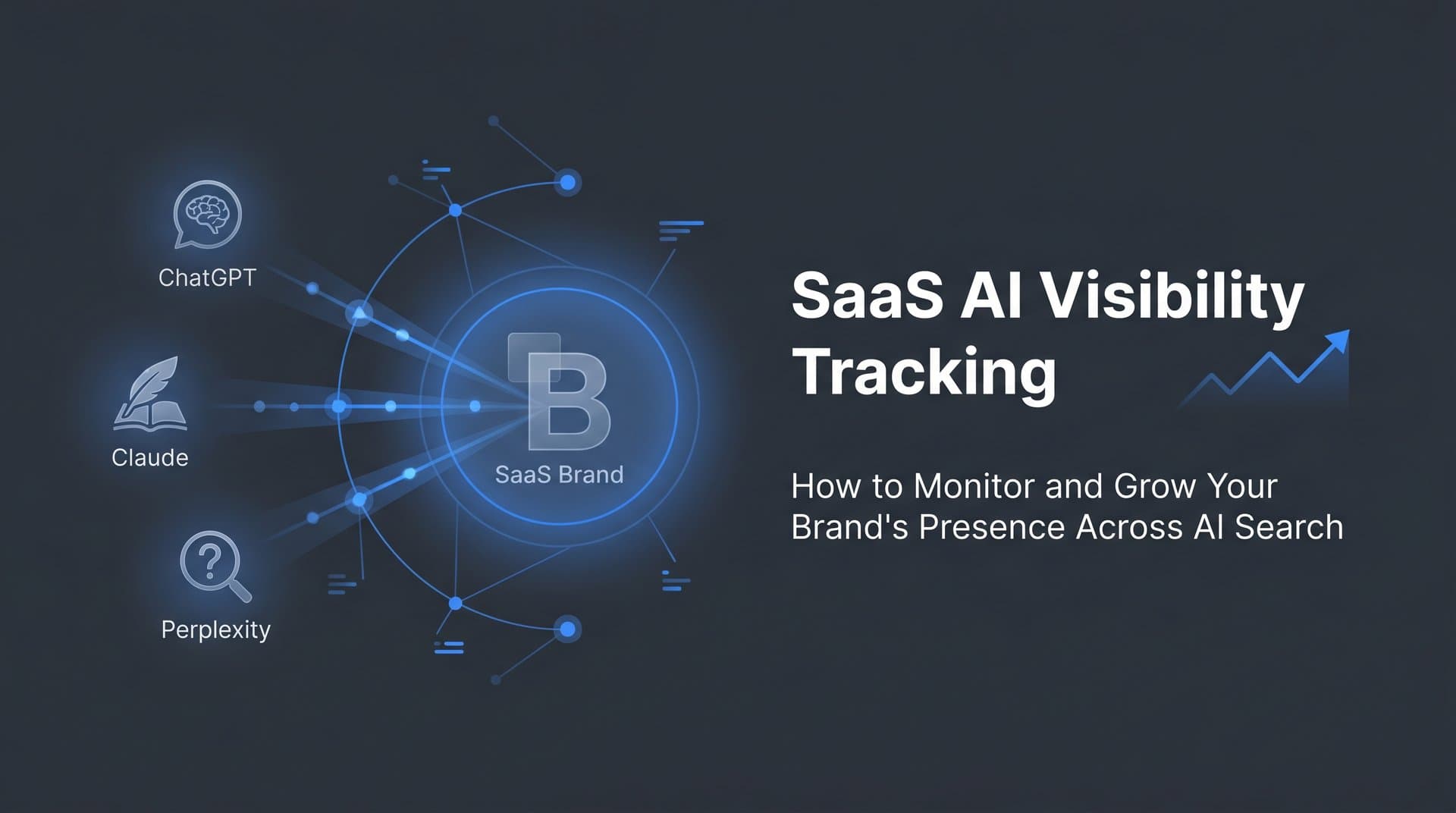
One nuance that's easy to underestimate: different AI models may represent your brand very differently. ChatGPT, Claude, Perplexity, and Gemini each have distinct training datasets, retrieval mechanisms, and response styles. Your brand might be well-represented in Claude's responses and largely absent from Perplexity's. Monitoring across a single platform gives you an incomplete picture. Effective SaaS brand monitoring AI requires coverage across all the major AI platforms your buyers are likely to use.
This multi-platform approach is exactly what tools like Sight AI's AI Visibility tracking software are built for: monitoring brand mentions across six or more AI platforms simultaneously, tracking sentiment and prompt coverage, and surfacing competitive gaps in a single dashboard. Without that kind of systematic coverage, you're essentially flying blind in a channel that's increasingly influencing your pipeline.
From Monitoring to Action: Turning AI Visibility Data Into Growth
Monitoring your AI brand presence is valuable. But the real payoff comes when you use that data to drive decisions. Here's where SaaS brand monitoring AI moves from a passive observation tool to an active growth lever.
The most immediate value is content gap identification. When you run prompt tracking and discover that your brand doesn't appear in AI responses to certain queries, you've found a content opportunity. If buyers are asking AI tools "what's the best tool for [specific use case]" and your brand never surfaces, it likely means you don't have strong, authoritative content on that topic. Understanding why your brand is not appearing in AI searches is the first step toward closing that gap.
This is fundamentally different from traditional keyword research. You're not just looking for search volume. You're looking at which topics trigger AI recommendations, and whether your brand is part of those recommendations. The signal is more direct: AI models either mention you or they don't. That binary feedback makes prioritization clearer.
Sentiment tracking serves a different but equally important function. It helps SaaS teams catch and correct inaccurate or negative AI-generated brand descriptions before they become entrenched. AI models can perpetuate outdated information, mischaracterize product positioning, or repeat inaccuracies that appeared in older web content. If your monitoring system flags that multiple AI platforms are describing your product as lacking a feature you actually launched, that's an urgent signal to publish clear, authoritative content that corrects the record.
Competitive visibility data is perhaps the most strategically powerful output. When you can see exactly which prompt categories a competitor dominates, you can build a targeted response. If a competitor consistently earns AI mentions for "best tool for [specific workflow]" and you don't, you now have a specific content brief: create authoritative, well-structured content that positions your brand in that context. Over time, as AI models encounter your content through crawling and retrieval, your share of voice in those categories can improve your brand mentions in AI responses.
The key mindset shift is treating AI brand monitoring data the same way you treat SEO analytics: as a continuous feedback loop that informs your content roadmap, positioning decisions, and competitive strategy. It's not a one-time audit. It's an ongoing intelligence system that gets more valuable as you accumulate trend data over time.
Building a GEO-Optimized Content Strategy for AI Mentions
Understanding your AI visibility gap is one thing. Closing it requires a content strategy built around Generative Engine Optimization, or GEO. This is the practice of creating and structuring content specifically so AI models can easily extract, cite, and recommend your brand in their responses.
GEO differs from traditional SEO in a meaningful way. Traditional SEO is primarily about ranking a page in a list of results. GEO is about making your content the source an AI model draws from when synthesizing an answer. Understanding the distinction between LLM monitoring and traditional SEO is essential for modern SaaS marketers. The goal isn't just traffic to your page. It's being the authoritative voice that an AI model references when a buyer asks a relevant question.
Several practical tactics make content more GEO-friendly. First, authoritative data presentation matters enormously. AI models tend to cite content that presents clear, factual, well-organized information. If your content includes original research, specific data points, or definitive statements about your category, it becomes more citable. Vague, generic content rarely makes it into AI-synthesized answers.
Clear Entity Definitions: AI models need to understand what your brand is and what it does in unambiguous terms. Your content should clearly define your product category, your core use cases, and your key differentiators in language that's easy for a language model to parse and repeat accurately.
Structured Comparisons: Buyers use AI to compare options. Content that explicitly compares your product to alternatives, in a fair and structured way, is highly useful for AI models answering comparison queries. This kind of content signals relevance to the exact prompts you're trying to appear in.
FAQ-Style Content: AI models are essentially very sophisticated question-answering systems. Content structured around common questions in your category, with clear, concise answers, maps directly to how AI models synthesize responses. Applying LLM prompt engineering for brand visibility principles to your content structure can significantly increase your chances of being cited.
The GEO feedback loop is what makes this approach scalable. You publish optimized content, then use your AI brand monitoring system to check whether AI models begin referencing your brand in the relevant prompt categories. If visibility improves, you've validated the approach and can replicate it. If it doesn't, you refine the content structure or topic focus and try again. This iterative cycle, informed by real monitoring data, is how SaaS brands systematically improve their AI presence over time.
Technical Infrastructure: Indexing, Speed, and Discoverability
Even the best GEO-optimized content can't influence AI responses if it hasn't been discovered yet. This is where technical infrastructure becomes a critical part of your SaaS brand monitoring AI strategy.
AI models and the retrieval systems that feed them need to find your content quickly. The longer it takes for new content to be indexed by search engines and AI crawlers, the longer it sits in a blind spot, unable to influence the AI-generated responses your buyers are reading. Improving AI visibility for SaaS companies starts with ensuring your content is discoverable in the first place.
The IndexNow protocol is one of the most practical tools for addressing this. Supported by Microsoft Bing and other search engines, IndexNow allows websites to instantly notify search engines when new content is published or existing content is updated, rather than waiting for crawlers to discover it on their own schedule. This dramatically accelerates the time between publishing and indexing, which means your new GEO-optimized content enters the information ecosystem faster.
Automated sitemap management works alongside IndexNow to keep your site's content inventory current and accurate. When search engines and AI crawlers have an up-to-date map of your site's content, they can discover and index new pages more efficiently. Together, these mechanisms reduce the lag between content creation and content discoverability.
Beyond indexing speed, foundational technical SEO practices remain important. Crawlability ensures that search engines and AI systems can access your content without running into blocked pages or broken links. Structured data markup helps AI systems understand the context and type of content on your pages. Clean site architecture makes it easier for crawlers to navigate your content hierarchy and understand which pages are most authoritative.
These technical foundations support both traditional search visibility and AI model discoverability. They're not separate concerns. A site that's well-structured for search engines is generally well-positioned for AI retrieval systems as well. The investment in technical infrastructure pays dividends across both channels.
Measuring Success: KPIs and Benchmarks for AI Brand Monitoring
Any growth strategy without measurement is just guesswork. AI brand monitoring is no different. SaaS teams need a clear set of KPIs to evaluate whether their efforts are moving the needle and where to focus next.
The primary metric is AI Visibility Score over time. This composite score, tracking mention frequency, sentiment quality, and prompt coverage across AI platforms, gives you a single trend line to watch. A rising score indicates that your content and optimization efforts are working. A flat or declining score signals that competitors are gaining ground or that your content strategy needs adjustment. Leveraging the right AI brand visibility tracking tools makes this measurement systematic rather than ad hoc.
Share of Voice Across AI Platforms: Track how often your brand appears in relevant prompts compared to your top competitors, broken down by AI platform. This shows you not just overall performance but where you're winning and where you're losing ground specifically.
Sentiment Shift: Monitor whether AI-generated descriptions of your brand are becoming more positive and accurate over time. If your sentiment score improves after publishing corrective content, that's a clear signal the strategy is working.
Prompt Coverage Breadth: Track how many distinct prompt categories trigger your brand mentions. Early in your monitoring journey, you may appear in only a narrow set of queries. As your GEO content strategy matures, you should see coverage expanding into new topic areas and use cases.
Setting realistic benchmarks starts with establishing a baseline. Before you can measure improvement, you need to know where you stand today. Run a comprehensive prompt tracking audit across your key AI platforms, record your current AI Visibility Score, and document your share of voice against competitors. Platforms designed for real-time brand monitoring across LLMs can automate much of this baseline work. That baseline becomes your starting point for measuring the impact of every content and optimization initiative that follows.
It's also worth integrating AI brand monitoring KPIs with your broader marketing metrics. AI visibility doesn't exist in isolation. Improvements in AI share of voice often correlate with organic traffic growth, improved brand search volume, and stronger pipeline from content channels. Tracking these connections helps you make the business case for continued investment in AI brand monitoring and GEO content strategy.
The Bottom Line: Your AI Brand Presence Is a Competitive Asset
SaaS brand monitoring AI has moved from a forward-looking concept to an operational necessity. As AI-driven discovery becomes a primary channel for buyer research, the brands that understand and actively manage their AI presence will have a meaningful advantage over those that don't.
The workflow is clear: monitor your AI visibility across platforms to understand where you appear and how you're characterized, identify content gaps and competitive blind spots, create GEO-optimized content designed to influence AI responses, ensure fast indexing so that content enters the ecosystem quickly, and measure results continuously to refine your approach.
None of this requires guesswork. The data is there. The tools exist to collect it, analyze it, and turn it into a content strategy that compounds over time. What it requires is a commitment to treating AI brand visibility as seriously as you treat your SEO rankings or your review site scores.
Your buyers are already using ChatGPT, Claude, and Perplexity to evaluate your category. The question is whether those AI models are recommending you, misrepresenting you, or ignoring you entirely. You can't improve what you can't see.
Stop guessing how AI models like ChatGPT and Claude talk about your brand. Get visibility into every mention, track content opportunities, and automate your path to organic traffic growth. Start tracking your AI visibility today and see exactly where your brand appears across top AI platforms.