Something fundamental has shifted in how people find information. Millions of users now open ChatGPT, Claude, or Perplexity and ask conversational questions instead of typing keywords into a search bar. They want recommendations, comparisons, and direct answers. And increasingly, they act on what the AI tells them without ever clicking a traditional search result.
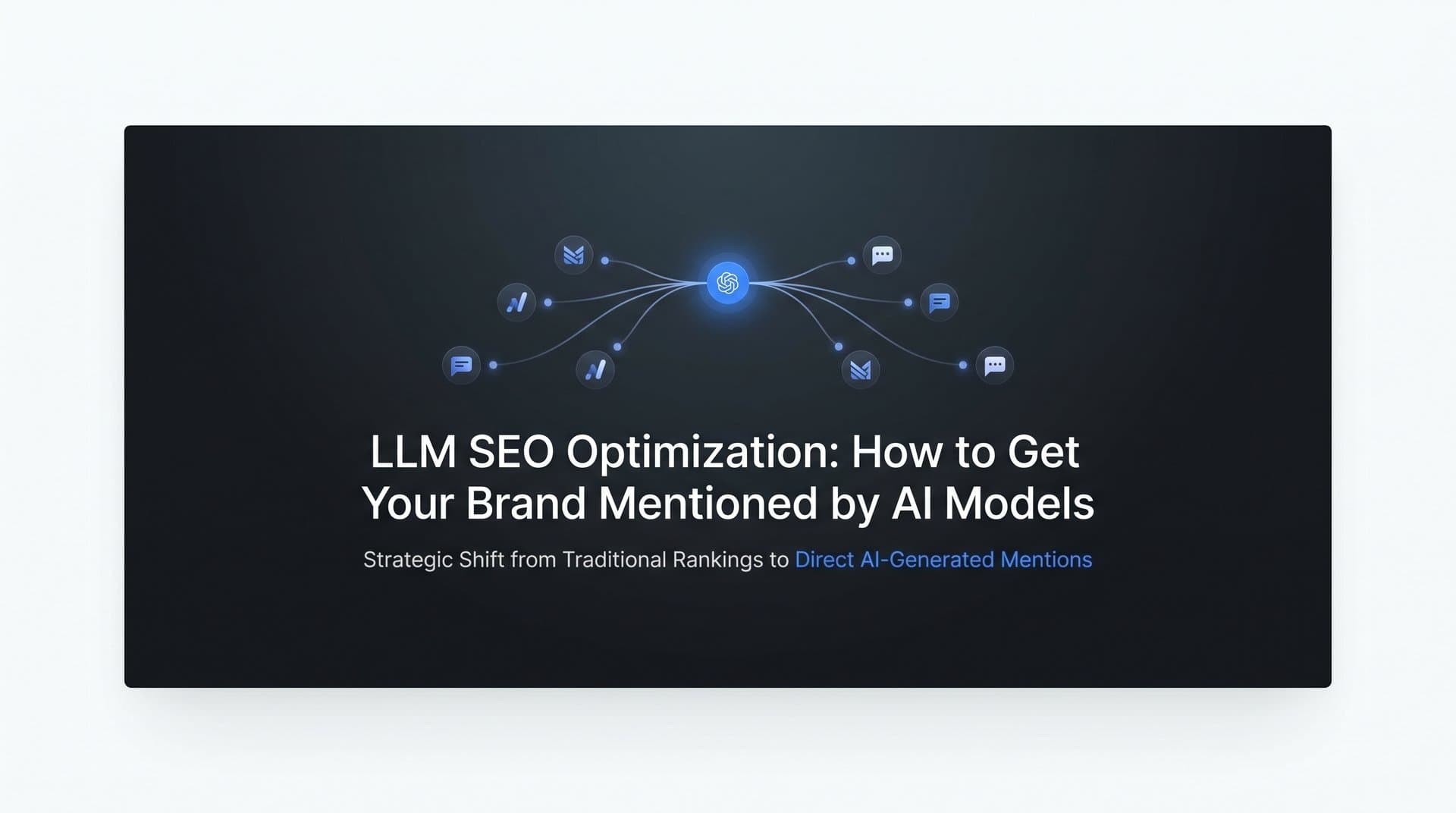
This behavioral shift has created an entirely new optimization frontier: LLM SEO optimization. While traditional SEO focuses on earning high rankings in search engine results pages, LLM SEO optimization focuses on something different. It's about influencing how large language models reference, recommend, and describe your brand when users ask relevant questions.
Think of it this way. If someone asks ChatGPT "what's the best tool for tracking AI brand mentions?" you want your brand to be the answer. Not just ranking on page one of Google, but actually appearing in the AI's response as a credible, recommended option. That's the new game, and the rules are different enough that they deserve a dedicated playbook.
This article breaks down exactly what LLM SEO optimization is, why it matters for marketers and founders in 2026, and how to build a practical strategy that gets your brand surfaced in AI-generated answers. Whether you're starting from scratch or looking to extend an existing SEO strategy, here's what you need to know.
Why AI Models Are Becoming the New Search Interface
To understand why LLM SEO optimization matters, you first need to understand how large language models actually generate answers. It's not as simple as "the AI searched the web." The reality is more layered, and that layering is exactly what creates the optimization opportunity.
Modern LLMs generate responses through a combination of mechanisms. The base model draws on patterns learned during training from vast amounts of text across the web. On top of that, many AI platforms now use retrieval-augmented generation, or RAG, which allows the model to pull in real-time or recently indexed web content to supplement its responses. Some platforms also do live web crawling at query time. The result is a dynamic synthesis of stored knowledge and fresh retrieval.
Here's why this changes the optimization game entirely. In traditional SEO, you're optimizing for a ranking algorithm that evaluates pages and sorts them into a list. In LLM SEO optimization, you're optimizing for a synthesis process. The AI isn't presenting a list of links; it's constructing a narrative answer. Your brand either gets woven into that narrative or it doesn't. Understanding what LLM optimization actually entails is the first step toward building an effective strategy.
The contrast with traditional SEO becomes clear when you compare the outputs. Traditional SEO produces blue links. LLM SEO optimization produces brand mentions, citations, and recommendations embedded inside conversational responses. A user asking "which CRM is best for small teams?" gets an answer that names specific products. The brands mentioned in that answer receive a very different kind of visibility than a brand sitting at position four in a search results page.
The user behavior shift reinforces why this matters for your organic traffic pipeline. Conversational search optimization addresses the reality that AI-driven queries tend to drive high-intent interactions. Users asking AI models for recommendations are often further along in their decision-making process. They're not browsing; they're deciding. Getting mentioned at that moment has significant commercial value, and that value will compound as AI-driven search continues to grow.
For marketers and founders, this isn't a distant future concern. It's a present-day gap in most brand strategies. The brands building their AI presence now are establishing the kind of entity recognition and citation footprint that will be very difficult to replicate later.
The Three Core Pillars of LLM SEO Optimization
LLM SEO optimization isn't a single tactic. It's a discipline built on three interconnected pillars. Get all three working together and you create a compounding advantage. Neglect one and you'll find the others underperform.
Pillar 1: Structured, Authoritative Content
LLMs favor content that directly and clearly answers questions. This isn't about keyword stuffing or hitting a word count. It's about producing factually rich, well-organized content that defines entities clearly, provides contextual depth, and leaves little ambiguity about what your brand does and why it matters.
Think about how an AI model decides what to include in a response. It's looking for content that confidently answers the question at hand. Content that hedges, buries the key point in paragraph seven, or spends three paragraphs on preamble before getting to the answer is less likely to be surfaced. Direct, structured content with clear definitions, logical flow, and specific claims performs better in both RAG retrieval and training data influence.
This means your content strategy needs to prioritize clarity over cleverness. Define what your product or service does in plain, specific language. Answer the questions your target audience is actually asking AI models. Structure your pages so the most important information appears early and is easy to extract. A strong approach to SEO content optimization ensures your material is both human-readable and AI-extractable.
Pillar 2: Brand Entity Recognition
LLMs build internal representations of entities: brands, products, people, and concepts. These representations are shaped by how consistently and authoritatively an entity appears across diverse sources on the web. If your brand name appears frequently in credible contexts alongside relevant topics, the model develops a stronger association between your brand and those topics.
This is why brand entity recognition is so central to LLM SEO optimization. It's not enough to have great content on your own website. You need a consistent, well-cited digital footprint across authoritative third-party sources. Industry publications, directories, review platforms, expert roundups, and press coverage all contribute to the web-wide signal that tells LLMs your brand is a legitimate, relevant player in your space.
Pillar 3: Technical Discoverability
AI retrieval systems rely on the same foundational infrastructure as traditional search engines. If your content isn't crawlable, properly indexed, and formatted in ways that parsing systems can understand, it won't make it into the retrieval pool regardless of how good it is.
Schema markup helps AI systems understand the structure and meaning of your content. Clean HTML without unnecessary complexity makes parsing more reliable. Fast indexing ensures your newest and most relevant content is available to RAG systems when users ask questions. Technical discoverability isn't glamorous, but it's the foundation everything else depends on.
Crafting Content That LLMs Actually Reference
Knowing that LLMs favor authoritative, structured content is one thing. Knowing how to actually write it is another. There are specific content patterns that increase the likelihood of your material being surfaced in AI-generated responses, and they're worth understanding in detail.
Write in a direct, Q&A-friendly style. LLMs are optimized to answer questions, so they naturally pull from content that mirrors that format. If your page directly asks and answers the questions your audience is posing to AI models, you're essentially writing in the same format the AI is trying to produce. This doesn't mean your content needs to be a literal FAQ. It means your headings should reflect real questions, your answers should come quickly, and your paragraphs should be tight and purposeful.
Excessive preamble, generic introductions, and filler content that delays the actual answer all reduce the extractability of your content. An AI trying to synthesize a response about your product doesn't need your company's founding story in the first paragraph. It needs a clear, confident description of what you do and why it matters. Exploring proven LLM optimization strategies can help you structure content that models consistently reference.
Semantic richness and topical clustering are equally important. When your content comprehensively covers a topic and its related subtopics, you become the authoritative source on that subject in the eyes of both search engines and AI retrieval systems. A single page about "AI visibility tracking" is less powerful than a content cluster that covers AI visibility tracking, how LLMs mention brands, prompt tracking methodology, sentiment analysis for AI mentions, and related concepts. Applying semantic search optimization techniques increases the surface area for AI citation.
Structured data and definition-style formatting give AI models something concrete to extract and paraphrase. When you define a term, compare options in a structured way, or present information in a format that has clear labels and relationships, you're making it easier for an AI to incorporate that information into a response. Comparison tables, numbered processes, and clearly labeled definitions all serve this function.
Consider what a user might ask an AI model that should lead to your brand being mentioned. Then work backward and make sure you have content that directly, clearly, and authoritatively answers that question. That's the core content creation loop for LLM SEO optimization.
Expanding Your Brand's AI Footprint Beyond Your Own Site
Your website is your foundation, but it can't be your only presence if you want LLMs to recognize your brand as a credible, relevant entity. AI models cross-reference multiple sources to validate relevance and authority. A brand that appears only on its own website carries far less weight than a brand that appears consistently across a diverse ecosystem of authoritative sources.
Earning mentions on third-party sites is one of the highest-leverage activities in LLM SEO optimization. Industry publications, professional directories, software review platforms, and niche community sites all contribute to the web-wide signal that shapes how LLMs represent your brand. When a model encounters your brand name in multiple independent, credible contexts alongside the same topics and use cases, it builds a stronger, more confident association.
Digital PR is a direct path to building this footprint. Expert quotes in industry articles, contributed bylines, podcast appearances that generate show notes and transcripts, and co-authored research all create high-quality, contextual mentions of your brand across authoritative domains. These aren't just backlinks for traditional SEO; they're data points that inform how LLMs understand who you are and what you're known for. Understanding the difference between LLM monitoring and traditional SEO helps you allocate effort across both disciplines effectively.
The framing of those mentions matters as much as their existence. You want your brand to appear alongside the specific topics and keywords you're trying to own. If you want to be associated with "AI visibility tracking," your mentions across the web should consistently use that language when describing your product. Inconsistent framing dilutes the entity signal and makes it harder for LLMs to build a clear association.
This brings up a critical operational question: how do you know how AI models are currently talking about your brand? Many marketers are flying blind here. They're investing in content and PR without any visibility into whether those efforts are actually translating into AI mentions. Monitoring how AI models describe your brand, what prompts trigger your appearance, and what sentiment surrounds those mentions is the feedback loop that makes LLM SEO optimization a disciplined practice rather than guesswork.
Tracking your brand across platforms like ChatGPT, Claude, and Perplexity gives you the data you need to identify gaps, adjust your content strategy, and measure whether your AI footprint is growing over time. Dedicated LLM visibility optimization software can automate this monitoring at scale.
Technical Foundations That Power AI Discoverability
Even the best content strategy will underperform if the technical infrastructure beneath it is weak. AI retrieval systems, particularly those using RAG architectures, depend on content being properly indexed and accessible. Technical SEO isn't separate from LLM SEO optimization; it's the delivery mechanism that ensures your content actually reaches the systems that matter.
Crawl efficiency and indexing speed are more important than ever. When you publish new content or update existing pages, you want that content to enter the web index as quickly as possible. LLMs with real-time retrieval capabilities pull from recently indexed pages. A page that takes weeks to get indexed is a page that misses the window where it could be influencing AI responses to current, time-sensitive queries. A deep dive into search engine indexing optimization can help you dramatically reduce that lag.
The IndexNow protocol is a practical tool for addressing this. It allows you to proactively notify search engines and AI crawlers when content changes, rather than waiting for them to discover updates on their own schedule. Pairing IndexNow with automated sitemap updates creates a system where every content change is immediately signaled to the indexing infrastructure, dramatically reducing the lag between publishing and discoverability.
Site architecture plays a significant role in how AI retrieval systems parse your content hierarchy. Clean, logical internal linking helps crawlers understand the relationships between your pages and the relative importance of different content. When a retrieval system can clearly navigate from a broad topic page to specific subtopic pages, it builds a more complete picture of your content ecosystem and the entities within it.
Schema markup deserves specific attention in the context of LLM SEO optimization. Structured data provides explicit signals about what your content is about, who created it, what entities it references, and how different pieces of content relate to each other. For AI retrieval systems trying to parse meaning from large volumes of content, schema markup is like a clear label on a filing cabinet. It reduces ambiguity and increases the precision with which your content can be matched to relevant queries.
Clean HTML without unnecessary JavaScript rendering dependencies also matters. Content that requires complex client-side rendering to display is harder for crawlers to parse reliably. When in doubt, prioritize server-rendered, clean HTML for your most important content. It's a simple change that removes a common technical barrier between your content and the AI systems you want to influence.
Measuring What Matters: Your AI Visibility Score
One of the challenges with LLM SEO optimization is that traditional metrics don't capture it. Organic traffic rankings, click-through rates, and domain authority scores tell you how you're performing in traditional search. They don't tell you whether ChatGPT recommends your product when a user asks for options in your category.
This is where the concept of an AI Visibility Score becomes valuable. An AI Visibility Score is a metric that quantifies how often and how favorably AI models mention your brand across different platforms. It aggregates data from prompt tracking across multiple AI models, sentiment analysis of the mentions that do occur, and the breadth of topics and queries that trigger your brand to appear. Exploring the best LLM optimization tools for AI visibility can help you build this tracking infrastructure efficiently.
The tracking methodology involves systematically querying AI models with prompts relevant to your industry, use cases, and target topics, then analyzing the responses for brand mentions. This can be done manually at small scale, but at any meaningful level of coverage it requires automated tooling that monitors multiple platforms simultaneously and tracks changes over time.
Sentiment analysis adds another dimension to the picture. It's not enough to know that an AI model mentions your brand; you want to know whether it describes you positively, neutrally, or negatively, and in what context. A mention that frames your product as a "limited option" is very different from one that positions you as a "leading solution." Understanding the sentiment of your AI mentions helps you identify content and PR opportunities to shift the narrative.
Connecting AI visibility metrics back to traditional SEO KPIs creates a more complete picture of your brand's organic health. Improvements in AI visibility often correlate with broader brand authority gains that show up in organic traffic, branded search volume, and backlink acquisition. The two disciplines reinforce each other when executed well, which is why treating LLM SEO optimization as a complement to traditional SEO rather than a replacement produces the best results. A comprehensive AI search engine optimization guide can help you align both strategies under a unified framework.
Building for the Search Landscape That's Already Here
LLM SEO optimization isn't a future-proofing exercise. It's a response to a search landscape that has already changed. Users are already asking AI models for recommendations, comparisons, and expert guidance. The brands that appear in those responses are already capturing attention and intent that never reaches a traditional search results page.
The good news is that the foundational work is achievable. Structured, authoritative content. A consistent brand entity footprint across the web. Technical infrastructure that enables fast discovery. A monitoring system that tells you how AI models currently represent your brand. These are the building blocks of an LLM SEO strategy, and each one compounds over time.
Start by understanding your current position. Before you optimize, you need to know where you stand. How do ChatGPT, Claude, and Perplexity describe your brand today? What prompts trigger your appearance? What sentiment surrounds those mentions? That baseline data is what everything else is built on.
Traditional SEO remains essential. Rankings, backlinks, and technical site health still matter enormously. But the brands that will have a durable advantage in organic acquisition are the ones treating AI visibility as an equally important discipline running alongside their existing SEO program.
The window to build a compounding early-mover advantage is open right now. Start tracking your AI visibility today and see exactly where your brand appears across the top AI platforms. Stop guessing how ChatGPT and Claude talk about your brand, and start building the strategy that puts you in the answer.