When someone asks ChatGPT, Claude, or Perplexity for product recommendations in your industry, does your brand come up? For most companies, the answer is no—and that's a massive missed opportunity.
AI-powered search and recommendation systems are rapidly becoming the primary way people discover products, services, and solutions. Unlike traditional SEO where you optimize for Google's algorithm, appearing in AI recommendations requires a fundamentally different approach: you need to become part of the training data and knowledge sources that AI models actually reference.
This guide walks you through six concrete steps to increase your brand's visibility across AI platforms. You'll learn how to structure your content for AI consumption, build the authority signals that models recognize, and track whether your efforts are actually working.
Whether you're a marketer trying to capture this emerging channel or a founder wondering why competitors keep getting mentioned instead of you, these steps will give you a clear path forward.
Step 1: Audit Your Current AI Visibility Baseline
Before you can improve your AI visibility, you need to know exactly where you stand today. Think of this as your diagnostic phase—you're identifying both the problem and the opportunity.
Start by querying major AI platforms with the exact prompts your customers would use. Open ChatGPT, Claude, Perplexity, and Gemini. Ask each one variations of questions like "What are the best [product category] for [use case]?" or "Which [service type] should I choose for [specific need]?"
Pay close attention to the responses. Does your brand appear at all? If it does, in what context? Are you mentioned positively as a top recommendation, or merely listed among many alternatives? Are you compared favorably against competitors, or positioned as a budget option?
Document everything systematically. Create a spreadsheet tracking which AI platform mentioned you, for which specific prompts, in what position, and with what sentiment. This baseline data becomes your measurement framework for everything that follows.
Now run the same queries for your top competitors. This is where it gets interesting—you'll often discover that brands you consider peers are getting significantly more AI visibility than you. Note the patterns. Are competitors appearing in AI recommendations because they're cited in authoritative industry publications? Do they appear in comparison contexts that position them as category leaders?
The gap between your actual market position and how AI models perceive your brand reveals your opportunity. If you're a market leader but AI barely mentions you, that's a red flag. If you're an emerging player but already getting positive mentions, you're ahead of the curve.
Use AI visibility tracking tools to automate this process beyond your initial audit. Manual queries give you directional insight, but systematic tracking across dozens of prompts and multiple AI platforms reveals patterns you'd otherwise miss. Set up monitoring for your brand name, product categories, and the specific problem statements your solution addresses.
This baseline audit typically takes 2-3 hours if done manually, but it's time well invested. You'll emerge with concrete data on where you stand, which competitors are winning AI visibility, and exactly which prompts you need to optimize for.
Step 2: Create AI-Readable Content Architecture
AI models don't read your website the way humans do. They need clear, structured information they can parse, understand, and confidently reference when generating recommendations. Your content architecture determines whether AI can actually use your information.
Start with structured data markup—the machine-readable code that explicitly tells AI what your content means. Implement FAQ schema on pages where you answer common questions. Add Product schema to product pages with clear specifications, pricing, and features. Use Organization schema on your homepage to establish your company's identity, founding date, and core offerings.
These schemas act like labels on file folders. Without them, AI has to guess what your content means. With them, you're providing explicit context that models can reference with confidence.
Next, create an llms.txt file for your website. This emerging standard works like robots.txt but specifically guides AI crawlers to your most important content. Place it in your root directory and list your key pages—your main product pages, definitive guides, about page, and any authoritative resources that position your expertise.
Your content itself needs restructuring for AI consumption. AI models favor content with clear hierarchies, explicit definitions, and factual statements they can extract and cite. Break complex topics into distinct sections with descriptive headings. Use bullet points for lists of features or benefits. Define terms explicitly rather than assuming context.
Write content that answers specific questions definitively. Instead of marketing copy that teases benefits, provide comprehensive information that AI can confidently reference. If someone asks "What features should I look for in [your product category]?" your content should provide a complete, factual answer—not just a sales pitch for your solution.
Format matters more than you think. AI models parse content hierarchically. Your H2 headings should clearly state what each section covers. Introductory sentences should summarize key points. Paragraphs should stay focused on single concepts rather than mixing multiple ideas.
This isn't about dumbing down your content—it's about making it unambiguous. The clearer and more structured your information, the more likely AI models will reference it when generating recommendations in your category.
Step 3: Build Authority Through Strategic Content Placement
Here's the reality: AI models don't treat all sources equally. Content published on authoritative platforms carries significantly more weight than content on your own website. To appear in AI recommendations, you need presence where AI models actually look for trusted information.
Focus on platforms AI models frequently reference in their training data. Industry publications with editorial standards, established trade journals, and recognized expert platforms all carry authority signals that AI recognizes. A mention in TechCrunch or your industry's leading publication does more for AI visibility than a dozen blog posts on your own site.
Contribute expert content to these high-authority sources. Write guest articles, participate in expert roundups, offer commentary on industry trends. The goal isn't just backlinks—it's establishing your brand as a referenced source in contexts where AI looks for authoritative information.
Wikipedia citations remain particularly valuable, though getting mentioned requires genuine notability and reliable secondary sources. If your company meets Wikipedia's notability guidelines, ensure your Wikipedia page exists and accurately represents your offerings. AI models frequently reference Wikipedia when establishing factual context about companies and products.
Consistency across web properties matters more than most brands realize. Ensure your NAP information—Name, Address, Phone—matches exactly across every platform where you're listed. Inconsistent information confuses AI models and reduces confidence in citing your brand.
Create linkable assets that naturally attract references from authoritative sources. Original research, comprehensive industry reports, and definitive guides become resources other sites cite. When authoritative sources link to your content, AI models interpret that as a trust signal. Understanding how AI models choose recommendations helps you prioritize which authority signals matter most.
Think beyond traditional link building. You're building a web of authoritative mentions that AI models encounter during training and reference during inference. Every mention in a trusted publication, every citation in an industry report, every reference in an expert comparison—these create the authority signals that influence AI recommendations.
This step requires patience. Building authority takes months, not weeks. But the compounding effect is significant. Each authoritative mention makes the next one easier to earn, and AI models increasingly recognize your brand as a legitimate player in your category.
Step 4: Optimize for Question-Based Discovery
People interact with AI differently than they search Google. They ask questions in natural language, expecting conversational answers. Your content needs to match how people actually phrase their queries to AI assistants.
Start by researching the exact prompts users ask about your product category. What questions do potential customers pose to ChatGPT when evaluating solutions? Common patterns include "best [product type] for [use case]," "how to choose [solution]," and "what's the difference between [option A] and [option B]?"
Create content that directly answers these questions with comprehensive, balanced information. If someone asks "What are the best project management tools for remote teams?" your content should provide a genuine answer—not just a pitch for your product, but a fair comparison that positions your solution within the broader landscape.
This might feel counterintuitive. You're essentially creating content that mentions competitors. But here's why it works: AI models favor content that provides complete, unbiased information. When your content fairly compares options and positions your solution based on specific use cases, AI is more likely to reference it—and mention your brand in the process. Learning how to optimize content for ChatGPT recommendations specifically can accelerate your results.
Include comparative information that acknowledges where your solution excels and where alternatives might be better fits. If your tool is ideal for enterprise teams but overkill for solopreneurs, say that explicitly. AI models reward honesty and specificity over generic marketing claims.
Write in natural language that mirrors conversational queries. Instead of keyword-stuffed headlines like "Best Project Management Software Tools 2026," use natural phrasing: "Which Project Management Tool Should You Choose for Your Remote Team?" The second version matches how people actually ask AI for recommendations.
Pay special attention to "how to choose" and "what to look for" content. These query types signal buying intent, and AI models frequently reference comprehensive guides when answering them. Create content that walks through evaluation criteria, explains trade-offs, and helps readers make informed decisions—with your solution positioned as a strong option for specific use cases.
The goal isn't manipulation—it's helpfulness. When your content genuinely helps people make better decisions, AI models naturally reference it more often. And when they do, your brand gets mentioned in contexts where purchase decisions are being made.
Step 5: Generate Fresh, Indexable Content Consistently
AI models are trained on data with temporal boundaries. Content published after a model's training cutoff doesn't exist in its knowledge base—until the next training cycle. This creates both a challenge and an opportunity: you need consistent content publication to stay present in AI's evolving knowledge.
Establish a regular publishing cadence focused on evergreen topics in your industry. These are subjects AI will reference repeatedly because they address fundamental questions in your category. Think foundational guides, methodology explanations, and comprehensive resources that remain relevant beyond news cycles.
Use IndexNow or similar rapid indexing protocols to ensure your content gets discovered quickly. Traditional crawling can take days or weeks. IndexNow notifies search engines and AI crawlers immediately when you publish new content, accelerating the discovery process.
Content freshness signals matter. AI models trained on recent data will encounter—and potentially reference—your latest content. This doesn't mean chasing trends or publishing daily. It means maintaining an active presence with substantive content that demonstrates ongoing expertise in your field.
Focus on content that answers emerging questions in your industry. As your market evolves, new use cases, challenges, and solutions emerge. Creating content that addresses these developments positions your brand as current and relevant—qualities AI models factor into recommendations. If your content is not appearing in AI searches, freshness and indexing issues are often the culprit.
Update existing high-value content regularly. Refreshing your cornerstone content with current information, new examples, and updated data signals to AI that your resources remain authoritative. A comprehensive guide last updated in 2023 carries less weight than one updated in 2026.
Balance breadth and depth strategically. Cover the full spectrum of topics in your domain, but go deep on areas where you have unique expertise. AI models reference specialized content when answering specific queries, and comprehensive coverage when providing broader recommendations.
The key is consistency over volume. Publishing one excellent, comprehensive piece monthly beats publishing weekly thin content. AI models favor authoritative, thorough resources over superficial coverage of trending topics.
Step 6: Monitor, Measure, and Iterate Your AI Presence
Optimization without measurement is guesswork. You need systematic monitoring to understand whether your efforts are actually improving your AI visibility—and which tactics are working best.
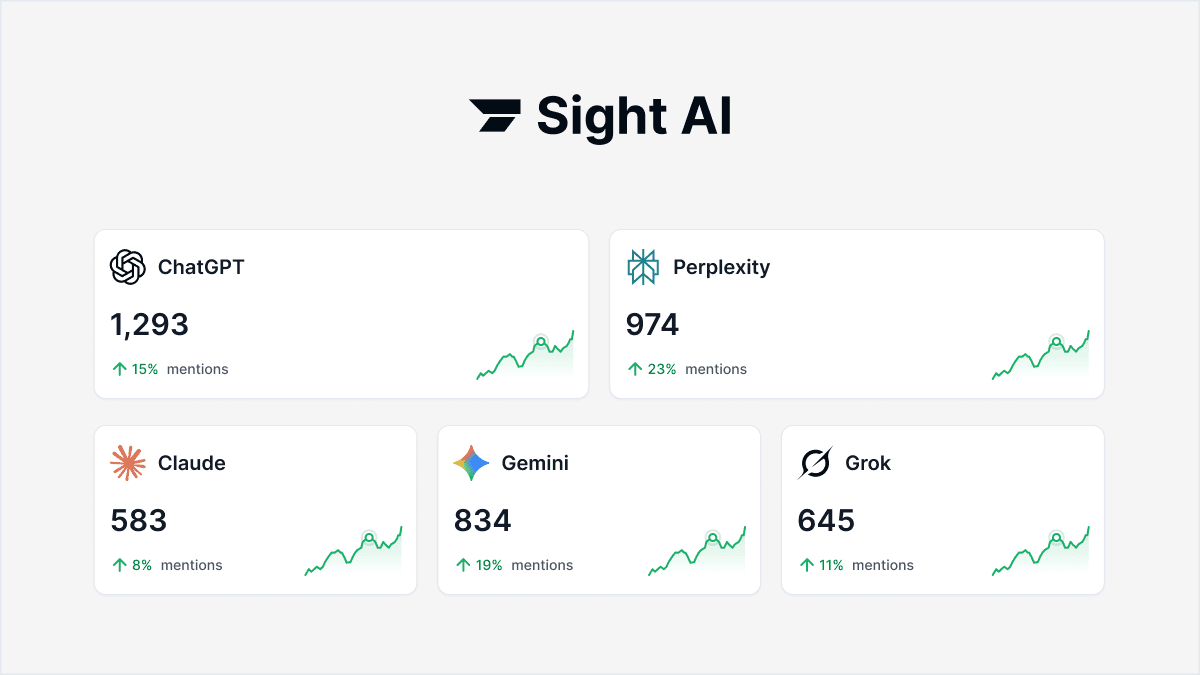
Set up ongoing tracking of brand mentions across multiple AI platforms. Query ChatGPT, Claude, Perplexity, Gemini, and other major models regularly with the same prompts you used in your baseline audit. Document changes in mention frequency, context, and positioning. Implementing a system to monitor AI recommendations consistently is essential for long-term success.
Analyze the sentiment and context of AI mentions. Being mentioned isn't enough—you need to understand how you're being presented. Are you recommended enthusiastically as a top choice, or listed neutrally among many alternatives? Do AI responses position you for specific use cases, or as a general option?
Compare visibility changes against your content publication and optimization timeline. When you published that comprehensive comparison guide, did mentions increase? After implementing structured data, did AI responses become more specific about your features? These correlations reveal which tactics drive results.
Track which types of content generate the most AI mentions. You might discover that your technical documentation gets referenced more than marketing content, or that comparison articles drive more mentions than product announcements. Let data guide your content strategy.
Monitor competitor mentions alongside your own. AI visibility is relative—if competitors are mentioned more frequently or in more favorable contexts, that gap represents your opportunity. Analyze what content and authority signals they've built that you haven't.
Pay attention to prompt variations. The same question phrased differently can yield different results. Test multiple phrasings of common queries to understand the full landscape of how AI models discuss your category and where your brand appears—or doesn't. If you're wondering how to appear in Perplexity results specifically, tracking prompt variations across that platform reveals unique optimization opportunities.
Adjust your strategy based on patterns. If AI consistently mentions you for one use case but not others, create more content reinforcing your strength while building authority in underrepresented areas. If certain content formats drive mentions, double down on those formats.
This monitoring process should be systematic, not sporadic. Monthly tracking reveals trends that weekly checks might miss. Quarterly reviews let you assess strategic shifts and plan content priorities for the next period.
Putting It All Together
Appearing in AI recommendations isn't a one-time optimization—it's an ongoing process of creating authoritative, well-structured content and monitoring how AI models perceive your brand. The landscape is still emerging, which means early movers gain disproportionate advantage.
Start with your baseline audit to understand where you currently stand. Implement the technical foundations—structured data, llms.txt, and content architecture that AI can parse confidently. Build authority through strategic placement on platforms AI models reference. Create content that directly answers the questions your customers ask AI assistants.
Maintain consistency with regular content publication and updates. And critically, monitor your progress so you can iterate based on what actually works for your brand and industry.
The brands winning AI visibility today are those treating it as a distinct channel with its own rules. Traditional SEO tactics help, but they're not sufficient. You need to think about how AI models consume information, what signals they interpret as authority, and how they synthesize recommendations from multiple sources.
Use this checklist to track your progress: baseline visibility documented, structured data implemented, llms.txt created, authority content published on external platforms, question-based content live on your site, indexing protocols automated, and systematic monitoring active. Each step builds on the previous ones, creating compounding visibility over time.
The sooner you start, the more advantage you'll build as AI-powered discovery becomes the norm. Companies that wait until AI recommendations dominate their category will find themselves playing catch-up against competitors who established authority early.
Stop guessing how AI models like ChatGPT and Claude talk about your brand—get visibility into every mention, track content opportunities, and automate your path to organic traffic growth. Start tracking your AI visibility today and see exactly where your brand appears across top AI platforms.