Most marketing teams have a graveyard problem. You spend days — sometimes weeks — researching, drafting, and polishing a long-form article. It goes live, gets shared across your channels, maybe earns some solid traffic in the first week. Then it disappears into the archive, never to be touched again. Meanwhile, your audience on LinkedIn never saw it. Your email subscribers got a one-line mention. The podcast listener who would have loved it never knew it existed.
This is the core inefficiency of modern content marketing: high production cost, limited distribution surface. And it's not a creativity problem or a quality problem. It's a systems problem.
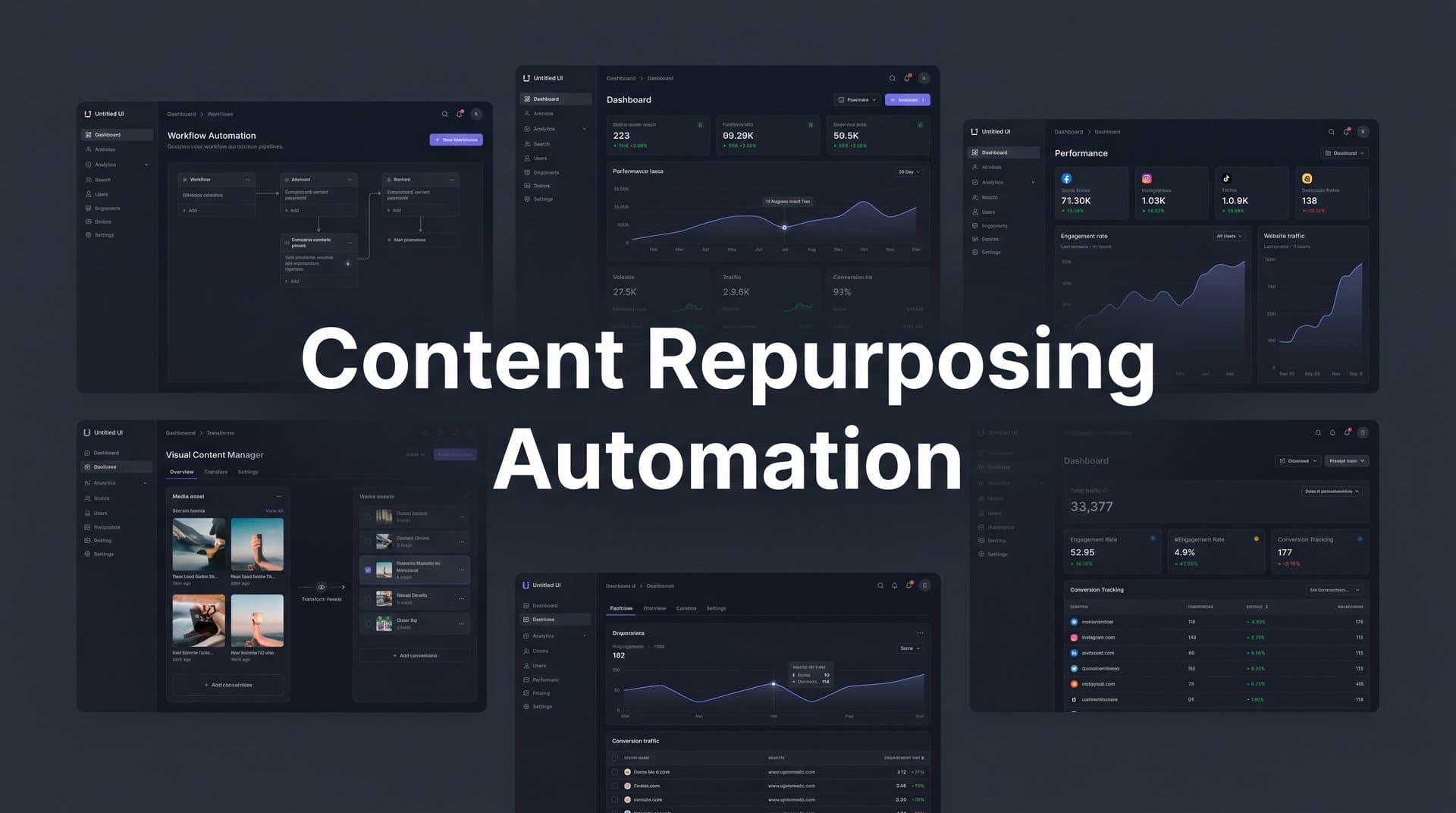
Content repurposing automation is the strategic answer. By using AI-powered workflows to systematically transform existing content into multiple formats across multiple channels, teams can extract dramatically more value from every asset they produce — without adding headcount or burning out their writers. One well-crafted article becomes a LinkedIn carousel, an email snippet, a short-form explainer, and a social thread, all generated and published with minimal manual effort at each step.
The timing matters more than ever. Both traditional search engines and AI models like ChatGPT, Claude, and Perplexity now reward brands that appear consistently across formats and topics. Teams that build automated repurposing systems are not just saving time — they are compounding their organic and AI search presence with every piece of content they publish.
By the end of this article, you will understand exactly what content repurposing automation involves, how to structure a workflow that runs largely on autopilot, which formats deliver the most repurposing value, and how to measure whether your system is actually working.
The Anatomy of a Content Repurposing Workflow
Content repurposing automation is the use of AI tools and structured workflows to convert a single source asset into multiple derivative formats, with minimal manual intervention at each transformation step. The source asset might be a long-form blog post, a webinar recording, a research report, or a podcast episode. The derivatives might be social posts, email snippets, video scripts, short-form articles, or structured FAQ pages. The key word is "systematic" — this is not occasional reformatting, it is a repeatable process that fires every time new content enters the pipeline.
Every repurposing workflow, regardless of complexity, moves through three core stages.
Ingestion: The source content is pulled into the workflow. This might happen automatically when a new article is published to your CMS, when a webinar recording is uploaded to a storage platform, or when a podcast episode is submitted to a feed. The trigger can be manual or event-driven, but the goal is to eliminate the need for someone to manually initiate the process every time.
Transformation: AI agents reformat, summarize, expand, or restructure the source content for specific target channels. A long-form guide might be condensed into a five-point LinkedIn post. A webinar transcript might be restructured into a searchable blog article. The transformation layer is where the intelligence lives — and where the difference between a generic prompt and a specialized agent becomes apparent.
Distribution: The derivative assets are published or scheduled automatically. CMS integrations push articles to your website. Social schedulers queue posts for optimal timing. Email platforms receive formatted snippets ready for the next campaign. Indexing tools ensure search engines discover the new content immediately.
It is worth distinguishing between three levels of repurposing maturity. Manual repurposing means a human reads the source content, then rewrites or reformats it by hand for each channel — time-intensive and difficult to scale. Semi-automated repurposing uses AI to draft derivatives but requires heavy human review and editing before anything goes live. Fully automated repurposing has AI handling the transformation and publishing, with humans reviewing only at defined checkpoints — approving a batch of derivatives once a week rather than editing every individual piece.
Most teams starting out operate at the semi-automated level and graduate toward full automation as they build confidence in their AI agents and establish quality guardrails. The goal is not to remove human judgment entirely, but to focus human attention where it creates the most value: strategy, quality control, and creative direction rather than copy-pasting and reformatting.
Why Automation Changes the Economics of Content Marketing
Here is the compounding content problem in plain terms. Your team invests significant time and budget into producing a single long-form asset. Without systematic repurposing, that asset reaches the audience who happened to visit your blog or see the one social post you wrote about it. The vast majority of people who would find it valuable never encounter it. The asset depreciates rapidly after its initial publication window, and the production cost is never fully recovered.
Automation removes the bottleneck. When a single piece of content can trigger the automatic generation of ten or more derivative assets across different channels and formats, the effective reach of that original investment multiplies without a proportional increase in cost. The economics shift from "one piece, one audience" to "one piece, many audiences, many touchpoints."
This matters beyond productivity. Content breadth directly influences organic visibility in ways that are becoming increasingly important. Traditional search engines have long rewarded sites that cover topics comprehensively and consistently. But the newer dynamic involves AI search. Models like ChatGPT, Claude, and Perplexity draw on the breadth of indexed content when deciding which brands and sources to cite in their responses. A brand that appears across multiple content formats and angles on a given topic is more likely to be surfaced than one that has a single article on the subject.
This makes content repurposing automation a direct lever for AI visibility, not just a content production efficiency play. When your original guide on a technical topic spawns a structured FAQ, a short-form explainer, a listicle, and a social thread — all indexed and discoverable — you are increasing the surface area of content that AI models can draw from when generating responses relevant to your space.
The resource reality for most marketing teams, founders, and agencies reinforces the case. Hiring additional writers to cover more channels is expensive, slow to ramp, and hard to sustain. A small team managing content for a growing SaaS company or an agency handling multiple client accounts cannot realistically maintain a high publishing cadence across SEO articles, LinkedIn, email, and other channels through manual effort alone. Automation makes the same team capable of sustaining output that would otherwise require significantly more headcount.
For agencies in particular, the multiplier effect is substantial. A repurposing workflow built once can be applied across every client account, compounding the efficiency gains rather than rebuilding the system from scratch for each engagement.
What Gets Repurposed and Into What: A Format Map
Not all content repurposes equally well, and not all derivative formats serve the same strategic purpose. Understanding the most productive source-to-derivative transformations helps you prioritize where to invest your automation effort.
Long-form blog posts are the highest-yield source asset for most content teams. A detailed guide or explainer article contains enough structured information to generate LinkedIn carousels (breaking the key points into visual slides), Twitter/X threads (one insight per tweet), email newsletter digests (a curated summary with a link to the full piece), and short-form articles targeting related keyword variations.
Webinar recordings are chronically underutilized. A one-hour webinar contains enough material for a full transcript, multiple short video clips highlighting key moments, a summary article structured for SEO, and a series of social posts pulling quotable insights from the speaker.
Research reports and original data translate naturally into data-driven listicles, infographic content, and structured FAQ pages. The factual density of a research report makes it particularly well-suited for formats that AI models tend to cite — structured, authoritative, answer-focused content.
Podcast episodes can become SEO-optimized blog posts through transcript processing and AI-assisted restructuring, turning an audio conversation into a searchable, indexable article.
This brings up the concept of the "content core": identifying which assets in your existing library have the highest repurposing yield. Evergreen guides, detailed explainers, and comprehensive how-to articles tend to be high-yield because their information remains relevant over time and covers enough ground to generate multiple distinct derivative formats. Conversely, time-sensitive news commentary, highly specific event recaps, or narrowly scoped posts often have low repurposing yield — the effort to transform them rarely justifies the output.
SEO and GEO considerations should actively shape your format decisions, not just your source selection. Repurposed content aimed at traditional search visibility needs to target specific keyword variations and maintain sufficient depth to rank. But content optimized for Generative Engine Optimization (GEO) — structured to increase citation likelihood in AI model responses — needs to be particularly factual, answer-focused, and clearly structured. A repurposed FAQ page or a structured explainer article is more likely to be cited by an AI model than a loosely formatted social recap.
The practical implication: when your AI agents transform a source article into derivative formats, the brief for each derivative should specify not just the channel but the optimization intent. A LinkedIn post optimized for engagement looks different from a short-form article optimized for AI citation, even if both originate from the same source material.
Building the Automation Stack: Tools, Triggers, and AI Agents
A functional content repurposing automation stack has three distinct layers, and understanding each layer helps you make smarter decisions about where to invest and what to connect.
The AI content generation layer is where transformation happens. This is the collection of AI agents responsible for taking source content and producing derivative formats. The critical distinction here is between specialized agents and general-purpose LLMs. A generic prompt to a large language model asking it to "turn this article into a LinkedIn post" will produce inconsistent results — sometimes too long, sometimes off-brand, sometimes missing the structural conventions of the format.
Specialized agents, purpose-built or carefully prompted for specific output types, produce far more consistent results. A listicle agent knows to structure content with numbered headers and brief explanatory paragraphs. An explainer agent knows to define terms before using them and to build from foundational concepts to advanced ones. A social caption agent knows platform-specific length constraints and engagement conventions. When you deploy a suite of specialized agents rather than a single general prompt, the quality and consistency of your repurposed content improves substantially.
The workflow orchestration layer manages triggers and sequencing. This is what fires the agents automatically when new content enters the system. A trigger might be set to activate when a new article is published to your CMS, when a new recording is added to a designated folder, or on a scheduled basis for processing a batch of content. The orchestration layer ensures the right agents are applied to the right source content and that the outputs are routed to the correct publishing destinations.
The publishing and distribution layer handles the final mile. CMS integrations push derivative articles to your website. Social schedulers queue posts for distribution. Email platforms receive formatted snippets. And critically, indexing tools with IndexNow integration ensure that newly published derivative content is discovered by search engines immediately rather than waiting days or weeks for a standard crawl cycle.
This last point is often overlooked but strategically important. If your repurposing workflow generates ten new derivative assets from a single source article, those assets only compound your SEO and AI visibility if they are actually indexed and discoverable. Automated sitemap updates and IndexNow integration close the loop — every published derivative is submitted for indexing at the moment of publication, accelerating the timeline from content creation to search engine visibility.
The practical architecture for most teams involves connecting these three layers through a platform that handles all of them, rather than stitching together separate tools for each function. Fragmented stacks create maintenance overhead and introduce points of failure in the automation chain.
Measuring What Your Repurposed Content Actually Achieves
Repurposing automation without measurement is just publishing volume. The goal is not to produce more content — it is to produce more value. That requires tracking the right metrics at the right level of granularity.
The first measurement principle for repurposed content is to track derivatives individually, not just the source asset. If your original article earns solid organic impressions but three of the ten derivatives you generated from it earn almost none, that tells you something specific: either those formats are not resonating, they are not well-optimized, or they are not being indexed. Aggregate metrics mask these signals.
Organic impressions per derivative asset tells you which formats are gaining search visibility. A structured FAQ derived from a long-form guide might outperform the original article for certain query types. A short-form explainer might rank for keyword variations the original never targeted. Tracking at the derivative level reveals these opportunities.
Engagement rates compared to source content tells you whether the reformatted versions are resonating with their intended audiences. A LinkedIn carousel derived from a blog post might generate significantly more engagement than the original post linking to the article — which validates the format transformation even if the underlying content is the same.
The more forward-looking measurement layer involves AI visibility. As you scale content breadth through repurposing automation, you should be tracking how frequently AI models like ChatGPT, Claude, and Perplexity cite your brand in responses relevant to your topic areas. This is AI visibility scoring: monitoring brand mention frequency and sentiment across AI platforms to understand whether your content distribution strategy is translating into AI search presence.
The connection between content breadth and AI citation frequency is not immediate — it builds over time as more indexed, structured content signals to AI models that your brand is an authoritative source on a given topic. Establishing a baseline AI visibility score before launching your repurposing automation, and then tracking it monthly as your derivative content scales, gives you a meaningful signal of compounding impact.
Measurement should also inform prioritization. Derivative formats that consistently drive organic traffic or AI citations deserve more automation investment. Formats that consistently underperform can be deprioritized or restructured before more resources flow into them.
From One Article to an Automated Content Engine
Pull the pieces together and the end-to-end flow looks like this: you publish a source asset, which triggers a set of specialized AI agents to generate derivative formats across your target channels. Those derivatives are auto-published through CMS integrations and social schedulers, indexed immediately via IndexNow, and tracked through both SEO performance dashboards and AI visibility monitoring. Human review happens at defined checkpoints — not at every individual step.
The result is a content engine that compounds over time. Every new source asset you add to the pipeline generates a new set of derivatives. Every derivative that gets indexed adds to your organic and AI search surface area. Every piece of repurposed content that earns impressions or citations creates data that informs which formats to prioritize next. The system does not just save time — it builds momentum.
It is worth being clear that content repurposing automation is not a one-time setup. It is an iterative system that improves as you refine your agents, adjust your format mix based on performance data, and expand the types of source content entering the pipeline. The first month of running automated repurposing workflows will look different from the sixth month, as you learn which derivative formats drive the most value for your specific audience and topic area.
This is where Sight AI's platform is built to operate. With 13+ specialized AI agents for generating SEO and GEO-optimized content across formats, automatic IndexNow integration for immediate indexing of every published derivative, and AI visibility tracking that monitors brand mentions across ChatGPT, Claude, Perplexity, and other AI platforms, Sight AI provides the full stack required to run this engine in one place. From content generation to indexing to visibility measurement, the loop is closed without requiring a fragmented collection of tools.
The Bottom Line on Smarter Content Distribution
The teams winning in organic and AI search are not necessarily the ones producing the most original content. They are the ones extracting the most value from what they already create. Content repurposing automation is the mechanism that makes that extraction systematic, scalable, and measurable.
If you have an existing library of long-form guides, detailed explainers, or recorded webinars, you already have the raw material for a repurposing engine. The question is whether your current stack can handle the full loop: generating derivatives with specialized AI agents, publishing them automatically, indexing them immediately, and tracking their performance across both traditional SEO and AI visibility metrics.
Start by auditing your content library for high-yield repurposing candidates. Identify your evergreen, information-dense assets. Then map out which derivative formats align with your distribution priorities and your GEO objectives. Once you have that foundation, the automation layer can be built on top of it.
Start tracking your AI visibility today and see exactly where your brand appears across top AI platforms — then use that data to build a repurposing strategy that gets your content cited, indexed, and discovered at every touchpoint where your audience is searching.