As AI models increasingly shape how customers discover and evaluate brands, monitoring what LLMs say about your business has become mission-critical. Whether ChatGPT is recommending your competitors, Claude is misrepresenting your pricing, or Perplexity is citing outdated information about your products, you need visibility into these AI-generated responses.
The challenge? Most LLM monitoring tools were built for engineering teams debugging applications, not marketers tracking brand presence. You need solutions that show you where your brand appears, how it's positioned against competitors, and what content gaps are costing you AI-generated recommendations.
Here are the top LLM monitoring solutions available today, evaluated for their ability to track brand mentions, analyze sentiment, and identify optimization opportunities across major AI platforms.
1. Sight AI
Best for: Marketers and agencies tracking brand visibility across consumer-facing AI platforms
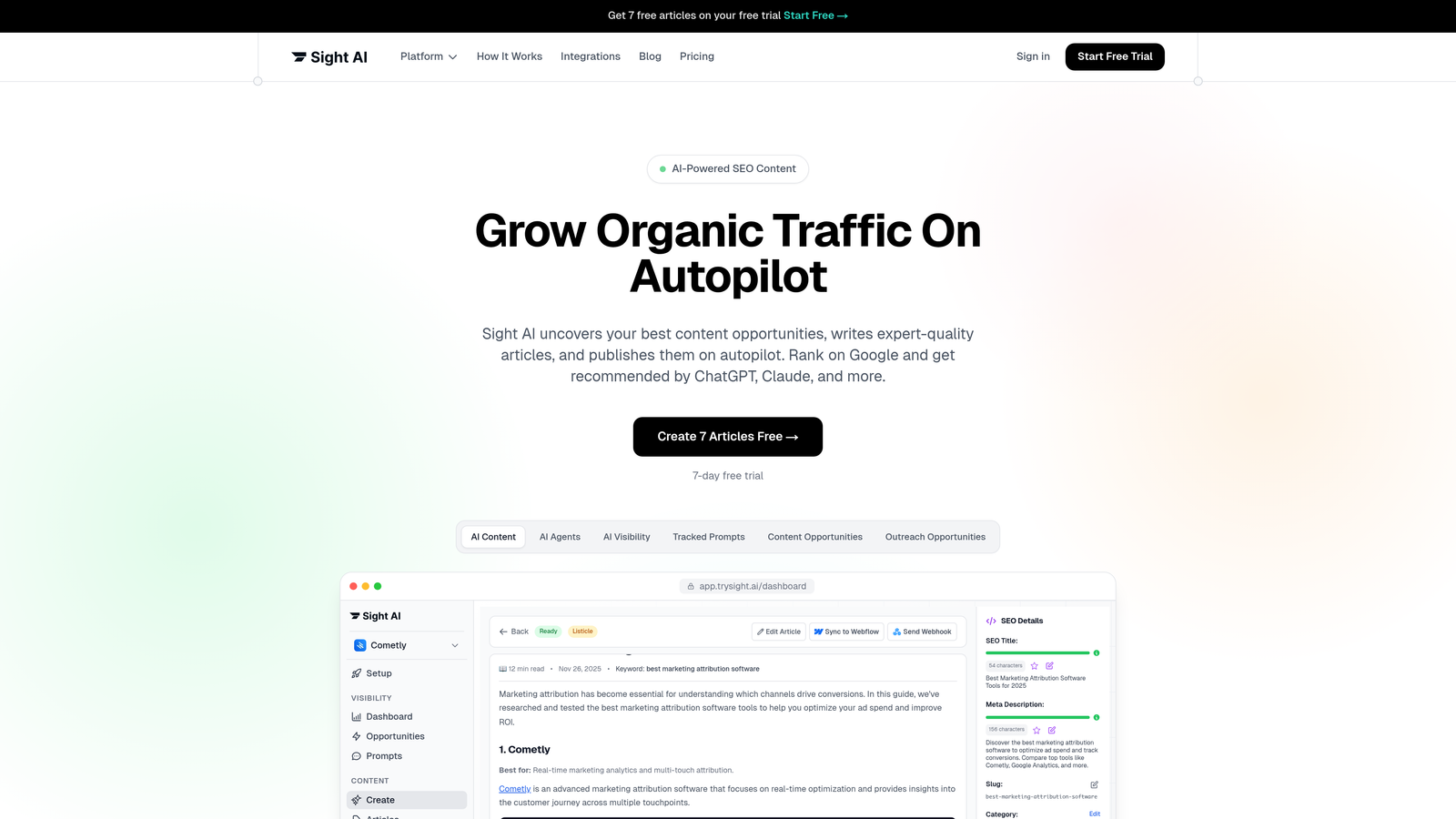
Sight AI is an AI visibility tracking platform that monitors how ChatGPT, Claude, Perplexity, and other major AI models discuss your brand in their responses.
Where This Tool Shines
Unlike developer-focused observability tools, Sight AI addresses the marketing challenge of AI search optimization. It tracks actual brand mentions across consumer-facing AI platforms, showing you exactly where you appear, how you're positioned against competitors, and which prompts trigger recommendations.
The platform combines monitoring with actionable optimization. When it identifies content gaps preventing AI mentions, the integrated content writer generates SEO and GEO-optimized articles designed to improve your visibility. The IndexNow integration ensures new content gets discovered quickly by search engines and AI training processes.
Key Features
Multi-Platform Tracking: Monitors brand mentions across ChatGPT, Claude, Perplexity, and three other major AI platforms from a single dashboard.
AI Visibility Score: Quantifies your brand's AI presence with sentiment analysis, prompt tracking, and competitive positioning metrics.
Content Gap Analysis: Identifies topics and queries where competitors get mentioned but your brand doesn't, highlighting optimization opportunities.
Integrated Content Creation: Features 13+ specialized AI agents that generate optimized articles, listicles, and guides designed to improve AI visibility.
Automatic Indexing: IndexNow integration pushes new content to search engines immediately, accelerating discovery and potential inclusion in AI training data.
Best For
Marketing teams, founders, and agencies focused on organic traffic growth through AI channels. Particularly valuable if you're seeing competitors recommended by AI assistants but your brand rarely appears, or if you want to track how AI models discuss your products and services.
Pricing
Contact for pricing. Offers plans tailored for marketers, founders, and agencies with varying monitoring and content creation needs.
2. Langfuse
Best for: Development teams building LLM applications who need detailed debugging and tracing capabilities
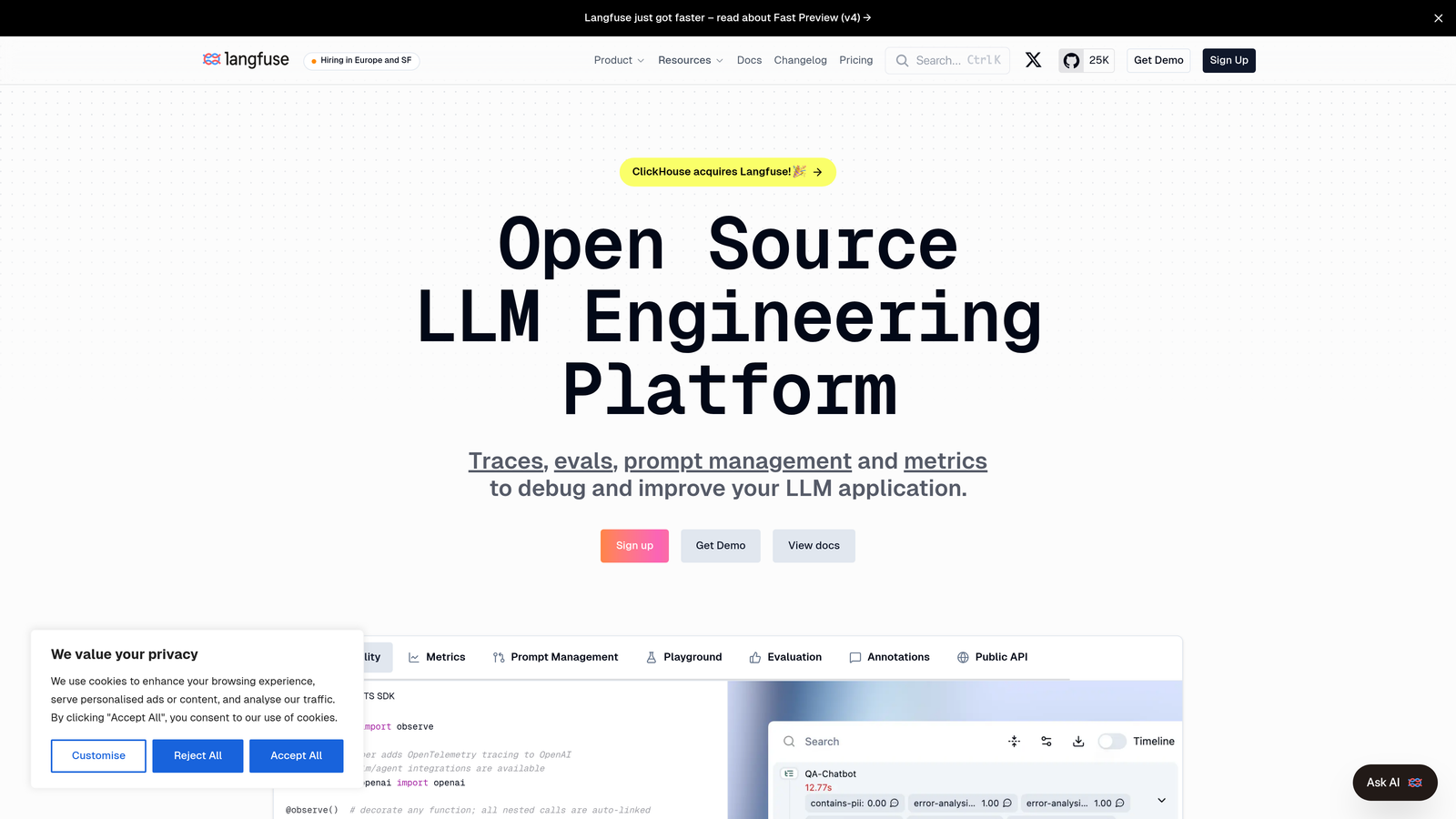
Langfuse is an open-source LLM observability platform providing comprehensive tracing, prompt management, and evaluation tools for AI application development.
Where This Tool Shines
Langfuse excels at the technical side of LLM monitoring. The detailed trace visualization lets developers follow complex LLM chains step-by-step, making it invaluable for debugging multi-step AI workflows. The open-source nature means you can self-host for complete data control.
The prompt management capabilities stand out. Version your prompts, track which versions perform best, and roll back changes when needed. This becomes critical as your application scales and multiple team members iterate on prompts.
Key Features
Open-Source Architecture: Self-host the platform for complete control over your monitoring data and infrastructure.
Trace Visualization: Follow LLM request chains through complex workflows with detailed step-by-step breakdowns.
Prompt Versioning: Manage prompt iterations, compare performance across versions, and maintain a complete prompt history.
Cost Tracking: Monitor API costs per request, user, and session to identify expensive usage patterns.
Evaluation Frameworks: Build custom scoring systems to evaluate LLM output quality against your specific criteria.
Best For
Engineering teams building production LLM applications who need granular debugging capabilities and want control over their monitoring infrastructure. Especially valuable for teams with compliance requirements that mandate self-hosted solutions.
Pricing
Free tier available for development and small projects. Pro plans start at $59/month with increased limits. Enterprise pricing available for custom deployments.
3. Arize AI
Best for: Enterprise data science teams monitoring both traditional ML models and LLMs
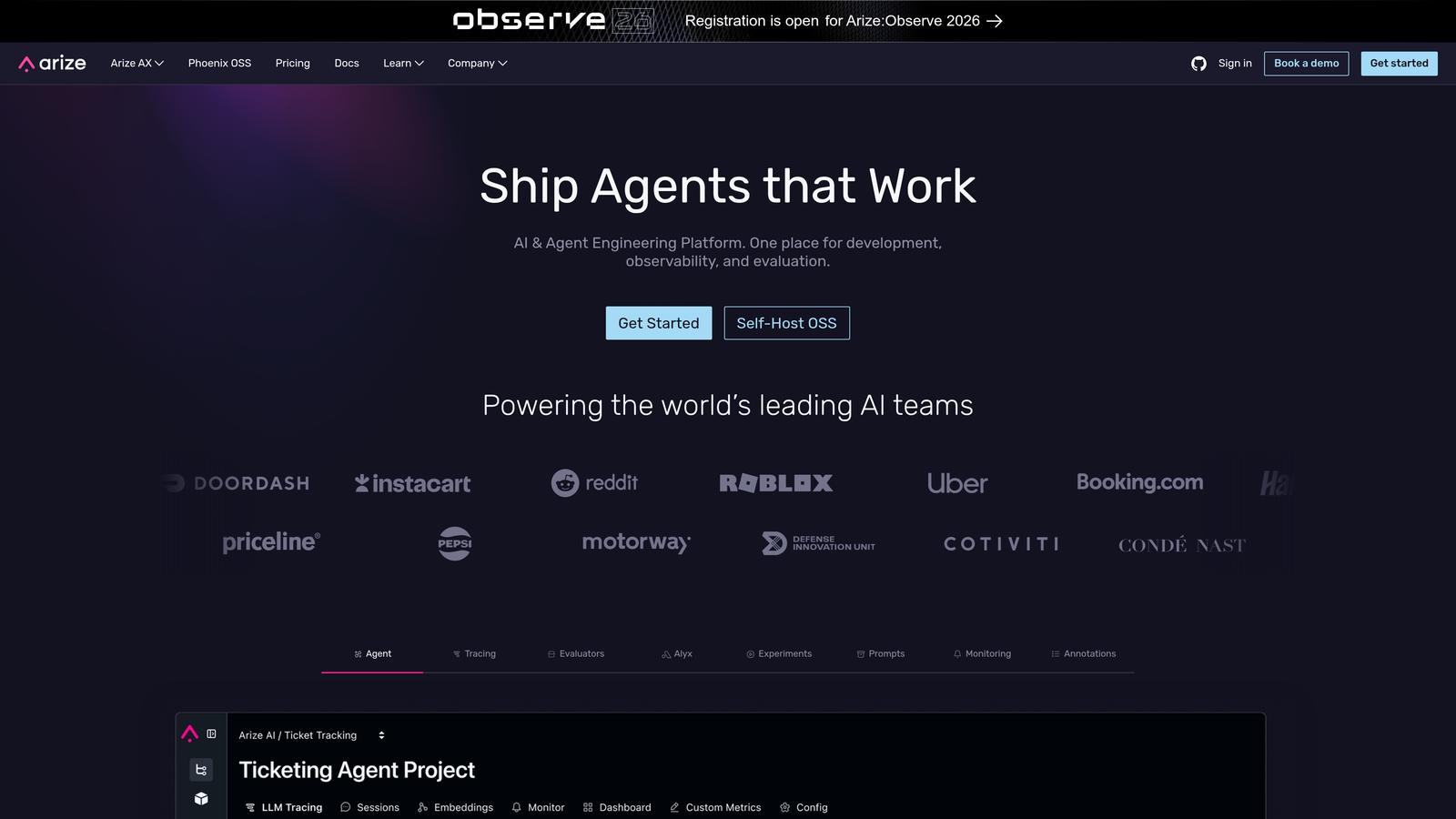
Arize AI is an enterprise ML observability platform offering comprehensive monitoring capabilities for traditional machine learning models and large language models.
Where This Tool Shines
Arize brings enterprise-grade ML observability to the LLM space. If you're already monitoring traditional ML models, Arize provides a unified platform for all your AI systems. The embedding drift detection is particularly sophisticated, identifying when your LLM's understanding of concepts shifts over time.
The automated root cause analysis saves significant debugging time. When performance degrades, Arize automatically surfaces likely causes rather than forcing you to manually investigate thousands of traces.
Key Features
Unified ML and LLM Monitoring: Single platform for observing traditional ML models and LLM applications with consistent interfaces.
Embedding Drift Detection: Identifies when LLM embeddings shift, indicating changes in how the model understands concepts.
Automated Root Cause Analysis: Automatically surfaces likely causes of performance degradation without manual trace investigation.
Version Benchmarking: Compare performance across model versions to validate improvements before full deployment.
Enterprise Security: SOC 2 compliance, role-based access control, and audit logging for regulated industries.
Best For
Enterprise data science and ML engineering teams with diverse AI systems to monitor. Particularly valuable if you're running both traditional ML models and LLM applications and want unified observability.
Pricing
Free tier available for small teams getting started. Enterprise pricing scales based on data volume and feature requirements.
4. Weights & Biases
Best for: ML teams needing comprehensive experiment tracking alongside LLM monitoring
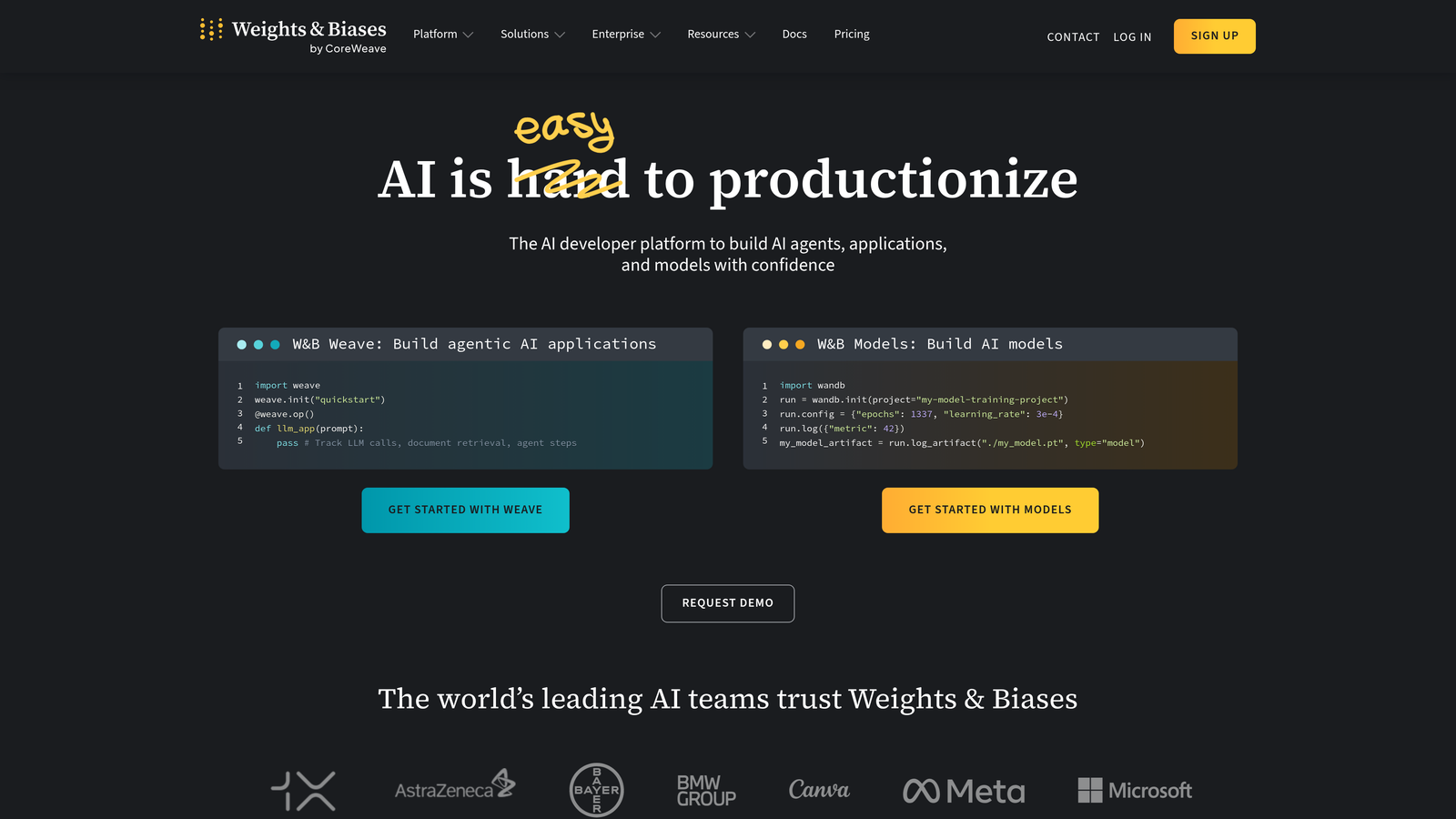
Weights & Biases is an MLOps platform providing experiment tracking, model evaluation, and LLM monitoring with strong collaboration features for machine learning teams.
Where This Tool Shines
Weights & Biases excels at the full ML lifecycle, not just production monitoring. The experiment tracking capabilities let you compare dozens of LLM configurations side-by-side, identifying which prompts, parameters, and architectures perform best before deployment.
The collaboration features make it valuable for distributed teams. Share experiment results, annotate findings, and build reports that communicate model performance to stakeholders who don't live in the code.
Key Features
Comprehensive Experiment Tracking: Log and compare LLM experiments with automatic metric tracking and visualization.
LLM Evaluation Tools: Compare model outputs, evaluate response quality, and benchmark performance across providers.
Team Collaboration: Share experiments, annotate results, and build stakeholder reports within the platform.
Framework Integration: Native support for PyTorch, TensorFlow, Hugging Face, and major ML frameworks.
Artifact Versioning: Track model versions, datasets, and prompts with complete lineage and rollback capabilities.
Best For
ML teams actively experimenting with LLM implementations who need to track iterations and communicate results across the organization. Especially valuable if you're evaluating multiple LLM providers or fine-tuning models.
Pricing
Free for individual researchers and hobbyists. Team plans start at $50 per user per month with advanced features and collaboration tools.
5. Helicone
Best for: Teams focused on LLM cost monitoring and request optimization
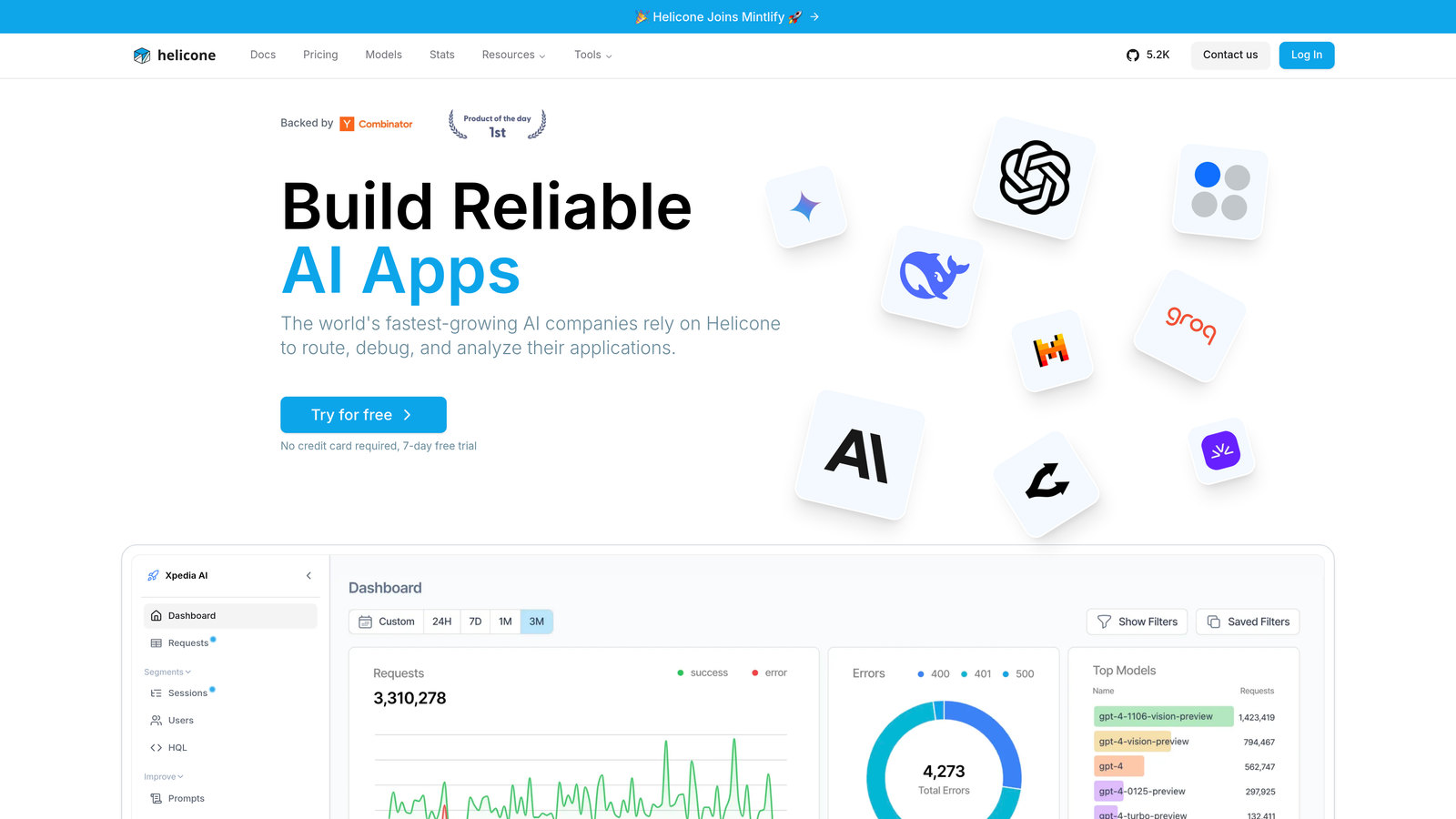
Helicone is an LLM observability platform specializing in cost tracking, request logging, and usage analytics with remarkably simple integration.
Where This Tool Shines
Helicone solves the LLM cost problem with surgical precision. The one-line integration means you can start tracking spending in minutes, not days. The request caching feature alone can cut API costs substantially by reusing responses to identical queries.
The user-level analytics reveal which customers or features drive the most LLM usage. This becomes critical for pricing SaaS products with LLM features, where a few power users can dramatically impact your margins.
Key Features
One-Line Integration: Add monitoring to OpenAI, Anthropic, and other providers by changing a single line of code.
Detailed Cost Tracking: Monitor spending per user, request, and feature with budget alerts and forecasting.
Request Caching: Automatically cache and reuse responses to identical prompts, reducing API costs without code changes.
User Analytics: Track usage patterns by customer to identify high-cost users and optimize pricing models.
Prompt Management: Version and template prompts to standardize LLM interactions across your application.
Best For
Startups and development teams where LLM API costs are a significant concern. Particularly valuable if you're building customer-facing features powered by expensive models and need granular cost visibility.
Pricing
Free tier includes 100,000 requests per month. Pro plan at $20/month adds advanced analytics and higher limits.
6. Datadog LLM Observability
Best for: Organizations already using Datadog who want unified observability across infrastructure and AI
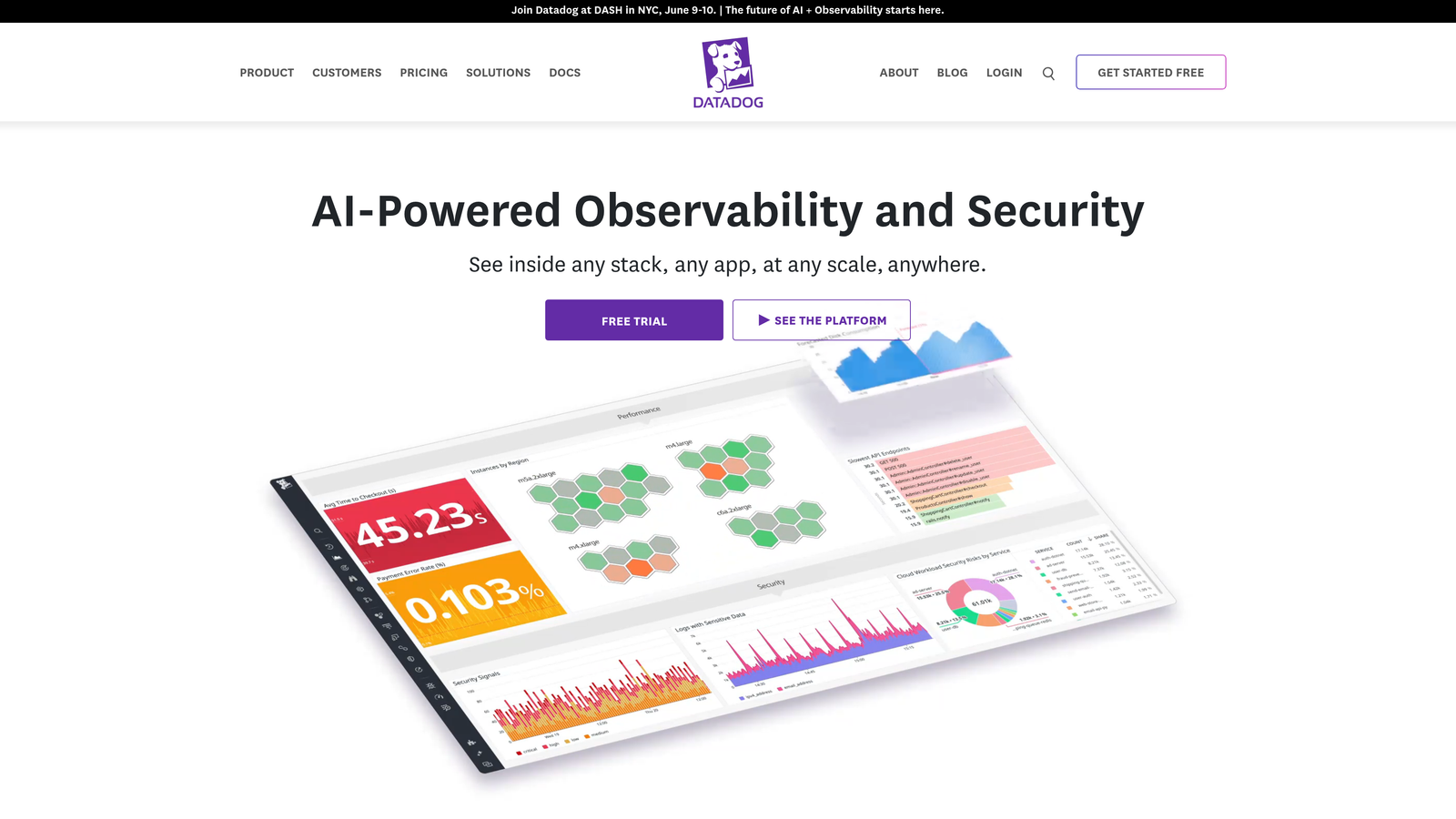
Datadog LLM Observability integrates LLM monitoring into Datadog's broader observability platform, providing unified visibility across your entire stack.
Where This Tool Shines
If you're already monitoring infrastructure with Datadog, adding LLM observability creates powerful unified visibility. Correlate LLM performance with database latency, API errors, or infrastructure issues without switching tools.
The existing Datadog alerting and dashboard infrastructure extends naturally to LLM metrics. Set up anomaly detection on response times or cost spikes using the same workflows you use for traditional application monitoring.
Key Features
Unified Stack Observability: Monitor LLMs alongside databases, APIs, and infrastructure in a single platform.
Trace Visualization: Follow LLM chains through your application stack with detailed request traces.
Cost and Latency Monitoring: Track LLM spending and performance metrics with the same tools you use for infrastructure.
Dashboard Integration: Add LLM metrics to existing Datadog dashboards for holistic application monitoring.
Alerting and Anomaly Detection: Leverage Datadog's mature alerting system for LLM performance and cost issues.
Best For
Engineering teams already invested in the Datadog ecosystem who want to extend their existing observability practices to LLM applications without adopting separate tools.
Pricing
Included as part of Datadog APM. Pricing scales based on hosts monitored and data volume, following Datadog's standard pricing model.
7. Galileo
Best for: Teams prioritizing output quality and hallucination detection in production LLM applications
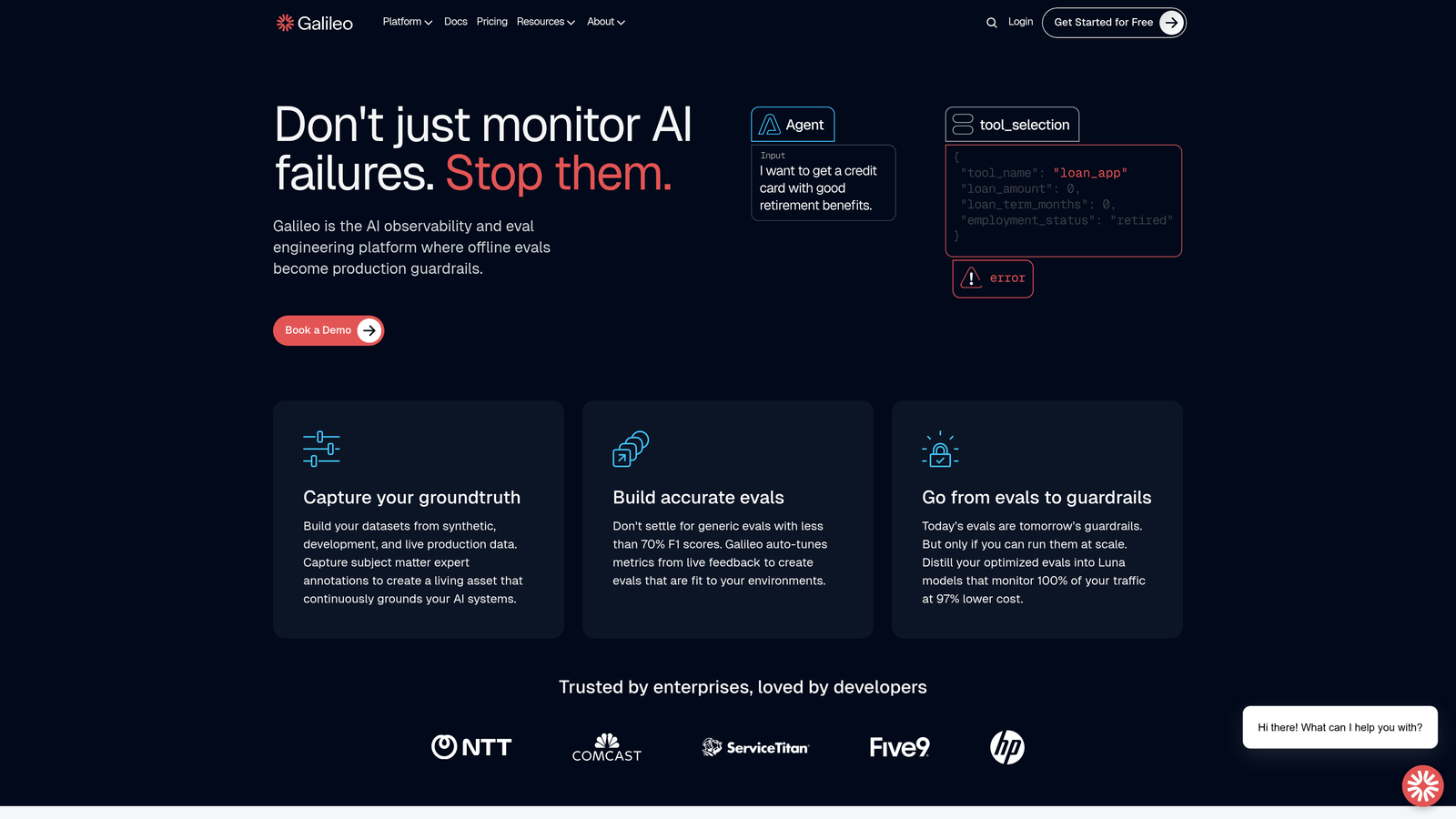
Galileo is an LLM evaluation and guardrails platform specializing in detecting hallucinations, measuring output quality, and ensuring response accuracy.
Where This Tool Shines
Galileo tackles the hardest problem in LLM deployment: ensuring output quality and accuracy. The hallucination detection scores each response, flagging when the model generates plausible-sounding but incorrect information. This becomes critical for high-stakes applications where accuracy matters.
The RAG evaluation capabilities help optimize retrieval-augmented generation systems. Identify when your retrieval system surfaces irrelevant context or when the LLM ignores good context in favor of hallucinated content.
Key Features
Hallucination Detection: Automatically score LLM responses for factual accuracy and flag potential hallucinations.
Output Quality Metrics: Measure response relevance, coherence, and alignment with expected outputs.
Production Guardrails: Implement automated quality checks that prevent low-quality responses from reaching users.
RAG Evaluation: Assess retrieval quality and measure how well LLMs utilize provided context.
Fine-Tuning Data Curation: Identify high-quality examples for model fine-tuning from production data.
Best For
Teams deploying LLMs in contexts where accuracy is critical, such as customer support, medical applications, or financial services. Particularly valuable if you're using RAG systems and need to optimize retrieval performance.
Pricing
Free tier available for evaluation and development. Enterprise pricing scales based on usage volume and feature requirements.
8. Portkey
Best for: Teams using multiple LLM providers who need unified routing and failover capabilities
Portkey is an LLM gateway and observability platform providing multi-provider routing, automatic failover, and unified monitoring across AI providers.
Where This Tool Shines
Portkey solves the multi-provider challenge elegantly. Route requests across OpenAI, Anthropic, Google, and others with automatic failover when a provider experiences downtime. The load balancing distributes requests to optimize for cost, latency, or quality.
The semantic caching is particularly clever. Unlike simple request caching, it identifies semantically similar prompts and reuses responses, dramatically reducing redundant API calls without requiring exact matches.
Key Features
Multi-Provider Gateway: Route requests across multiple LLM providers with automatic failover and retry logic.
Load Balancing: Distribute requests based on cost, latency, or custom rules to optimize performance.
Unified Monitoring: Track usage, costs, and performance across all providers in a single dashboard.
Semantic Caching: Reuse responses for semantically similar prompts, not just exact matches, reducing API costs.
Virtual Keys: Manage API credentials securely without exposing them in application code.
Best For
Development teams using multiple LLM providers who need reliability through failover and want to optimize costs across providers. Especially valuable if you're experimenting with different models for different use cases.
Pricing
Free tier includes 10,000 requests per month. Pro plan starts at $49/month with increased limits and advanced routing features.
9. LangSmith
Best for: Teams building applications with LangChain who need native debugging and monitoring
LangSmith is an LLM development and monitoring platform from LangChain, offering tight integration with the LangChain ecosystem for building and debugging AI applications.
Where This Tool Shines
If you're building with LangChain, LangSmith provides the most natural monitoring experience. The native integration means traces automatically capture LangChain-specific constructs like chains, agents, and retrievers without manual instrumentation.
The prompt playground lets you test and iterate on prompts directly in the monitoring interface. See how changes affect outputs across multiple test cases before deploying to production.
Key Features
Native LangChain Integration: Automatic tracing for LangChain applications without manual instrumentation.
Trace Visualization: Debug complex chains and agent workflows with detailed step-by-step traces.
Dataset Management: Build and version evaluation datasets to test LLM behavior across scenarios.
Prompt Playground: Test prompt variations and see results across multiple examples before deployment.
Annotation Queues: Collect human feedback on LLM outputs to improve evaluation and fine-tuning.
Best For
Development teams building LLM applications with the LangChain framework who want seamless monitoring without additional instrumentation work. Particularly valuable if you're using complex chains or agent architectures.
Pricing
Free tier available for individual developers. Plus plan at $39/month adds team collaboration and increased limits. Enterprise pricing available for larger deployments.
Finding Your Best Fit
The right LLM monitoring solution depends on what you're actually trying to monitor. These tools serve fundamentally different use cases, and choosing the wrong category wastes time and budget.
If you're a marketer or agency tracking how AI assistants represent your brand to consumers, Sight AI addresses your specific challenge. It monitors the AI platforms your customers actually use, identifies why competitors get recommended instead of you, and provides actionable paths to improve visibility. The integrated content creation and indexing tools close the loop from insight to optimization.
Engineering teams building LLM applications need different capabilities entirely. Langfuse and LangSmith excel at debugging complex workflows and managing prompt iterations. Helicone focuses on the cost control problem that plagues many LLM applications. Portkey solves multi-provider reliability challenges.
Enterprise data science teams with diverse AI systems should consider Arize AI or Weights & Biases for unified ML and LLM observability. Teams already invested in Datadog benefit from extending their existing stack to cover LLM monitoring.
For applications where output quality is critical, Galileo's hallucination detection and guardrails provide essential safety layers. This becomes non-negotiable in regulated industries or high-stakes contexts where LLM errors carry real consequences.
The AI search landscape continues evolving rapidly. Consumer-facing AI assistants are becoming significant discovery and conversion channels, while LLM applications proliferate across industries. Whatever solution you choose, establishing monitoring now positions you to adapt as these platforms reshape how customers find and evaluate solutions. Start tracking your AI visibility today and see exactly where your brand appears across top AI platforms.