Picture this: A potential customer opens ChatGPT and types, "What's the best marketing analytics platform for small businesses?" Within seconds, they receive a confident recommendation—complete with features, pricing insights, and use cases. Your competitor gets mentioned. You don't.
This scenario is playing out millions of times daily across ChatGPT, Claude, Perplexity, and other AI platforms. The search landscape has fundamentally shifted. Users increasingly bypass Google entirely, turning instead to AI assistants for product recommendations, comparisons, and purchasing advice. These conversations happen in private, leaving traditional analytics blind to a massive portion of the customer journey.
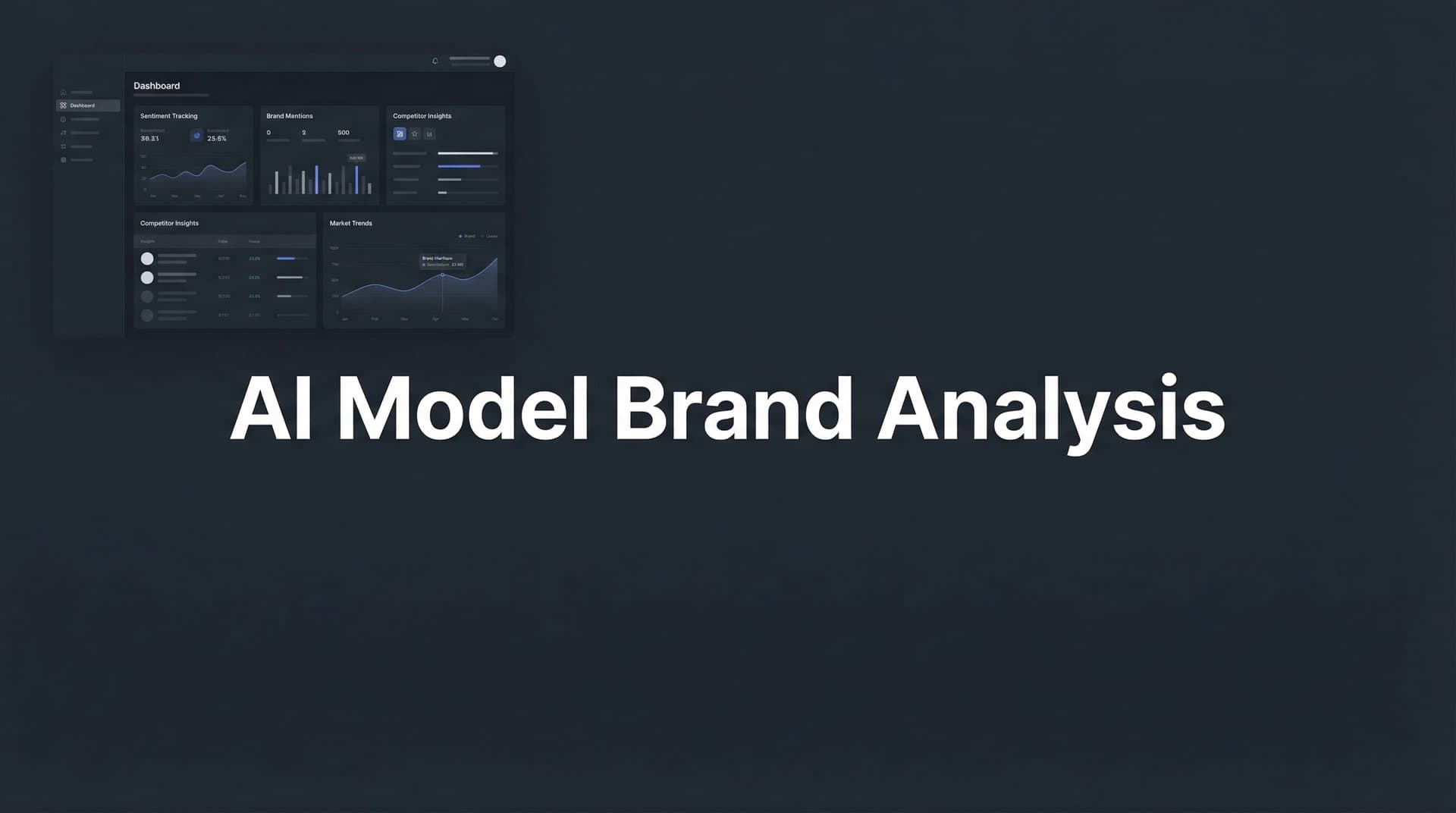
The critical question facing marketers today isn't just "Do we rank on Google?"—it's "When someone asks an AI for recommendations in our category, does our brand get mentioned?" This is where AI model brand analysis comes in: a systematic approach to understanding, tracking, and optimizing how AI systems perceive and represent your brand across platforms.
This isn't about gaming algorithms or manipulating AI responses. It's about ensuring that when AI models answer questions relevant to your business, they have access to accurate, comprehensive information about your brand. It's about understanding the new visibility battleground and positioning your brand to capture demand at the moment of intent—when users are actively seeking solutions.
The New Visibility Battleground: Why AI Models Matter for Your Brand
The way people discover products and services is undergoing a seismic shift. Traditional search behavior—typing keywords into Google, scanning blue links, clicking through to websites—is being supplemented and, in many cases, replaced by conversational queries to AI assistants.
Users trust these AI recommendations because they feel personalized and comprehensive. Instead of sifting through search results and reading multiple reviews, they receive what appears to be expert analysis delivered in natural language. The AI becomes a trusted advisor, and brands that earn favorable mentions in these conversations capture attention at the most valuable moment: when someone is actively looking for a solution.
Here's the fundamental difference between traditional SEO visibility and AI visibility: SEO is about ranking—securing a position on a search results page. AI visibility is about being mentioned, recommended, and accurately represented in conversational responses. You can rank #1 on Google for a keyword but never get mentioned by ChatGPT when users ask related questions. Conversely, you might have modest search rankings but consistently appear in AI recommendations because your brand has strong signals in the data these models access.
The business impact is direct and measurable. When AI models mention your brand favorably in response to buying-intent queries, you're capturing demand from users who have already moved past awareness and are actively evaluating solutions. Understanding how AI models choose brands to recommend is essential for capturing these opportunities. These aren't cold prospects—they're warm leads seeking specific recommendations. Brands that appear in these conversations benefit from implied endorsement, while those absent lose opportunities to competitors who have optimized their AI presence.
Think of it like this: traditional SEO gets you onto the consideration list. AI visibility determines whether you make it into the conversation at all. As AI assistants become the default interface for information retrieval, brands without a strategy for AI model analysis are essentially invisible to a growing segment of their target market.
Anatomy of AI Model Brand Analysis: What You're Actually Measuring
AI model brand analysis isn't a single metric—it's a framework of interconnected measurements that together reveal how AI systems perceive and represent your brand. Understanding what to measure is the foundation of any effective AI visibility strategy.
Mention Frequency: The most fundamental metric is whether your brand appears at all when relevant prompts are asked. This isn't just about vanity—it's about share of voice in AI conversations. If users ask "What are the top project management tools?" and your brand appears in 7 out of 10 responses while competitors appear in 9 out of 10, you're losing mindshare. Implementing effective AI model brand mention tracking tells you how consistently AI models consider your brand relevant to specific queries.
Sentiment Analysis: Being mentioned isn't enough—context matters enormously. Is your brand presented positively, with strengths highlighted? Neutrally, as just another option? Or negatively, with criticisms or limitations emphasized? AI sentiment analysis examines the tone and framing of brand mentions. A brand consistently described as "affordable but limited" faces different challenges than one characterized as "premium and feature-rich."
Context Accuracy: AI models sometimes hallucinate or work with outdated information. Your brand might be mentioned with incorrect pricing, obsolete features, or inaccurate company details. Accuracy assessment ensures that when AI discusses your brand, the information aligns with current reality. This matters because users trust AI responses—inaccurate information can send prospects away or create false expectations.
Recommendation Positioning: Where does your brand appear in AI recommendations? Are you the first option mentioned, buried in the middle of a list, or only included as an afterthought? Positioning within responses significantly impacts visibility and perceived authority. Being consistently listed first signals that AI models view your brand as a category leader.
Understanding prompt variations is crucial because different phrasings trigger different responses. "Best email marketing software" might yield different brand mentions than "email marketing tools for e-commerce" or "affordable email marketing platforms." Comprehensive AI brand analysis maps the prompt landscape—identifying which question variations surface your brand and which leave you absent. This reveals content gaps and optimization opportunities.
Tracking must happen across multiple platforms because AI models differ in their training data, retrieval methods, and update frequencies. ChatGPT might mention your brand consistently while Claude rarely does, or Perplexity might surface recent content that other models miss. Learning how to track brand in multiple AI models reveals where your brand presence is strong and where it needs attention. The major platforms to monitor include ChatGPT, Claude, Perplexity, Gemini, and emerging AI assistants as they gain adoption.
How AI Models Form Brand Perceptions
To influence how AI models represent your brand, you need to understand how they form perceptions in the first place. AI brand representation isn't random—it's shaped by specific data sources and mechanisms that marketers can learn to navigate.
Training Data Influence: Large language models are trained on massive datasets scraped from the internet—articles, reviews, documentation, social media, and countless other sources. The content that existed during a model's training period shapes its baseline understanding of your brand. If authoritative publications covered your product launch favorably, that positive signal is baked into the model's knowledge. Conversely, if your brand had limited online presence during training, the model has little information to draw from when users ask about your category.
This creates an interesting dynamic: your historical content strategy affects current AI visibility. The blog posts, press releases, and third-party coverage from years ago continue influencing how AI models discuss your brand today. Understanding how AI models rank brands helps you recognize that AI perceptions have roots in your brand's digital history.
Real-Time Retrieval: Many modern AI models don't rely solely on training data. They perform real-time web searches to supplement responses with current information. Perplexity, for example, explicitly shows sources it retrieved. ChatGPT's browsing capability allows it to access recent content. This retrieval mechanism creates opportunities for influence through fresh, authoritative content that AI models can discover and cite when answering user queries.
The implication is significant: you can actively shape AI brand representation through strategic content creation. Publishing comprehensive guides, maintaining updated documentation, earning authoritative backlinks, and ensuring your brand appears in high-quality contexts all feed into what AI models retrieve and present to users.
There's a powerful feedback loop at work here. Your content strategy influences how AI models represent your brand. Those AI representations affect whether users discover and engage with your brand. User engagement generates new content—reviews, mentions, discussions—that further shapes AI perceptions. Brands that understand this cycle can accelerate positive momentum, while those ignoring AI visibility risk a negative spiral where absence leads to less engagement, which reinforces absence.
Think of AI models as constantly updated mirrors reflecting your brand's digital footprint. The clearer and more authoritative that footprint, the more accurately and favorably AI systems represent you. This isn't about manipulation—it's about ensuring that comprehensive, accurate information about your brand exists in the places AI models look when forming responses.
Building Your AI Brand Analysis Framework
Understanding AI model brand analysis conceptually is one thing. Implementing a systematic approach that delivers actionable insights is another. Here's how to build a framework that works.
Step 1: Identify the Prompts and Questions Relevant to Your Market
Start by mapping the question landscape in your industry. What do potential customers actually ask AI assistants when looking for solutions like yours? This isn't guesswork—it's research. Think about buying-intent queries: "What's the best [product category] for [use case]?" Consider comparison queries: "X vs Y vs Z comparison." Include problem-focused questions: "How do I solve [specific problem]?"
Expand beyond obvious prompts. Users ask AI assistants questions they wouldn't type into Google because conversational interfaces encourage natural language. "I'm a small business owner struggling with inventory management—what software should I use?" captures intent that keyword-based thinking might miss.
Document competitor prompts as well. What questions surface your competitors but not you? These gaps represent immediate opportunities. Create a comprehensive prompt library organized by intent stage (awareness, consideration, decision) and use case. This library becomes your testing ground for AI brand analysis.
Step 2: Establish Baseline Measurements Across Multiple AI Platforms
With your prompt library ready, systematically test each prompt across major AI platforms. Record whether your brand is mentioned, how it's described, sentiment, accuracy, and positioning relative to competitors. Using AI model brand tracking software reveals your starting point and highlights platform-specific differences.
Don't test prompts just once. AI models can produce varying responses to identical prompts due to their probabilistic nature. Test each prompt multiple times to understand consistency. If your brand appears in 8 out of 10 responses to a specific prompt on ChatGPT but only 2 out of 10 on Claude, that's valuable intelligence about where to focus optimization efforts.
Document everything in a structured format. Spreadsheets work for small-scale analysis, but dedicated AI visibility tracking tools become essential as your prompt library grows. The goal is creating a repeatable measurement system that captures nuance while remaining manageable.
Step 3: Create a Monitoring Cadence and Track Changes Over Time
AI brand analysis isn't a one-time audit—it's ongoing monitoring. AI models update, your content evolves, competitors adjust their strategies, and new information about your brand appears online. Establishing a regular monitoring cadence ensures you catch changes and can respond strategically.
Monthly monitoring works well for most brands as a starting point. Test your core prompt library across platforms, compare results to previous periods, and identify trends. Are mentions increasing or decreasing? Has sentiment shifted? Are new competitors appearing in responses where they previously didn't? Implementing a robust AI model brand monitoring tool makes this process manageable.
Increase monitoring frequency around major events: product launches, rebrands, significant press coverage, or competitive moves. These moments can shift AI perceptions quickly, and real-time awareness allows for rapid response if issues emerge. Set up alerts for sudden changes in mention frequency or sentiment that might indicate problems requiring immediate attention.
From Insights to Action: Improving Your AI Brand Presence
Measurement without action is just data collection. The real value of AI model brand analysis comes from translating insights into strategies that improve how AI systems represent your brand. Here's how to move from understanding to optimization.
Content Optimization Strategies That Influence AI Model Outputs
AI models pull information from authoritative, comprehensive sources. Your content strategy should prioritize creating resources that AI systems find valuable when forming responses. Write detailed guides that answer common questions in your category thoroughly. Publish comparison content that positions your brand accurately alongside competitors. Maintain up-to-date documentation that AI models can reference when users ask about features or capabilities.
Focus on earning authoritative backlinks and mentions from respected publications. When AI models retrieve information, they weight sources based on perceived authority. A mention in a major industry publication carries more influence than a random blog post. Strategic PR and content partnerships that generate high-quality coverage directly impact AI brand representation.
Optimize for the questions AI users actually ask, not just traditional keywords. If your AI brand analysis reveals that users ask "What's the easiest [product category] for beginners?" but you've never created content addressing ease of use for newcomers, that's a clear content gap. Learning how to improve brand visibility in AI helps you create resources that directly answer the prompts where you want better visibility.
Addressing Negative Sentiment or Inaccurate Information in AI Responses
When AI models present your brand negatively or inaccurately, you can't directly edit their responses—but you can address the underlying information sources. If inaccurate pricing appears consistently, ensure your website clearly displays current pricing and that authoritative sources cite correct information. If outdated features are mentioned, publish prominent announcements about updates and new capabilities.
Negative sentiment often stems from legitimate issues reflected in reviews and discussions. Rather than trying to suppress criticism, address the underlying problems and create new positive signals. Launch improved features, enhance customer support, and encourage satisfied customers to share experiences. Knowing how to monitor AI model brand sentiment helps you track whether fresh positive content balances or outweighs older negative signals.
For factual errors that persist despite your efforts to correct source information, consider reaching out to platforms directly. Many AI companies have processes for reporting inaccuracies, particularly when incorrect information could harm users or businesses.
Aligning Your GEO Efforts With Brand Analysis Findings
Generative Engine Optimization (GEO)—the practice of optimizing content to appear in AI-generated responses—should be informed by your brand analysis findings. If your analysis reveals that certain prompt types never surface your brand, prioritize creating content optimized for those queries. If competitors consistently outrank you in AI recommendations, analyze what content and signals they have that you lack.
GEO isn't separate from AI brand analysis—they're complementary disciplines. Brand analysis tells you where you stand and identifies opportunities. GEO is the execution layer that capitalizes on those opportunities through strategic content creation, technical optimization, and authority building. Together, they form a complete approach to AI visibility.
Putting It All Together: Your AI Visibility Roadmap
Implementing AI model brand analysis doesn't require massive resources or technical expertise—it requires systematic thinking and consistent execution. Here's your quick-start roadmap for building an effective AI visibility practice.
Quick-Start Checklist:
1. Create your initial prompt library with 20-30 buying-intent questions relevant to your category and use cases.
2. Test these prompts across ChatGPT, Claude, and Perplexity at minimum, recording mention frequency, sentiment, and positioning for your brand and top competitors.
3. Identify your three biggest visibility gaps—prompts where competitors appear but you don't, or where sentiment is notably negative.
4. Develop content addressing these gaps: comprehensive guides, updated documentation, or resources that directly answer the prompts where you need visibility.
5. Establish monthly monitoring for your core prompt library and quarterly deep-dive analysis to identify trends and adjust strategy.
Key Metrics to Report to Stakeholders
When demonstrating the value of AI brand analysis to leadership, focus on metrics that connect to business outcomes. Share of voice in AI recommendations compared to competitors shows competitive positioning. Mention frequency trends over time demonstrate whether your optimization efforts are working. Using brand sentiment analysis tools reveals brand perception health in AI contexts.
Connect AI visibility metrics to downstream business impact when possible. If you see increased brand mentions in AI responses during a period, look for corresponding upticks in branded search volume, direct traffic, or conversion rates from users who mention finding you through AI assistants. These connections help stakeholders understand that AI visibility isn't vanity metrics—it's a channel driving real business results.
Staying Ahead as AI Models Continue to Change
The AI landscape evolves rapidly. Models update their training data, new platforms emerge, retrieval methods change, and user behavior shifts. Building flexibility into your AI brand analysis framework ensures you can adapt rather than constantly rebuilding from scratch.
Stay informed about major AI model updates and how they might affect brand representation. When ChatGPT updates its knowledge cutoff or Claude changes its retrieval approach, test your core prompts again to understand impact. Monitor emerging AI platforms before they reach mainstream adoption—early optimization on new platforms can establish strong positioning before competition intensifies.
Most importantly, treat AI brand analysis as an ongoing practice, not a project with an end date. The brands that win in this new visibility landscape are those that make AI monitoring as routine as checking Google Analytics or social media metrics. Consistency compounds over time, and early adopters build advantages that become increasingly difficult for competitors to overcome.
Your Next Move in the AI Visibility Game
AI model brand analysis isn't optional for forward-thinking marketers—it's rapidly becoming as essential as traditional SEO. The shift toward AI-assisted discovery is accelerating, not slowing down. Every day that passes with your brand absent from AI recommendations is a day competitors capture mindshare and opportunities that could have been yours.
The competitive advantage of early adoption is significant and tangible. Brands that understand and optimize their AI presence now are building visibility moats that will be difficult to breach. They're capturing demand from users who bypass traditional search entirely. They're shaping how AI models perceive their category before those perceptions solidify. They're learning and iterating while competitors remain blind to this emerging channel.
The good news? You don't need to be a technical expert or have massive resources to start. You need systematic thinking, consistent execution, and the right tools to make measurement and optimization manageable at scale. The brands succeeding with AI visibility aren't necessarily the biggest or most established—they're the ones that recognized the shift early and took action.
Stop guessing how AI models like ChatGPT and Claude talk about your brand—get visibility into every mention, track content opportunities, and automate your path to organic traffic growth. Start tracking your AI visibility today and see exactly where your brand appears across top AI platforms.