Content teams are under more pressure than ever to produce high-quality, search-optimized articles at scale without sacrificing accuracy or brand voice. The challenge isn't a lack of ideas; it's the operational bottleneck between strategy and publication. An AI agent content creation workflow solves this by automating the repetitive, time-consuming stages of content production while keeping human judgment where it matters most.
In this guide, you'll learn how to build a repeatable, end-to-end workflow using AI agents, from keyword research and brief creation through to drafting, optimization, and publishing. Whether you're a solo founder trying to compete with larger content teams, a marketer looking to scale output, or an agency managing multiple client pipelines, this workflow gives you a structured system you can implement immediately.
By the end, you'll have a clear process for assigning AI agents to specific content tasks, a quality control layer that prevents generic output, and a publishing pipeline that gets your content indexed and discoverable faster. The goal isn't to replace strategic thinking. It's to eliminate the manual labor that slows it down.
Step 1: Define Your Content Goals and Keyword Strategy
Before you deploy a single AI agent, you need to answer a fundamental question: what are you actually trying to achieve? This sounds obvious, but skipping this step is the most common reason AI-generated content ends up technically correct and strategically useless.
Start by establishing clear content objectives. Are you targeting traditional organic search traffic through Google rankings? Are you building AI search visibility, also known as Generative Engine Optimization (GEO), so your brand gets cited by models like ChatGPT, Claude, and Perplexity? Or both? The answer shapes every downstream decision in your workflow.
Next, map your keyword strategy to funnel stages. Informational queries ("what is X") require educational content that builds authority. Navigational queries ("best X tools") require comparison-style content that positions your brand. Transactional queries ("X pricing" or "X vs Y") require content that converts. AI agents produce significantly better output when the target intent is unambiguous, so define it explicitly before briefing them.
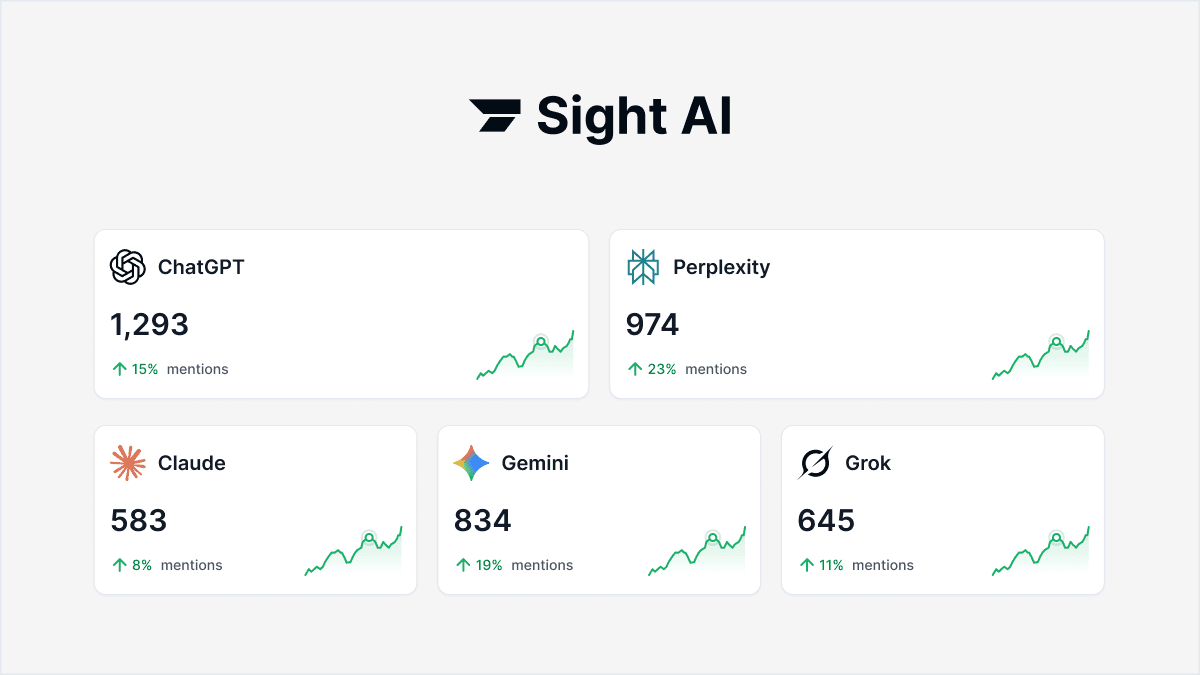
Here's a tactic that many teams overlook: use AI visibility data to identify which topics your brand is already being mentioned for across AI models, then find the gaps. If your brand appears in Perplexity responses about one topic but is completely absent from ChatGPT responses about a closely related topic, that gap represents a high-priority content opportunity. This kind of insight transforms your keyword strategy from guesswork into a data-driven prioritization system.
Prioritize keywords with clear search intent over high-volume vanity terms. A topic with moderate search volume and unambiguous intent will consistently outperform a high-volume term where the intent is mixed or unclear, both in rankings and in AI model citations.
Common pitfall: Skipping this step leads to AI agents generating content that is technically well-written but strategically misaligned. Fix intent before you brief, not after you've already generated three drafts.
Success indicator: You have a prioritized list of 10 to 20 target topics, each with a defined intent, target audience, funnel stage, and desired outcome. This list becomes the input queue for your entire content workflow.
Step 2: Assemble Your AI Agent Stack and Assign Roles
One of the most important architectural decisions in an AI agent content creation workflow is this: use specialized agents for distinct tasks rather than one generalist agent for everything. A single agent asked to research, outline, write, optimize, and review simultaneously will produce mediocre output at every stage. Specialization is where the quality gains come from.
Here are the core agent roles to define for a content production pipeline:
Research Agent: Handles SERP analysis, competitor content gap identification, and topic clustering. Input is a target keyword; output is a structured research brief with key angles, competitor weaknesses, and relevant subtopics to cover.
Brief Agent: Takes the research output and generates a structured content brief, including heading hierarchy, key points per section, word count targets, and internal link opportunities. This agent bridges strategy and execution.
Writer Agent: Generates the full article draft based on the brief. This agent should operate with clear constraints: heading structure, paragraph length limits, tone guidelines, and placeholders for internal links or data points to be verified.
Optimization Agent: Reviews the draft against SEO and GEO criteria. This includes keyword usage and density, heading hierarchy, meta description quality, and GEO signals such as conversational phrasing and direct, quotable answers within each major section.
Review Agent: Checks for brand voice consistency, factual accuracy flags, and any hallucinations or unsupported claims. This agent can operate with your brand guidelines and a set of verification rules loaded as context.
The difference between single-agent and multi-agent pipelines matters here. In a multi-agent system, each agent operates within a narrow, well-defined scope. This means the writer agent isn't trying to simultaneously optimize for SEO while maintaining brand voice while checking facts. It's just writing. That focus produces dramatically better first drafts.
Platforms like Sight AI offer 13+ specialized AI agents with an Autopilot Mode, which allows you to configure these agent roles and handoff triggers without building custom infrastructure from scratch. This is particularly valuable for teams that want the benefits of a multi-agent pipeline without the engineering overhead.
Common pitfall: Assigning overlapping responsibilities to agents creates redundant output and inflated word counts. Keep role boundaries clean. Each agent should have a single defined input, a single defined output, and a clear trigger for handing off to the next agent.
Success indicator: You can describe exactly what each agent receives, what it produces, and what condition triggers the handoff. If you can't describe that clearly, the roles aren't defined tightly enough yet.
Step 3: Build a Structured Content Brief Template
The brief is the most critical input in your entire workflow. The principle of "garbage in, garbage out" applies here more than anywhere else. A well-constructed brief doesn't just tell the writer agent what to write; it tells it how to think about the topic, who it's writing for, and what success looks like.
A well-structured brief for AI agents should include the following components:
Primary keyword: The exact target term with defined search intent.
Secondary keywords: Related terms and semantic variations to weave naturally throughout the draft.
Target audience: Specific enough to be actionable. Not "marketers" but "B2B SaaS marketers managing content teams of two to five people."
Content type: Listicle, step-by-step guide, explainer, comparison, or thought leadership. Each type has different structural conventions that the writer agent needs to follow.
Desired word count: A range, not a fixed number, to give the agent room to cover topics with appropriate depth.
Tone and voice guidelines: This is where most teams get vague, and that vagueness is expensive. "Professional" is not a useful instruction. Instead, provide two or three example sentences that demonstrate your brand voice. The agent can pattern-match against concrete examples far more reliably than it can interpret abstract descriptors.
Key points to cover: A structured list of the arguments, insights, or information each major section must contain. This prevents the agent from filling space with generic filler.
GEO-specific instructions: Tell the writer agent explicitly to structure content so that it answers conversational queries directly. AI search models favor concise, authoritative answers, so your brief should instruct the agent to include a direct, quotable answer within the first 100 words of each major section.
For format, use a consistent JSON or markdown template so briefs can be passed programmatically between agents without manual reformatting. Consistency here eliminates a surprising amount of friction as your content workflow scales.
Common pitfall: Vague tone instructions produce inconsistent output across articles, which erodes brand voice over time. Invest the time upfront to create sentence-level examples of your brand voice and include them in every brief.
Success indicator: Any writer agent receiving your brief produces a first draft that requires fewer than three structural revisions. If you're consistently making major structural changes, the brief is the problem, not the agent.
Step 4: Run the Draft-Optimize-Review Loop
This is the core execution phase of your AI agent content creation workflow. Structure it as a loop, not a linear sequence, because drafts rarely pass all optimization checks on the first pass. Expecting perfection in one pass leads to frustration; designing for iteration leads to consistently strong output.
The loop has three phases, each handled by a specialized agent or human checkpoint.
Draft phase: The writer agent generates the full article based on the brief. Set clear parameters: heading structure (H2 for major sections, H3 for subsections), maximum paragraph length, tone consistency, and placeholders for internal links or data points that need verification. The writer agent's only job here is to produce a well-structured, readable draft. Optimization comes next.
Separating the draft and optimize phases is a deliberate architectural choice. When a writer agent is simultaneously trying to optimize for keyword density while maintaining narrative flow, the output suffers on both dimensions. Sequential, focused tasks produce better results.
Optimize phase: Pass the draft to your optimization agent. This agent checks keyword usage and placement, heading hierarchy, meta description quality, and GEO signals. For GEO optimization specifically, the agent should verify that each major section opens with a concise, quotable answer to the implied query. This structure increases the likelihood that AI models will surface your content when answering related questions.
The optimization agent should also check for internal link opportunities and insert contextually relevant links before the draft moves to review. Internal linking at the time of publication, rather than retroactively, ensures new pages immediately receive link equity from existing high-authority pages.
Review phase: This is where human judgment is non-negotiable. A human reviewer, or a dedicated review agent with brand guidelines and a fact-checking ruleset loaded as context, checks for factual accuracy, brand voice consistency, and any AI-generated hallucinations or unsupported claims. Every claim that could be misread as a fabricated statistic or unverified assertion should be flagged for verification before approval.
Define a clear Service Level Agreement for this phase. For example, approved or returned with revision notes within 24 hours. Without a defined SLA, review becomes the bottleneck that defeats the purpose of the entire workflow.
Common pitfall: Skipping the review phase and auto-publishing AI drafts is the fastest way to damage brand credibility. Always include at least one human checkpoint before publication, regardless of how confident you are in the agent's output quality.
Success indicator: Drafts pass optimization checks with minimal revision and receive human approval within your defined SLA. If drafts are consistently failing optimization checks, revisit the brief template in Step 3.
Step 5: Automate Publishing and Indexing
A completed, approved article sitting in a draft folder generates zero traffic. Publishing speed matters, but indexing speed matters even more. The faster search engines discover and process your content, the sooner you start accumulating ranking signals and visibility data.
Configure CMS auto-publishing as the first automation layer. Connect your AI workflow to your CMS, whether that's WordPress, Webflow, or another platform, so approved drafts are published with correct metadata already applied: title tags, meta descriptions, categories, tags, and internal links. Manual publishing introduces delay and inconsistency; automation eliminates both.
The second layer is IndexNow integration. IndexNow is a protocol supported by Bing, Yandex, and other search engines that allows you to notify them the moment new content goes live. Rather than waiting for a crawler to organically discover your new page, which can take days or weeks, IndexNow triggers near-instant discovery. For content teams publishing at scale, this compounds into a meaningful advantage over time.
The third layer is automated XML sitemap updates. Every time new content is published, your sitemap should update automatically so crawlers always have an accurate, current map of your site structure. An outdated sitemap is a surprisingly common reason new content takes longer to get indexed than it should.
Internal linking deserves specific attention here. Your optimization agent should identify and insert contextually relevant internal links before the article is published, not as a retroactive task. This ensures new pages immediately receive link equity from existing high-authority pages in your site architecture, improving both crawlability and ranking potential from day one.
Platforms like Sight AI include IndexNow integration and automated sitemap updates as part of their publishing pipeline, which means these three layers can operate without manual intervention once configured.
Common pitfall: Publishing without updating your sitemap or triggering IndexNow means new content can sit undiscovered for days or even weeks. In a competitive content environment, that lag has real costs.
Success indicator: New articles appear in Google Search Console as discovered within 48 hours of publication. If you're consistently seeing longer discovery times, check your IndexNow integration and sitemap update configuration.
Step 6: Monitor AI Visibility and Iterate
Publishing is not the end of your workflow. It's the beginning of the measurement phase that informs your next content cycle. The teams that build compounding content advantages are the ones that treat performance data as an input to strategy, not just a report card.
Track performance across two distinct layers. The first is traditional SEO metrics: keyword rankings, organic clicks, impressions, and click-through rates. These tell you how your content is performing in conventional search. The second is AI visibility metrics: how often your brand or specific content pieces are cited by ChatGPT, Claude, Perplexity, and other AI models when users ask relevant questions.
These two layers don't always move together. A piece of content can rank well in Google but be largely absent from AI model responses. Conversely, content that's structured with strong GEO signals, direct answers, and authoritative framing may get cited frequently in AI search even before it climbs traditional rankings. Tracking both gives you a complete picture of your content's actual reach.
AI Visibility Score data, available through platforms like Sight AI, lets you identify which published articles are generating brand mentions in AI search and which are being ignored. This reveals two things: content gaps you haven't addressed yet, and optimization opportunities in existing content that could be revised to improve citation rates.
Sentiment analysis adds another dimension. It's not enough to know whether you're being mentioned; you need to know how. Positive, neutral, or negative framing in AI model responses affects brand perception in AI-driven discovery. If your brand is being mentioned in a neutral or unfavorable context, that's a signal to revisit both the content and the brand narrative you're projecting.
Feed this performance data back into Step 1. Topics that perform well in AI search should inform your next keyword prioritization round. This creates a compounding content flywheel: better data leads to better briefs, which leads to better content, which generates more visibility data, which leads to better strategy.
Common pitfall: Optimizing exclusively for Google rankings while ignoring AI search visibility means missing a growing share of discovery traffic as more users rely on AI models for information and recommendations.
Success indicator: You can attribute measurable increases in brand mentions across AI platforms to specific content pieces published through your workflow. When you can draw that line, your workflow is functioning as a strategic system, not just a production tool.
Putting It All Together
Building an AI agent content creation workflow is less about technology and more about process discipline. The steps above give you a repeatable system: define strategy, configure specialized agents, brief them precisely, run a structured draft-optimize-review loop, automate publishing and indexing, and measure both SEO and AI visibility performance.
Here's a quick-start checklist to confirm your workflow is ready to run:
✓ Keyword strategy and intent mapping complete
✓ AI agent roles defined with clear inputs and outputs
✓ Brief template created and tested with at least one real article
✓ Draft-optimize-review loop configured with a human checkpoint
✓ CMS auto-publishing and IndexNow integration active
✓ AI visibility monitoring set up across target platforms
The teams seeing the strongest results from AI content workflows are those who treat AI agents as specialized team members with defined responsibilities, not as a single tool that does everything. Start with two or three agents handling your highest-friction tasks, validate the output quality, then expand. Trying to automate everything at once before validating quality at each stage is the most common implementation mistake.
If you're looking for a platform that combines AI content generation, SEO and GEO optimization, and AI visibility tracking in one place, Sight AI's Autopilot Mode and 13+ specialized agents are built for exactly this workflow. Stop guessing how AI models like ChatGPT and Claude talk about your brand. Start tracking your AI visibility today and see exactly where your brand appears across top AI platforms.