When you boil it down, content in SEO is any piece of information on your website that a search engine can crawl and a real person can find value in. This covers everything from blog posts and product pages to videos and images—basically, anything you create to attract, engage, and ultimately win over an audience that finds you through Google.
Defining Content in the World of SEO

Here’s a helpful way to think about it: your website is like a digital storefront. SEO is the big, bright sign out front that lets people know you’re open for business.
But what happens when they walk in? That's where content comes in.
Content is the expert salesperson on the floor. It’s the friendly face that answers questions, demos the products, and builds a genuine connection with every visitor. Without that salesperson, the store is just an empty room with products on a shelf. In the same way, content is the very substance that gives your website purpose and value.
It's the critical bridge connecting a person's problem—typed into a search bar—to your business's solution. For search engines, content is the currency they trade in.
The True Purpose of SEO Content
When we really dig into the question, "what is content in SEO," we're asking how to speak two languages at once: the language of search engine algorithms and the language of human users. Search engines are just incredibly sophisticated matching systems. Their only job is to find the most relevant, helpful, and trustworthy answer for any question someone asks.
Your content's job is to be that answer.
This means any high-quality piece of content is doing several jobs at the same time:
- It Answers Questions: It gets straight to the point and addresses what the user was looking for with clear, accurate information.
- It Demonstrates Authority: It proves to both Google and your audience that you’re a credible expert on the topic.
- It Builds Trust: Through consistently useful information, it starts to build a real relationship with potential customers.
- It Drives Business Goals: Ultimately, it nudges visitors toward an action you care about, whether that's signing up for a newsletter, booking a demo, or hitting "buy now."
In modern SEO, content isn't just a container for keywords anymore; it's the entire experience you deliver. If your content is genuinely the best resource out there for a specific search, Google will work hard to get it in front of the right people.
Core Functions at a Glance
To really get a handle on its role, it helps to break down the main jobs content does within your SEO strategy. Every blog post, landing page, or video should be created with a clear purpose, contributing to your bigger goals of visibility and growth.
When you nail this, you kickstart a powerful cycle: great content attracts more people, which sends positive signals to search engines, which boosts your rankings even further. You can learn more about perfecting this process in our guide to what is content optimization.
Before we dive into the different types of content and how to create them, the table below gives a quick summary of these core functions. Think of it as a high-level map showing how content fuels SEO success.
The Core Functions of Content in SEO
A summary of the primary roles that high-quality content plays in achieving SEO success and driving business goals.
| Function | Description | Business Impact |
|---|---|---|
| Attract & Engage | Captures user attention by answering questions and providing valuable information, keeping them on the site. | Generates top-of-funnel traffic and builds initial brand awareness. |
| Build Authority | Demonstrates expertise on a topic, establishing the site as a credible and trustworthy source for users and search engines. | Increases keyword rankings and builds brand reputation and loyalty. |
| Drive Conversions | Guides users toward specific actions, such as making a purchase, filling out a form, or contacting sales. | Directly contributes to leads, sales, and overall revenue growth. |
With this foundation in place, we can start exploring the specific strategies and techniques that turn simple words and images into powerful drivers of organic growth.
The Three Pillars of High-Performing SEO Content

To really get what content means in SEO, you have to accept that not all content is created equal. Each piece needs a specific job. To build a strategy that actually works, you have to think like an architect, designing different types of content that support your entire structure.
Think of it like this: your audience finds and interacts with your brand at different stages of their journey. Some are just digging for information, others are ready to pull out their wallets, and a few are trying to figure out who you are as a company. A smart content plan speaks to all three groups.
This framework helps you move from just randomly publishing articles to building a content portfolio where every single piece has a clear purpose.
Pillar 1: Informational Content
The first and biggest pillar is Informational Content. This is the stuff you create to answer questions, solve nagging problems, and teach your audience something valuable. It’s aimed squarely at people at the top of the funnel who are exploring a topic, not necessarily looking to buy anything just yet.
Its main goal is to position your brand as a helpful, go-to expert. This is where you build trust and awareness long before someone even thinks about becoming a customer. A staggering 80% of all online searches are informational. By providing the best answers, you get in front of this massive audience.
Examples of informational content include:
- Blog Posts and Articles: Deep dives like, "How to Choose the Right Project Management Software."
- Tutorials and How-To Guides: Simple, step-by-step instructions that walk someone through a task.
- Infographics: Visual summaries of data or complex ideas that are super easy to scan and share.
- Glossaries and Definitions: Straightforward explanations of industry jargon.
Creating genuinely useful informational content pulls in organic traffic, earns valuable backlinks from other sites, and builds an audience that will remember you when they’re ready to take the next step.
Pillar 2: Transactional Content
While informational content builds awareness, Transactional Content is all about driving action. This pillar is for users who are past the research phase and are actively looking to make a purchase or sign up. Their intent is crystal clear: they’re ready to convert.
This content is your digital salesperson, designed to persuade and make the transaction seamless. It's focused on your products or services, so the language needs to be compelling, clear, and direct, zeroing in on benefits, features, and why your solution is the best choice.
Transactional content is where SEO directly turns into revenue. Optimizing these pages is absolutely critical because they target users with the highest commercial intent, making them some of the most valuable real estate on your website.
Common types of transactional content are:
- Product Pages: Detailed descriptions, specs, pricing, and great photos of what you're selling.
- Service Pages: Clear explanations of your services, outlining the value a customer gets.
- Comparison Pages: Head-to-head comparisons of your product against a competitor’s, highlighting your key advantages.
- Free Trial or Demo Pages: Landing pages built to get users to sign up and try your offering.
For more on how to make these pillars work together, check out our guide on creating an effective SEO content strategy that pulls it all together.
Pillar 3: Brand and Navigational Content
The final pillar is Brand and Navigational Content. This serves people who already know who you are and are specifically searching for your company. Their queries often include your brand name, like "Sight AI pricing" or "Sight AI reviews."
The goal here is to reinforce trust, build deeper loyalty, and make it incredibly easy for existing customers and warm leads to find what they're looking for. While transactional content closes the deal, brand content confirms it was the right decision by providing social proof and showing what your company stands for.
This pillar includes:
- Homepage: The front door to your website, clearly stating who you are and what you do.
- About Us Page: The story behind your brand, your mission, and the people making it happen.
- Case Studies: Real-world success stories showing how customers solved a problem with your product or service.
- Testimonials and Reviews: Direct quotes and feedback from happy customers that build instant credibility.
A truly complete content plan strategically develops assets across all three pillars. This balanced approach ensures you’re not just attracting new visitors, but also converting interested prospects and keeping loyal customers happy.
Mastering On-Page SEO Elements for Your Content
Understanding the types of content you need to create is a huge first step. But for search engines to actually find, understand, and rank that content, you need to leave some clear signposts for them.
These signposts are what we call on-page SEO elements. Think of them like the perfectly organized labels on the outside of a filing cabinet. They tell Google exactly what's inside each page, making it dead simple to categorize and pull up for the right person searching.
Without these, even the most brilliant article is just a book with a blank cover sitting on a shelf in a massive library. Getting these elements right is the foundation for making sure your hard work gets discovered.
Title Tags: Your First Impression in the Search Results
Your title tag is arguably the single most important on-page factor. It's the blue clickable link that shows up in the search results, and it's the very first thing a potential reader sees. Its job is to both describe the page's content accurately and be compelling enough to earn the click.
A great title tag pulls double duty:
- It tells search engines the page's main topic, ideally with your primary keyword near the beginning.
- It convinces a human that your page holds the best answer to their problem, making it stand out from the other nine results on the page.
For instance, a weak title like "Project Software" is forgettable. A much stronger, optimized version would be "The 10 Best Project Management Software Tools for Small Teams (2024)." It's specific, packed with valuable keywords, and offers a clear promise to the user.
Meta Descriptions: Your Sales Pitch
Sitting right below your title tag in the search results is the meta description. This little snippet of text (usually around 155-160 characters) doesn't directly influence your rankings, but it has a massive impact on your click-through rate (CTR).
Think of it as a mini-advertisement for your page. It's your shot to expand on the promise you made in the title and give searchers a compelling reason to choose your link over everyone else's. A solid meta description quickly summarizes the page's value and often includes a gentle nudge, like "Learn more," "Discover how," or "Find your perfect fit."
Header Tags: Giving Your Content Structure
Once someone clicks through to your site, header tags (H1, H2, H3, etc.) are what bring order to the chaos. They create a clear, logical hierarchy that makes your content much easier for both people and search engine crawlers to scan and understand.
- H1 Tag: This is your page's main headline. You should only ever have one, and it typically matches or closely mirrors your title tag.
- H2 Tags: Use these for your main subheadings, breaking the article down into its core sections. They're also fantastic spots to work in related keywords.
- H3-H6 Tags: These let you break down those core sections even further into more specific, bite-sized chunks, making complex topics feel less intimidating.
This structure is absolutely critical. A well-organized article keeps readers on the page longer, which reduces bounce rates and sends all the right signals to Google. Our guide on how to use H tags for SEO digs much deeper into getting this hierarchy right.
Don't Forget URLs and Paragraphs
Even the little things add up. Your page’s URL should be short, clean, and easy to read. Instead of a messy, auto-generated URL like yourdomain.com/p?id=123-article, you want something clean like yourdomain.com/what-is-content-in-seo. It's more user-friendly and gives search engines another clue about your page's topic.
On-page SEO isn't about trying to "trick" the algorithms. It's about clear communication. When you optimize these elements, you're translating your content into a language that search engines can perfectly understand and reward.
The clarity of your individual paragraphs matters, too. Starting each one with a strong, clear topic sentence makes the whole piece more readable and improves the user experience. If you ever get stuck, a topic sentence generator can be a surprisingly helpful tool for sparking ideas. Nailing these on-page basics gives your amazing content the technical foundation it needs to climb the rankings.
A Modern Workflow from Keyword to Creation
Knowing all the on-page elements is one thing, but how do you actually build a repeatable system for creating content that works? Fantastic SEO content isn’t a happy accident. It’s the product of a well-oiled machine, a structured workflow that takes an idea and turns it into a high-ranking, published article.
Following a process like this ensures every single piece you create is intentional, backed by data, and perfectly matched with what both your audience and the search engines are looking for. It’s about being methodical, not just creative.
Step 1: Start with Keyword Research and Intent Mapping
Every successful article begins with a deep dive into the exact words people are typing into Google. But today, keyword research goes way beyond just chasing high search volumes. You have to uncover the user intent—the "why" behind the search query.
Is someone just looking for information? Are they comparing different products? Or are they ready to pull out their credit card? Answering that fundamental question sets the stage for your entire article. This is where you connect your content goals (like being informational or transactional) to specific keywords.
For example, a keyword like "what is seo content" has crystal-clear informational intent. That person wants a definition, a solid explanation, and probably some examples. Your job is to build a comprehensive guide that scratches that exact itch. Our article on building an effective SEO keyword strategy lays out a detailed roadmap for nailing this crucial first step.
Step 2: Perform a Content Gap Analysis
Once you’ve got your target keyword and you understand the intent behind it, it’s time for a little competitive recon. A content gap analysis is just a fancy way of saying you need to analyze the top-ranking articles for your keyword to see what they’re doing right—and more importantly, what they’re missing.
What questions are they not fully answering? Are there important subtopics they completely ignored? The point here isn't to copy what’s already out there; it's to find the openings where you can create something that is just flat-out better.
You can figure this out by asking a few simple questions:
- Comprehensiveness: Is the existing content really thorough, or does it leave you hanging with more questions than answers?
- Freshness: Is the information up-to-date? Or are there new stats, trends, or developments they haven't bothered to include?
- User Experience: Are the top articles actually easy to read? Do they use clear formatting, helpful images, and other elements to keep you engaged?
Your mission is to fill the gaps your competitors left open, creating the single most helpful and complete resource for that specific search.
Step 3: Build a Comprehensive Outline
Armed with your keyword insights and competitive analysis, you're ready to build a powerful outline. Think of this as the blueprint for your article. It ensures you cover every critical point in a logical flow that’s a breeze for readers to follow.
A great outline maps your H2s and H3s directly to the subtopics and questions you uncovered during your research. It organizes all your arguments, data points, and examples before you even think about writing the first sentence. This simple step saves you from rambling and guarantees the final piece is structured for maximum readability and SEO impact.
A detailed outline is the most important part of the content creation process. It transforms your research into a coherent story and ensures that when you start writing, you're focused on quality and clarity, not figuring out what to say next.
Step 4: Blend Human Expertise with AI Efficiency
Now it's time to actually bring the article to life. The most effective modern workflows blend the raw speed of AI with the irreplaceable touch of a human expert. Use AI tools to blast through initial research, generate a first draft, and get past that dreaded writer's block.
But it’s the human element that elevates content from just "good" to truly "great." An expert has to review, edit, and enrich that AI draft to make sure it hits all the E-E-A-T notes—adding unique insights, personal experience, and credible data that only a person can provide. This infographic breaks down the core on-page elements that demand that final human polish.
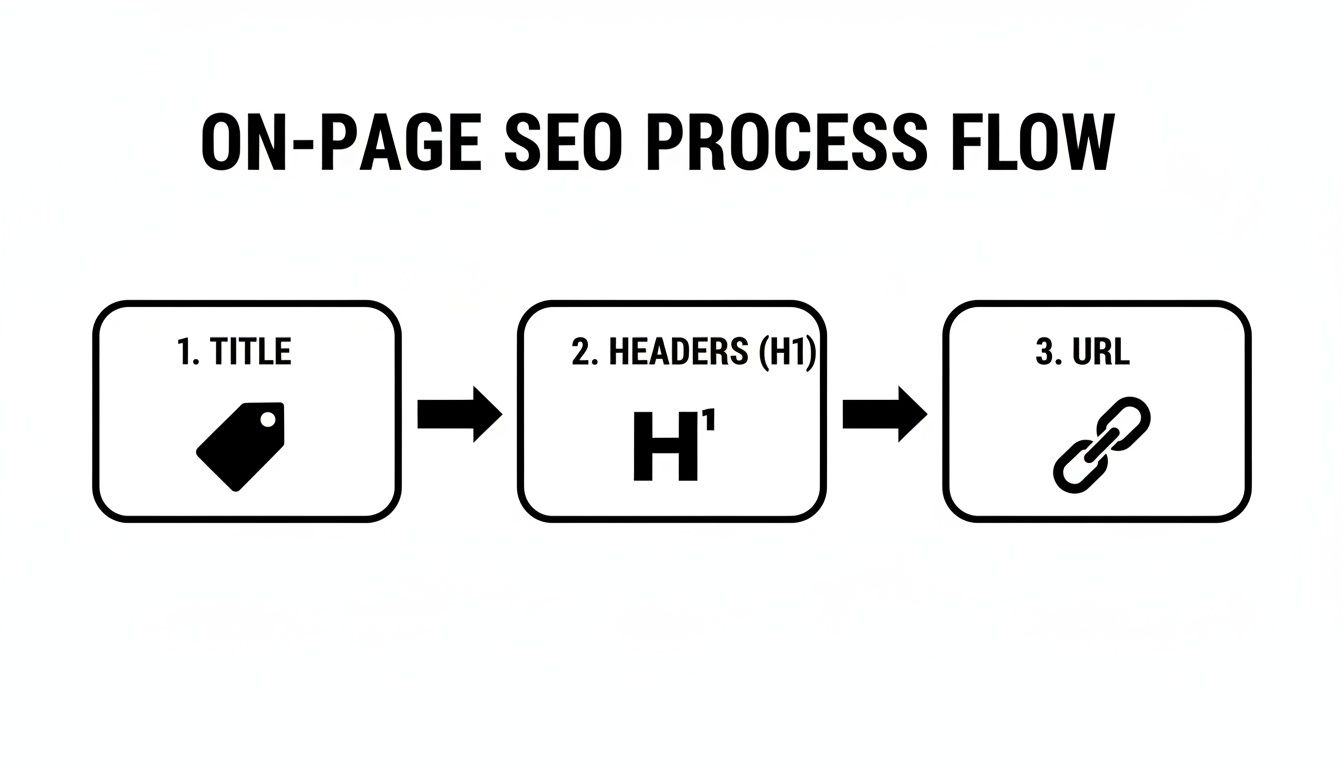
This process really drives home how foundational pieces like the title, headers, and URL structure the user’s journey and signal relevance to search engines. The emphasis on longer content also plays a huge role. Recent data shows the average first-page result on Google is 1,447 words long, proving that search engines reward in-depth content that truly answers a user's query. By sticking to this workflow, you'll consistently create content that is not only well-researched but also authoritative and genuinely helpful.
Optimizing for E-E-A-T and User Experience

It used to be enough to just write a comprehensive article. Not anymore. To really make an impact today, your content has to prove it’s trustworthy, and that’s where Google’s E-E-A-T guidelines come in. This isn't just another acronym; it's a fundamental shift in how search engines measure quality.
E-E-A-T stands for Experience, Expertise, Authoritativeness, and Trustworthiness. Think of it as Google’s way of separating genuinely helpful information from the noise. It’s no longer just about what you say, but who is saying it and why anyone should believe them.
Weaving E-E-A-T Signals into Your Content
Building E-E-A-T isn’t a one-off task you can check off a list. It’s an ongoing process of demonstrating your credibility so clearly that both users and search engines can’t miss it. Your goal is to show that your content comes from real people who know their stuff, inside and out.
Here are a few practical ways to do just that:
- Show, Don't Just Tell: The "E" for Experience is the newest piece of the puzzle, and it’s all about firsthand knowledge. If you're reviewing a product, include original photos of you using it. Share a personal story or an insight that someone who hasn't been there couldn't possibly know.
- Put a Face to the Name: Don't let your experts be anonymous. Create detailed author bios with their credentials, professional headshots, and links to their LinkedIn or other relevant social profiles. This is a direct signal of Expertise.
- Back Up Your Claims: Always link out to reputable studies, official data, or well-known authorities in your field. Citing credible sources shows you’ve done your homework and builds Trustworthiness.
- Let Others Vouch for You: Nothing builds credibility like social proof. Sprinkle in testimonials, customer reviews, and case studies. When real people stand behind your brand, it sends a powerful signal of Authoritativeness.
E-E-A-T is fundamentally about building trust at scale. Every signal you add, from a detailed author bio to a citation from a respected source, acts as a building block for your site's long-term reputation.
Connecting Trust with Great User Experience
Here's the thing: E-E-A-T and great user experience (UX) go hand in hand. Google wants to reward content that people actually find helpful and enjoy reading. If someone clicks on your page and bounces right off, that’s a red flag to Google that your content didn't deliver on its promise.
A great user experience keeps people on your page longer, signaling to search engines that you're a high-quality result. It's a simple truth of modern SEO: the best way to optimize for algorithms is to obsess over the experience you create for humans.
Think about how these UX elements support E-E-A-T:
- Readability: Short paragraphs, clear headings, and plenty of white space make your content easy to digest.
- Internal Linking: Guiding readers to other relevant articles on your site keeps them engaged and showcases the depth of your knowledge.
- Multimedia: Images, videos, and charts break up the text and make complex ideas easier to understand.
This is where AI can be a huge help. The right tools can structure an article with these best practices baked in, freeing up your human experts to focus on adding their unique experience and insights. In fact, 65% of SEO professionals report better results when using AI, and some companies have seen traffic jump by as much as 45% with AI-driven content.
At the end of the day, a seamless user experience proves you’re trustworthy by showing you respect the reader's time. Our guide on using AI-generated SEO content dives deeper into how to strike the perfect balance between automation and essential human oversight.
Measuring Content Performance in the AI Era
Look, creating great content is only ever half the job. If you’re not measuring its impact, you're essentially flying blind. To figure out if your SEO content is actually working, you need to track specific Key Performance Indicators (KPIs) that tie your efforts back to real business goals. These numbers tell you what’s hitting the mark and where your strategy needs a tune-up.
The most obvious starting point is organic traffic—how many people are finding you through a search engine? But don't stop there. You need to look at keyword rankings to see if you’re actually climbing the ladder for the terms you’re targeting. Ultimately, conversion rates are what tell you if all that traffic and visibility is translating into action, like someone signing up for a trial or buying your product.
Key Metrics to Monitor
To get a full picture of how your content is doing, you'll want to keep an eye on a handful of core metrics that, together, tell the whole story:
- Organic Traffic: How many visitors are coming from search? Google Analytics is your best friend here.
- Keyword Rankings: Are you moving up for your most important keywords? This is the most direct measure of your SEO's pulse.
- Click-Through Rate (CTR): Of all the people who see your page in the search results, what percentage actually clicks? A low CTR might mean your title or meta description isn't compelling enough.
- Bounce Rate: Are people landing on your page and leaving right away? A high bounce rate can be a red flag that your content doesn't match what the searcher was looking for.
- Time on Page: How long are visitors sticking around to read what you've written? More time on page is a strong signal that your content is high-quality and engaging.
The New Frontier: Generative Engine Optimization
But here’s the thing—the way we measure success is already changing, and fast. The game has been completely upended by AI-powered search. While it's true that 68% of online experiences still kick off with a search engine, Google's AI Overviews are creating a massive shift in how people interact with results.
Since they launched, AI Overviews have popped up for nearly 10% of all keywords and have seen a 116% surge in how often they appear. Now for the kicker: while search impressions have jumped over 49%, click-through rates have plummeted by almost 30%. Why? Because people are getting their answers directly from the AI summary without ever needing to click through to a website. You can dig deeper into how AI is shaking up SEO in this detailed report on SEOMator.com.
This shift means the next competitive frontier is Generative Engine Optimization (GEO)—the practice of getting your content cited directly within these AI-powered answers. Being the source for an AI Overview is the new top ranking.
And this brings our entire journey full circle. Understanding what "content" means for SEO today is about creating information so valuable, accurate, and perfectly structured that AI models choose your site to quote. This isn't just about chasing clicks anymore; it’s about becoming a trusted source of truth in the age of AI.
Of course, here is the rewritten section, crafted to sound completely human and natural, following the provided style guide and examples.
Common Questions About SEO Content
Even after you get the hang of what SEO content is, a few practical questions always seem to pop up. Let's tackle some of the most common ones that content marketers and SEO managers run into. This should help you move from knowing the theory to actually putting it into practice.
How Often Should I Publish New Content for SEO?
This is the million-dollar question, but there’s no single magic number. The real secret is that consistency and quality matter far more than raw frequency.
For most businesses, a good starting point is one or two high-quality, in-depth articles per week. But that’s just a guideline. If you're in a super competitive niche, you might need to publish more often just to keep up. On the flip side, a smaller company could see great results with just one comprehensive, well-researched article every couple of weeks.
The key is to find a rhythm you can actually stick to. It’s always, always better to publish one amazing article per month than four mediocre ones per week.
Is It Better to Create New Content or Update Old Content?
Honestly, a great SEO strategy needs both. Think of it this way: creating new content is how you expand your territory. It’s essential for targeting new keywords and building your website's authority on different topics.
But updating old content—often called a "content refresh"—is a seriously powerful tactic that too many people ignore. Taking a post that's a year or two old and refreshing it with new information, current stats, and better examples can give its rankings a massive boost. Make it a habit to regularly audit your existing content to find these refresh opportunities. It keeps everything relevant and signals to Google that your site is alive and well.
An effective content strategy isn't about choosing one over the other. It's about balancing the creation of new assets with the optimization of existing ones. This dual approach maximizes your reach and squeezes every drop of value out of the content you produce.
Does AI-Generated Content Hurt SEO Rankings?
Nope. Using AI itself does not inherently hurt your SEO rankings. Google has been pretty clear on this: they reward high-quality content, no matter how it’s made. The problem isn’t the AI; it's the output of low-quality, unedited, and unhelpful content that offers zero real value to a human reader.
The smart way to use AI is as a tool—an assistant to help with research, outlines, and first drafts. That content is then handed off to a human expert who reviews, edits, and adds their own insights to ensure it's accurate, original, and loaded with E-E-A-T signals. This is a game-changing strategy. Modern AI writing platforms are built for this exact workflow, combining AI's speed with the human oversight needed to create truly great content.
Ready to turn AI visibility insights into measurable growth? Sight AI helps you monitor how AI models talk about your brand, find high-value content gaps, and produce SEO-optimized articles with specialized AI agents. Learn how you can automate your content workflow and drive sustainable rankings at https://www.trysight.ai.