Content optimization is the art and science of refining your content so it resonates with both search engines and your audience. The ultimate goal? To hit specific business targets, whether that's climbing the Google rankings, boosting engagement, or pulling in more qualified leads. This means sharpening everything from your keyword strategy and readability to the user experience and the technical nuts and bolts of your site.
Defining Content Optimization for Business Growth

Think of it like a master chef perfecting a signature dish. The base recipe—your raw content—might be good on its own, but it’s not going to earn a Michelin star. The chef, in this case, is the optimizer. They meticulously tweak ingredients (keywords), adjust the plating (formatting and readability), and ensure every bite delights the diner (user experience).
This is what turns your content from a passive file sitting on a server into an active, hardworking tool that drives real business results. It’s the crucial bridge between just creating content and actually achieving something with it.
The Two Audiences You Must Serve
Great content optimization always serves two masters at once: the search engine algorithms and the human beings reading your work. You simply can't win by focusing on just one.
- For Search Engines: Optimization is about sending crystal-clear signals to Google's bots about your content's topic, relevance, and authority. This is where technical details like meta descriptions, header tags, and internal links come into play.
- For Human Readers: This side is all about creating a valuable, frictionless experience. Is the content easy to scan? Is it visually engaging? Does it directly answer the user's question without a lot of fluff?
The sweet spot for content optimization is where technical SEO and a deep understanding of user intent meet. It’s how you ensure that when search engines send people your way, those visitors find exactly what they were looking for and leave feeling satisfied.
This dual focus is a non-negotiable part of modern SEO. To see how these elements fit together, check out our deep dive into content SEO best practices.
To clarify, let's break down the main objectives of a solid content optimization strategy.
Key Goals of Content Optimization
| Goal | Description | Primary Beneficiary |
|---|---|---|
| Improve Search Rankings | Enhance visibility on search engine results pages (SERPs) for relevant keywords. | SEO Performance |
| Increase Organic Traffic | Attract more visitors from organic search by ranking higher and for more queries. | Website Growth |
| Boost User Engagement | Keep readers on the page longer with clear, readable, and valuable content. | Audience Experience |
| Drive Conversions | Guide users to take a desired action, like signing up, downloading, or buying. | Business Revenue |
| Build Authority & Trust | Establish credibility by providing comprehensive, accurate, and helpful information. | Brand Reputation |
Each of these goals feeds into the others, creating a powerful cycle of growth. Higher engagement signals quality to Google, which boosts rankings, which in turn drives more traffic and potential conversions.
Why Optimization Is Non-Negotiable Today
In today's crowded digital world, just hitting "publish" is a recipe for failure. Without optimization, even a brilliantly written article will likely get lost in the noise, invisible to the people who need it.
The stakes are massive. Content optimization is a key driver of the global content marketing industry, which was valued at $413.2 billion in 2022 and is rocketing toward a projected $2 trillion by 2032. Businesses that optimize see a clear payoff, with 68% reporting higher ROI by integrating AI into their strategies.
While we often talk about content optimization in the context of websites and blogs, the core principles apply everywhere. For example, understanding What ASO Stands For and How to Master It reveals how the same ideas of keyword relevance and user experience are critical for getting an app discovered.
Ultimately, optimization is what ensures your investment in content creation actually delivers a measurable return.
Understanding the Core Pillars of Optimization
Content optimization isn't a one-and-done task. It's a full-blown strategy built on several key practices that all have to work together. To really get what content optimization is, you have to understand its five core pillars. These are the foundation for any plan meant to boost your visibility, hook readers, and actually drive results.
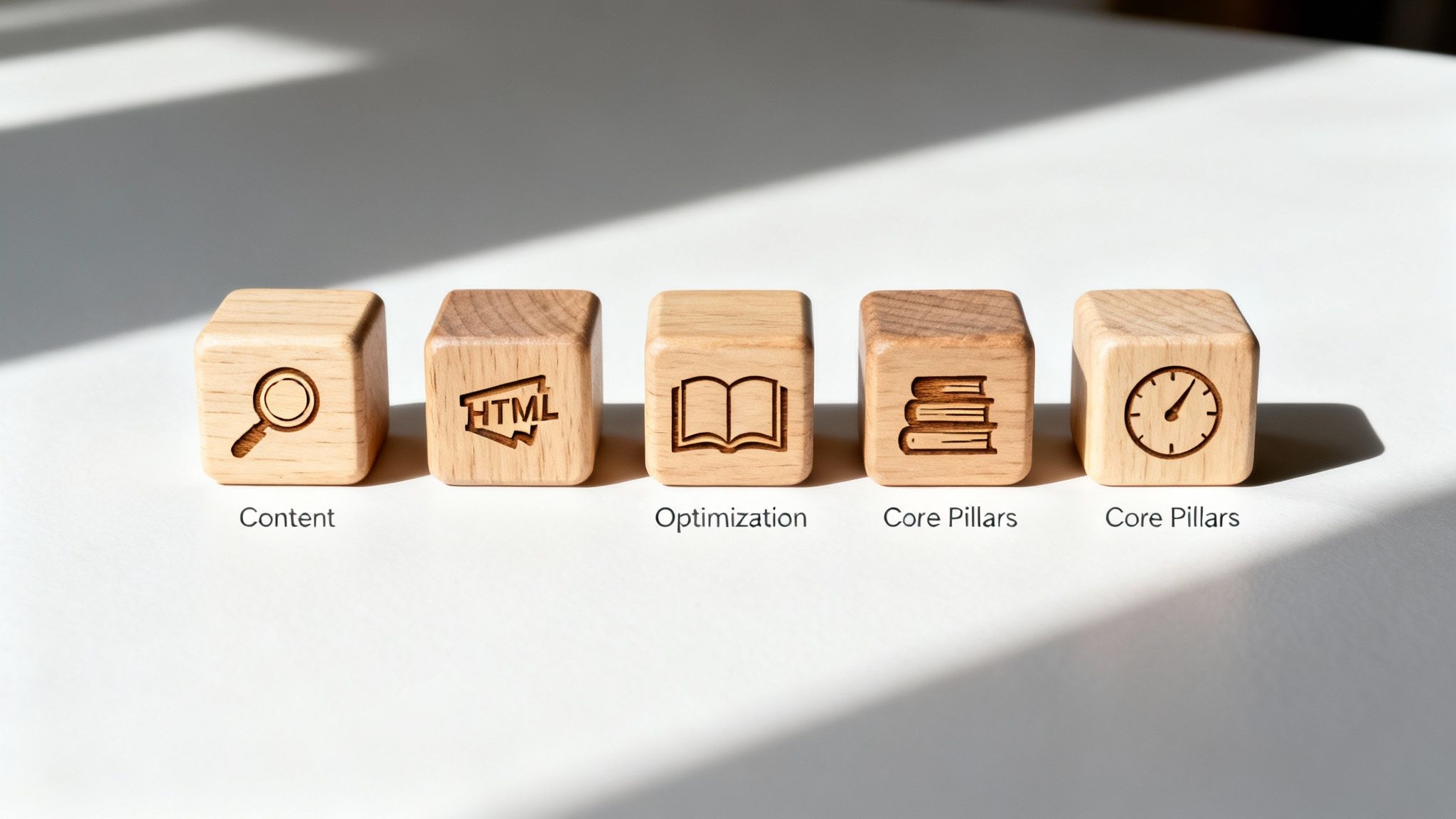
Think of these pillars like the legs of a table—if one is wobbly or missing, the whole thing is unstable. Each pillar tackles a different piece of the puzzle, from how search engines see you to how real people engage with your work. Let's break them down one by one.
Search Intent and Keyword Strategy
This is your content's roadmap. Before you even think about writing, you need to know exactly who you're talking to and what they're typing into Google. A good keyword strategy isn't about jamming terms onto a page; it's about matching your content to the user's search intent.
What's their goal? Are they looking to buy something (transactional intent), learn something specific (informational intent), or weigh their options (commercial intent)? Nailing this alignment is the most critical first step. If you miss the mark here, even the most beautifully written article will fall flat.
For a deeper dive, our guide on how to optimize content for SEO offers a complete framework for connecting keywords to what users actually need.
On-Page SEO Elements
Okay, so you know your keywords and the user's intent. Now you have to structure your page so search engines can make sense of it all. That's where on-page SEO comes in—optimizing all the individual elements of a webpage.
These elements are like direct signals to search engine crawlers, telling them what your page is all about. The key components include:
- Title Tags and Meta Descriptions: This is your content's first impression on the search results page. Make it count.
- Header Tags (H1, H2, H3): Headers create a clear hierarchy, making your content easy to scan for both people and search bots.
- URL Structure: A clean, descriptive URL gives everyone a clear clue about the page's topic.
- Image Alt Text: This simple text describes your images to search engines and screen readers, boosting both accessibility and relevance.
Get your on-page SEO right, and you're telling Google exactly how to index your content and why it deserves to rank.
Readability and User Experience
Getting someone to click your link is only half the battle. The real challenge is keeping them there, and that's all about readability and user experience (UX). This pillar is focused entirely on the human on the other side of the screen.
If your content is a giant wall of text or a pain to navigate, people will hit the back button—a nasty signal known as "pogo-sticking."
Great user experience turns a visitor into a reader. It's the difference between content that gets skimmed and content that gets absorbed, shared, and remembered.
To keep people engaged, focus on these simple wins:
- Short Paragraphs and Sentences: Break down big ideas into bite-sized chunks.
- Clear Formatting: Use bullet points, numbered lists, and bold text to make key info pop.
- Engaging Visuals: Images, charts, and videos can break up the text and keep people on the page longer.
Topical Authority
This pillar answers one crucial question for Google: "Are you a real expert on this topic?" Topical authority is all about proving you have deep, comprehensive knowledge in your niche. You can't just write one amazing article; you need to build a whole library of them.
Think of your website as that library. A single book on "digital marketing" is a nice start, but an entire section covering SEO, content strategy, email campaigns, and social media proves you know your stuff. This web of interconnected content signals to search engines that you're a definitive, trustworthy source, which helps all your related content rank higher.
Technical Performance
Finally, none of this matters if your site is slow, broken, or impossible to access. Technical performance is the bedrock that everything else is built on. It ensures your amazing content can actually be delivered to users without a hitch.
The big three technical factors are:
- Page Load Speed: People are impatient. They expect pages to load in under three seconds. Anything slower, and they're gone.
- Mobile-Friendliness: With over 60% of searches happening on mobile, your site has to look and work perfectly on any device.
- Crawlability and Indexability: If search engines can't easily find and understand your pages, they might as well not exist.
A Practical Step-By-Step Optimization Workflow
Knowing the theory behind content optimization is great, but putting it into practice is where the magic happens. To get real, tangible results, you need a repeatable process. Think of the following steps as your pre-flight checklist for every piece of content you touch, whether it's brand new or a few years old.
Just like a pilot runs through specific checks before takeoff, this workflow makes sure your content is ready to climb the search rankings and hit its goals. It takes the guesswork out of the equation and gives you a structured path to follow.
Start with a Content Audit
Your journey starts with what you already have. A content audit is simply the process of combing through your existing content to find the pages with the most potential for a quick win. Don't try to boil the ocean and optimize everything at once—look for the low-hanging fruit.
These are usually pages that are:
- Ranking on page two or three of Google: These pages are so close. They've already proven they have some relevance, they just need a solid push to get onto page one, where 75% of users never leave.
- Targeting high-value keywords: Focus your energy on content that will directly impact your business goals if it starts ranking higher.
- Showing declining traffic: An audit can help you spot content that used to be a star performer but is now losing ground to the competition.
Perform Deep SERP Analysis
Once you’ve picked a page to work on, the next step is to get your hands dirty analyzing the Search Engine Results Page (SERP) for its main keyword. This isn’t just about seeing who’s at the top; it’s about figuring out why they’re there.
Look at the top-ranking pages and start asking the hard questions. What type of content is Google rewarding here? Is it blog posts, product pages, or maybe videos? What specific subtopics does every single top result cover? This kind of analysis is like cracking the code—it shows you the user's intent and gives you a clear blueprint for what your content needs to include.
Refresh and Expand Your Content
Armed with your SERP analysis, it’s time to get into the content itself. This is way more than fixing a few typos. The mission is to make your content substantively better, more helpful, and more comprehensive than anything else out there.
A strategic refresh might mean:
- Adding new sections to cover subtopics your competitors completely missed.
- Updating old, stale statistics, facts, or examples with fresh ones.
- Dropping in new visuals like infographics or charts to make complex ideas easy to grasp.
Your goal is simple: turn your page into the most thorough and genuinely helpful resource on this topic. This sends a powerful signal to search engines that your content delivers superior value.
Implement On-Page SEO Best Practices
Now you’re ready to dial in the technical, on-page elements. Make sure your primary keyword is placed strategically in your title tag, meta description, and H1 tag. Use H2s and H3s to break up your content into a logical structure that’s easy to scan for both people and search engine crawlers.
This is a make-or-break step. 90% of organizations have a content marketing strategy, and 73% of B2C marketers rely on keyword research to make it work. Nailing these on-page tweaks is non-negotiable if you want to capture that first-page traffic.
Enhance Readability and User Experience
With the core content and SEO dialed in, it's time to put on your reader's hat. Break up those intimidating walls of text into short, easy-to-read paragraphs—think one to three sentences, max. Use bullet points and numbered lists to make information scannable and clear.
Make sure your images have descriptive alt text and your calls-to-action (CTAs) are impossible to misunderstand. For anyone in e-commerce, this is where you blend SEO with a smooth shopping experience—for example, when you optimize Amazon product listings, you're making it easier for both search engines and customers to find what they need.
Build a Strong Internal Linking Structure
Last but not least, you need to reinforce your page's authority within your own site. Find other relevant, high-authority pages you've already published and add links from them to your newly optimized page. This is how you spread "link equity" around and show search engines how all your content is thematically connected.
At the same time, look for opportunities inside your refreshed article to link out to other helpful resources on your site. This keeps people clicking, reading, and moving through your content ecosystem. To see how this fits into a larger, more automated strategy, check out our guide on building an AI content workflow. Following a structured process like this turns optimization from a random chore into a predictable engine for growth.
Building Your Content Optimization Toolkit
You wouldn't expect a mechanic to fix your car without a proper wrench set, right? The same logic applies to content optimization. To do this job right, you need more than just skill—you need the right tools to diagnose problems, spot opportunities, and actually measure what's working.
Without a solid toolkit, you’re basically flying blind, making guesses and hoping for the best. The right software, however, lets you move from guesswork to data-backed decisions. Let's break down the essential tools you need to build a professional optimization workflow.
Keyword Research and SERP Analysis Platforms
This is ground zero. These platforms are your eyes and ears in the market, showing you the exact phrases your audience is plugging into Google. They help you decode the competitive landscape by revealing crucial metrics like search volume and keyword difficulty.
Think of them as your strategic foundation. Top-tier tools in this category include:
- Ahrefs: A powerhouse suite known for its incredible keyword explorer and backlink analysis.
- Semrush: Offers a robust collection of tools for keyword research, deep competitor analysis, and rank tracking.
Using these platforms, you can uncover high-potential keywords that your competitors have completely missed and get a realistic picture of what it’ll take to land on page one.
A great tool doesn't just throw data at you; it gives you strategic insight. It helps you answer the 'why' behind the rankings, revealing the content formats, search intent, and topical depth needed to win.
Content Intelligence and Optimization Software
Once you’ve picked your target keywords, content intelligence tools step in to guide the actual writing and editing. Think of this software as an expert co-pilot, giving you real-time feedback to make sure your article is perfectly aligned with what's already ranking. These tools analyze the top-performing content and spit out data-backed recommendations on everything from word count and readability to which related topics you absolutely must cover.
This process often follows a simple but powerful workflow: audit existing content, analyze the data for gaps, and refresh it for better performance.
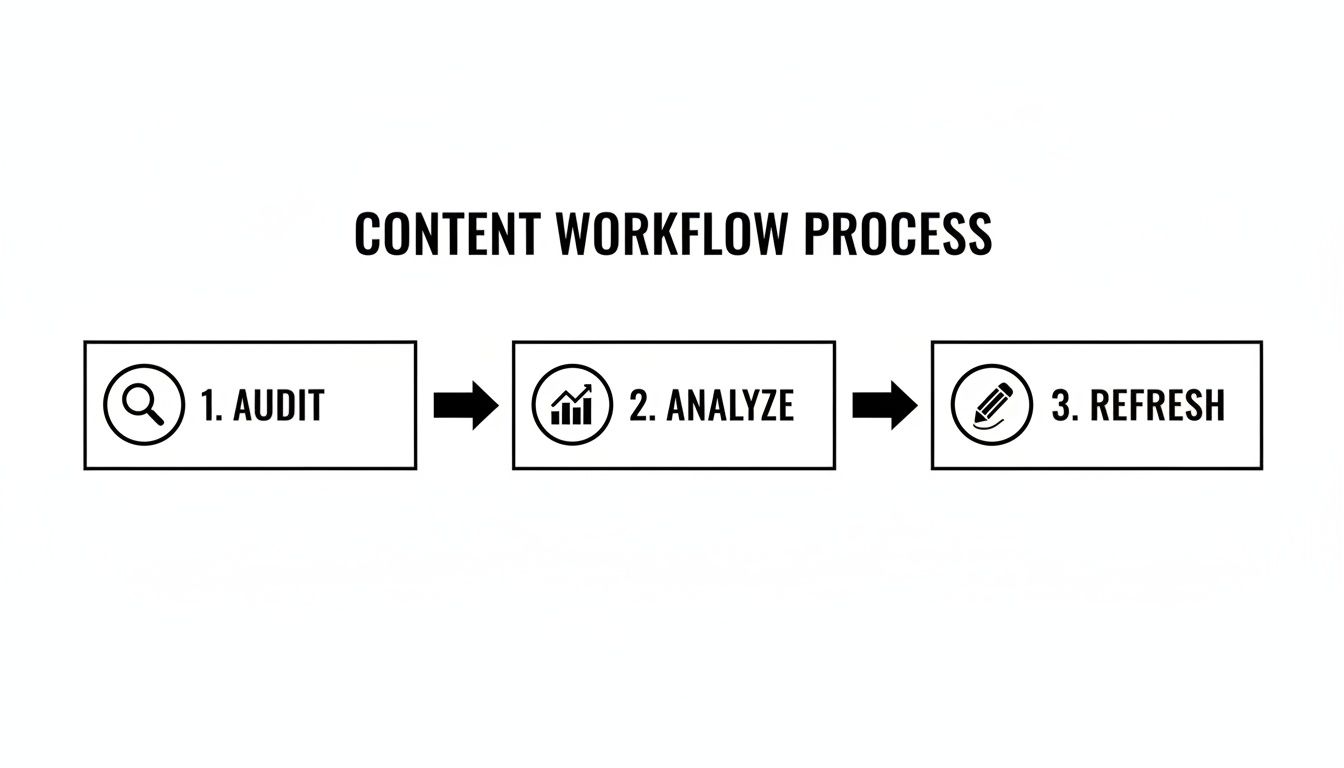
Platforms like SurferSEO or Clearscope give your draft a "content score," which is a simple, quantifiable way to see how well you’ve covered a topic before you even hit publish. And with the rise of AI, these platforms have become even more insightful. In fact, a recent B2B marketing report found that 40% of marketers plan to invest in AI-powered optimization solutions in 2025. For a deeper dive, check out our guide on the top AI SEO tools available today.
Technical SEO Crawlers and Auditing Tools
You could write the most brilliant article in the world, but if technical glitches are hiding it from search engines, it might as well not exist. Technical SEO crawlers are like a health inspector for your website. They crawl your site just like a search engine bot, flagging critical issues holding you back.
These tools are great at finding problems like:
- Broken links (404 errors)
- Painfully slow page load speeds
- Missing or duplicate meta tags
- Indexing and crawlability roadblocks
Screaming Frog SEO Spider is the classic desktop crawler that gives you an exhaustive audit of your site's technical health. Fixing these foundational issues is non-negotiable; it ensures search engines can find, crawl, and index your content without hitting any snags.
Analytics and Performance Tracking Platforms
Finally, how do you know if any of this is actually working? Analytics platforms are your scorecard. They track the metrics that matter, like organic traffic, keyword rankings, click-through rates, and how users are engaging with your pages.
- Google Search Console: This is a must-have. It’s a free tool that gives you a direct look at how your site is performing in Google Search.
- Google Analytics: Provides deep insights into user behavior, where your traffic is coming from, and how it leads to conversions.
By keeping a close eye on these platforms, you can prove the ROI of your content efforts and pinpoint which pages need another round of optimization. This closes the loop, turning your optimization process into a continuous cycle of improvement.
How to Measure Your Optimization Success
So, you’ve put in the work to optimize a piece of content. How do you know if it actually worked? If you can’t measure your efforts, you can’t improve them. And you certainly can’t prove the value of your work.
Flying blind isn't a strategy. Optimizing content without tracking the results is like driving with your eyes closed—sure, you're moving, but you have no clue if you're heading in the right direction. This is where you need to shift away from simple vanity metrics and dial in on the Key Performance Indicators (KPIs) that actually tie back to business growth.
By setting up a clear measurement framework, you create a powerful feedback loop. The data from your actions directly informs your next move, creating a cycle of continuous improvement.
Key Metrics to Keep an Eye On
To get the full story, you need to track a mix of metrics. Think of them as leading and lagging indicators. Leading indicators, like a jump in keyword rankings, show you’re on the right track early on. Lagging indicators, like a spike in demo requests, confirm your strategy is hitting the mark and delivering real value.
Here are the essentials you need to be watching:
- Organic Search Rankings: This is your most direct feedback on SEO success. Before you touch a page, log its position for your target keywords. After you optimize, watch it climb. Seeing a keyword jump from the dreaded page two to the front page is a massive win.
- Organic Traffic: More visitors coming from search engines is a clear signal that your higher rankings and refreshed title tags are pulling people in. Don't just look at sitewide traffic; dive into Google Analytics and check the numbers at the individual page level to see which pieces of content are driving that growth.
- Click-Through Rate (CTR): You'll find this gem in Google Search Console. CTR tells you the percentage of people who saw your page in the search results and actually clicked on it. A simple tweak to your title tag or meta description can send this number soaring.
The real measure of success is how well your content aligns with business goals. For example, 32% of companies say their primary success metric is organic search rankings, while 28% zero in on overall web traffic. This focus pays off, as 58% of B2B firms reported that their content efforts directly led to increased sales in 2023. You can dig deeper and learn how businesses track content marketing success.
Bridging the Gap: Tying Optimization to Business Goals
Rankings and traffic are great, but the C-suite wants to see how your work impacts the bottom line. This is where the magic happens—connecting your SEO efforts to tangible business outcomes.
It's this connection that transforms content optimization from a line item on the marketing budget into a powerful, revenue-generating engine.
You absolutely must track how your newly optimized pages contribute to conversions that your business cares about:
- Leads Generated: How many people filled out a form, subscribed to a newsletter, or downloaded an ebook after landing on that page? Set up goals in your analytics to track this.
- Sales and Revenue: If you're running an e-commerce site, this is straightforward. Attribute sales directly to the organic traffic that lands on your optimized product and category pages.
- Engagement Metrics: Don't sleep on metrics like time on page and scroll depth. They’re strong signals that users are finding your content genuinely valuable. Highly engaged visitors are far more likely to trust your brand and take that next step, whatever it may be.
By properly setting up goal tracking, you can pinpoint exactly which articles are driving these critical actions. That data is your ammunition for proving ROI and making a rock-solid case for more investment in your content strategy. To build a comprehensive dashboard, it’s critical to understand how to measure SEO success from every angle.
Key Metrics for Tracking Content Optimization ROI
Monitoring the right KPIs is essential for proving the value of your content optimization efforts. This table breaks down what to watch, what it means, and where to find the data.
| Metric (KPI) | What It Measures | Primary Tool for Tracking |
|---|---|---|
| Organic Search Rankings | Your visibility in search results for specific target keywords. | Ahrefs, Semrush, SE Ranking |
| Organic Traffic | The number of visitors arriving at your site from search engines. | Google Analytics (GA4) |
| Click-Through Rate (CTR) | The percentage of users who click your link after seeing it in SERPs. | Google Search Console |
| Leads Generated | The number of new contacts acquired through forms or sign-ups. | Google Analytics, Hubspot |
| Conversion Rate | The percentage of visitors who complete a desired action (e.g., purchase). | Google Analytics, CRM |
| Time on Page | How long users spend reading a specific piece of content. | Google Analytics |
| Bounce Rate | The percentage of visitors who leave after viewing only one page. | Google Analytics |
| Revenue Attributed | The direct sales or monetary value generated from organic traffic. | Google Analytics, E-commerce Platform |
Tracking these metrics gives you a 360-degree view of your performance, allowing you to connect content changes directly to business impact and make smarter decisions for future campaigns.
What's Next for Content Optimization?
If you want to stay ahead in SEO, you have to look forward. The ground is always shifting under our feet, thanks to new tech and the ever-changing ways people search for things. What works like a charm today is just the starting point for what you'll need to do tomorrow.
The biggest change right now? Artificial intelligence is weaving its way into every single part of the process. AI isn't some shiny new toy anymore; it's a fundamental piece of any serious content strategy. It's helping us automate keyword clustering, generate incredibly detailed content briefs from real data, and even fine-tune our writing for semantic search. Think of it as a super-powered assistant, speeding everything up and finding insights a human might miss.
Programmatic SEO and New Content Formats Are on the Rise
Beyond just helping us write, we're seeing programmatic SEO take hold, especially for businesses sitting on huge piles of data, like e-commerce stores or big marketplaces. This isn't about writing one article at a time. It's about using automation to create thousands of optimized pages that target super-specific, long-tail keywords on a scale that would be impossible to do by hand.
At the same time, optimization is breaking out of the text-only box. The future is about showing up everywhere your audience is, which means mastering different formats:
- Video SEO: This is all about tweaking your video titles, descriptions, and transcripts so they pop up on YouTube and in Google search results.
- Audio Search: It's about making your podcasts and audio clips discoverable when people use voice assistants or search for audio content.
This shift means you have to think about how and where people are looking for information and be ready with the right kind of content.
It's All About Continuous Optimization and Building Trust
The old "set it and forget it" approach to content is completely dead. The winners in the future will be those who embrace a loop of continuous optimization—constantly publishing, measuring, analyzing, and refreshing what's already out there. Your top-performing articles aren't static trophies; they're living assets that need regular care to stay relevant and authoritative.
At the heart of all this is the relentless need to build and prove your E-E-A-T (Experience, Expertise, Authoritativeness, and Trustworthiness). Future-proofing your content means baking these signals into everything you create, from detailed author bios to citing your own original research.
This focus on authentic, trustworthy content isn't just a nice-to-have; it delivers real financial returns. In 2023, content marketing provided the highest ROI for 14% of marketers, and technology is only amplifying that. In fact, 73% of marketers are already using AI for content creation, with 67% saying it has actually improved the quality of their work. You can dig into more of this data by exploring the latest content marketing statistics and trends.
When it comes down to it, the future of content optimization is a smart mix of human expertise and machine efficiency. It’s a commitment to never stop improving and a deep, unwavering focus on earning the trust of your audience.
Got Questions About Content Optimization?
Even with a solid plan, a few questions always seem to pop up when people start digging into content optimization. It's totally normal. Getting straight answers helps clear up any confusion and gives you the confidence to actually start putting these ideas to work.
Let's run through a few of the most common ones. My goal here is to give you quick, practical answers that build on everything we've covered so far.
How Often Should I Optimize My Content?
This isn’t a one-and-done kind of deal. Think of content optimization as regular maintenance for your most valuable digital assets.
For your big, important "pillar" pages—the ones that drive the most business—you'll want to pop the hood and check performance every 6-12 months. This keeps them fresh, competitive, and in line with what your audience (and Google) wants to see.
When it comes to new posts, give them about 3-4 months to breathe. After that, you'll have enough data to see if they're taking off or if they need a little nudge. Pro tip: always prioritize optimizing pages that have huge potential but are stuck on page two or three of the search results. Those are your low-hanging fruit for a quick win.
What Is the Difference Between Content Creation and Optimization?
It’s like building a race car versus tuning it for the track.
Content creation is the initial build. You’re fabricating the chassis, dropping in the engine, and bolting everything together from scratch. You're making something brand new.
Content optimization, on the other hand, is what the pit crew does during the race. They're tweaking the engine for more power, swapping tires for better grip, and adjusting the aerodynamics to shave off milliseconds. Optimization is all about taking what you already have—new or old—and refining it to win the race for attention and engagement.
Can I Optimize for Both SEO and Conversions at Once?
Not only can you, but you absolutely must. The best content strategies don’t treat these as separate goals. They're two sides of the same coin, working together to guide a visitor from discovery to action.
- SEO is what gets people in the door. Things like smart keyword targeting, a speedy website, and building topical authority are all about attracting the right people from search engines.
- Conversion optimization is what seals the deal. Clear calls-to-action (CTAs), convincing copy, and trust signals like testimonials or case studies are what persuade visitors to take that next step once they've arrived.
Think about it: a page that ranks #1 but doesn't convert is just a vanity metric. And a high-converting page that nobody can find is a wasted effort. Real content optimization is about making both work in perfect harmony to drive real business growth.
Ready to put your content on autopilot and scale your organic growth? IndexPilot uses trainable AI Agents to handle everything from keyword research and writing to optimization and publishing. Connect your CMS, set your strategy, and watch as our platform transforms your SEO into a reliable engine for traffic, leads, and revenue.