Not long ago, the idea of using AI to write content felt like something out of science fiction. Today, it’s a core part of modern digital marketing. It's as fundamental as e-commerce is to retail. For brands looking to grow their online presence, ignoring AI simply isn't an option anymore.
The New Reality of AI-Generated SEO Content

This shift isn't just about a cool new piece of tech; it's a complete change in how the content game is played. The speed and sheer volume of content that can now be produced means the fight for your audience's attention is more intense than ever. Getting a handle on this new reality is the first step to using AI the right way.
Widespread Adoption by Marketers
The move to AI-generated SEO content has been incredibly fast, with businesses of all sizes jumping on board. This isn't just a tool for massive corporations. Small businesses and startups are using it to punch above their weight and compete. For many, AI is the key to maintaining a consistent publishing schedule that was once impossible due to tight budgets and small teams.
The data backs this up. A massive 67% of small businesses are already using AI for content and SEO. The majority of marketers using it report better rankings and more organic traffic. This isn't a passing fad; it's a fundamental change in how marketing gets done. If you want to go deeper on this, you should check out the latest trends in AI content generation at https://www.trysight.ai/blog/latest-trends-in-ai-content-generation.
An Opportunity for Adaptation
It's easy to look at this AI wave as a threat, but that's the wrong way to see it. It's actually a massive opportunity for teams willing to adjust their playbook. The real magic isn't just in churning out text but in using AI to supercharge human expertise.
AI lets marketing teams automate the grunt work of research and first drafts. This frees up your human experts to focus on strategy, unique insights, and brand voice—the stuff that actually builds trust and authority.
Recent studies show just how common AI content has become. Between 2019 and 2025, the share of AI-written pages in Google's top results jumped from a tiny 2.27% to 17.31%. That’s a huge leap, proving this is here to stay.
With platforms like Sight AI now able to produce long-form, optimized articles, brands can finally compete at scale, as long as there's a human guiding the process. To really grasp how AI is reshaping the search landscape, it's worth reading up on the future of SEO in the era of generative AI. This new world rewards those who can masterfully blend machine efficiency with human creativity.
Optimizing for Discovery Beyond Traditional Search

For years, winning at SEO felt straightforward: get to the top of the search engine results page (SERP). But the ground is shifting right under our feet. Sticking to the classic "10 blue links" strategy is like setting up a shop on a street that gets less and less foot traffic every single day.
The new game is all about AI visibility. This isn't just about showing up in Google's search results; it's about making sure your brand and your insights appear directly inside the answers generated by AI models like ChatGPT, Perplexity, and Google's own AI Overviews. These platforms are rapidly becoming the go-to source for answers, opening up a completely new way for people to discover you.
The Rise of Answer Engines
Think about the change like this: you used to have a library card catalog that pointed you to the right book (the blue link). Now, you have a personal librarian who reads all the relevant books for you and just gives you the synthesized answer directly. That's exactly how large language models (LLMs) work, and it's fundamentally rewiring how people find information.
This isn't some far-off trend—it's happening right now. Traffic from AI search is growing so quickly that SEO teams have to think beyond just links and rankings. In fact, sessions from LLMs like ChatGPT and Perplexity exploded by an incredible 527% year over year between 2024 and 2025. What's more, visitors who arrive from these AI platforms tend to spend 68% more time on a website, which signals they're more engaged and qualified.
The broader search landscape is changing, too. Roughly 60% of searches now result in no click at all because users get their answer right on the SERP from an AI Overview or another rich result. In the U.S. alone, 13.14% of queries already trigger one of these AI-powered summaries. Getting cited in those answers is the new page one.
Why AI Citations Are the New Rankings
Earning a citation in an AI-generated answer is way more than just a nice-to-have metric. It's a massive form of brand validation. When an AI model cites your content, it’s basically telling the user, "This brand is an authority on the topic." It builds trust before they've even had a chance to click through to your site. This is a core idea behind Answer Engine Optimization. You can learn more about getting your content featured in our complete guide on what is Answer Engine Optimization: https://www.trysight.ai/blog/what-is-answer-engine-optimization.
Your goal is no longer just to rank, but to become a foundational source of information that AI models trust and reference. This requires a proactive strategy focused on creating clear, factual, and well-structured content that directly answers user questions.
This evolution of discovery isn't just happening in traditional search and chat. As the lines blur, knowing how to apply SEO principles to platforms like TikTok is becoming essential. This includes strategies for optimizing for TikTok SEO to reach the widest possible audience.
Platforms like Sight AI were built specifically for this new reality. By monitoring your brand mentions across the major AI models, it helps you spot opportunities to get cited more often. This allows you to turn those visibility insights into powerful AI-generated SEO content that's engineered to perform well in both traditional search and the new world of AI answers.
The Balancing Act: Weighing the Risks and Rewards of AI Content
Jumping into AI-generated SEO content is a bit like being handed the keys to a race car for the first time. The raw speed is exhilarating, but you know deep down that one wrong move could send you spinning off the track. The discourse around AI in content is often a shouting match between evangelists and skeptics, but the truth, as it usually is, lies somewhere in the middle.
Think of AI not as a magic bullet but as a powerful amplifier. It's a tool, and its value depends entirely on how you use it. When applied with a clear strategy and a human touch, AI can put your content production into overdrive. But if you rely on it blindly, you risk creating a mountain of problems that can tank your SEO efforts and erode your brand’s credibility.
The Clear Advantages of AI in Content Creation
The most undeniable benefit of bringing AI into your workflow is speed. A task that could tie up a human writer for hours, or even a full day—like researching and drafting a long-form article—can be knocked out by an AI in just a few minutes. This isn't just about moving faster; it's about unlocking scale. Suddenly, even a small team can build out entire topic clusters and establish topical authority at a pace that was unimaginable a few years ago.
This newfound efficiency naturally leads to big cost savings. High-quality content has always required a serious investment in writers, researchers, and editors. By letting AI handle the initial grunt work, you cut down on the human hours needed for each piece of content, stretching your budget further. This frees up your team to focus on the things AI can't do—like high-level strategy, creative direction, and adding genuine human experience to the final product.
- Unmatched Speed: Go from a blank page to a full first draft in minutes instead of days.
- Massive Scalability: Churn out a high volume of articles to quickly build authority and serve your audience's needs across the board.
- Cost-Efficiency: Lower your cost per article, allowing you to get more high-quality content out the door with the same budget.
- Broader Topic Coverage: Tackle niche, long-tail keywords that were previously too time-consuming or expensive to target.
The Critical Risks You Cannot Ignore
For all its amazing benefits, the risks that come with AI-generated content are very real and demand your full attention. The biggest landmine is factual inaccuracy. AI models are notorious for "hallucinating"—confidently stating made-up facts, citing non-existent sources, or fabricating statistics. Publishing this kind of misinformation doesn't just mislead your audience; it can shatter your brand's reputation for trustworthiness.
Another huge challenge is keeping your brand's unique voice from getting lost in the noise. AI-generated text often defaults to a bland, almost sterile tone. Without a heavy dose of human editing, your content can sound robotic and fail to create any real connection with your readers, a phenomenon we call brand voice dilution.
The ultimate benchmark is Google’s E-E-A-T framework: Experience, Expertise, Authoritativeness, and Trustworthiness. Your content has to be helpful, reliable, and made for people, period. AI-generated content that is derivative, inaccurate, or lacks any real human insight will never clear this bar.
Finally, while Google has said it won’t penalize content just for being made with AI, it has always penalized low-quality, unhelpful content. If your AI is just spitting out unoriginal fluff that rehashes what’s already out there, it’s not going to rank. Worse, it could get flagged as spammy, actively harming your site's standing.
Benefits vs. Risks of AI-Generated SEO Content
Making a smart decision means seeing the full picture—the good, the bad, and the plan to deal with the bad. The table below lays out the biggest benefits of AI content, the risks that come with them, and how you can steer clear of the pitfalls.
| Benefit | Risk | Mitigation Strategy |
|---|---|---|
| Speed & Scalability | Factual Inaccuracy & "Hallucinations" | Never publish without a human in the loop. Every single piece of AI content needs to be rigorously fact-checked and edited. |
| Cost-Efficiency | Brand Voice Dilution & Generic Tone | Use the AI draft as a starting point. Have human editors weave in your brand's unique personality, stories, and point of view. |
| Broad Topic Coverage | Lack of Originality & Poor E-E-A-T | Pair AI with a true subject matter expert. Let the AI build the frame, but have an expert add their unique experience and insights. |
Ultimately, integrating AI successfully isn't about replacing humans; it's about empowering them. By understanding this trade-off, you can build a workflow that gives you the best of both worlds: the speed of machines and the irreplaceable insight of human expertise.
A Practical Workflow for High-Quality AI Content
Let's be real: creating AI-generated SEO content that actually ranks isn't about pushing a button and publishing whatever the machine spits out. If you want to succeed, you need a thoughtful, human-led workflow where AI acts as a super-powered assistant, not an autonomous author. This process is all about getting the speed of AI without sacrificing the quality, authenticity, and E-E-A-T signals search engines—and readers—crave.
Think of it like building a custom home. You wouldn't just dump a pile of bricks on a lot and hope for the best. You need a detailed blueprint (your strategy), quality materials (solid research), skilled labor (the AI generation), and a master craftsperson for the crucial finishing touches (your human review). This workflow is that blueprint.
Step 1: Strategic Topic and Keyword Identification
The foundation of any great piece of content is picking the right topic. This isn't about what you think people want to read; it's about what the data says they're actively searching for. The goal here is to find content gaps—topics your audience needs answers on that your competitors have overlooked or covered poorly.
Using tools to analyze search data helps you uncover high-intent keywords and specific questions that signal a real user need. This is where a platform like Sight AI starts doing the heavy lifting, automatically surfacing opportunities based on real-time visibility data and competitive analysis. It points you directly to the conversations you need to join.
Step 2: AI-Assisted Research and Outlining
Once you've locked in your target keyword and topic, it's time to build the article's skeleton. A strong, detailed outline is what separates a comprehensive, logical article from a rambling mess. Doing this manually means hours of sifting through SERPs and competitor pages.
AI can slash that time dramatically. By analyzing the top-ranking content for your keyword, AI tools can generate a detailed outline in minutes. This structure usually includes the key headings (H2s, H3s), essential sub-topics, and "People Also Ask" questions you need to cover to fully satisfy search intent. If you're building these structures yourself, a good guide is invaluable; you can learn more about crafting the perfect structure in our SEO content brief template.
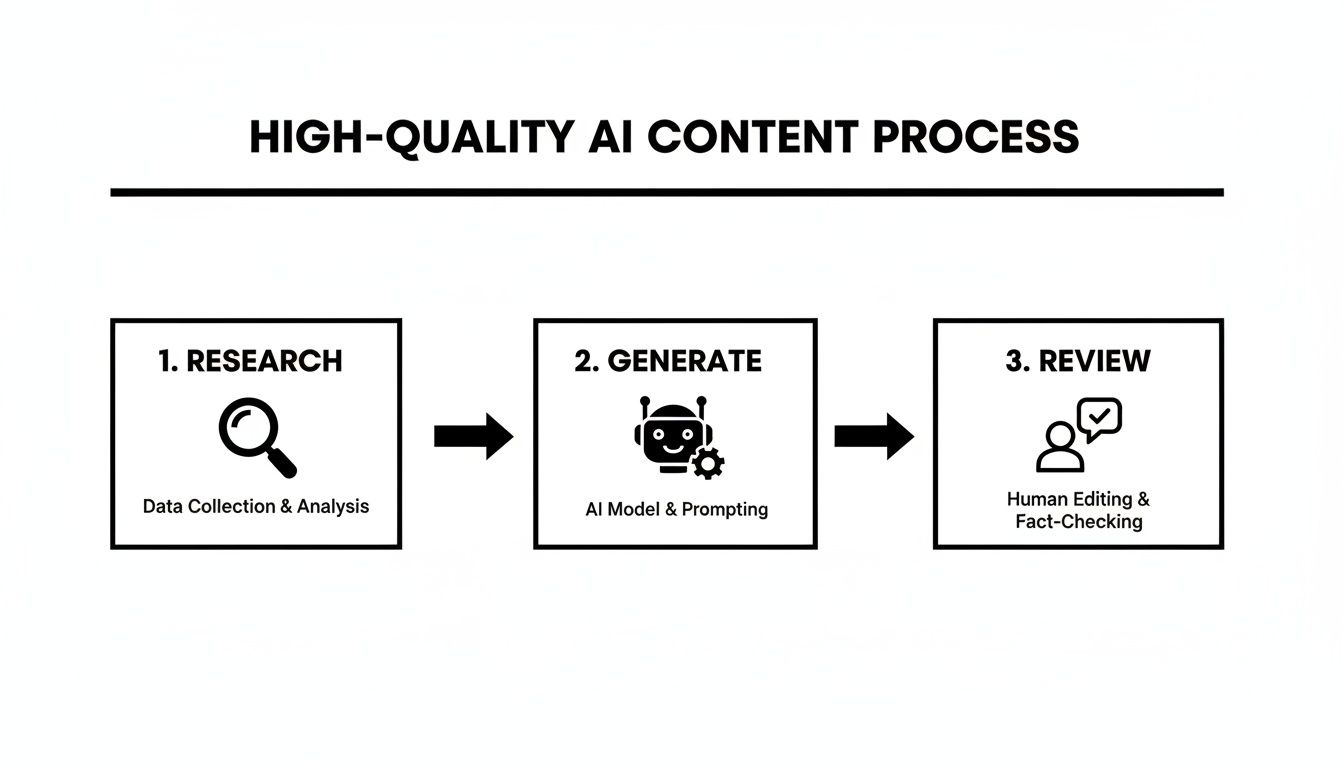
This process shows that while AI generation is a core step, it's bookended by crucial, human-led stages of research and review.
Step 3: Guided Content Generation
With a solid outline ready to go, it’s time for the AI to start writing. This is where modern AI really shines, but it needs clear direction. Just telling an AI to "write a blog post about X" is a recipe for generic, bland text. Effective prompting is everything.
You need to feed the AI detailed instructions, including:
- The Target Audience: Who are you actually talking to? What keeps them up at night?
- The Desired Tone: Should the article sound formal, conversational, witty, or authoritative?
- Specific Points to Include: Give it key data, internal links you want to use, and unique angles from your outline.
Platforms like Sight AI use specialized agents for this phase, which are already trained to create long-form, SEO-optimized articles. This approach yields a much higher quality first draft than you'd get from a general-purpose chatbot, handling most of the structural work for you.
Step 4: The Crucial Human Review and Enhancement
This is, without a doubt, the most important step in the entire workflow. The AI has given you a solid, well-structured draft, but it has no soul. The human review is where you inject real expertise, personality, and trustworthiness.
This is not just a quick proofread for typos. The human editor’s job is to elevate the content from technically correct to genuinely helpful and engaging. It's the final, non-negotiable quality gate.
During this stage, a subject matter expert needs to roll up their sleeves and:
- Fact-Check Everything: Verify every statistic, claim, and technical detail. AI can and does make things up.
- Add Unique Insights: Weave in personal stories, real-world examples, or expert opinions that an AI could never replicate.
- Refine Brand Voice: Make sure the language, tone, and style feel exactly like your brand.
- Improve Readability: Break up long paragraphs, add bolding and bullets, and make sure the whole thing flows naturally for a human reader.
Step 5: On-Page SEO and Technical Optimization
The last step before hitting "publish" is a final on-page SEO check. This is where you make sure all the technical elements are buttoned up so search engines can easily find and understand your masterpiece. This includes optimizing your meta title and description, adding relevant internal and external links, and making sure your images are compressed and have proper alt text.
Automated systems like Sight AI can handle most of this, publishing directly to your CMS and even updating your sitemap automatically. This final technical polish ensures that your high-quality, human-enhanced content is perfectly positioned for search engines to crawl, index, and ultimately rank.
How Sight AI Turns Visibility Insights into Content That Ranks
Knowing the theory behind high-quality AI-generated SEO content is one thing, but consistently putting it into practice is a whole different ball game. A winning strategy needs a tight, fast loop between insight and action. You have to know where your brand stands in this new AI-driven discovery world and then move on that knowledge—fast.
This is where a dedicated platform closes the gap. Instead of juggling a half-dozen tools for monitoring, research, and writing, a solution like Sight AI weaves these jobs into a single, automated workflow. It all starts by answering the most important new question in marketing: "How do AI models see my brand?"
From Monitoring to Content Opportunities
Sight AI keeps a close watch on how your brand is portrayed across major AI models like ChatGPT, Gemini, Perplexity, and Grok. It doesn't just count mentions; it dives deeper, analyzing sentiment, tracking your position in generated answers, and flagging where competitors are getting cited instead of you. This gives you a real-time map of your AI visibility.
But these insights are more than just numbers on a dashboard. The platform turns them into real, actionable content opportunities. For example, if Sight AI spots a competitor being frequently cited for questions about a product feature you also offer, it flags this as a critical content gap. It pinpoints the exact topics and keywords you need to own to reclaim that conversation. You can learn more about how the platform tracks these crucial data points and improves your brand's presence in our guide to AI visibility.
This dashboard shows how Sight AI visualizes brand mentions and sentiment across different AI models, providing a clear overview of your digital presence.
By keeping an eye on these metrics, teams can quickly see which AI platforms are driving positive engagement and where they need to deploy strategic content to fix negative sentiment or fill visibility gaps.
Automating the Heavy Lifting of Content Production
Once an opportunity is locked in, Sight AI’s specialized agents take over the most time-consuming parts of content creation. These aren't your average, general-purpose chatbots; each agent is trained for a very specific task in the SEO content workflow.
Here’s a look at how it operationalizes the process:
- AI-Powered Research: The platform starts by analyzing top-ranking content and SERP data to figure out exactly what an article needs to cover to satisfy search intent.
- Strategic Outlining: Next, it builds a detailed, SEO-friendly outline, complete with key headings, sub-topics, and frequently asked questions.
- Draft Generation: Specialized writing agents then produce a full-length article, typically between 2,500–4,500 words, with optimized formatting and on-page best practices already baked in.
This automated foundation handles about 80% of the work. That frees up your human experts to focus on what they do best: adding unique insights, refining the brand voice, and giving it that final quality check.
The goal is to build organic traffic momentum consistently, even with limited resources. Automation makes a sustainable, high-volume publishing cadence possible for any team.
Accelerating Discovery and Compounding Growth
Creating great content is only half the battle; getting it discovered is just as important. Sight AI speeds up this final stage by integrating directly with your technical SEO infrastructure. The platform can publish finished articles right to your CMS, automatically update your sitemap, and submit the new URL to search engines like Google and Bing through IndexNow protocols.
This end-to-end automation turns a complex, multi-day headache into a streamlined operation. For teams looking to build authority and capture organic traffic, the Autopilot mode takes it a step further, generating and publishing one optimized article every single day. This steady output creates a powerful compounding effect, growing your digital footprint and ensuring your brand not only ranks in traditional search but also becomes a go-to source for the next generation of AI-driven answer engines.
Measuring the Success of Your AI Content Program
Creating a steady stream of AI-generated SEO content is a great start, but if you have no way to measure its impact, you're just creating noise. Pushing content into the void and hoping for the best isn't a strategy. To actually prove the value of your efforts and dial in your approach, you need a solid framework for tracking performance.
This means looking beyond vanity metrics like page views. A successful AI content program requires a blended approach, one that looks at how your content performs in traditional search, how visible it is in AI-powered answer engines, and—most importantly—how it impacts your business goals. Each piece of the puzzle tells a different part of the story, giving you a complete picture of what’s working.
Core Metrics to Monitor
To get a true sense of performance, you need to pull data from three different buckets. This ensures you’re not just chasing rankings but also seeing how that visibility actually translates into tangible business results. It’s the difference between knowing people are seeing your content and knowing it actually matters to your bottom line.
Traditional SEO Metrics: These are the foundational KPIs you’re probably already tracking. They confirm that your content is being found and valued by search engines like Google. Key metrics here are Organic Traffic, Keyword Rankings, and Backlinks. If you need a refresher on monitoring your keyword positions, check out our guide on understanding what rank tracking is and why it's so critical.
AI Visibility Metrics: This is a newer, but increasingly important, set of KPIs that measures your brand’s footprint in AI models. These are crucial for understanding your presence in platforms like ChatGPT and Google's AI Overviews. You'll want to track things like Brand Mentions in AI Models, Citation Volume, and the general Sentiment Score to see how these systems are interpreting your brand.
Business-Focused Metrics: At the end of the day, your content needs to drive growth. These metrics connect all your SEO work back to real-world outcomes. Keep a close eye on Conversion Rates from your AI-generated articles, the Quality of Leads they bring in, and the overall Content ROI.
The table below breaks down these essential metrics, the tools you can use to track them, and what each one really tells you about your AI-powered content strategy.
Key Metrics for AI-Powered SEO Success
This table offers a snapshot of the essential KPIs to track, the tools you might use, and what each metric reveals about your content's performance.
| Metric Category | Key Performance Indicator (KPI) | How to Measure It |
|---|---|---|
| Traditional SEO | Organic Traffic & Keyword Rankings | Google Analytics, SEMrush |
| AI Visibility | Brand Mentions & Citation Volume | Sight AI, Custom Monitoring |
| Business Impact | Conversion Rate & Content ROI | Google Analytics, CRM Data |
By keeping tabs on these different areas, you get a much more holistic view. You're not just seeing if your content ranks; you're seeing if it's being cited by AI and, ultimately, if it's helping the business grow. That's how you build a program that lasts.
Have Questions? We've Got Answers.
Jumping into the world of AI-generated SEO content can bring up a lot of questions. Let's tackle some of the most common ones head-on, so you can move forward with a clear, confident strategy.
Will Google Penalize My Site for Using AI Content?
Short answer: No, Google won't penalize you just for using AI.
Google’s main goal has always been to reward high-quality, helpful content that actually solves a user's problem. They don’t really care how it was made, as long as it meets that standard and aligns with their E-E-A-T guidelines.
The real risk isn't the tool itself—it's what you do with it. Low-quality, spammy, or duplicate content is going to get dinged, whether it was written by a human or a machine. The winning formula is to use AI as a smart assistant to produce well-researched drafts, which a human expert then polishes, fact-checks, and injects with unique insights. This hybrid approach gives you the best of both worlds: efficiency and excellence.
How Can I Make Sure AI Content Sounds Like My Brand?
This is where your human team becomes absolutely essential. You can prompt an AI to mimic a certain tone, but it can’t truly capture the subtle quirks, inside jokes, and unique perspective that make your brand your brand.
Think of the AI draft as a perfectly primed canvas. Your content team or a subject matter expert is the artist who comes in to add the finishing touches. This is where you weave in specific company terminology, share customer stories, and infuse the content with the personality your audience recognizes and trusts. Platforms like Sight AI are designed for this exact workflow—they handle the heavy lifting so your team can focus on the high-value creative work that only they can do.
A good way to think about it is the 80/20 rule. Let AI handle 80% of the grunt work—the research, outlining, and initial drafting. Then, reserve the critical 20% for your human experts to add unique insights, validate facts, and ensure every word is perfectly on-brand.
This balanced approach lets you scale your content production without ever losing the authentic voice that builds a loyal audience.
Ready to turn AI visibility insights into content that ranks? See how Sight AI monitors your brand's presence across major AI models and automates the creation of high-quality, SEO-optimized articles. Start building your organic traffic momentum today at https://www.trysight.ai.