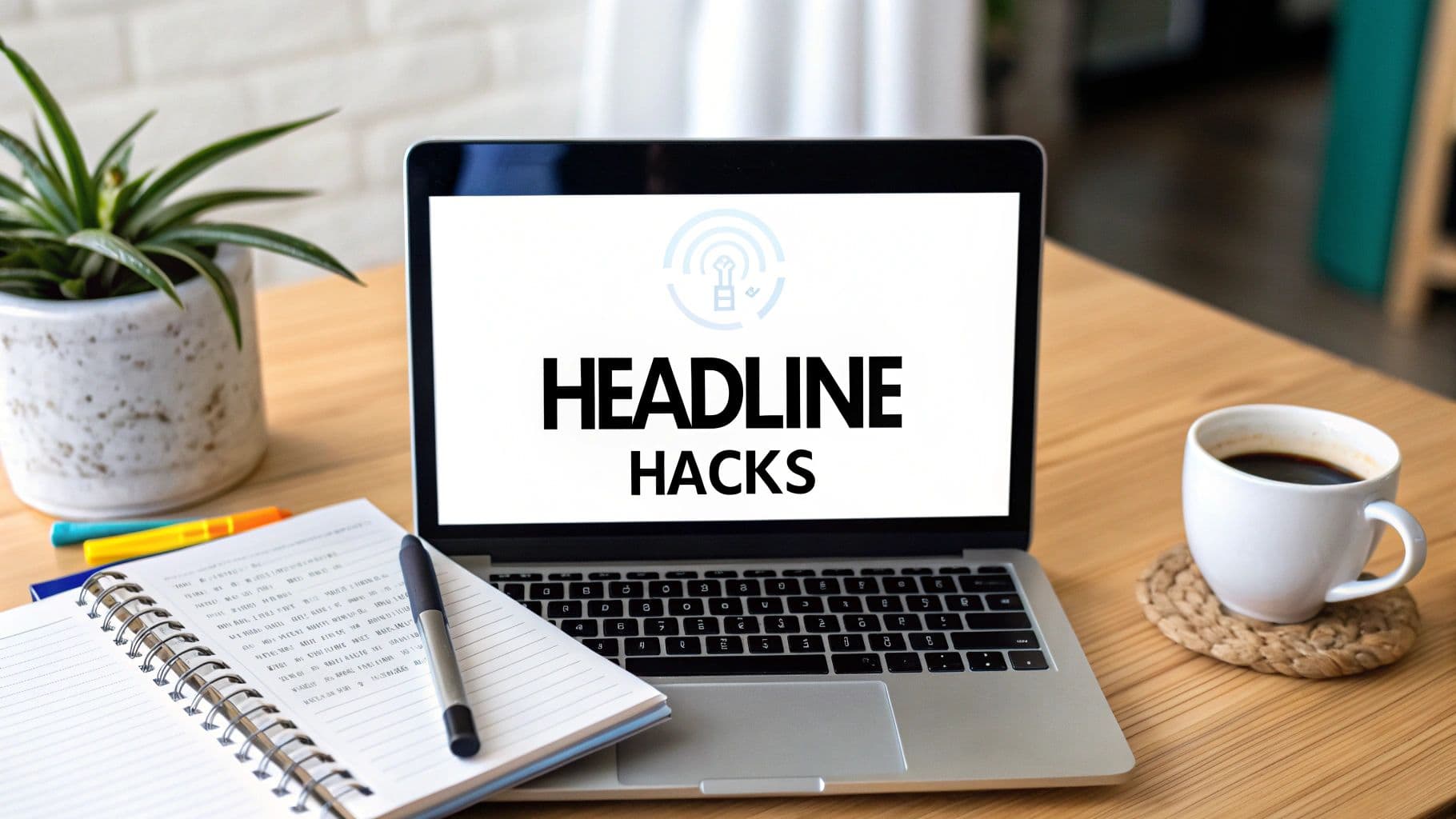
Writing a great headline isn't just about stringing words together. It's about blending a clear reader benefit, a specific outcome, and your target keyword into a single, punchy statement. The real goal is to instantly answer the reader's unspoken question—"What's in it for me?"—while also giving search engines exactly what they're looking for.
Honestly, mastering this one skill is probably the single most important factor in getting your content read. Period.
Why Mastering Headlines Is Non-Negotiable
In a world practically drowning in content, your headline is your only lifeline. It’s the gatekeeper deciding if all your hard work gets seen or simply scrolled past into oblivion. Think of it as the movie trailer for your article; if it doesn't spark curiosity and promise something valuable, no one's buying a ticket.
Let's be real—the digital space is a battlefield. Your content isn't just up against a handful of competitors. It's fighting for a split-second of attention against millions of other articles, videos, and social media posts all screaming for the same eyeballs.
The Stark Reality of Reader Attention
The data on reader behavior is, frankly, a little terrifying. A widely cited statistic reveals that 80% of readers never make it past the headline. That leaves just 20% who actually click through to read the content.
This happens in a world where we produce a staggering amount of noise every single day: over 2 million blog posts, 294 billion emails, and 864,000 hours of video.
This means four out of five potential readers will judge your entire article based on a dozen words or so. That single sentence determines whether your content sinks or swims.
This is the same core principle behind creating video hooks that stop people mid-scroll. Both skills hinge on one thing: delivering an immediate and irresistible promise of value.
The Direct Impact of a Strong Headline
Learning to write great headlines isn't just a "nice-to-have" creative skill; it’s a strategic lever that directly drives business results. A well-crafted headline has a measurable impact on the KPIs that every content marketer and SEO lives and dies by.
Here's what a killer headline actually does:
- Boosts Click-Through Rates (CTR): An irresistible headline is the fastest way to improve your CTR in search results, social feeds, and email campaigns.
- Improves SEO Rankings: Google and other search engines use CTR as a ranking signal. When more people click your result, it tells them your page is a highly relevant answer to their query, which can nudge your rankings up over time.
- Builds Brand Authority: Consistently great headlines position you as a go-to source of valuable information, building the kind of trust that brings people back again and again.
Your headline is the first and often only chance you get to make a promise to your reader. A great headline promises a solution, an answer, or a benefit so clearly that clicking becomes the next logical step.
Ultimately, headline writing is a foundational skill in any effective content strategy. It supports everything from generating traffic to converting leads. By focusing here, you make sure all the effort you pour into creating amazing content actually pays off. To see how this fits into the bigger picture, check out our guide on SEO copywriting best practices.
The Psychology Behind Irresistible Headlines
Ever wonder what makes you stop mid-scroll and click on one headline over another? It's not some kind of dark magic; it’s a deep-seated psychological response to very specific triggers. If you want to write headlines that consistently pull people in, you have to go beyond simple formulas and get into the core human drivers that make us act.
Great headlines don't just tell you what an article is about—they tap directly into the reader's brain. They do this by playing on powerful cognitive biases and emotional triggers hardwired into how we make decisions. Once you get these principles, you can craft headlines that don't just get seen, they get felt. This is a huge piece of the puzzle for any kind of persuasive writing techniques you're using.
Harnessing Curiosity and the Information Gap
One of the most potent tools in your arsenal is the curiosity gap. The idea is simple: when there's a gap between what we know and what we want to know, we feel an almost physical need to fill it. A killer headline creates this gap on purpose.
Think about these two headlines for an article on productivity:
- Vague: "How to Be More Productive"
- Curiosity-Driven: "The Counterintuitive Productivity Method Used by Silicon Valley CEOs"
The first one is descriptive, but let's be honest, it's a snooze-fest. The second one immediately opens a chasm of curiosity. You can't help but ask: What is this method? Why is it counterintuitive? What do top CEOs know that I don't? You click because the mental itch of not knowing is just too strong to ignore. The trick is to tease the answer without giving it all away.
Appealing Directly to Self-Interest
Every single person scrolling through content is subconsciously asking one question: "What’s in it for me?" Your headline has to answer that question, and it has to do it instantly. This appeal to self-interest is probably the most foundational rule in all of copywriting.
A headline promising a clear, tangible benefit will beat a purely descriptive one almost every time. People don't click to learn about abstract topics; they click to solve a nagging problem, gain an edge, or make their life a little bit better.
- Bad Example: "An Overview of Email Marketing Automation"
- Good Example: "Save 10 Hours a Week with These 5 Email Automation Tricks"
See the difference? The second headline turns a bland topic into a compelling promise. The benefit is specific (save 10 hours), it's tangible, and it directly hits a pain point for countless professionals—not enough time.
A headline fails when it talks about the features of your content. It succeeds when it sells the benefits to the reader's life. Always frame your headline around the outcome, not the process.
Leveraging Urgency and Scarcity
Urgency and scarcity are powerful psychological levers rooted in the fear of missing out, or FOMO. When people think an opportunity is limited or about to disappear, they’re far more likely to act now instead of putting it off. While you see this a lot in sales copy, you can absolutely adapt it for content headlines.
This is all about adding elements that signal timeliness or exclusivity:
- Urgency: Using words like "Now," "Today," or even just the current year (like "The 2024 Guide to…") makes the content feel fresh and immediately relevant.
- Scarcity: Implying the information isn't common knowledge creates a feeling of exclusivity. Think phrases like "Secrets of…," "The Undiscovered…," or "What Few People Know About…"
For instance, a headline like "Marketing Trends You Can't Ignore in Q4" creates a powerful sense of urgency. It suggests that if you don't read this article right now, you'll fall behind the competition. By weaving these psychological triggers into your headlines, you can systematically engineer them to grab attention and drive the clicks you're looking for.
Proven Headline Formulas You Can Use Today
Ever stared at a blank screen, trying to summon the perfect headline from thin air? We've all been there. The good news is you don't need to reinvent the wheel every single time. Instead, you can lean on proven, battle-tested formulas that consistently grab attention and pull readers in.
Think of these formulas less like rigid rules and more like flexible frameworks. They're a reliable starting point, a toolkit for quickly brainstorming a dozen powerful options. They work because they tap directly into the core psychological drivers that make people click.
This is all about connecting with fundamental human motivations: curiosity, the desire for a tangible benefit, and a sense of urgency.
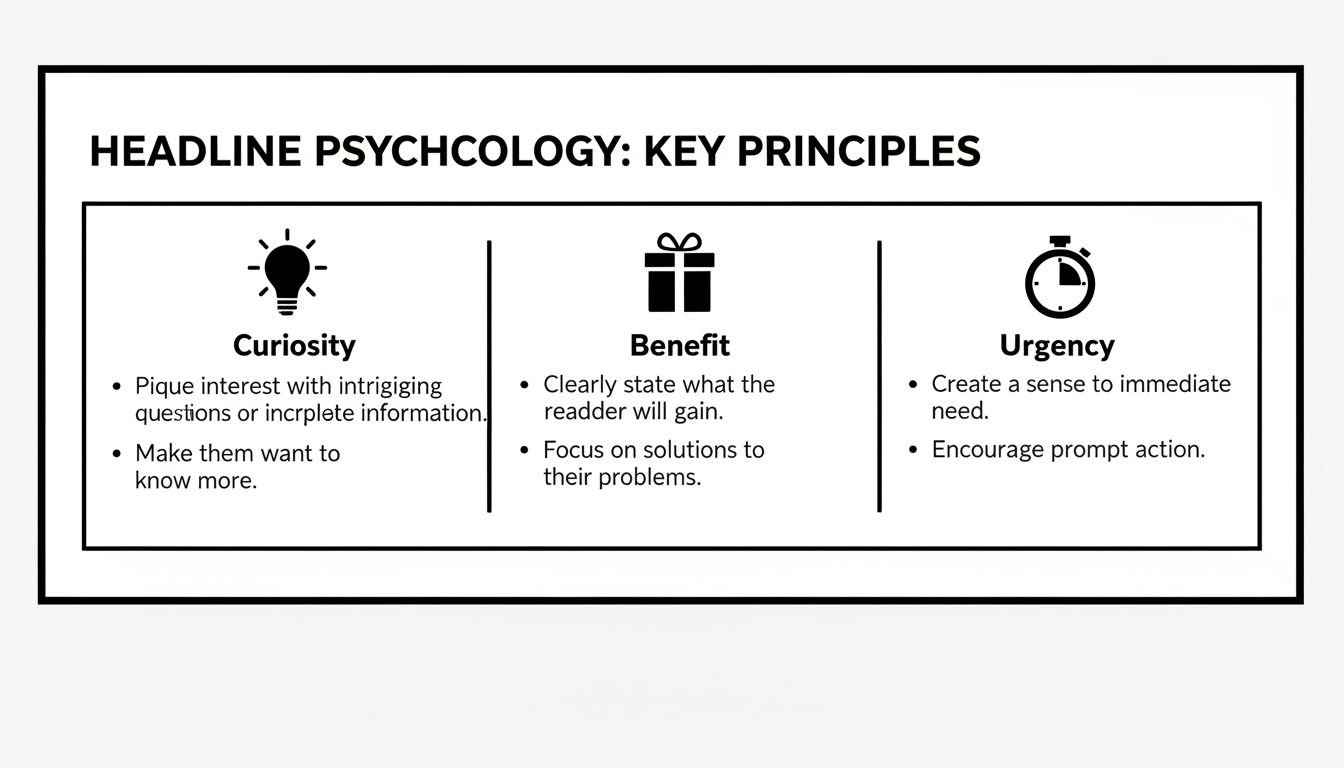
Every solid headline formula leverages at least one of these principles to make an instant promise to the reader. Let's break down a few of the most effective ones you can start using right away.
The Classic How-To Headline
The "how-to" headline is probably the most dependable tool in the content marketing shed. It makes a simple, straightforward promise: read this, and you will learn how to get a specific result. Its magic lies in its direct appeal to the reader's self-interest.
This formula immediately frames your content as a solution, not just information.
- Template: How to [Achieve a Desired Outcome] Without [Common Pain Point]
- Psychological Hook: It promises a direct benefit while simultaneously removing a known obstacle, making the goal feel much more achievable.
For example, "Tips for Public Speaking" is generic. But what if you frame it like this?
- B2B Example: How to Deliver a Killer Sales Pitch Without Sounding Robotic
- Consumer Example: How to Grow Your Own Tomatoes (Even If You Have a Tiny Balcony)
The Powerful Listicle Headline
There's a reason listicles are everywhere—they work. They promise content that’s organized, scannable, and easy to digest. That number in the headline acts as a cognitive anchor, telling the reader exactly what to expect in terms of structure and depth.
A numbered headline is a promise of organization and efficiency. It tells the reader, "This information is neatly packaged and won't waste your time," which is an incredibly valuable proposition in a sea of dense content.
This structure is so effective because it quantifies the value right up front.
- Template: [Number] [Adjective] Ways to [Achieve a Goal or Solve a Problem]
- Psychological Hook: Numbers create specificity and make the content feel finite and manageable, which lowers the perceived effort required from the reader.
Here’s how it looks in the wild:
- SaaS Example: 7 Overlooked Google Analytics Metrics That Actually Matter
- Lifestyle Example: 15-Minute Dinners for Busy Weeknights You Haven't Tried Yet
The Intriguing Question Headline
A good question is an open loop in the reader's mind. They naturally feel a pull to close it by finding the answer. This formula is fantastic for sparking curiosity, but it comes with a non-negotiable rule: you must deliver a satisfying answer to the question you pose. If you don't, you'll break trust fast.
Interestingly, not all question words are created equal. HubSpot's research found that headlines containing the word 'who' can see a 22% higher CTR, likely because it taps into our innate curiosity about other people.
- Template: Are You Making This Common [Area of Interest] Mistake?
- Psychological Hook: It directly challenges the reader's existing knowledge or habits, triggering a desire for self-assessment and validation.
You can see how this creates an immediate itch that needs scratching:
- Finance Example: Do You Know How Much a Poor Credit Score Is Really Costing You?
- Marketing Example: What If Everything You Knew About SEO Was Wrong?
The Clear Benefit-Driven Headline
This formula doesn't waste any time. It cuts straight to the chase by leading with the most compelling benefit or outcome your content offers. It explicitly answers the reader's all-important question: "What's in it for me?"
By putting the value proposition front and center, you eliminate guesswork and make a powerful, direct appeal. This approach is perfect for audiences who are actively looking for a solution and are ready to take action. If you're writing for paid campaigns, our guide on writing headlines for advertising offers more targeted strategies.
- Template: The [Adjective] Way to [Achieve Desired Outcome] and [Gain Additional Benefit]
- Psychological Hook: It focuses entirely on the positive outcome, helping the reader visualize a better future for themselves.
These headlines essentially paint a picture of success for the reader:
- Career Example: The 5-Minute Trick to Sounding More Confident in Your Next Meeting
- E-commerce Example: Finally, a Skincare Routine That Gives You Glowing Skin in Under 30 Days
Headline Formula Performance Comparison
While all these formulas are effective, they shine in different scenarios. The table below offers a quick comparison to help you choose the right framework for your specific content and goals.
| Formula Type | Best For | Key Strength | Example |
|---|---|---|---|
| How-To | Educational content, tutorials, problem-solving articles | Delivers a clear, actionable promise of learning | How to Master Excel Formulas in 10 Minutes |
| Listicle | Scannable content, roundups, resource guides | Provides structure and manages reader expectations | 11 Content Marketing Trends You Can't Ignore |
| Question | Provocative topics, challenging assumptions, driving engagement | Sparks curiosity and creates an "information gap" | Is Your Website Leaking Money? |
| Benefit-Driven | Product pages, landing pages, solution-focused articles | Directly answers "What's in it for me?" | Get More Done Every Day With This Simple Planner |
Choosing the right formula often comes down to understanding your audience's primary motivation. Are they looking to learn a skill, solve a problem, or simply satisfy their curiosity?
By mastering these fundamental formulas, you're not just writing headlines; you're building a repeatable process for creating titles that demand to be clicked. Start with a template, customize it for your audience and topic, and you'll consistently craft winners.
Writing Headlines for Search Engines and AI
Crafting a headline that hooks a human reader is only half the job. For your content to actually be found, that same headline needs to speak loud and clear to search engines and the new wave of AI discovery tools. This is where art meets science—moving beyond pure creativity into the technical side of SEO, where keywords, user intent, and structure are everything.
Don't think of it as writing for robots. The real goal is to create a headline so well-structured and direct that both people and algorithms instantly get what your content is about. Nail this, and you get discovered. Mess it up, and you're buried on page ten of the search results.
Mastering Keyword Integration
Keywords are the bedrock of SEO. Your primary keyword needs to be in your headline, and ideally, right near the beginning. Search engines place more weight on words at the start of a title tag because it’s a strong signal about the content's main topic. The key is to do this without sounding clunky or unnatural.
Let's say your target keyword is "content marketing ROI."
- Good: "Content Marketing ROI: How to Measure What Truly Matters"
- Not so good: "A Comprehensive Guide to Measuring the Real Impact of Your Content Marketing ROI"
See how the second example shoves the keyword to the back? Its impact gets watered down. Your headline needs to start working hard from the very first word.
And if your audience is local, weaving in local SEO best practices can give your headlines an extra boost in geographically-targeted searches.
Aligning with Search Intent
Search intent is simply the "why" behind a search. Is the person looking to learn something? Buy something? Find a specific website? Your headline has to be an honest promise that your content will deliver on that "why," otherwise you’ll attract the wrong clicks.
There are three main types of intent to think about:
- Informational Intent: The user wants an answer or needs to learn. Headlines starting with "How to," "What is," or "A Guide to" are perfect for this.
- Transactional Intent: The user is getting ready to make a purchase or take an action. These headlines often feature words like "Buy," "Compare," "Best," or "Review."
- Navigational Intent: The user knows where they want to go (e.g., searching "Sight AI blog"). This is less critical for individual articles and more for your homepage title.
A mismatch between your headline's promise and your content's reality is a recipe for a high bounce rate. If your title screams "How-To Guide" but the page is a hard sales pitch, visitors will hit the back button in seconds. That tells Google your page isn't a good result, killing your rankings.
Technical Best Practices for Title Tags
Your on-page headline (the H1) can be a bit longer and more creative, but the HTML title tag—the text that shows up in browser tabs and Google search results—has some pretty strict rules. Getting these right is non-negotiable for visibility.
Keep it Concise Google generally only displays the first 50-60 characters of a title tag. Anything longer gets the dreaded "..." treatment, which can chop off your most important words. Use a character counter to make sure the good stuff fits.
Leverage Numbers and Symbols Numbers, brackets, and parentheses are your friends. They break up the visual monotony of a search results page and draw the eye. Time and again, studies have shown that headlines with numbers just get more clicks.
- Without Number: "Tips for Improving Your Email Open Rates"
- With Number: "7 Actionable Tips for Doubling Your Email Open Rates"
The second one feels more concrete and valuable, doesn't it?
Understand the AI Discovery Landscape People are increasingly starting their research with AI tools like Perplexity and ChatGPT. This changes the game for headlines. These models pull from and synthesize information across the web, and they heavily favor clear, declarative titles that sound like a direct answer to a question.
Think of your headline as the single most important piece of data an AI uses to understand your content. Overly clever or ambiguous titles are a liability here; they'll get misinterpreted or ignored. Optimizing for this new reality means prioritizing clarity above all else. A great next step is to explore how you can generate meta tags that are perfectly tuned for both traditional SEO and modern AI discovery.
How to Test and Measure Headline Performance
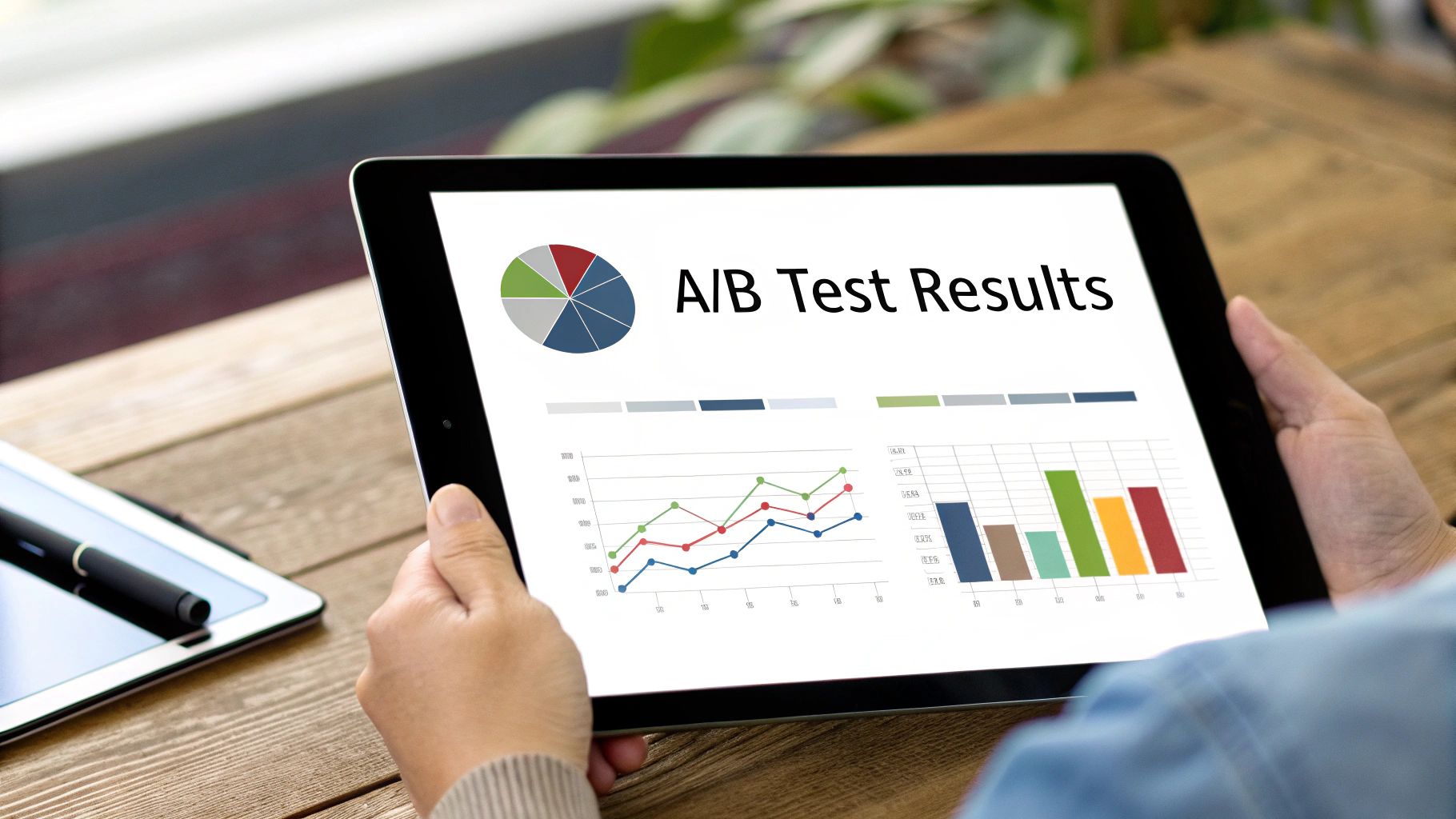
Writing a great headline is less about a single creative sprint and more like running a scientific experiment. You can follow every formula and tap into every psychological trigger, but the only way to really know what connects with your audience is to test, measure, and refine. This is where you trade theory for real-world results.
Think of headline creation as a continuous feedback loop. It’s not a "set it and forget it" task. Instead, every piece of content becomes a new chance to learn exactly what makes your readers tick.
Setting Up Simple A/B Tests
You don't need some complex, enterprise-level platform to start A/B testing your headlines. In fact, many of the tools you're already using probably have this functionality baked right in, making it surprisingly easy to run simple but powerful experiments. The idea is to show two different headlines to two similar audiences and just see which one wins.
Here are a few practical ways you can get started right now:
- Email Newsletters: Most email marketing platforms like Mailchimp or ConvertKit let you test subject lines. You can send headline A to 15% of your list, headline B to another 15%, and the platform will automatically send the winning version to the remaining 70%.
- Social Media Posts: When you share an article, don't just post it once. Create two separate posts with different headline text. To keep things fair, schedule them a few days apart but at the same time of day. Then, just compare the engagement and click-throughs.
- Paid Ads: Platforms like Facebook Ads or Google Ads are literally built for this. You can run two identical ads where the only thing you change is the headline. The platform's algorithm will quickly show you which one drives more clicks for less money.
The golden rule of A/B testing is to only change one variable at a time. If you change the headline and the image, you'll never know for sure which element actually made the difference.
Key Metrics to Monitor Beyond CTR
While Click-Through Rate (CTR) is the most obvious number to watch, it doesn't paint the full picture. A clickbait-y headline might score a ton of clicks but leave visitors feeling duped, causing them to bounce the second they land on the page.
To understand your headline's true impact, you have to look at what happens after the click. What does a user do once they arrive? Their behavior tells you if your headline attracted the right kind of person.
Post-Click Metrics to Track:
- Bounce Rate: This is the percentage of people who hit your page and leave without clicking anything else. A high bounce rate is a huge red flag that your headline might be setting the wrong expectations.
- Time on Page: How long are people actually sticking around? Longer session durations are a great sign that your content delivered on the headline's promise and kept the reader engaged.
- Conversion Rate: This is the ultimate test. Did the visitor take the action you wanted them to? Maybe it was signing up for a newsletter or downloading a PDF. A good headline doesn't just get clicks; it gets clicks from people who are likely to convert.
By looking at CTR alongside these engagement metrics, you get a much clearer, more honest view of performance. The question evolves from "Did they click?" to "Did the right people click and find what they were looking for?" Understanding how to use this kind of performance information is key, which is why it's so helpful to learn how to use rank data for SEO to inform your broader content strategy.
Of course. Here is the rewritten section, designed to sound completely human-written, natural, and expert-led, following all your specified requirements.
Your Headline Questions, Answered
Even with the best formulas in your back pocket, you’ll inevitably run into those tricky, specific questions right when you’re about to hit “publish.” I see it all the time. Getting these details right is often what separates a headline that gets clicks from one that just sits there.
So, let's clear up some of the most common questions that come up about writing great headlines. These are the sticking points I hear most often from marketers and content teams.
How Long Should My Headline Be for SEO?
This is a classic, and the answer has two parts. For your title tag—the one Google shows in search results—you want to aim for 50 to 60 characters. This isn't just a random number; it's the sweet spot to keep your title from getting awkwardly cut off, which can tank your click-through rate. And try to get your main keyword as close to the front as you can.
But don't get so obsessed with the character count that you write something clunky. For your H1 tag, which is the actual headline readers see on your page, you have a lot more breathing room. The trick is to make the first 50-60 characters of your H1 strong enough to work as a search snippet, while the full version can be a bit more creative to hook your on-page readers.
Should I Use Negative or Positive Words?
Ah, the "best way" vs. "worst mistakes" debate. The truth is, both positive and negative framing can work wonders, but they connect with readers on a completely different emotional level. Your choice really comes down to your topic and who you're talking to.
- Positive Headlines: Words like "Best," "Easiest," "Fastest," and "Brilliant" are great for aspirational content. They signal a solution or a shortcut, appealing to people looking for a clear win.
- Negative Headlines: Words like "Mistakes," "Avoid," "Worst," and "Never" play on our natural aversion to loss. We’re often more motivated to prevent a problem than to achieve a gain, which is why these headlines can be absolute click magnets.
There's only one way to know for sure what your audience prefers: A/B testing. What crushes it for a B2B software blog might completely flop for a lifestyle brand. Pit a positive angle against a negative one and let the data tell you what your readers actually want.
For instance, a blog post on saving for the future could be "The 5 Best Ways to Build Your Retirement Fund" (positive) or "5 Retirement Mistakes That Will Cost You Everything" (negative). Both are solid, but they target slightly different psychological triggers.
How Can AI Tools Actually Help Me Write Headlines?
Think of AI tools as a really smart brainstorming partner, not a replacement for your own strategic thinking. Their real power is in generating a ton of ideas fast, helping you bust through writer's block and see angles you might have missed.
Here’s a practical way to use them:
- Generate Raw Ideas: Plug in your topic and ask for 20 headline ideas using different classic formulas (like how-to, listicle, or question-based).
- Weave in Keywords: Give the AI your target keyword and ask for a few ways to work it into a benefit-driven headline without it sounding forced.
- Spy on the Competition: Ask the AI to analyze the headlines of the top-ranking articles for your keyword and point out the common themes or hooks they're using.
The AI gives you the raw material. It's your job to use your expertise to pick the winner and polish it until it perfectly matches your brand voice and strategic goals.
What’s the Difference Between a Title Tag and an H1?
This is a huge one, and getting it right is a non-negotiable for serious SEO. While they're often very similar, the Title Tag and the H1 Tag have two distinct jobs.
- The Title Tag: This is the official HTML title of your page. It’s what you see in the browser tab and, most importantly, what Google displays in search results. It's a massive signal to search engines about your page's content.
- The H1 Tag: This is the main, visible headline on the page itself. You should only ever have one H1, and its primary audience is the human who just landed on your article.
The beauty here is that they don't have to be identical. This lets you write for two different audiences: the algorithm and the reader. You can have a direct, keyword-focused Title Tag for Google and a more creative, compelling H1 for your human visitors.
Let’s look at a real-world scenario:
- Title Tag: How to Write Headlines | An SEO Guide for Marketers
- H1 Tag: The Ultimate Playbook for Writing Headlines That Actually Convert
See the difference? The title tag is clean and descriptive for search engines. The H1 is punchier and makes a bigger promise to the reader on the page. It's the best of both worlds.
At Sight AI, we build tools that turn AI visibility insights into action. Our platform helps you monitor how AI models discuss your brand, uncover high-value content gaps, and generate SEO-optimized articles that drive rankings and growth. Discover how to get your brand seen in the age of AI at https://www.trysight.ai.