
An effective SEO keyword strategy isn’t just a list of terms you want to rank for. It's the whole process—the thoughtful act of finding, analyzing, and choosing the exact search terms your ideal customers are typing into Google to find answers, products, or services just like yours. Think of it as the blueprint for all your content, guiding every article and landing page you create to pull in the right kind of organic traffic and hit real business goals.
Building Your SEO Keyword Strategy Foundation
Before you even think about opening Ahrefs or Semrush, the best strategies start with a hard look at the business itself. Chasing keywords without this foundation is like sailing without a compass. You’ll be busy, sure, but you won’t get anywhere that actually matters. The real goal here is to draw a straight line from every piece of content you create directly to a business outcome.
This initial groundwork ensures your efforts are sharp, efficient, and measurable right from the start.
Align SEO Efforts With Business Goals
Every single keyword you target has to serve a bigger purpose. What are you actually trying to accomplish? Are you trying to flood the sales team with qualified leads? Drive more online sales for a new product line? Or maybe just get your brand name known in a new market? Each of these goals demands a completely different flavor of seo keyword strategy.
Take a SaaS company focused on lead gen, for example. They’ll be all over keywords that scream "I'm ready to buy," like "best project management software for small teams." But a brand that's playing the long game to build authority will go after informational keywords, something like "how to improve team productivity."
A classic rookie mistake is getting tunnel vision on high-volume keywords. They look great on a spreadsheet, but they often attract a ton of traffic that has zero interest in what you're selling. A lower-volume keyword with clear commercial intent can be infinitely more valuable for driving actual revenue.
Define Your Ideal Audience Persona
Once you know your "why," you need to get crystal clear on your "who." And I mean go way beyond basic demographics. What are the problems that keep your ideal customer up at night? What questions are they asking at every stage of their buying journey? Getting inside their head and understanding their pain points is the secret to uncovering the exact language they use when they're looking for help.
This step directly fuels the kind of keywords you'll hunt for later. An audience of senior-level developers will use very different jargon than a group of small business owners, even if they're searching for a similar solution.
Establish Clear Key Performance Indicators
So, how will you know if any of this is actually working? Setting clear Key Performance Indicators (KPIs) from day one is non-negotiable. These are the metrics that give you a baseline, letting you measure progress and prove that your SEO efforts are more than just a cost center.
Your KPIs should be a direct reflection of your business goals. Here's what that looks like in practice:
- For Lead Generation: Keep a close eye on your organic conversion rate, cost per lead from organic search, and how you're ranking for those bottom-of-the-funnel keywords.
- For E-commerce Sales: Your world revolves around organic revenue, the average order value from search traffic, and the visibility of your product pages for transactional terms.
- For Brand Awareness: You'll want to measure organic impressions, how many people are searching for your brand name directly, and your overall share of voice for the big topics in your industry.
To connect these dots, I’ve put together a table that maps common business objectives to the specific SEO metrics you should be tracking.
Connecting Business Goals to SEO KPIs
| Business Goal | Primary SEO KPI | Secondary SEO KPI | Example Keyword Focus |
|---|---|---|---|
| Increase Lead Generation | Organic Conversions | Keyword Rankings for "Solution" terms | "best crm for real estate agents" |
| Drive E-commerce Sales | Organic Revenue | Product Page Impressions | "buy size 10 running shoes" |
| Boost Brand Awareness | Organic Impressions | Branded Search Volume | "what is sight ai" |
| Build Thought Leadership | Top 10 Keyword Rankings | Organic Traffic to Blog | "how to create a content strategy" |
This table isn't exhaustive, but it shows how a clear business objective translates directly into a tangible SEO metric and a specific type of keyword you should pursue. It’s about making your efforts intentional.
This entire process flow shows how business goals, audience understanding, and KPIs work in harmony as the bedrock of your strategy.
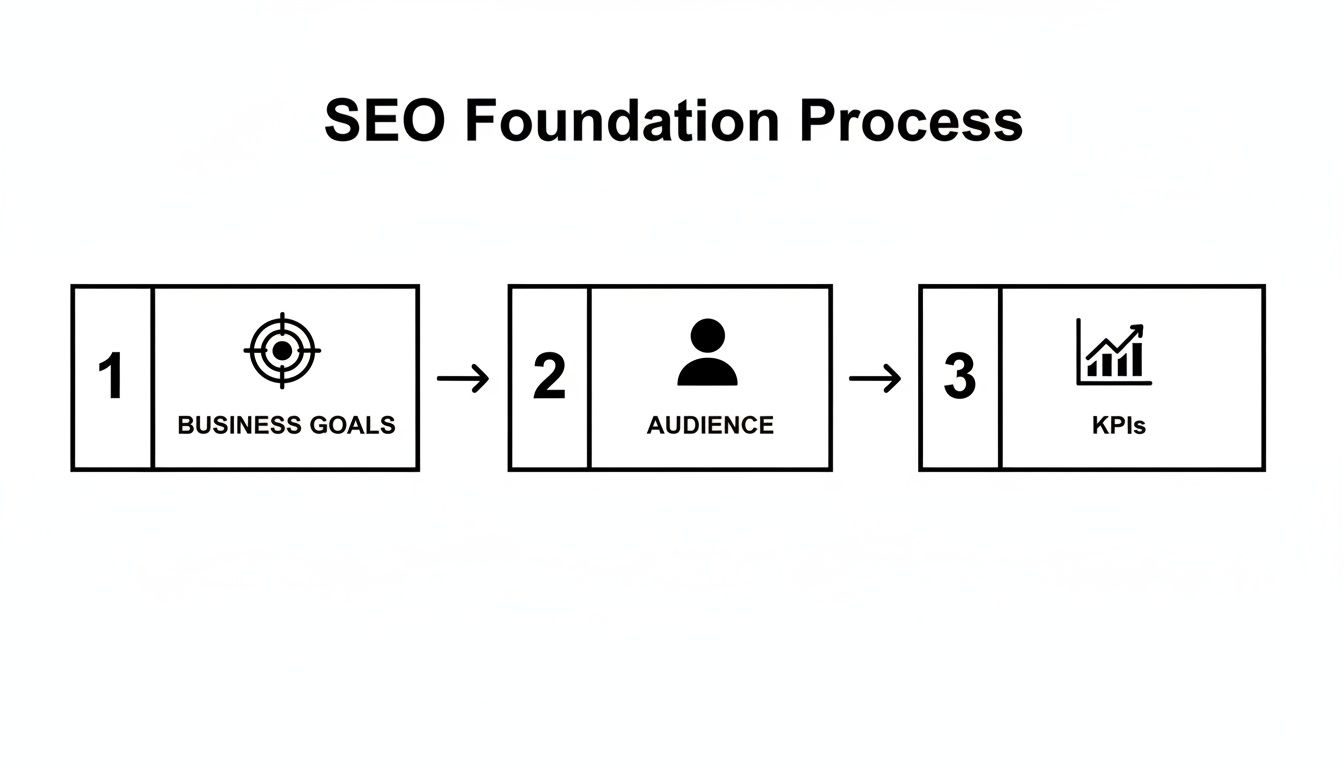
As the visual shows, a winning strategy always flows from a core business objective, through a deep understanding of the audience, and lands on measurable results. This is what separates random acts of content from a system that delivers predictable growth. To see how this fits into the bigger picture, it's worth understanding how a modern SEO content strategy weaves these foundational pieces into a comprehensive plan.
Keyword research remains the cornerstone of SEO, but it's still seen as a major hurdle by 39% of pros. Yet, getting it right can deliver massive returns—some companies have seen a 748% ROI just from thought leadership content that was strategically tied to transactional keywords.
With this foundation locked in, you’re ready for the next phase: grouping all those keywords into logical themes. You can get the full rundown on that important step in our guide on what is keyword clustering.
Uncovering Keywords and Deciphering User Intent
A truly effective SEO keyword strategy goes way beyond just guessing the obvious terms. It's about tapping into the actual language your audience uses every single day. This whole journey kicks off with what we call "seed" keywords—these are the broad, foundational terms directly tied to what you do. Start by thinking about your core products, services, and the specific problems you solve.
For example, if you sell organic dog food, your seed keywords are pretty straightforward: "organic dog food," "grain-free puppy food," or "healthy dog treats." These terms are your starting point, the seeds from which a much larger, more strategic keyword list will eventually grow.
Expanding Your Keyword Horizons
Once you've got your seed list, it's time to branch out and see what else is out there. A fantastic way to uncover new ideas is to simply peek at what your competitors are already ranking for. Using an SEO tool, you can plug in a competitor's domain and get a list of the keywords driving their traffic, often revealing angles you hadn't even considered.
Another goldmine is hiding in plain sight: Google's "People Also Ask" (PAA) section. These are real questions people are asking related to your seed keywords, giving you a direct line into their brains and their biggest information gaps.
But don't stop there. Go where your audience is having real, unfiltered conversations.
- Reddit: Search for subreddits in your niche (like r/dogs or r/DogCare) and just listen. Look for common questions, product debates, and everyday frustrations.
- Quora: This platform is literally built on questions. Pop in your seed keywords and see what your audience is genuinely curious about and the exact words they use.
- Forums & Communities: Niche industry forums are absolute treasure troves of authentic customer language and pain points.
The goal here is to build out a comprehensive list that reflects the full spectrum of how people search. This is crucial because a staggering 91.8% of all search queries are long-tail keywords—and these longer, more specific phrases often convert at a much higher rate. With 70% of searches now featuring more than three words, you have to go beyond the basics to capture that high-value traffic.
The Real Magic: Deciphering Search Intent
Here's the thing: a long list of keywords is pretty useless if you don't understand the "why" behind each search. This is user intent, and it's the key to creating content that actually ranks. Generally, intent falls into four main categories, and knowing which one you're targeting dictates everything that follows.
Key Takeaway: Matching your content to user intent is non-negotiable for ranking. If Google sees that searchers want a step-by-step guide and all you've got is a product page, your chances of hitting page one are slim to none, no matter how "optimized" it is.
Let's quickly break down the four types of intent:
- Informational: The user is looking for an answer or wants to learn something. Think "how to," "what is," or "why is."
- Navigational: The user already knows where they want to go. Searches like "Sight AI blog" or "login to HubSpot" fit here.
- Transactional: The user is ready to pull out their wallet and make a purchase. These queries often include words like "buy," "deal," or "discount."
- Commercial Investigation: The user is in research mode, comparing options before they buy. You'll see keywords with "best," "review," "vs," or "alternative."
To figure out the intent for any given keyword, you have to become a detective and analyze the Search Engine Results Page (SERP). The SERP is Google's answer key—it's showing you exactly what type of content it believes best satisfies that query. For a deeper look at this foundational process, check out our guide on what is keyword research in SEO.
Go ahead, search for your target phrase. What's ranking at the top? Is it a series of blog posts, product pages, comparison articles, or a bunch of videos? Pay close attention to SERP features like featured snippets, PAA boxes, or video carousels. These are all giant clues telling you what searchers find most helpful.
This screenshot shows the results for a classic informational query, which is completely dominated by guides and "how-to" articles.

The fact that "People Also Ask" and video results are present confirms that Google understands the user is in a learning phase, not a buying one. When you align your content with this proven intent, you dramatically increase your chances of ranking well and actually connecting with your audience.
Finding Opportunities in Competitor Keyword Gaps
Why reinvent the wheel when your competitors have already done some of the heavy lifting for you? Let's be honest, analyzing the keywords that are already working for them isn't about copying—it's about gathering strategic intel. They’ve poured time and money into figuring out what resonates with your shared audience, essentially creating a roadmap of proven topics and terms you can learn from.
This is where a keyword gap analysis comes in. By systematically finding the keywords they rank for that you don't, you can uncover some seriously high-impact content ideas you might have otherwise missed. It’s one of the most efficient ways to grow your organic footprint.
Pinpointing Your True SEO Competitors
First thing’s first: your business competitors and your search competitors aren't always the same people. A small, niche blog could be absolutely crushing the SERPs for a high-value keyword, making them a direct competitor in the search results even if they don't sell a similar product.
Your job is to identify 3-5 domains that pop up again and again for the keywords you want to own. SEO tools make this easy. Just plug in your main seed keywords and see who consistently owns the first page. These are the rivals whose playbooks you need to dissect.
Executing the Keyword Gap Analysis
Once you have your list of search competitors, you can jump into tools like Ahrefs, Semrush, or Moz to run the analysis. The process is pretty straightforward: you input your domain and your competitors' domains, and the tool spits out a report showing where your keyword profiles overlap and—more importantly—where they don’t.
The results will usually break down into a few key buckets:
- Shared Keywords: Terms you and your competitors both rank for.
- Your Keywords: Terms you rank for, but they're missing out on.
- Competitor Keywords (The Goldmine): Terms they rank for that you haven't touched.
That third category is where you'll strike gold. It’s your list of "low-hanging fruit"—proven keywords with existing demand that you aren’t targeting yet. For a more detailed look at setting up this kind of deep dive, our guide on how to do SEO competitor analysis offers a complete step-by-step framework.
Don't just export a massive spreadsheet of keyword gaps and call it a day. The real magic is in the filtering and prioritizing. Hunt for keywords with solid search volume, manageable difficulty, and a direct connection to your business goals. A keyword driving tons of traffic for a competitor might be completely irrelevant to what you actually sell.
From Gaps to Actionable Strategy
Okay, so you have a filtered list of keyword gaps. Now what? Not every gap represents an opportunity worth chasing. You have to put on your strategist hat and ask some tough questions to figure out where you have a real shot at winning.
For every promising keyword, run it through this quick evaluation:
- Content Quality: Take a hard look at the top-ranking pages. Can you genuinely create something 10x better? That could mean making it more comprehensive, organizing it better, keeping it more up-to-date, or coming at it from a completely fresh angle.
- SERP Intent: What is Google actually rewarding for this query? If the top results are all video tutorials and your team only produces blog posts, you're going to have a hard time breaking in. Match the format.
- Domain Authority: Be realistic. How does your site's authority stack up against the domains already on page one? If the SERP is clogged with industry giants, it might be smarter to target a less competitive long-tail version of the keyword first.
This kind of analysis makes sure you're placing your bets on keywords where you can actually compete and outrank the competition. A great way to find these gaps is by performing an Amazon competitive analysis; even if you're not in e-commerce, the principles of dissecting a rival's strategy are universal. By turning these competitor insights into a focused content plan, you build a much more powerful and efficient seo keyword strategy.
Prioritizing Keywords for Your Content Funnel
Let’s be honest—a massive spreadsheet full of keywords isn't a strategy. It's just raw data. The real magic in building an effective SEO keyword strategy happens when you turn that data dump into a clear, actionable content roadmap. This is where prioritization comes in. It transforms a messy list into a strategic plan, making sure you focus your time and budget where they’ll actually move the needle.
Without a system to rank your opportunities, you'll end up chasing keywords that are way too competitive, irrelevant to your business goals, or just attract an audience with zero intention of ever buying from you. Good prioritization is what separates the content teams that are just busy from the ones that are truly productive.
Creating a Practical Keyword Scoring Framework
To get from chaos to clarity, you need a simple scoring framework. This isn't about complex algorithms; it's about objectively evaluating each keyword against the metrics that actually matter to your business. It takes the guesswork and emotion out of the equation.
Your scoring model can be a simple spreadsheet where you give each keyword a score (say, 1-5) based on a few core criteria. While you can tweak this to fit your needs, a solid starting point includes these four pillars:
- Business Relevance: How directly does this keyword tie into a product or service you sell? A high score means it's a perfect match for your core offer.
- Search Volume: What’s the estimated monthly search traffic for this term? This gives you a sense of the potential audience size.
- Ranking Difficulty: Realistically, how hard will it be to crack the top 10 search results? This is all about the authority of the sites already sitting there.
- Conversion Potential: How likely is someone searching this term to become a lead or a customer? A keyword like "buy project management software" has way more potential than "what is agile methodology."
Pro Tip: Don't get hypnotized by high search volume. A keyword with 50 monthly searches and sky-high conversion potential is often far more valuable than one with 5,000 searches that only attracts people looking for free information.
Mapping Keywords to the Marketing Funnel
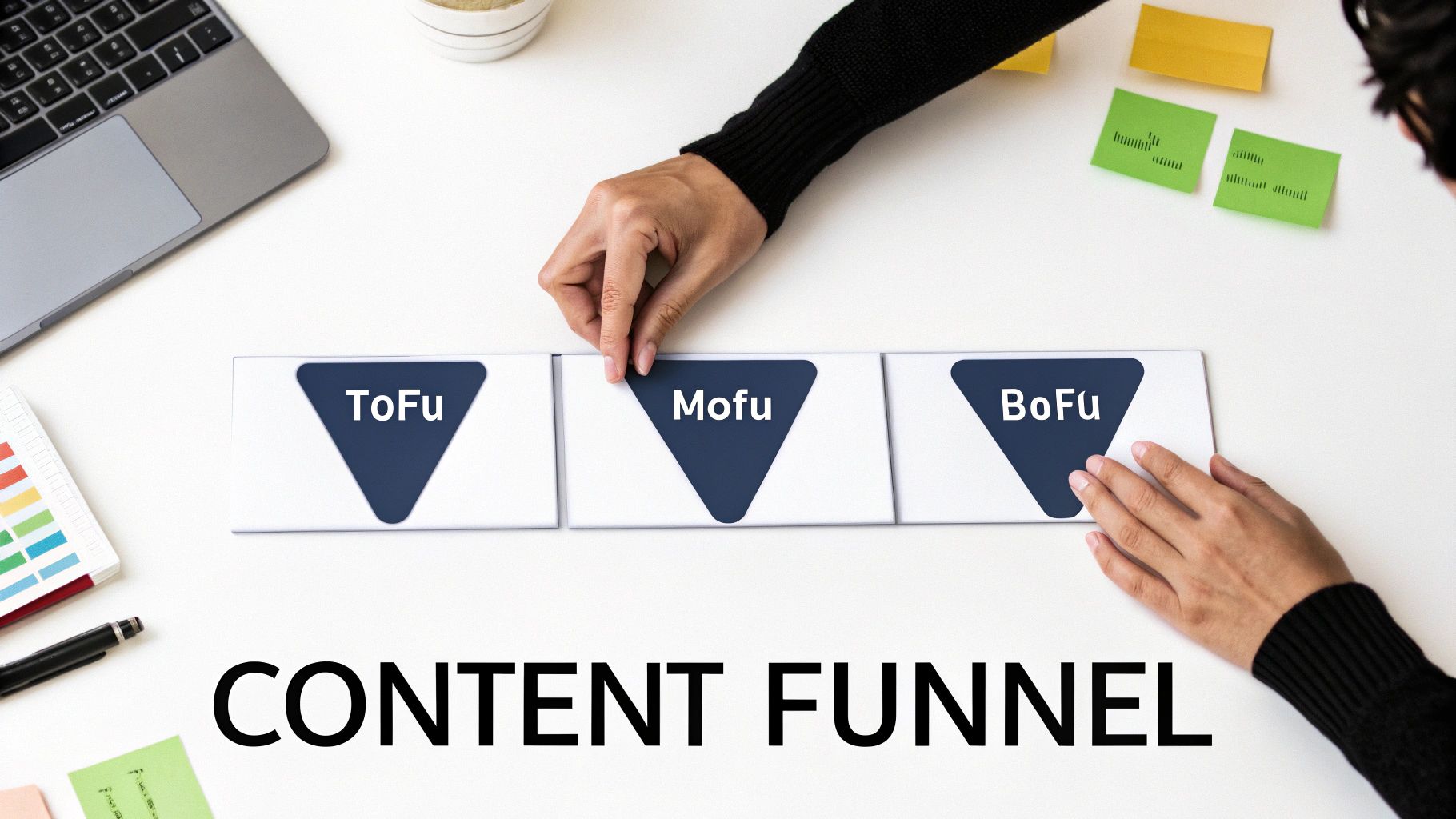
Once your keywords are scored and you have a ranked list, the next critical step is to map them to the different stages of the marketing funnel. This is how you build a complete content ecosystem that can attract, engage, and ultimately convert your ideal customers. It’s the difference between publishing random articles and building a cohesive customer journey.
For a deeper look at this process, our guide on how many keywords you should use for SEO breaks down how this funnel-based approach works in practice.
Here’s a simple framework to help you map your own keywords to the right funnel stage and content type.
Keyword to Funnel Mapping Framework
| Funnel Stage | User Intent | Example Keyword | Ideal Content Type |
|---|---|---|---|
| Top of Funnel (ToFu) | Informational | "how to improve team collaboration" | Blog Post, Guide, Infographic |
| Middle of Funnel (MoFu) | Commercial Investigation | "best project management tools for remote teams" | Comparison Article, Case Study, Webinar |
| Bottom of Funnel (BoFu) | Transactional | "Sight AI pricing" | Pricing Page, Demo Page, Free Trial |
This mapping process ensures your content creation is perfectly aligned with the user's mindset at each distinct stage of their journey.
Top of Funnel (TOFU) Awareness Keywords
At the very top, people are just realizing they have a problem or a need. They're looking for information, answers, and education. Your job here is to be a helpful, trusted resource, not to push a sale.
These keywords are almost always informational. They often start with phrases like:
- "How to..."
- "What is..."
- "Why is..."
- "Best ways to..."
A keyword like "how to improve team collaboration" is a classic TOFU query. The perfect piece of content is a comprehensive blog post or a detailed guide that genuinely solves their problem, positioning your brand as the expert in the space.
Middle of Funnel (MOFU) Consideration Keywords
Now we're in the middle. Users have put a name to their problem and are actively researching and comparing potential solutions. They’re digging for deeper details, looking for reviews, comparisons, and proof that a solution works.
These keywords have commercial investigation intent. Keep an eye out for modifiers like:
- "Best [solution] for [use case]"
- "[Product A] vs [Product B]"
- "[Solution] alternatives"
- "Review of [product]"
A search for "best project management tools for remote teams" is a perfect MOFU keyword. This calls for a detailed comparison guide, an in-depth product review, or a case study that shows off your solution in a real-world scenario.
Bottom of Funnel (BOFU) Decision Keywords
Finally, at the bottom of the funnel, the user is ready to pull the trigger. They’re looking for specific information about your product, its pricing, or how to sign up. The intent here is clearly transactional.
These keywords are highly specific and often include your brand name or buying terms:
- "[Brand name] pricing"
- "[Product name] demo"
- "Buy [product]"
- "[Brand name] free trial"
Targeting "Sight AI pricing" demands a clear, no-nonsense pricing page or a features page that guides users straight to a signup. By mapping keywords this way, you ensure you have the right content ready to meet users at every critical point, smoothly guiding them from that first spark of awareness to becoming a paying customer.
Using AI to Execute Your Content Strategy
You've got a prioritized keyword map. That’s a huge win, but now you’re staring at the next mountain: actually creating the content. A brilliant plan is just a document if you can't produce high-quality articles consistently. This is exactly where modern AI platforms stop being a novelty and become a core part of a winning SEO keyword strategy, helping you scale up without watering down your quality.
The old way was a grind. Turning a single target keyword into a polished, optimized article meant hours of manual research, outlining, writing, and editing. It was slow and expensive. But the new wave of AI tools collapses that timeline, letting you jump on opportunities before your competitors even spot them.
From Keyword to Comprehensive Content Brief
Every great piece of content starts with a solid brief. It's the blueprint that keeps your writer—whether human or AI—on track, ensuring the final article nails the keyword's intent and serves your business goals. Forget vague instructions like "write about our new feature." An AI-powered brief is a detailed battle plan.
Instead of spending an hour digging through SERPs, modern platforms can analyze them instantly and spit out a brief that includes:
- Target Audience Profile: A quick sketch of who you're writing for, what they're struggling with, and how much they already know.
- Primary and Secondary Keywords: The must-have terms needed to build topical authority.
- Key Talking Points: An outline built from what's already ranking, so you know you're covering the essential subtopics.
- Angle and Tone of Voice: Clear guidance on what perspective to take and how to sound like you.
This process turns a tedious, hour-long research task into something you can knock out in a few minutes, giving every article a strong foundation.
Accelerating Research and First Drafts
With the brief locked in, AI can step in as your research assistant and co-writer. Platforms like Sight AI are built for this, using specialized agents to do the heavy lifting of researching and drafting long-form content. This isn't about clicking a button and getting a generic 500-word blurb. It's about generating a structured, in-depth article that's ready for a human expert to refine.
The AI will typically pull SERP data, identify common questions from "People Also Ask," and find relevant stats to weave into a comprehensive first draft. This draft comes pre-formatted with headings, short paragraphs, and key ideas, saving your team from the agony of a blinking cursor on a blank page.
AI is your first-draft engine, not your final editor. The goal is to get 80% of the way there in a fraction of the time. This frees up your human experts to spend their time on the final 20%—adding strategic insights, perfecting the brand voice, and fact-checking.
This efficiency isn't just a nice-to-have; it's becoming critical. As AI reshapes SEO, speed and scale matter more than ever. A recent Semrush report on AI and SEO statistics found that 86% of SEO experts now use AI in their workflows, and 60% are already using tools like ChatGPT for brainstorming and research. This is where platforms that automate in-depth, 'AI-citable' content are becoming non-negotiable for winning in search.
The Crucial Role of Human-AI Collaboration
Let’s be crystal clear: just hitting "publish" on raw AI output is a fast track to mediocre, forgettable content. To actually build trust and stand out, you need a human-in-the-loop workflow. This hybrid model is the only way to protect your brand's unique voice and ensure your content lives up to Google's standards for Experience, Expertise, Authoritativeness, and Trustworthiness (E-E-A-T).
For a deeper dive into making this hybrid approach work, check out our guide on using AI for SEO content which breaks down the best practices.
The human editor’s job is to elevate the AI's output by:
- Injecting unique insights and personal stories.
- Verifying all facts and statistics for accuracy.
- Refining the tone to sound unmistakably like your brand.
- Adding custom graphics and real-world examples.
By pairing the raw speed of AI with the strategic creativity of your human experts, you can dramatically accelerate your content pipeline. It's a powerful combination that gets more content indexed and ranking faster than ever, turning that carefully crafted keyword strategy into real, tangible organic growth.
Right, so you’ve built your keyword strategy. Don't pop the champagne just yet.
A keyword strategy isn't a "set it and forget it" kind of deal. It’s a living, breathing part of your marketing that needs regular check-ups to stay in fighting shape. This is the part of the process where you stop guessing and start knowing—turning raw data into smarter decisions that actually move the needle.
Think of it as a feedback loop. It's how you spot what's truly clicking with your audience, so you can double down on the winners and cut the dead weight.
What to Watch: The Key Metrics That Matter
To figure out what’s working, you need to track the right numbers. Your two best friends here are going to be Google Analytics 4 (GA4) and Google Search Console (GSC). They’re free, and they give you a direct line into how people are finding and using your content.
These are the vital signs I check religiously:
- Organic Sessions (GA4): This is your big-picture health indicator. Is your overall search traffic climbing, dropping, or just flatlining?
- Keyword Rankings (GSC): Where do you stand for your money keywords? Keep a close eye on terms jumping onto page one—or worse, falling off. That's where the magic (or the trouble) happens.
- Click-Through Rate (CTR) (GSC): This metric tells you if your headlines and meta descriptions are doing their job. A high ranking with a low CTR is a huge red flag; it means your snippet isn't compelling enough to earn the click.
- Conversions (GA4): This is the bottom line. Is all this traffic actually turning into sign-ups, leads, or sales? If not, you've got a problem.
Time for a Tune-Up: Running Regular Content Audits
A quarterly content audit sounds like a chore, but it's where you find the hidden gems and the baggage holding you back. The goal is simple: identify your winners, your losers, and the content that's almost there.
Once you’ve sorted your pages into those buckets, you have a few options:
- Refresh: Got pages hanging out on page two or three for valuable keywords? These are prime candidates for a refresh. Update the stats, add a new section or two, sprinkle in some internal links, and polish up the on-page SEO. Often, that's all it takes to give them the final push.
- Consolidate: Have you accidentally written about the same topic five different times? You might be suffering from keyword cannibalization, where your own pages are fighting each other in the SERPs. The fix is to merge them into one powerhouse piece and redirect the old URLs.
- Prune: Let's be honest—some content just isn't worth saving. If a page has zero traffic, no rankings, and no backlinks, it might be time to say goodbye. Cut it, and redirect the URL to a closely related, high-performing page.
Your data tells a story about what your audience actually cares about. If an article about a niche feature is blowing up and driving conversions, that's a massive signal to build more content around that topic. Ignoring these signals is like leaving money on the table.
Turning Data Into Smarter Moves
Tracking metrics is one thing, but knowing what to do with them is what separates the pros from the amateurs.
If you see a topic cluster taking off, that’s your green light to build more supporting content and strengthen that pillar. On the flip side, if you're pouring resources into a hyper-competitive keyword and getting nowhere, it might be time to pivot. Look for a long-tail alternative where you actually stand a chance of winning.
This constant cycle of measuring, learning, and refining is what turns a good keyword strategy into a great one that delivers results, month after month.
Got Questions? Let's Talk Keyword Strategy.
As you start putting all these pieces together, a few questions always seem to pop up. Let's tackle some of the most common ones I hear from teams building out their keyword strategies.
How Often Should I Revisit My Keyword Research?
Look, keyword research is never a "one and done" kind of deal. The search landscape is always shifting.
I recommend a major strategic review at least once a year, or maybe semi-annually, just to make sure everything still aligns with your bigger business goals. But you can't just set it and forget it for 12 months. You should be peeking at what competitors are doing and sniffing out new opportunities every quarter.
And if you're in a really fast-moving industry? Bumping that up to a monthly check-in is a smart move. It keeps your strategy fresh and ready to adapt.
What Is the Difference Between a Keyword and a Topic Cluster?
This one's a classic. A keyword is simple: it's the specific phrase someone types into Google. Think "best running shoes for flat feet."
A topic cluster, on the other hand, is a whole content strategy. You create a big, central "pillar" page on a broad topic (like "running shoes"). Then, you build out a bunch of smaller "cluster" pages that dive deep into related subtopics ("running shoes for flat feet," "how to clean running shoes," "trail vs. road running shoes").
You link all those cluster pages back to the main pillar page. This whole structure basically screams "topical authority" to Google, which helps you rank for a much wider net of related search terms.
A quick tip from the trenches: Don't ignore what some tools call "zero-volume" keywords. Many keyword tools just can't accurately estimate the search volume for super niche, long-tail queries. These can be absolute gold because they often signal high purchase intent and have virtually no competition. If the keyword is a perfect match for your business, it's almost always worth going after.
At Sight AI, we help you turn these strategic frameworks into real-world results, fast. Our platform doesn't just show you the most valuable content gaps—it uses specialized AI agents to research, write, and publish fully SEO-optimized articles. It’s how you scale your content strategy and drive growth that lasts. See how you can execute your keyword strategy faster at https://www.trysight.ai.