
Figuring out the return on investment (ROI) for content marketing goes way beyond just counting direct sales. It’s really about measuring the total business value you get from your content efforts compared to what you spent to create them. Think of it like a long-term investment that builds real assets, like brand authority and organic traffic, which deliver compounding returns over time.
Decoding the True Value of Your Content

So many marketers get stuck trying to connect their content creation to the bottom-line results that make stakeholders sit up and listen. The real challenge is framing its value beyond simple revenue numbers. Content marketing isn't a one-and-done campaign; it’s the slow, steady process of building a valuable business asset that works for you 24/7.
This asset pays you back in a bunch of different ways—some direct, some indirect. A product page is built for an immediate sale, sure. But a high-quality blog post might attract someone who signs up for your newsletter, follows you on social media, and finally becomes a customer months down the road.
Thinking Beyond Direct Revenue
To truly get your head around the ROI on content marketing, you have to account for its full impact on the business. Your content is a silent salesperson, a brand ambassador, and a customer service rep all rolled into one. It builds trust, educates your audience, and nurtures relationships long before anyone ever clicks "buy."
Here are the key areas where content really delivers value:
- Brand Authority and Trust: When you consistently publish insightful content, you become the go-to expert. People start to trust your brand as a reliable resource.
- Audience Growth: Genuinely helpful content attracts and keeps a loyal audience, which is how you grow your email lists and social media following.
- Customer Loyalty: Educational content helps customers get more out of your product, which cuts down on churn and boosts their lifetime value.
- Organic Visibility: Every single piece of content is another chance to rank on search engines, driving a steady stream of "free" traffic over the long haul. You can learn more about how content fuels search performance in our guide on what content is in SEO.
The Compounding Effect of Content
Paid ads are great, but they stop delivering the second you stop paying. Content is different. Its ROI actually grows over time. An article you publish today can keep generating leads and sales for years to come.
This long-term impact is huge. Well-executed content marketing strategies can generate an average of $984,000 in yearly revenue. Top-performing campaigns see compounding returns, with a 3-year average ROI of 856% as the content's authority and reach expand. You can find more insights in these content marketing ROI statistics.
Once you understand this compounding effect, you can justify your content strategy and budget with confidence. You're not just talking about blog posts; you're articulating a complete value story that turns abstract efforts into tangible business outcomes.
Calculating Your Total Content Marketing Investment

To get a real handle on your content marketing ROI, you have to start with a brutally honest look at what you’re actually spending. The "I" in ROI is just as important as the "R," but it’s the part everyone seems to underestimate. Too many teams just tally up the obvious stuff, like the invoice from a freelance writer, and call it a day. That mistake leaves you with a skewed, overly rosy ROI figure that doesn't reflect reality.
A true investment calculation digs much deeper than direct costs. You need to account for every single resource that goes into getting your content from an idea to a published piece that your audience sees. Think of it like building a house: you wouldn't just count the cost of the lumber. You'd also have to factor in the architect's plans, the power tools, the permits, and the crew's wages.
Itemizing Your Content Production Costs
Let's start with the easy part: the direct expenses for creating the content itself. This is the foundation of your investment, covering all the external help you pay for. Resist the urge to lump it all into one "content" line item on a spreadsheet. Breaking it down is how you'll figure out where the money is really going.
Your production costs will likely include:
- Freelance and Agency Fees: This is what you pay writers, editors, graphic designers, video producers, or any marketing agencies you have on retainer.
- Stock Assets: Don't forget subscriptions for stock photos, video clips, or background music. Those costs add up and are essential for quality.
- Guest Contributor Payments: If you're paying industry experts or influencers to write a guest post or appear on a webinar, that fee goes right here.
This level of detail helps you spot which content formats are the most expensive to create—a critical piece of information when you start analyzing the return on individual assets later on.
Accounting for Tools and Technology
Your content doesn't just magically appear. It's planned, written, and fine-tuned using a whole stack of software, and each one comes with a subscription fee. These are the operational costs that keep your content engine running, and they're one of the most common things people forget to include, which artificially inflates their ROI.
A complete investment calculation must include every piece of software that touches your content's lifecycle. From SEO tools for research and project management platforms for organization to the analytics software for measurement—every subscription is part of the cost.
Make sure you're adding up the monthly or annual fees for platforms such as:
- SEO and Research Tools (e.g., Ahrefs, Semrush)
- Project Management Software (e.g., Asana, Trello)
- Content Management Systems (CMS) if you're paying for a premium version or specific plugins.
- Analytics and Reporting Platforms (e.g., while Google Analytics is free, many premium tools are not).
- Design and Video Editing Software (e.g., Adobe Creative Cloud).
The Hidden Cost of Internal Team Time
This is the big one. The most overlooked—and often the most significant—expense is the time your own team spends on content. Every hour an employee dedicates to the content machine is a real cost to the business, whether it's a manager reviewing a draft, a designer creating a custom graphic, or a marketer uploading a blog post. Figuring this out can feel a bit tricky, but it's essential for an honest ROI calculation. If you want to see just how quickly this time adds up, check out our guide on why content creation often takes too long.
To put a number on it, you’ll need to multiply the hours each team member spends on content-related tasks by their hourly wage. Don’t forget to include time for:
- Strategy meetings and content planning sessions
- Keyword and topic research
- Creating outlines and writing creative briefs
- The entire drafting, editing, and approval process
- Design, formatting, and getting it ready to publish
- Publishing, distributing, and promoting the content
By carefully tracking these direct, technological, and internal costs, you build a complete and defensible picture of your total investment. This financial groundwork is the bedrock of any credible ROI model that can truly prove the business value of your work.
Formulas for Measuring Content Marketing ROI
Alright, let's talk numbers. To get buy-in from the C-suite, you need to speak their language, and that language is dollars and cents. This is where we stop talking about the "value" of content in abstract terms and start proving its financial impact with cold, hard math. It might sound intimidating, but the core formulas are actually pretty simple.
The one you probably already know from Business 101 is the universal formula for ROI:
(Return − Investment) / Investment × 100% = ROI
This little equation spits out a clear percentage that tells you exactly how much you earned for every dollar spent. A 200% ROI means for every $1 you put in, you got $3 back—a $2 profit. Simple. The real trick isn't the formula itself; it's figuring out what to plug in for "Return" and "Investment."
The Basic ROI Calculation in Action
Let’s walk through a quick example. Say your team spends $5,000 in a quarter creating a few blog posts and a killer e-book. That’s your Investment.
From the leads that came directly from that content, you can trace $15,000 in new sales. That’s your Return.
Let's do the math:
- ($15,000 - $5,000) / $5,000
- $10,000 / $5,000 = 2
- 2 × 100% = 200% ROI
Not bad at all. This is a fantastic starting point, but it's really just scratching the surface. The real magic happens when you start using more specific formulas that connect directly to your business goals, whether that’s lead generation, e-commerce sales, or just getting your brand name out there.
To help you get started, here's a quick-reference table with the essential formulas for measuring different parts of your content marketing ROI.
Essential Formulas for Measuring Content Marketing ROI
| Metric | Formula | What It Measures |
|---|---|---|
| Basic ROI | (Return - Investment) / Investment × 100% |
The overall profitability of your content marketing efforts. |
| Cost Per Lead (CPL) | Total Content Investment / Total New Leads Generated |
How much it costs to acquire a single lead through your content. |
| Lead Conversion Rate | (Number of Conversions / Total Visitors) × 100% |
How effective your content is at persuading visitors to take action. |
| Customer Lifetime Value (CLV) | (Avg. Purchase Value × Avg. Purchase Frequency) × Avg. Customer Lifespan |
The total revenue you can expect from a single customer acquired by content. |
| Earned Media Value | Organic Visitors × Average CPC |
The dollar value of your organic traffic if you had paid for it via ads. |
These formulas give you a framework, but let's dive a little deeper into how to apply them.
Advanced Formulas for Deeper Insights
To get a truly accurate picture of what's working, you need to break down that "Return" variable into more granular metrics. The right approach depends on your business model, but here are a few indispensable formulas you should have in your toolkit.
1. Cost Per Lead (CPL) This one tells you exactly how efficient your content is at bringing in new prospects. For any B2B or service-based company, this is a non-negotiable metric.
- Formula: Total Content Investment / Total New Leads Generated = CPL
- Example: You spent that same $5,000 on content and got 50 qualified leads. Your CPL is $100. Now you know the acquisition cost for every potential customer your content attracts.
2. Lead Conversion Rate This measures how persuasive your content actually is. It’s the percentage of people who read your stuff and then take the action you want them to, like filling out a form or downloading a guide.
- Formula: (Number of Conversions / Total Visitors) × 100% = Conversion Rate
- Example: Your e-book landing page gets 1,000 visitors, and 50 people download it. That's a 5% conversion rate. To dig deeper into what numbers matter here, check out our guide on key website metrics to track.
3. Customer Lifetime Value (CLV) This is the holy grail for proving long-term value. CLV is the total revenue you can realistically expect from a single customer over their entire relationship with you.
- Formula: (Average Purchase Value × Average Purchase Frequency) × Average Customer Lifespan = CLV
- Example: A customer you acquired through a blog post spends $100 a month with you for 36 months. Their CLV is $3,600. When you can show that your content attracts customers with a high CLV, you've hit the jackpot.
How to Value Returns That Aren't Cash
Not every win comes with a dollar sign attached. What about that huge spike in organic traffic or your growing reputation as a thought leader? You can—and should—put a number on that, too. A great way to do this is by calculating the Earned Media Value of your organic traffic.
Just think about what it would have cost to buy that same traffic through paid ads. If your new blog post brings in 10,000 organic visitors and the average cost-per-click (CPC) for your target keywords is $2.50, the earned media value of that traffic is a whopping $25,000. Suddenly, your SEO efforts have a very clear dollar value.
There's a reason the global content marketing industry is projected to hit $107 billion by 2026—when measured correctly, the ROI is undeniable. With 82% of businesses already on board, the shift from traditional advertising is clear. Email marketing, a cornerstone of content strategy, can return an incredible $36 for every $1 spent. And when you're working with different formats, don't forget to track specialized metrics like video marketing ROI to get a full picture.
By using this mix of formulas, you can move beyond vague metrics and build a powerful, data-driven case for the true financial impact of your content.
Choosing the Right Content Attribution Model
Calculating the return on your content is about more than just plugging your investment and total revenue into a formula. The real trick is figuring out exactly which pieces of content led to specific sales. A customer almost never reads one blog post and immediately pulls out their credit card; their journey is usually a winding road of multiple touchpoints spread over weeks or even months.
This is where content attribution enters the picture. Think of it like assigning credit to players on a soccer team after a big win. Did the victory belong to the midfielder who started the play, the forward who got the assist, or the striker who scored the final goal? Each attribution model is just a different set of rules for handing out that credit.
The model you land on will completely shape how you see your ROI on content marketing. It directly influences which content formats you double down on and which topics you decide are worth the investment.
This concept map breaks down the fundamental flow of calculating content ROI, showing how your attribution model acts as the guide between your initial investment and the final return you see.
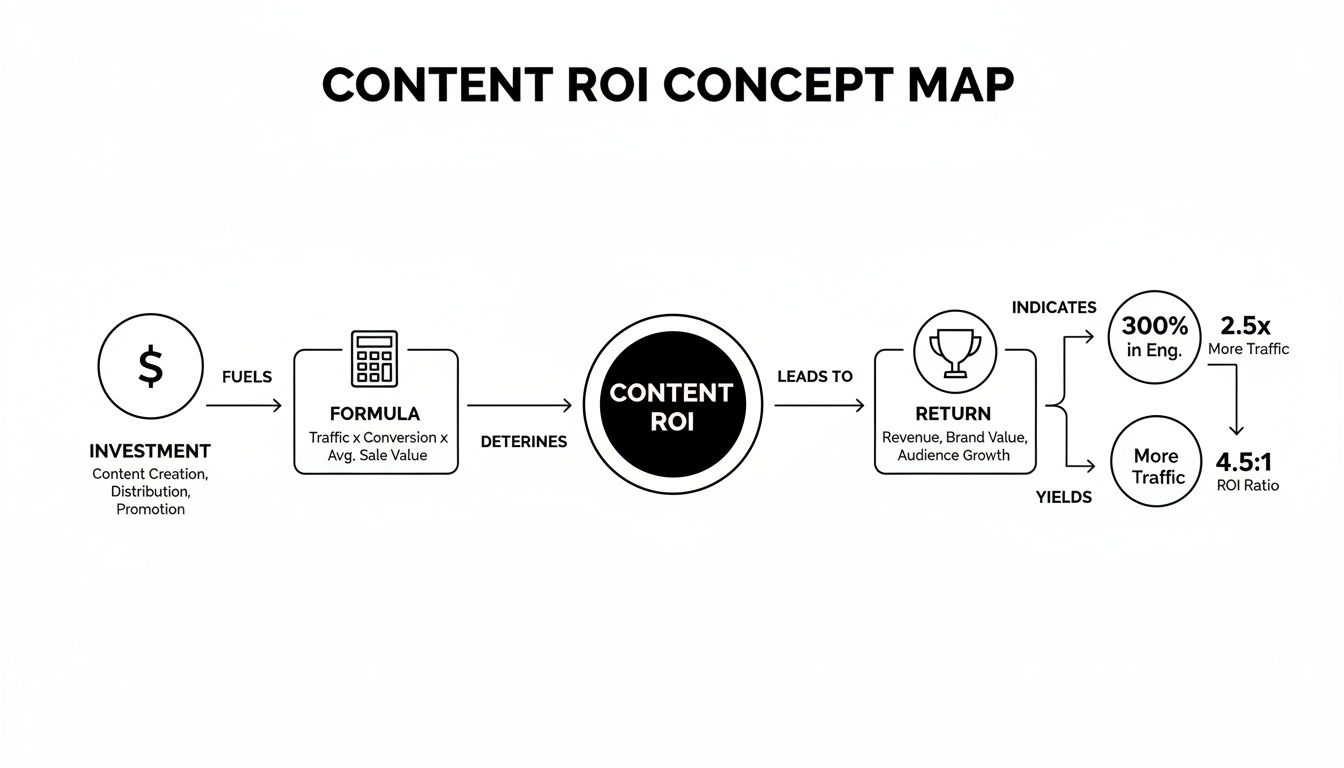 As you can see, a solid formula is the bridge between your spending and your results, which makes accurate attribution the foundation for a true ROI picture.
Single-Touch Attribution Models
Single-touch models are the simplest way to go. They give 100% of the credit for a conversion to a single interaction in the customer's journey. While they're definitely easy to set up, they often paint an oversimplified picture of a complex process.
First-Touch Attribution: This model credits the very first piece of content a person interacted with before becoming a lead. It’s like giving all the glory to the opening act that got the crowd hyped for the headliner.
- Best For: Companies laser-focused on top-of-funnel awareness. It helps you see which content is most effective at introducing your brand to entirely new audiences.
Last-Touch Attribution: Here, the final piece of content someone engaged with right before converting gets all the credit. This is like celebrating only the player who scored the winning goal, completely ignoring all the assists that made it happen.
- Best For: Teams concentrating on bottom-of-funnel conversions and sales-ready content. It shines a spotlight on the assets that are best at closing deals.
The biggest problem with single-touch models? They completely ignore everything that happens in the middle of the customer journey. They don't value the blog posts, case studies, and webinars that carefully nurture a lead from curious visitor to paying customer.
Multi-Touch Attribution Models
Multi-touch models give you a more balanced and realistic view by spreading the credit across multiple touchpoints. They operate on the belief that every interaction plays some role in the final conversion, giving you a much fuller picture of how your content is performing. If you want to go even deeper on this, you can learn more about advanced AI attribution tracking methods in our other guide.
Here are a few common multi-touch approaches:
Linear Attribution: This model is the definition of "everyone gets a trophy." It splits credit equally among every single piece of content the customer touched. If they read four blog posts before buying, each post gets 25% of the credit. It’s simple, but it values an initial blog view the same as a final demo request.
Time-Decay Attribution: This model gives more weight to the interactions that happened closer to the conversion. That first blog post they read a month ago gets a little credit, but the pricing page they looked at yesterday gets a whole lot more. It correctly assumes that later touchpoints are often more influential.
U-Shaped Attribution: This model gives the most credit to the very beginning and the very end of the journey. Typically, it assigns 40% of the credit to the first touch, 40% to the last touch (the conversion), and divides the remaining 20% among all the interactions in between. It values both the content that brought in the lead and the content that closed the deal.
Picking the right model really comes down to your business goals. If your main priority is just filling the top of your funnel with new leads, a first-touch model can give you the insights you need. But if you want a complete, holistic understanding of how your entire content ecosystem works together to drive revenue, a multi-touch model is non-negotiable for accurately measuring the true ROI on content marketing.
Actionable Strategies to Boost Your Content ROI
Knowing your content ROI is a huge win, but it's only half the game. Once you have the data, the real work begins. Moving from just measuring to actively improving is how you turn a content budget into a revenue-generating machine. It’s time to put those insights into practice.
Think of your content library like an investment portfolio. Some pieces are your star performers, bringing in steady returns year after year. Others? They're just sitting there, underperforming. Your job is to rebalance this portfolio—cut your losses on what isn't working and double down on your winners. This is how every dollar you spend starts working harder for your business.
Conduct a Ruthless Content Audit
The first step to improving your ROI on content marketing is figuring out what you’re actually working with. A content audit is a full-on, systematic review of everything you've published. The goal is to find your winners, your losers, and the hidden gems you didn’t even know you had. It’s less about judging past work and more about finding a data-backed path forward.
Start by cataloging your content and pulling the key metrics for each piece. You’ll want to look for:
- Traffic Drivers: Which articles are your organic search magnets?
- Conversion Champions: What content is actually generating leads or sales?
- Engagement Magnets: Which posts get the most shares, comments, or have the highest time on page?
- Content Ghosts: What's getting little to no traffic or engagement at all?
With this data in hand, you can decide the fate of each piece. Your top performers might be perfect candidates for a promotional push or a complete repurposing campaign. The underperformers? You can update and relaunch them, consolidate a few weak posts into one strong one, or just delete them if they’re completely irrelevant.
Optimize Your Conversion Funnels
Incredible content that doesn’t lead the reader anywhere is a massive missed opportunity. Even a tiny bump in your conversion rate can have a huge impact on your total return. Your content shouldn't just sit there and inform; it needs to gently guide the reader to the next logical step.
A common mistake is treating content as a standalone piece rather than part of an integrated conversion funnel. Every article should have a clear purpose and a call-to-action (CTA) that aligns with the reader's intent at that stage.
Take a hard look at your best-performing blog posts. Are the CTAs actually relevant? Someone who just finished an article on "how to choose the right software" is primed for a CTA offering a comparison guide or a free trial—not a generic "contact us" button. Use a mix of inline CTAs, banners, and lead magnets like checklists or templates to create clear pathways from reading to converting.
Repurpose Your Greatest Hits
Creating truly great content takes a lot of time and money. One of the absolute best ways to boost your ROI on content marketing is to squeeze every last drop of value out of your top-performing assets. A single, comprehensive guide can be a goldmine for dozens of smaller content pieces.
This approach expands your reach across different platforms with minimal extra effort, all while reinforcing your core message. For example:
- Break Down Long-Form Content: Turn that epic blog post into a series of punchy LinkedIn carousels, a viral Twitter thread, or a handful of short-form video scripts.
- Convert Data into Visuals: Take a data-heavy report or case study and transform it into a shareable, eye-catching infographic.
- Repackage Webinars: Slice a one-hour webinar into short, digestible video clips for social media or turn it into an educational email series for your subscribers.
When you adopt a "create once, distribute forever" mindset, you scale your content's impact without having to scale your budget right along with it.
Leverage Technology to Reduce Investment
Boosting ROI isn't just about increasing the 'Return' side of the equation; it's also about being smart and lowering the 'Investment'. Modern tools can slash the time and cost it takes to research, produce, and distribute content, freeing up your team to focus on the big-picture strategy.
AI, in particular, has become a complete game-changer for content teams. It can speed up topic research, generate detailed outlines, and even produce high-quality first drafts, cutting way down on manual work. This isn't just about saving money—it's about increasing your content velocity, which means you can publish more consistently and compound your organic growth much faster.
The data backs this up. A solid 68% of businesses report a boost in their content and SEO results after bringing AI tools into their workflow. Marketers using AI for personalization are seeing returns of 200% or more, and 23% have even seen their search rankings improve for AI-generated content. You can discover more statistics on AI's impact on marketing to see the full picture. By integrating these tools, you can publish better content at a fraction of the traditional cost, giving your bottom line a direct lift.
Building Your ROI Measurement Dashboard
You can track formulas and attribution models all day, but without a central hub, you’re just drowning in scattered data. To really get a grip on the ROI on content marketing, you need a single source of truth—a dynamic dashboard that shows you what’s working in real time. This is how you move beyond dusty quarterly reports and start making constant, data-backed improvements.
Think of this dashboard as the cockpit for your content marketing efforts. It’s got all the essential gauges—traffic, engagement, conversions, and budget—letting you make quick adjustments to stay on course. You can build this using tools like Google Analytics, Looker Studio, or other specialized analytics platforms.

The goal is simple: create a feedback loop where performance data directly shapes your content strategy. This is how you prove your value to the rest of the company, consistently.
Core Dashboard Components
A truly useful ROI dashboard isn’t crammed with every metric under the sun. It’s a curated view of the key performance indicators (KPIs) that matter most, organized by their role in the customer journey. This structure tells a clear story, showing how initial awareness eventually turns into real revenue.
If you're starting from scratch, our guide to creating an SEO performance dashboard is a great place to begin.
Here’s a blueprint of what every solid dashboard needs:
Traffic & Awareness Metrics: This is the top of your funnel, measuring your content's ability to pull in an audience. Key metrics here are Organic Traffic, New vs. Returning Users, and Top Landing Pages.
Engagement Metrics: Once people land on your content, are they actually sticking around? This section tells you how compelling your stuff is. Keep an eye on Average Time on Page, Bounce Rate, and Social Shares.
Conversion Metrics: This is where the magic happens—where content starts turning visitors into potential customers. You’ll want to track Goal Completions (like newsletter sign-ups), Lead Magnet Downloads, and your overall Lead Conversion Rate.
By organizing your dashboard this way, you can instantly see where your strategy is winning or falling short. High traffic but low engagement? That might point to a content quality issue. Great engagement but no conversions? Your calls-to-action might need some work.
Connecting Content to Revenue
The final, and most critical, piece of your dashboard is the one that connects your work directly to the bottom line. This is where you prove the financial impact of every article and video you create.
To get this right, you absolutely must integrate data from your Customer Relationship Management (CRM) system, like HubSpot or Salesforce. This connection is what allows you to see which pieces of content influenced deals and generated actual sales.
Here are the essential revenue-focused KPIs to include:
- Leads Generated by Content: The total count of new leads that can be directly attributed to your content.
- Lead Quality Score: A rating that tells you how likely a lead is to become a customer, helping you see which content attracts high-value prospects.
- Revenue Attributed to Content: The total dollar amount from closed deals where your content was a key touchpoint along the way.
Creating a dashboard like this turns ROI from an abstract concept into an ongoing, actionable process. It gives you undeniable proof of your content's value and empowers you to make smarter, more profitable decisions every single day.
Common Questions About Content Marketing ROI
When you start digging into the numbers, a few practical questions always seem to pop up. Let's face it, calculating the ROI on content marketing isn't always a clean, simple formula. So, let's tackle the most common hurdles to help you set realistic expectations and get a real grip on measurement.
How Long Does It Take to See a Positive ROI?
Content marketing is a marathon, not a sprint. While you might see some encouraging initial boosts in organic traffic or social media buzz within the first 3-6 months, a significant, positive financial return takes longer to build. The real magic happens with the compounding effect of your efforts over time.
Think of it like planting a tree. You have to put in the work upfront—watering and nurturing it—but eventually, it grows strong roots, carves out its space (in this case, on search engines), and starts producing fruit long after you've finished planting. A truly meaningful and measurable ROI on content marketing often starts to become clear around the 12-18 month mark.
Patience is the name of the game here. The return isn't linear; it snowballs as your content library grows, your search rankings solidify, and your brand becomes the go-to resource in your industry.
What Is a Good Content Marketing ROI Benchmark?
This is the million-dollar question, and the honest answer is: it depends. Your industry, business model, and how long you've been at this all play a huge role. That said, a common benchmark for a "good" return is around 300% (a 3:1 return) after the first year of a consistent strategy.
But that's just a starting point. Well-executed, mature content programs can blow that number out of the water. Some studies have shown that top-performing campaigns can deliver a 3-year average ROI exceeding 800%. Ultimately, the most important benchmark is your own—tracked over time. Focus on showing consistent improvement from one quarter to the next.
How Do I Measure Top-of-Funnel Blog ROI?
Measuring the return on non-gated, top-of-funnel content like blog posts is all about connecting the dots between that initial touchpoint and a later conversion. You have to track their influence down the line.
Here are a few practical ways to do it:
- Track User Journeys: Use your analytics to see how many people who first landed on a blog post eventually came back to sign up for your newsletter, download an ebook, or request a demo.
- Use Multi-Touch Attribution: This is non-negotiable. A simple "last-click" model will almost always ignore your blog's contribution. A linear or U-shaped model, however, will give that initial blog post the credit it deserves for starting the conversation.
- Calculate Traffic Value: Figure out what that organic traffic would have cost you in paid ads. If a blog post brings in 5,000 visitors from a keyword with a $3 cost-per-click (CPC), that post has an earned media value of $15,000. That's real money you didn't have to spend.
At Sight AI, we turn these complex ROI questions into clear, actionable insights. Our platform helps you spot high-value content gaps, produce optimized articles at scale, and track your brand’s visibility across search and AI, making sure every piece of content contributes to your bottom line. Discover how Sight AI can prove and improve your content ROI at https://www.trysight.ai.