A content calendar is much more than a simple schedule; it's the strategic roadmap that guides your entire marketing plan. Think of it as the architectural blueprint for your brand's narrative, ensuring every blog post, social media update, and video works together to hit your business goals.
The Blueprint for Your Content Strategy
Imagine your content team's workspace as a command center. Without a calendar, you're stuck in reactive mode—scrambling for last-minute ideas, posting whenever you can, and hoping for the best. It's a chaotic approach that rarely delivers the results you want.
A content calendar completely flips that script, shifting your team from reactive to proactive. It provides a clear, shared vision, detailing what content gets published, on which channels, and when. More importantly, it serves as the single source of truth that connects individual pieces of content back to your larger marketing campaigns and company-wide objectives.
Why a Calendar Is Essential for Growth
At its core, a content calendar brings order and purpose to your marketing. When you map out your content ahead of time, you create a consistent publishing schedule, which is absolutely vital for building audience trust and signaling to search engines that your site is a reliable source of fresh information.
But a well-structured calendar is far more than a to-do list with dates. It's a dynamic tool that directly drives tangible business outcomes. It helps your team:
- Maintain Consistency: A regular publishing rhythm keeps your audience engaged and tells search engines your site is active and valuable.
- Improve Collaboration: Everyone—from writers to designers to social media managers—knows what’s due and when. This clarity eliminates bottlenecks and makes the entire workflow smoother.
- Enhance Strategic Alignment: It ensures every article, video, or post has a clear purpose, whether that’s generating leads, boosting brand awareness, or supporting a major product launch.
The real impact here is the shift from treating content as a random activity to a key business driver. It creates a cohesive brand story that unfolds consistently across all your platforms.
This strategic shift translates directly into better performance. We’ve seen brands using structured content calendars boost their engagement by up to 40%. One SaaS company, for example, achieved this by auditing their past content performance and using their new calendar to double down on what worked—in their case, video tutorials.
To see just how transformative a planned approach can be, you can explore more data in this complete guide to managing content. By getting organized, you turn content creation from a guessing game into a predictable engine for growth.
Core Benefits of a Content Calendar at a Glance
To put it all together, a content calendar is the linchpin of a successful content strategy. The table below breaks down the key benefits and shows just how deeply it can impact your operations.
| Benefit | Impact on Your Strategy |
|---|---|
| Consistency | Builds audience trust and improves SEO signals. |
| Collaboration | Eliminates confusion and streamlines team workflows. |
| Strategic Alignment | Ensures every piece of content has a clear business purpose. |
| Efficiency | Reduces last-minute scrambling and saves valuable time. |
| Proactive Planning | Allows you to anticipate trends and plan for key events. |
| Performance Tracking | Makes it easier to measure what works and refine your strategy. |
Ultimately, implementing a calendar provides the structure needed to move from simply creating content to strategically driving results with it.
Anatomy of a High-Performing Content Calendar
A great content calendar is so much more than just a list of dates and topics. It’s the command center for your entire content operation. While a basic schedule might track what you’re publishing and when, a high-performing calendar turns that simple list into a strategic asset that actually drives measurable growth.
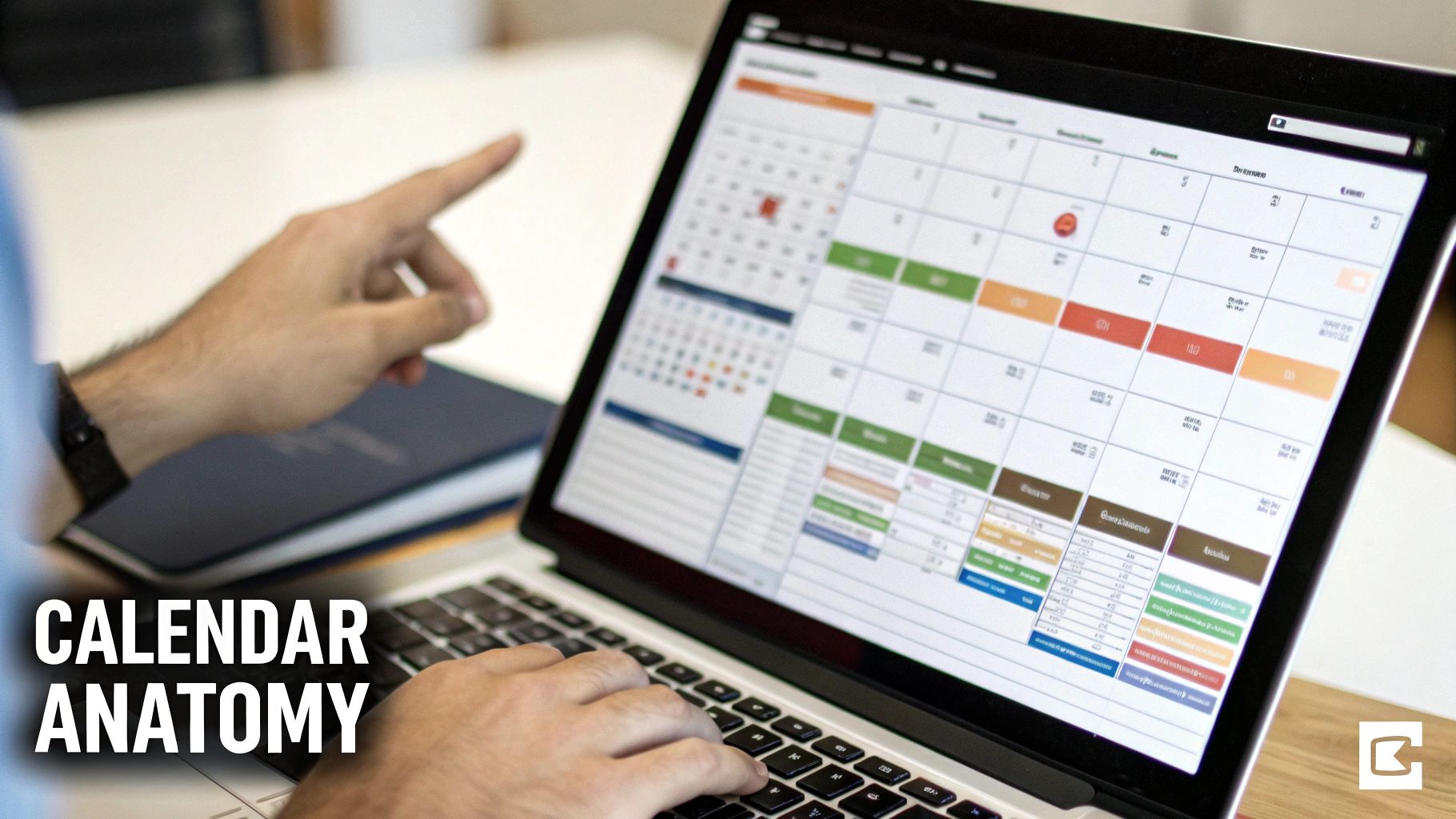
Think of it like the difference between a simple paper map and a GPS with live traffic updates. The map shows you the roads, sure, but a dynamic system gives you everything you need to navigate effectively, avoid roadblocks, and reach your destination faster. Your calendar should do the same for your content goals.
The Core Components for Success
To build a calendar that’s truly optimized for results, you have to go beyond the basics. While every team’s calendar will look a little different, the most effective ones all share a mix of foundational and strategic elements. You can explore various content planning strategies to see how these pieces fit into the bigger picture.
At a minimum, these are the non-negotiable fields you absolutely must include:
- Publication Date & Time: The exact moment your content is scheduled to go live.
- Content Title or Topic: A clear working title or the core subject matter.
- Content Format: Is it a blog post, a video, an infographic, or a social media story?
- Target Keywords: The primary and secondary SEO keywords you’re aiming to rank for.
- Author/Assignee: Who is responsible for getting the content created and finalized.
Strategic Layers That Drive Performance
Once you have the fundamentals locked in, adding strategic columns is what separates a good calendar from a great one. These extra details connect your content directly to your business objectives and give you the data you need for smarter decisions down the line.
A truly high-performing content calendar doesn't just track what you've done; it actively informs what you should do next. It becomes your feedback loop for continuous improvement.
For instance, tracked campaigns show 15-30% higher conversions when calendars include dedicated columns for calls-to-action (CTAs), specific hashtags, and performance metrics. These details allow for monthly audits that can reveal powerful patterns, like discovering that your video content outperforms static images by 40%.
By building in these extra layers, your calendar evolves from a simple schedule into an indispensable tool for growth.
Finding the Right Type of Calendar for Your Goals
Not all content calendars are created equal—and they shouldn't be. Just like a chef has different knives for different jobs, your marketing strategy dictates the kind of calendar you need. The goal is to build a tool that actually works for you, not one that just adds more admin to your plate.
After all, the needs of a B2B blog manager chasing long-term SEO wins are worlds apart from an e-commerce brand running a frantic holiday campaign on social media. Picking the right format from the start is the key to staying organized and effective.
Editorial vs. Social Media vs. Campaign Calendars
Let's break down the three most common types of content calendars. While they all help with planning, each one focuses on a different part of your marketing machine. Understanding the distinctions will help you figure out which one—or which combination—is the perfect fit for your team.
| Calendar Type | Primary Focus | Posting Frequency | Example Content |
|---|---|---|---|
| Editorial Calendar | Long-form content, SEO strategy, and thematic planning. | Low (Weekly/Bi-weekly) | Blog posts, case studies, white papers, e-books. |
| Social Media Calendar | Real-time engagement, community building, and brand voice. | High (Daily/Multiple times a day) | Instagram Reels, TikToks, LinkedIn updates, tweets. |
| Campaign Calendar | A specific, time-bound marketing initiative with a clear goal. | Varies (High-intensity bursts) | Product launch assets, webinar promotions, seasonal sales. |
As you can see, each calendar serves a unique purpose. An editorial calendar gives you that 30,000-foot view, while a social media calendar gets you down into the daily trenches. A campaign calendar is your special ops plan for major marketing pushes.
The most common setup involves an editorial calendar for the big picture and a separate social media calendar for the fast-paced stuff.
An editorial calendar is your strategic roadmap. It maps out major content pieces like blog posts, case studies, and e-books weeks or even months ahead. The focus here is on big themes, SEO goals, and guiding customers through their journey at a steady, deliberate pace.
A social media calendar, on the other hand, is built for speed. It’s a daily, sometimes hourly, plan for platforms like Instagram, TikTok, and LinkedIn. It has to be flexible enough to jump on real-time trends while keeping engagement metrics front and center.
Think of it like this: An editorial calendar is like planning a novel—you're focused on the overarching plot and character arcs. A social media calendar is like writing daily news headlines—they need to be quick, impactful, and ready to change at a moment's notice.
Finally, there’s the campaign calendar. This is a specialized, short-term tool built around a single initiative, like a product launch or a Black Friday sale. It pulls together every moving part—email, social, blogs, paid ads—to create one cohesive push with a clear start and end date.
To choose the right tool for your team, you can check out our guide on the best content scheduling tools and find the perfect fit.
How to Build Your First Content Calendar
Alright, let's turn theory into action. Building your first content calendar is the single most important step you can take toward a sustainable content strategy, and you don't need fancy, expensive software to do it. Seriously, you can get started right now with a simple spreadsheet. The goal here is to create a functional tool that brings some much-needed order to your content creation process.
This simple flow shows how different planning horizons are distinct but still feed into one another.
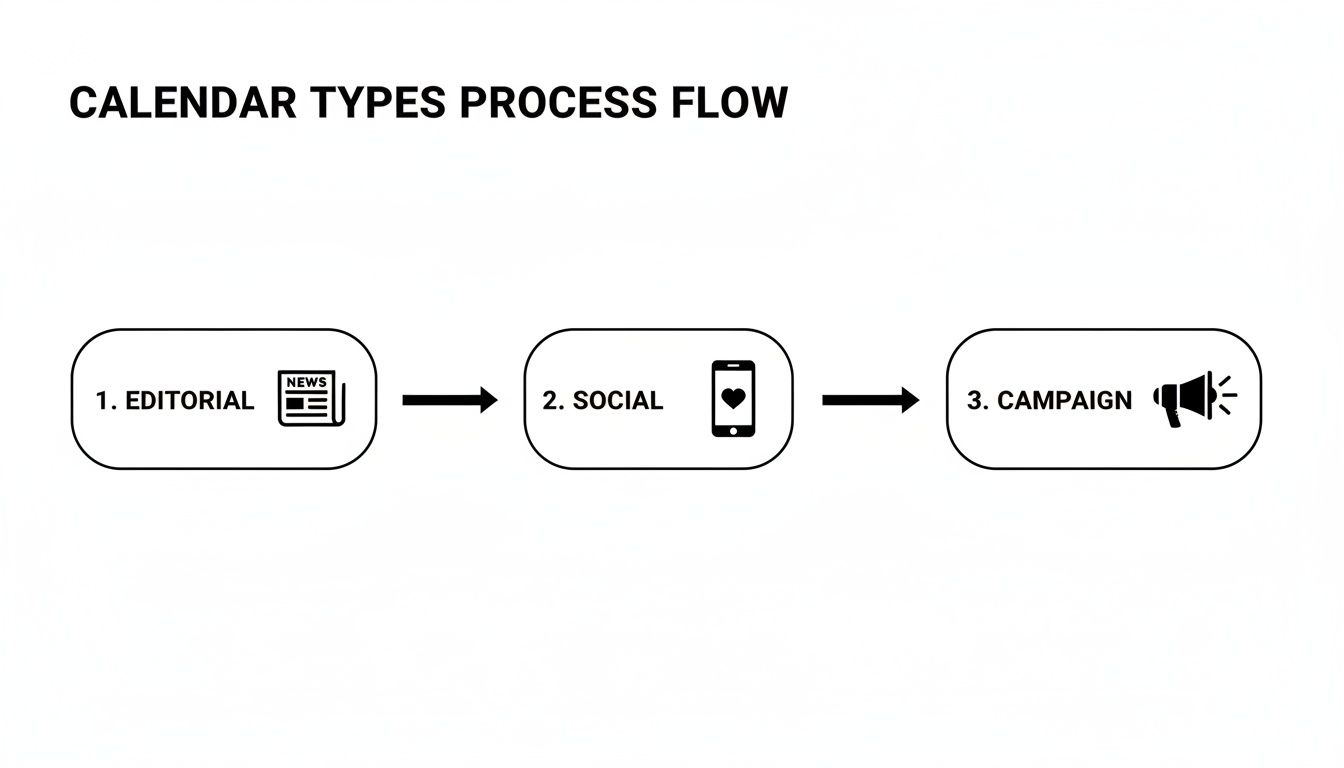
You can see how a big-picture editorial plan trickles down into the nitty-gritty of social media posts and specific campaign execution. Let's walk through exactly how to build your own.
Define Your Goals and Audience
First things first: anchor your calendar to clear objectives. What, exactly, do you want your content to accomplish? Are you trying to drive more organic traffic, generate qualified leads, or just get your brand name out there? Your goals will dictate every topic you even consider.
Next, get crystal clear on who you're talking to. Who is this content for? When you truly understand their pain points, their burning questions, and what actually interests them, you can create topics that provide real value and nudge them closer to your business goals.
Brainstorm Content Pillars
With your goals and audience dialed in, it’s time to brainstorm your core content pillars. Think of these as the 2-4 broad topics your brand can speak about with authority. For a project management software company, for example, those pillars might be "Team Productivity," "Agile Methodologies," and "Remote Work."
These pillars become the foundation for every content idea you generate, making sure everything you publish feels cohesive and on-brand. It also makes future brainstorming sessions way more focused and efficient.
A content calendar is only as strong as the strategy behind it. Your goals, audience, and content pillars are the essential ingredients that give your schedule purpose and direction.
Choose Your Tool and Map Your Workflow
Now, let's pick a tool that actually fits your team's needs. Plenty of successful content teams run their entire operation from a simple Google Sheet or a Trello board. The best tool is the one your team will actually open and use every single day.
Once you've got your tool, it's time to map out a realistic workflow. This means planning around major industry events and seasonal trends. It's a proven fact: businesses that plan 20-30% of their calendar around these moments see 25% higher traffic during peak times because they're tapping into predictable spikes in search interest.
Finally, outline the key steps from a raw idea to a published piece. You can learn more about this by creating a workflow that suits your team. This gives everyone on the team total clarity on who's doing what and when it's due, transforming your calendar from a simple schedule into a true operational playbook.
Using AI to Supercharge Your Content Planning
A modern content calendar doesn't just organize—it anticipates. When you bring AI into the mix, your calendar stops being a static spreadsheet and starts acting like a dynamic growth engine, actively working for you to uncover opportunities your team might otherwise miss.

Think about it. AI tools can analyze competitor content at a massive scale, pinpointing valuable keyword gaps and generating topic ideas backed by real data—ideas that are practically guaranteed to resonate with your audience. Instead of guessing what to create next, you can fill your calendar with content that already has proven demand.
From Insights to Automation
The real magic happens when these AI-driven insights connect directly to your workflow. For startup founders and agile agencies, this is where automation becomes a total game-changer. The best platforms can take an AI-generated topic and manage the entire production process from there.
By connecting AI insights to your content calendar, you move beyond simple planning and start building a predictable, scalable content machine.
For instance, platforms like Sight AI are built to do exactly this. They can generate 2,500-4,500 word SEO-optimized articles daily on Autopilot, pushing them straight to your CMS with IndexNow for faster indexing. This approach links your strategic calendar directly to execution, scaling your output without overwhelming your team.
You can learn more about the future of content creation with AI in our article.
Your Content Calendar Questions Answered
Putting a content calendar into practice always brings up a few key questions. Let's tackle the most common hurdles so you can get started with confidence.
How Far in Advance Should I Plan My Content?
As a rule of thumb, try to plan at least one month ahead for your regular content, like blogs and social media posts. This gives you enough breathing room for creation, review, and any unexpected bumps in the road.
But for those big-ticket items—major campaigns or seasonal pushes—you’ll want to think bigger. Planning three to six months ahead is a much safer bet. The key is to find a balance between structure and spontaneity. Always leave a little wiggle room in your calendar to jump on timely, trend-based opportunities.
What Is the Best Tool for a Content Calendar?
Honestly, the "best" tool is the one your team will actually use every day. If you're a solo creator or a small team, a well-organized Google Sheet or a Trello board can work wonders. They’re simple, effective, and get the job done.
Once your team starts growing, you might feel the limitations of these simpler systems. That’s when dedicated platforms like Asana, CoSchedule, or Monday.com really start to shine by offering more advanced collaboration and automation features. My advice? Start simple and only upgrade when you absolutely need to.
Remember, the goal is to streamline your workflow, not to add another complicated tool to your stack. A simple, functional system that gets used is always better than a powerful, complex one that gets ignored.
How Often Should I Review My Calendar?
Think of your content calendar as a living document, not something you set in stone. It’s a good idea to do a quick weekly check-in. This helps you make sure everything is on track and allows for small, necessary adjustments on the fly.
Then, at the end of each month, set aside time for a deeper review. Dig into what worked and what didn't. Which topics sparked the most engagement? Which formats fell a bit flat? Learning how to measure your content's effectiveness is key, and you can get a better handle on this by understanding the ROI of content marketing. Use these insights to make your next month’s plan even smarter.