Picture this: a potential customer is evaluating project management tools for their growing team. Instead of opening Google and scrolling through a list of results, they type a question into ChatGPT or Perplexity: "What are the best project management tools for remote SaaS teams?" Within seconds, they receive a confident, curated answer naming four or five specific products. Your brand is not one of them.
That moment is happening thousands of times a day across every software category imaginable. And for most SaaS companies, it is happening without their knowledge, without any way to measure it, and without a strategy to change it.
This is the core challenge of SaaS AI search visibility: the degree to which AI models recognize, reference, and recommend your brand when users ask relevant questions. It is distinct from traditional SEO in ways that matter enormously, and it is quickly becoming one of the most consequential competitive battlegrounds for SaaS companies of every size.
This article breaks down what AI search visibility actually means, why SaaS companies face a unique exposure here, how AI models decide which brands to mention, how to measure your current standing, and what practical steps you can take to improve it. Whether you are a founder, a head of marketing, or an agency managing SaaS clients, this is the framework you need to understand and act on.
Beyond Blue Links: How AI Search Is Reshaping SaaS Discovery
For the better part of two decades, search engine optimization meant one thing: ranking your pages as high as possible on a search engine results page. The goal was visibility within a list of ten blue links, and the game was fought over position one, two, and three.
That model is being fundamentally disrupted. AI-powered search platforms including ChatGPT, Claude, Perplexity, Google AI Overviews, and Microsoft Copilot now provide synthesized, conversational answers to user queries. Instead of presenting a list of options and asking the user to evaluate them, these systems make a judgment call and present a curated response. They are, in effect, doing the research on behalf of the user.
AI search visibility refers to the presence and prominence of your brand within those AI-generated answers. It is not about where your page ranks in a list. It is about whether your brand is synthesized into the answer at all.
For SaaS companies, this shift creates a fundamentally different competitive dynamic. Traditional SEO offered a degree of democratic access: a well-optimized page from a smaller company could outrank a larger competitor for a specific query. AI search changes the calculus. When a user asks an AI assistant for the best CRM for startups, they receive a short list of recommendations. Inclusion in that list is a binary outcome: you are either in the answer or you are not.
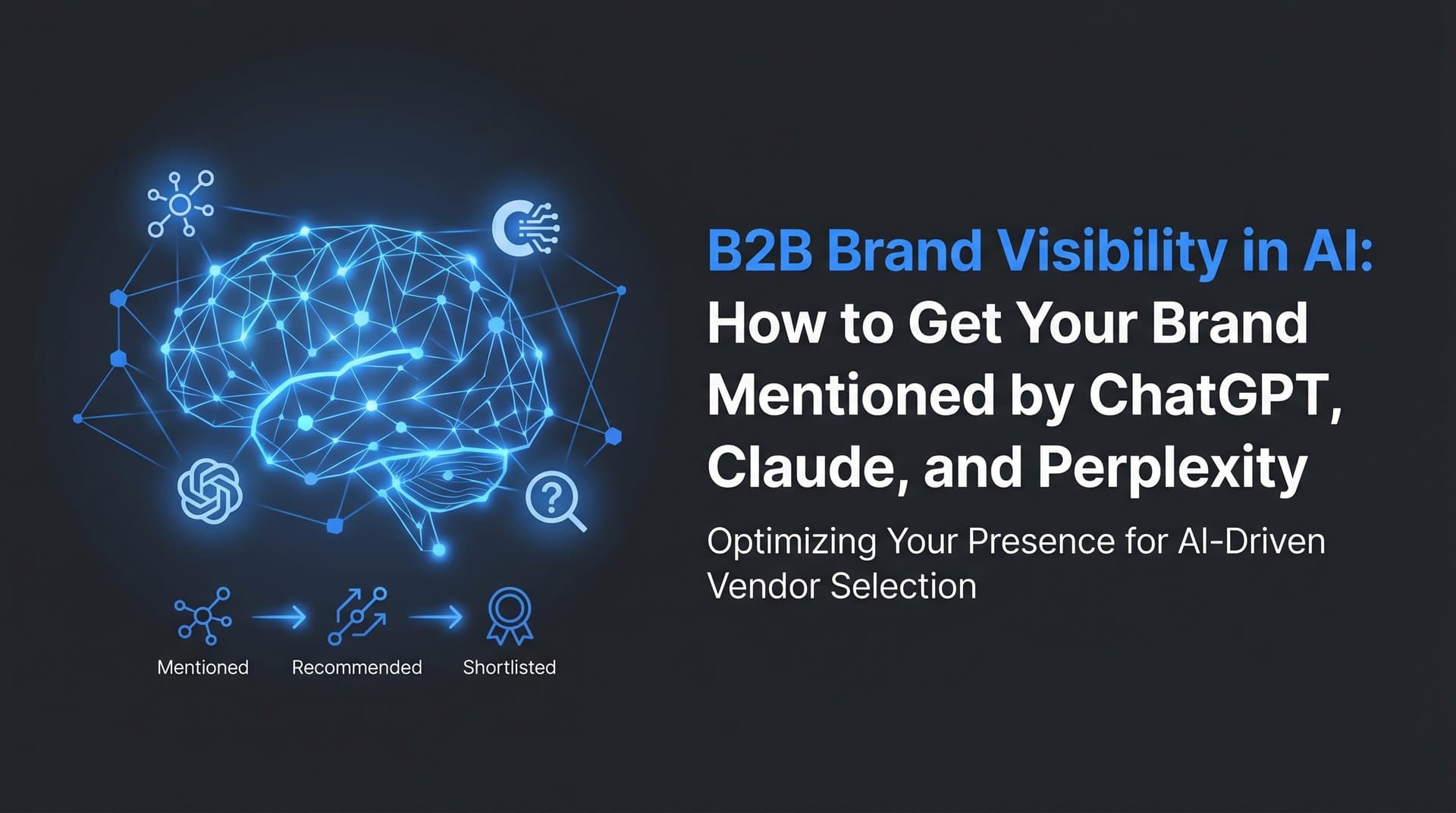
This matters especially for B2B SaaS because the research and evaluation phase of enterprise purchasing decisions has moved substantially into AI-assisted territory. Buyers are using ChatGPT and Perplexity to shortlist vendors, compare features, and understand category options before they ever visit a company website or speak to a sales rep. If your brand is not appearing in AI searches, you are being removed from consideration before the conversation even begins.
The shift is also behavioral, not just technological. Users who receive a confident, well-structured AI answer are significantly less likely to continue browsing. The single curated response has replaced the exploratory scroll through search results. That makes the stakes of inclusion versus exclusion higher than they have ever been for SaaS brands competing for top-of-funnel discovery.
Why SaaS Companies Are Especially Vulnerable to AI Visibility Gaps
Not all industries face equal risk from AI visibility gaps. SaaS companies, however, sit at the intersection of several factors that make this challenge particularly acute.
SaaS operates in highly category-driven markets. When someone asks an AI assistant to recommend tools for email marketing, analytics, customer support, or HR management, the AI tends to default to a short list of well-established names within that category. These are the brands that appear most frequently and consistently across the web content the AI has been trained on or is retrieving from. If your content footprint is thin, there is a real possibility the AI model simply does not have enough signal to include you, regardless of how strong your actual product is.
There is also a compounding risk that many SaaS teams underestimate. AI models learn from and retrieve web content. Companies that have historically underinvested in content marketing and SEO have built a smaller digital footprint. That smaller footprint means fewer mentions across authoritative sources, fewer third-party citations, and less topical coverage. The result is a feedback loop: low content investment leads to low AI visibility, which leads to fewer organic discovery opportunities, which reduces the pressure to invest in content. The gap widens over time.
The pipeline impact is direct and measurable in principle, even if it is often invisible in practice. When a prospect asks "What are the best tools for X?" and your brand is absent from the AI's answer, you lose consideration before your sales team ever gets a chance to engage. There is no lost lead form submission to track, no bounce rate to analyze. The opportunity simply never materializes. This makes AI visibility for SaaS companies particularly critical because these gaps are easy to overlook in standard marketing dashboards.
SaaS companies also tend to compete in crowded categories where the difference between being recommended and being ignored often comes down to which brands have built the most consistent, authoritative, and well-cited presence across the web. That is a content and distribution problem as much as it is a product problem. The good news is that it is solvable, but only if teams recognize it as a priority and understand what signals actually matter to AI systems.
How AI Models Decide Which Brands to Mention
Understanding what drives AI model recommendations is essential for any SaaS team serious about improving their visibility. While the exact mechanisms vary across platforms, there are consistent signals that influence whether and how your brand appears in AI-generated answers.
Frequency and consistency of mentions: AI models are influenced by how often a brand appears across authoritative web sources. This includes your own website content, but more importantly it includes third-party mentions: industry publications, software review platforms, analyst comparisons, and expert roundups. A brand that is mentioned consistently and positively across many independent sources sends a strong signal that it is a legitimate and recognized player in its category.
Structured and well-optimized content: AI systems respond well to content that is clearly organized, directly answers specific questions, and covers topics comprehensively. Thin, promotional content tends to be less useful to AI models than in-depth guides, comparison articles, and category explainers. This is the heart of Generative Engine Optimization, or GEO: structuring your content so that it is not just indexed by search engines, but genuinely useful and citable by AI systems generating answers.
Third-party citations and social proof: Reviews on platforms like G2, Capterra, and Trustpilot, mentions in comparison articles, and inclusion in industry roundups all function as external validation signals. AI models that use retrieval-augmented generation, or RAG, actively pull from recently indexed web content when forming answers. Being cited in these external sources increases the probability that your brand surfaces in those retrieved results.
Topical authority: AI models assess whether a brand has deep, consistent coverage of the topics relevant to its category. A SaaS company that has published comprehensive content across the full range of questions its buyers ask, not just product pages, builds topical authority that makes it more likely to be referenced across a wider set of relevant queries.
Content freshness and indexing speed: For RAG-based AI search systems, recency matters. Content that has been recently indexed is more likely to be retrieved and referenced than older, stale content. This makes search engine indexing optimization a practical competitive advantage. Protocols like IndexNow allow websites to proactively notify search engines of new or updated content, accelerating discovery.
Sentiment and context: AI models do not simply count mentions. They assess the context in which a brand is mentioned. Being referenced as a top recommendation in a comparison article carries far more weight than a passing mention in a critical review. Positive, recommendation-oriented mentions are the ones that meaningfully improve AI search visibility.
Measuring Your AI Search Visibility: Metrics That Matter
One of the biggest challenges SaaS teams face is that traditional SEO metrics do not capture AI search visibility at all. Your keyword rankings, organic traffic, and domain authority scores tell you how you are performing in conventional search. They tell you nothing about whether ChatGPT recommends you when someone asks for the best tool in your category.
This is why a new category of measurement has emerged: AI search visibility monitoring. The core concept is an AI Visibility Score, a composite metric that tracks how often and how favorably your brand appears across multiple AI platforms when relevant prompts are submitted.
The key dimensions to track include several distinct but related signals. Mention frequency measures how often your brand appears in AI-generated responses across platforms like ChatGPT, Claude, Perplexity, and Google AI Overviews. Sentiment analysis evaluates whether those mentions are positive, neutral, or negative, and whether your brand is being recommended or merely referenced. Prompt coverage maps which types of user questions trigger your brand to appear versus which ones surface only competitors. And competitive share of voice reveals how prominently your brand features relative to others in your category across AI-generated answers.
Together, these metrics give SaaS teams a clearer picture of their true discoverability landscape. A company might have strong organic search rankings and still have very low AI visibility if its content has not been structured for AI retrieval or if its third-party citation footprint is thin. Conversely, a brand with a strong external mention profile may perform well in AI search even without top SERP positions for every relevant keyword.
The practical implication is that SaaS marketing teams need dedicated AI visibility monitoring alongside their traditional SEO tools. Without it, they are flying blind on an increasingly important channel. Tracking which prompts trigger competitor mentions but not your own is particularly valuable: those gaps represent direct content and positioning opportunities where targeted investment can shift the competitive balance. Understanding why competitors are ranking in AI search results is the first step toward closing that gap.
A Practical Playbook for Improving SaaS AI Search Visibility
Improving your SaaS AI search visibility requires action across three interconnected areas: content strategy, technical foundations, and third-party signal building. Each reinforces the others, and the most effective programs address all three simultaneously.
Content Strategy for AI Visibility
The foundation of AI visibility is content that directly answers the questions AI models are trained to respond to. For SaaS companies, this means moving beyond product-centric pages and investing in content that addresses the full range of questions your buyers ask during research and evaluation.
Comparison pages are among the most valuable content types for AI visibility. When a user asks an AI assistant to compare your product against a competitor, the AI often draws from existing comparison content. If you have not published thorough, balanced comparison content, you are leaving that answer to be shaped by sources you do not control.
Definitive guides and category explainers build topical authority. A SaaS company that publishes comprehensive content covering every major question within its category signals to AI models that it is an authoritative source on those topics. This increases the likelihood of being referenced across a wider range of relevant prompts.
The discipline of Generative Engine Optimization, or GEO, sits at the intersection of traditional SEO and AI-specific optimization. GEO emphasizes clear structure, direct answers to specific questions, and content that is genuinely useful rather than promotional. Think of it as writing for the AI that will synthesize your content into an answer, not just for the human who will eventually read it. Our guide on search generative experience optimization covers these techniques in depth. GEO and SEO are complementary: strong SEO foundations, including proper heading structure, clear topic coverage, and authoritative linking, also support better GEO outcomes.
Technical Foundations
Even the best content cannot improve AI visibility if it is not being indexed quickly and reliably. Ensure your site's technical foundation supports fast discovery: sitemaps should be current and accurate, new content should be submitted promptly, and your site architecture should make it easy for crawlers to access your most important pages.
IndexNow integration is particularly valuable here. By proactively notifying search engines when new content is published or updated, you accelerate the time it takes for that content to enter the retrieval pool that RAG-based AI systems draw from. For teams publishing content regularly, this can meaningfully compress the lag between publication and AI visibility impact.
Building Third-Party Signals
External citations are among the strongest signals AI models use when deciding which brands to recommend. Earning mentions in authoritative publications, being listed in software review roundups, maintaining strong profiles on G2, Capterra, and similar platforms, and being included in analyst comparisons all contribute to the external validation footprint that AI models rely on.
This is not a one-time effort. Building third-party signals requires a sustained, proactive approach: pitching your product for inclusion in industry roundups, encouraging satisfied customers to leave reviews on key platforms, and building relationships with journalists and analysts who cover your category. Each new external mention is another data point that increases the probability of AI model recommendation. For a deeper dive into the specific factors that influence these outcomes, explore our breakdown of AI search engine ranking factors.
The compounding effect of this work is significant. As your content footprint grows, your third-party citations accumulate, and your indexing speed improves, the overall signal strength your brand sends to AI systems increases. AI visibility is not a switch you flip; it is an asset you build over time through consistent, strategic effort.
Building an AI Visibility Engine for Your SaaS Brand
The central takeaway from everything covered above is straightforward: SaaS AI search visibility is not a future concern you can address later. It is a present-day competitive dynamic that is already shaping which brands get discovered, considered, and chosen by buyers who are using AI assistants as their primary research tool.
The action framework is clear. Start by auditing your current AI visibility: submit relevant prompts to ChatGPT, Claude, and Perplexity and observe which brands are mentioned in your category. Note where you appear, where you do not, and which competitors consistently surface. That baseline gives you a concrete picture of the gap you are working to close.
From there, identify content gaps by mapping the questions your buyers ask against the content you have published. Prioritize comparison pages, category guides, and question-answering content that directly addresses high-intent research queries. Optimize that content for both SEO and GEO: structure it clearly, answer questions directly, and make it genuinely useful to both human readers and AI retrieval systems.
Accelerate your indexing by implementing IndexNow or similar protocols so new content enters the AI retrieval pool as quickly as possible. And invest in building third-party signals through review platforms, industry publications, and analyst coverage.
Finally, monitor continuously. AI visibility is dynamic. The brands that appear in AI answers today may shift as new content is published, as AI models are updated, and as your competitors invest in their own visibility strategies. Ongoing tracking of your AI Visibility Score, mention sentiment, and prompt coverage is what separates teams that manage this proactively from those who remain invisible without knowing it.
The tools to do this work exist today. Start tracking your AI visibility today and see exactly where your brand appears across top AI platforms, which prompts you are winning, and where your competitors are showing up instead of you. Stop guessing how AI models like ChatGPT and Claude talk about your brand, and start building the visibility engine that puts you in the answer every time it matters.