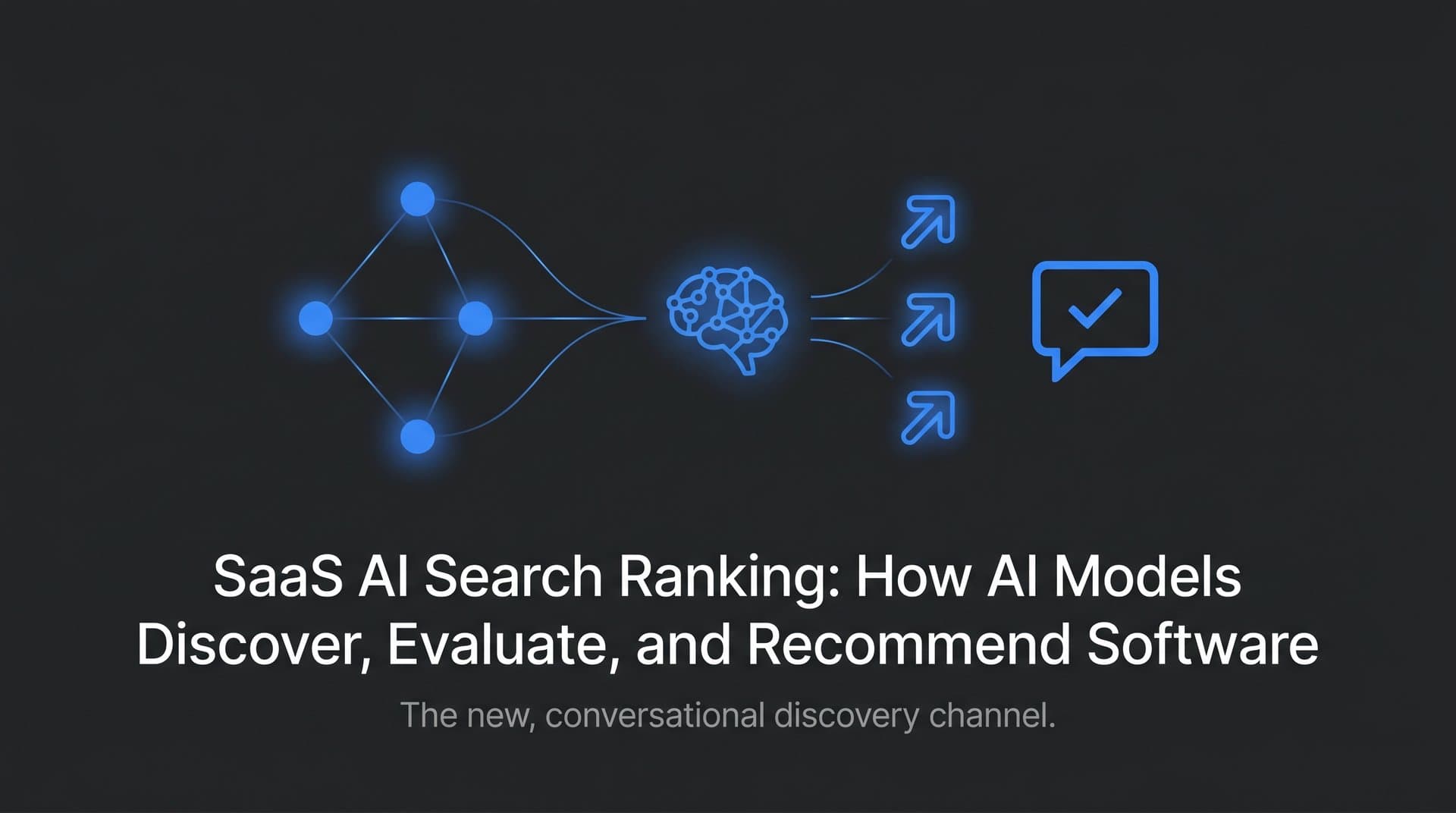
Something significant is changing in how software gets discovered. Instead of opening a browser and scrolling through Google results, a growing number of buyers are opening ChatGPT, Claude, or Perplexity and simply asking: "What's the best tool for managing customer onboarding?" or "Which CRM works best for early-stage SaaS companies?" They get a synthesized answer in seconds, often with a short list of recommended products, and they start their evaluation from there.
For SaaS companies, this shift raises a critical question: what determines whether your product gets mentioned when someone asks an AI for a recommendation? And perhaps more urgently, what happens to your pipeline if it doesn't?
This is the new frontier of SaaS AI search ranking. It's not the same as your Google position for a target keyword. It's something more nuanced and, in many ways, more consequential. AI models don't serve up ten blue links and let users decide. They synthesize, evaluate, and recommend. If your brand isn't part of that synthesis, you're invisible to a segment of decision-makers who are increasingly driving B2B purchasing decisions.
This article breaks down exactly how AI models discover, evaluate, and recommend SaaS products. You'll learn what signals actually influence AI-generated recommendations, how to measure your current AI visibility, what content strategies move the needle, and how to build a repeatable workflow for improving your standing across AI platforms. Whether you're a founder, marketer, or agency working with SaaS clients, this is the playbook you need right now.
Why AI-Powered Search Is Rewriting SaaS Discovery
Traditional search works through a familiar pattern: a user types a query, a search engine returns a ranked list of links, and the user clicks through to evaluate options. The search engine's job ends at the click. What happens next is between the buyer and the website.
AI-powered search breaks that pattern entirely. When someone asks ChatGPT or Perplexity for a software recommendation, they don't get links to evaluate. They get an answer. The AI has already done the synthesis, the comparison, and in many cases, the initial vetting. The user receives a curated shortlist with context about why each tool might fit their needs. The click happens much later in the process, if it happens at all. Understanding how AI search engines work is essential for any SaaS company navigating this shift.
For SaaS companies, this distinction matters enormously. In traditional search, you could win visibility through strong SEO and a compelling meta description. In AI-powered search, the model decides whether you're worth mentioning before the buyer ever sees your name. The evaluation happens inside the model, not on your website.
The buyer behavior shift driving this is real and accelerating. Founders evaluating tools for their stack, marketers building a martech ecosystem, and procurement teams validating vendor shortlists are all increasingly using conversational AI as a first step in their research. They use it to generate initial lists, understand category dynamics, and compare feature sets before they visit a single vendor website. By the time they arrive at your site, they may already have a strong opinion formed by what an AI told them.
So what does "SaaS AI search ranking" actually mean in this context? It's not a single score or a position on a results page. It's better understood as a combination of three things: the frequency with which AI models mention your brand in relevant queries, the prominence of those mentions (are you first on the list or buried at the end?), and the sentiment attached to those mentions (does the AI describe your product favorably, neutrally, or with caveats?).
These three dimensions together determine your effective AI visibility in your category. A brand that gets mentioned frequently, early in AI-generated lists, with positive framing has strong AI search ranking. A brand that gets mentioned occasionally, with qualified language, toward the end of a list has weak ranking. And a brand that doesn't appear in AI searches at all is effectively invisible to that segment of buyers.
This is the competitive landscape SaaS companies are navigating right now, whether they know it or not.
The Ranking Signals AI Models Actually Use
Here's where things get technically interesting. Unlike Google, which runs queries through a defined algorithm with documented ranking factors, AI models don't have a single "ranking system" for brand mentions. Their outputs are probabilistic, shaped by training data, retrieval pipelines, and the specific context of a conversation. But that doesn't mean the process is random. There are clear patterns in what makes a SaaS brand more likely to surface in AI-generated recommendations.
Volume and quality of web content mentioning your brand: AI models learn from the web. If your brand is mentioned frequently across high-quality sources, review platforms, industry blogs, comparison sites, and news coverage, that signal accumulates in training data and retrieval results. A brand that's referenced in dozens of authoritative contexts is far more likely to appear in AI recommendations than one that exists primarily on its own website. For a deeper dive into what drives these outcomes, explore our guide on AI search engine ranking factors.
Third-party authoritative references: This is the single most underappreciated factor in AI visibility. When respected publications, independent reviewers, and category experts mention your brand in context, that carries significant weight. Think G2 reviews, Capterra listings, analyst write-ups, founder interviews in industry media, and comparison articles from credible sources. These third-party signals tell AI models that your brand is real, recognized, and worth recommending.
Structured, crawlable website content: AI retrieval systems need to be able to parse what your product actually does. That means having clear, well-structured content on your site that explains your use cases, your target customer, your key features, and how you compare to alternatives. Vague marketing copy is difficult for AI systems to extract meaning from. Specific, factually rich content is much easier to index and reference.
Content recency and source authority: Many AI models, particularly those using retrieval-augmented generation (RAG) pipelines, pull from current web content when answering queries. This means recently published, authoritative content has a meaningful advantage. A detailed comparison article published last month from a credible source can influence AI responses in ways that older content may not.
It's worth contrasting these signals with traditional Google ranking factors. Some things overlap: the principles underlying Google's E-E-A-T framework (Experience, Expertise, Authoritativeness, Trustworthiness) remain highly relevant because they're essentially signals of content quality and brand credibility. If your content demonstrates genuine expertise and is cited by authoritative sources, that helps in both traditional SEO and AI visibility.
What matters less in AI search ranking is raw backlink quantity. Google's PageRank logic places enormous weight on the number of sites linking to you. AI models care more about contextual brand mentions: is your brand referenced in the right contexts, by the right sources, in ways that associate you with specific use cases and outcomes? A single detailed mention in a credible industry comparison piece may do more for your AI visibility than dozens of generic backlinks.
The practical implication is that SaaS companies need to think beyond link building and keyword optimization. Building a presence across the broader web ecosystem, through reviews, expert mentions, media coverage, and comprehensive educational content, is the foundation of strong AI search ranking.
Measuring Your Brand's AI Visibility Today
You can't improve what you don't measure, and measuring AI visibility is genuinely different from tracking keyword rankings. There's no dashboard that shows you "position 3 for 'best project management tool' on ChatGPT." The process requires systematic, ongoing monitoring.
The core approach is straightforward in concept: identify the prompts your target buyers are likely to use when asking AI models for software recommendations, then query those models regularly and track whether your brand appears in the responses. In practice, this means building a library of relevant prompts across different query types: category-level questions ("What are the best tools for X?"), comparison queries ("How does [your brand] compare to [competitor]?"), use-case questions ("What tool should I use for Y?"), and problem-framing queries ("How do companies typically solve Z?").
The key metrics to track across these queries include mention frequency (how often does your brand appear across a set of test prompts?), position within AI-generated lists (are you mentioned first or fifth?), sentiment (does the AI frame your product positively, with caveats, or neutrally?), and competitive comparison (which competitors appear more often or more favorably than you?). Dedicated AI search visibility tools can automate much of this tracking process.
The measurement challenge is real. AI outputs are non-deterministic, meaning the same prompt can produce different results across sessions. Models update over time as training data evolves. Different model versions behave differently. And results can vary based on conversation context, the phrasing of the question, and even the time of day for models with real-time retrieval.
This non-determinism is precisely why one-time audits aren't sufficient. A snapshot of your AI visibility today tells you something useful, but it won't tell you whether your content investments are moving the needle over time, or whether a competitor's recent content push has started edging you out of AI-generated recommendations. Continuous monitoring across multiple AI platforms is the only way to understand your actual AI search ranking trajectory. If you suspect competitors are ranking in AI search results ahead of you, structured monitoring will confirm it and reveal where to focus.
Tools like Sight AI's AI visibility tracking software are built specifically for this problem. By systematically querying models like ChatGPT, Claude, and Perplexity with prompts relevant to your category, tracking mention frequency, sentiment, and competitive positioning over time, you get the kind of structured visibility data that makes AI search ranking actionable rather than speculative.
Content Strategies That Boost SaaS AI Search Ranking
If AI models are trained on and retrieve from web content, then the most direct lever you have is the content you create and the content others create about you. This is where Generative Engine Optimization (GEO) comes in as a discipline distinct from, but complementary to, traditional SEO. Our comprehensive AI search engine optimization guide covers the foundational principles in detail.
GEO focuses on creating content that AI models can easily parse, reference, and incorporate into their responses. The principles are different from keyword-stuffed SEO content. Here's what actually works:
Factual density over keyword density: AI models are looking for content that contains specific, verifiable information. Detailed product comparisons, feature breakdowns, pricing context, and use-case specifics are far more useful to an AI retrieval system than content optimized primarily around keyword repetition. Write content that a researcher would cite, not content designed to rank for a single phrase.
Comprehensive use-case coverage: One of the most effective strategies for improving AI search ranking is building out thorough coverage of every use case your product addresses. If you're a project management tool, you want authoritative content covering how your product works for software teams, marketing teams, agencies, remote-first companies, and so on. AI models associate brands with categories and use cases based on the breadth and depth of available content.
Topical authority through consistent publishing: Publishing one comprehensive guide isn't enough. AI models develop associations between brands and topics through repeated exposure across multiple pieces of content. A consistent publishing cadence across your blog, resource center, and external placements builds the kind of topical authority that influences AI recommendations over time.
Structured information that's easy to extract: Use clear headings, logical content hierarchy, and well-organized sections. AI retrieval systems are better at extracting information from well-structured content than from dense, unbroken prose. Product comparison tables, feature lists, and clearly labeled sections all help.
On the technical side, ensuring your content is rapidly discoverable matters more than many SaaS marketers realize. Technologies like IndexNow allow you to notify search engines and AI crawlers instantly when you publish or update content, reducing the lag between when you publish and when that content becomes part of the retrievable web. Maintaining fast site crawlability, proper sitemaps, and clean technical architecture ensures that AI systems can access your content when they need it. Learn more about search engine indexing optimization to accelerate this process.
Sight AI's content generation platform, which uses specialized AI agents to produce SEO and GEO-optimized articles at scale, is designed specifically to address this challenge. Producing the volume of high-quality, factually rich content needed to build AI search visibility is a significant operational lift. Automation tools that maintain quality while scaling output make the strategy executable for teams that don't have unlimited content resources.
Building an AI Search Ranking Workflow for Your SaaS
Strategy without execution is just theory. Here's how to build an operational workflow that systematically improves your SaaS AI search ranking over time.
Step 1: Audit your current AI visibility. Start by identifying the 20-30 most relevant prompts your target buyers would use when asking AI models for software recommendations in your category. Run those prompts across ChatGPT, Claude, and Perplexity. Document where your brand appears, where it doesn't, what sentiment accompanies mentions, and which competitors are surfacing prominently. This baseline audit tells you where you stand and where the gaps are.
Step 2: Identify content gaps where competitors appear but you don't. The most valuable output of your visibility audit is a map of queries where competitors are mentioned and you're absent. These gaps represent direct opportunities. For each gap, ask: is there content on our site or elsewhere on the web that addresses this use case or query type? If not, that's your content priority list. Conducting thorough competitor SEO research will reveal exactly where rivals are outperforming you in both traditional and AI search.
Step 3: Create and publish optimized content targeting those gaps. For each identified gap, develop content that directly addresses the query context. This might be a detailed use-case guide, a product comparison, a how-to explainer, or a thought leadership piece that establishes your brand's perspective on a category-level question. Prioritize factual richness, clear structure, and genuine usefulness over SEO keyword density.
Step 4: Monitor changes and iterate. After publishing, continue running your prompt library against AI models on a regular cadence. Look for movement in mention frequency, position, and sentiment. Track whether new content is beginning to influence AI responses. Adjust your content strategy based on what's working and where gaps persist.
Automation plays an important role in making this workflow scalable. AI content generation for B2B SaaS can help you produce the volume of GEO-optimized content needed to build topical authority without requiring a large editorial team. The key is maintaining quality standards so that AI-generated content is factually accurate, well-structured, and genuinely useful rather than thin filler that won't influence AI retrieval systems.
There are also common pitfalls to avoid. Over-optimizing for a single AI model is a mistake: each model has different retrieval patterns, and your strategy should aim for broad visibility across platforms. Neglecting traditional SEO while chasing AI visibility is another trap, since many AI models use web search results as part of their retrieval pipelines. Your traditional SEO and GEO efforts should reinforce each other, not compete. And publishing thin content at scale without tracking results will burn resources without moving the needle. Every piece of content should be tied to a measurable visibility objective.
Where SaaS AI Search Ranking Is Headed Next
The AI search landscape is evolving quickly, and understanding where it's headed helps you make smarter strategic investments today.
Real-time retrieval is becoming standard across AI platforms. Models that previously relied primarily on static training data are increasingly incorporating live web search into their response generation. This means the gap between publishing content and having it influence AI recommendations is shrinking. It also means content recency is becoming a more significant factor: fresh, authoritative content has a growing advantage over older material.
Personalization of AI answers is also increasing. As AI models become better at understanding user context, the recommendations they generate will become more tailored to the specific buyer's situation, industry, company size, and stated needs. This has implications for content strategy: SaaS companies that have built out comprehensive, use-case-specific content will be better positioned to appear in personalized recommendations than those with generic category-level content. Applying proven conversational search optimization tactics will help your content align with how buyers naturally phrase their queries to AI models.
Brand reputation signals are gaining weight. As AI models become more sophisticated, the quality and consistency of how your brand is discussed across the web matters more. Positive reviews, credible media mentions, and expert endorsements aren't just good for traditional PR. They're becoming infrastructure for AI search ranking.
Perhaps most importantly, early movers in AI visibility optimization gain compounding advantages. AI models that learn to associate your brand with authority in a category today will continue referencing you as training data evolves and retrieval systems mature. The brands building strong AI visibility now are establishing a presence that will be increasingly difficult for late movers to displace.
The strategic imperative is clear: SaaS companies that treat AI search ranking as a core growth channel now, investing in measurement, content strategy, and systematic optimization, will outpace competitors who remain exclusively focused on traditional SEO while AI-driven discovery quietly reshapes their market.
Putting It All Together
SaaS AI search ranking represents a genuine shift in how software products are discovered, evaluated, and recommended. The buyers you want to reach are increasingly asking AI models for guidance, and those models are forming opinions about your brand based on signals you can influence.
The path forward has four core elements. First, understand the new ranking signals: third-party mentions, authoritative web presence, structured content, and contextual brand associations matter more than raw backlink counts. Second, measure your current AI visibility systematically across the platforms your buyers use, tracking mention frequency, sentiment, and competitive positioning over time. Third, invest in GEO-optimized content that's factually rich, well-structured, and comprehensive enough to build topical authority in your category. Fourth, build a repeatable workflow that connects visibility audits to content creation to ongoing monitoring, so you're continuously improving rather than guessing.
None of this happens by accident, and it doesn't happen from a single audit or a one-time content push. AI search ranking is an ongoing discipline, not a project with an end date.
The good news is that the tools to execute this strategy exist today. Start tracking your AI visibility today and see exactly where your brand appears across top AI platforms. Stop guessing how ChatGPT, Claude, and Perplexity talk about your product. Get the data, find the gaps, and build the content presence that puts your brand in front of buyers at the moment they're asking for recommendations. That's where the next wave of SaaS growth is being won.