Rank data in SEO is the raw information that tells you how your website is performing in search results. It’s the proof in the pudding, showing you exactly where you stand for certain keywords, how many people are seeing your site, and how they’re interacting with it. Without this data, you're just guessing.
What Is Rank Data and Why It Is Your SEO Compass
Imagine you’re on a cross-country road trip, but you’ve tossed your map and phone out the window. You’re still driving, sure, but are you getting any closer to your destination? That’s what doing SEO without rank data feels like. You’re busy creating content and building links, but you have no real clue if any of it is actually working.
Rank data is your strategic GPS. It gives you the precise coordinates of your website in the massive, ever-changing world of search results, pinpointing your position for the keywords that actually drive your business. This is far more than a vanity metric; it’s a direct reflection of your visibility in the market and where you stack up against the competition.
The Real Impact of Ranking Position
So, why does this matter so much? Because in SEO, the distance between the first and second position is a canyon. The #1 organic spot on a desktop search pulls in a massive 34% click-through rate (CTR). That number craters to just 18.7% for the site in the second position.
To truly get why rank data is a non-negotiable, you have to understand the core ideas of Search Engine Optimisation. With organic search accounting for more than half of all website traffic, ignoring these numbers is like willingly turning away the majority of your potential customers.
Think of rank data as your business's real-time report card from Google. It doesn’t just show your score; it reveals where you’re excelling, where you’re failing, and most importantly, what your competitors are doing better.
By digging into this data, you can stop making assumptions and start making sharp, informed decisions. It helps you:
- Pinpoint Opportunities: Find those high-value keywords where you’re lurking on page two, just a few tweaks away from a huge traffic boost.
- Diagnose Problems: Spot pages that have dropped in the rankings and figure out what went wrong before the damage gets worse.
- Monitor Competitors: See what’s working for others in your space, learn from their wins, and find gaps in their strategy you can exploit.
In the end, understanding and acting on this information is what separates successful SEO from wishful thinking. To get a better handle on the tools and methods used to gather this data, check out our guide on what is rank tracking.
Decoding the Different Types of Rank Data
To really get a handle on SEO, you have to understand that "rank data" isn't just one number. True visibility in today's search world is a mosaic of different data points, and each one tells a part of the story.
If you're only thinking about the classic "blue link" position, you're looking at your business through a keyhole—you’re missing most of the picture.
The most fundamental piece of the puzzle is, of course, the SERP position. This is your traditional spot on the search engine results page for a specific keyword. Position 1 is the trophy, but any spot on the first page is a huge win, especially when you consider that 75% of users never click past page one.
But beyond that simple number, a much richer world of information is hiding in plain sight.
This concept map breaks down how these key rank data points connect, linking your position, your competitors, and the strategic path you need to take to improve.
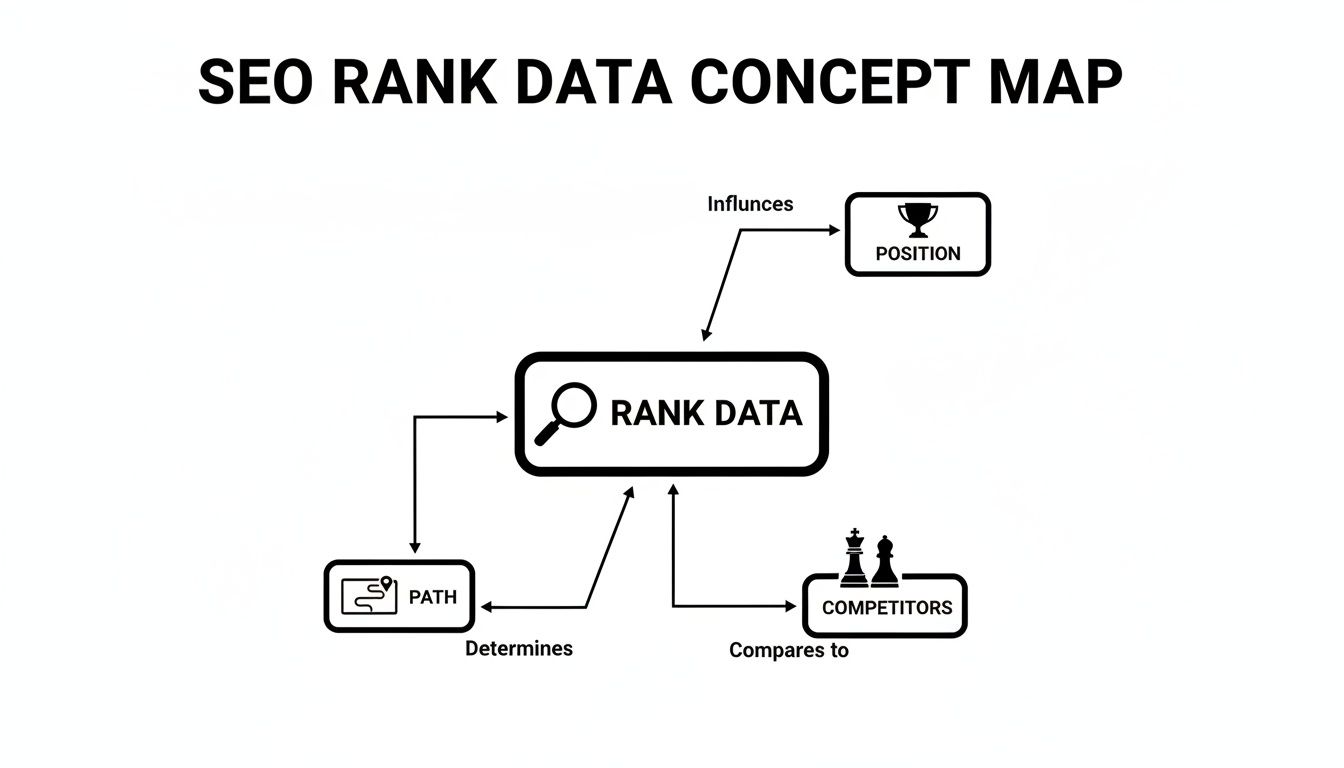
As you can see, your rank isn't an isolated metric. It’s the result of a strategic path that's heavily influenced by what your competitors are doing, which makes comprehensive data analysis absolutely essential.
Beyond the Blue Link: Winning the SERP Features
Search engines aren't just lists of links anymore. They provide answers directly on the results page through all sorts of special features. Honestly, ranking inside one of these can be even more valuable than a traditional number one spot.
- Featured Snippets: Often called "Position Zero," these are the answer boxes that pop up right at the very top. Nailing a featured snippet gives you instant authority and incredible visibility.
- Local Pack: For any search with local intent (like "coffee shop near me"), that map with three business listings is prime real estate. If you have a brick-and-mortar business, ranking here is non-negotiable.
- 'People Also Ask' (PAA) Boxes: These are the accordion-style dropdowns that answer related questions. Getting your content in a PAA box establishes your site as a go-to resource on a topic.
- Zero-Click Searches: This happens when a user's question is completely answered by a SERP feature—like a knowledge panel—so they don't even need to click a link. It might sound like a bad thing, but owning that answer builds massive brand recognition and trust.
Tracking these features is critical because they directly hammer your click-through rate (CTR) and overall brand authority. A top-ranking blue link might get totally ignored if it's sitting underneath a giant, flashy featured snippet from a competitor.
The New Frontier: AI Visibility
The very definition of "ranking" is expanding again. Search is breaking out of the Google and Bing boxes and moving into AI chatbots like ChatGPT, Gemini, and Perplexity. When these AI models spit out an answer, they often cite their sources.
Getting your brand mentioned or your content cited in these AI-generated answers is the next battleground for SEO. This is a brand new form of rank data—a direct endorsement from a trusted AI. It's exactly what platforms like Sight AI are built to monitor, tracking your visibility inside these new conversational engines.
Understanding the full spectrum of rank data, from old-school positions to new-school AI citations, is the only way to stay ahead. For a deeper dive into the tools that make this possible, explore the essential features every rank tracker should have to make sure you’re capturing the complete picture.
How to Reliably Collect Your Rank Data
Knowing what rank data is and actually getting your hands on it are two very different things. The real challenge isn't just knowing your numbers; it's gathering accurate information you can trust. Let's be honest, your entire SEO strategy is only as good as the data it’s built on, which is why a solid collection process is non-negotiable.
This means we have to move past occasionally Googling our own keywords. Those results are almost always skewed by your location and search history, giving you a completely unreliable picture of reality.
The stakes are incredibly high. The click-through rate (CTR) in Google's search results drops off a cliff after the first few spots. Think about it: position one grabs a massive 39.8% of clicks, position two gets 18.7%, and by position three, it's down to just 10.2%. Even more sobering? 75% of users never even click to the second page. This is exactly why businesses pour billions into SEO—the rewards are almost exclusively at the top.
To build a reliable picture of your performance, you need a smart mix of tools and methods that can handle the quirks of modern search.

Automated Rank Tracking Tools
By far, the most efficient way to keep an eye on your performance is with an automated rank tracker. These platforms do the heavy lifting for you, checking your keyword positions daily from specific locations and devices, all without the bias of your personal browser.
This hands-off approach gives you a consistent, objective stream of data over time. If you're looking for the right fit, you can learn more by checking out our guide on the https://www.trysight.ai/blog/best-serp-tracking-tools.
Leveraging Google Search Console
You can’t talk about rank data without mentioning Google Search Console (GSC). It's a free, indispensable firehose of information straight from the source. While it gives you average positions instead of exact daily ranks, its real magic is showing you all the queries that are driving impressions and clicks to your pages.
GSC is your direct line to Google. Use it to find "striking distance" keywords—those ranking on page two (positions 11-20)—that could jump to page one with a content refresh or some internal linking.
Using APIs and Proxies for Scale
For bigger operations, like agencies juggling dozens of clients, manual data collection is simply out of the question. This is where Search APIs and specialized tools come in. To collect data at scale without getting blocked by Google, many pros turn to high-quality, geo-targeted SEO proxies.
This setup allows for huge, customized data pulls, giving you the raw information you need without setting off any alarms.
No matter which methods you lean on, consistency is everything. Be sure to sidestep these common pitfalls:
- Ignoring Geotargeting: A #1 rank in New York is useless if your customers are in London. Always track your rankings from the locations that actually matter to your business.
- Forgetting Mobile: Mobile search volume blew past desktop years ago. If you're not tracking mobile-specific rankings, you're missing more than half the story.
- Infrequent Checks: The SERPs are in constant motion. Weekly checks are a decent starting point, but for your most important keywords, daily tracking is often necessary to spot trends and react before your competitors do.
Turning Your Data Into an Actionable SEO Strategy
Collecting rank data is the easy part. The real magic happens when you turn those raw numbers into a clear, actionable roadmap for growth.
Without that crucial next step, you’re just staring at a spreadsheet full of metrics, not an actual SEO strategy. It’s time to connect the dots, find the patterns hiding in plain sight, and give every single data point a purpose. This means moving beyond simple up-or-down keyword movements and digging deeper to diagnose root causes and spot high-impact opportunities that your competitors are probably missing.
From Data Point to Action Plan
The first step in making your data work for you is translating common observations into concrete tasks. This structured approach stops you from getting lost in the numbers and makes sure every insight leads directly to a tangible action. It’s all about bridging the gap between seeing a problem and actively fixing it.
To help with that, here’s a simple framework for turning data into direction. It’s designed to translate what you’re seeing in your rank reports into a clear plan for your content and SEO teams.
| Data Observation | Potential Meaning | Recommended Action |
|---|---|---|
| A keyword drops from position 5 to 11 | This often signals "keyword decay." Your content might be getting stale, or a competitor just published something much better. | Prioritize a comprehensive content refresh. Update statistics, add new sections, and sharpen your on-page SEO. |
| Competitors rank for keywords you don't | You’ve got a "content gap." These are topics your audience cares about that you aren't covering, leaving valuable traffic on the table. | Run a full content gap analysis. Build a list of the missing topics and get them into your content calendar, fast. |
| Impressions are high but CTR is low | Your page is showing up in search, but the title tag and meta description aren't compelling enough to actually earn the click. | A/B test different headlines and meta descriptions. Focus on making them more appealing and relevant to the search query. |
Uncovering Hidden Opportunities with AI Visibility
While that traditional analysis is absolutely essential, the game is changing. The rise of AI-powered search has introduced a whole new layer of visibility that you need to be tracking.
Consider this: AI search traffic has exploded by an incredible 527% year-over-year, and AI-generated content now accounts for 17.31% of Google's top results. This isn't some far-off trend; it's a massive shift that you simply can't afford to ignore.
This is where integrating AI visibility data becomes a powerful competitive advantage. Platforms like Sight AI are built for this new reality, monitoring how your brand is mentioned and cited within AI models like ChatGPT and Perplexity.
Tracking your brand's presence in AI answers isn't just a futuristic idea—it's a practical strategy for today. These mentions are high-intent endorsements that traditional rank trackers completely miss, revealing content opportunities your competitors don't even know exist.
For instance, if an AI model consistently cites a competitor’s article when answering a key industry question, that’s a direct signal. It tells you exactly what kind of content you need to create to capture that authority and visibility for yourself. You can dig deeper into this with our guide on how to perform a competitive analysis in SEO to build out this process.
By combining classic rank data with these new AI insights, you create a truly future-proof SEO strategy.
How to Report and Automate Your Rank Analysis
You've done the hard work of collecting and digging into your rank data. That's a huge first step. But the job isn't done until you can show its value and use it to scale your success. A report crammed with jargon and an endless scroll of keyword lists won't just fail to impress stakeholders—it will actively confuse them.
The secret is to tell a story that connects your SEO efforts directly to the bottom line.
Instead of just showing a keyword moving from position 7 to 3, frame your reports around real business metrics. Talk about how improved rankings for a specific cluster of keywords drove more organic traffic to a critical service page, resulting in a measurable jump in leads or sales. This simple shift in perspective turns rank data from a vanity metric into a clear story of ROI.
Creating Reports That Resonate
To make your data land with impact, you have to present it clearly and persuasively. An effective report isn’t a data dump; it’s a narrative about progress and opportunity.
- Focus on Trends Over Time: It’s easy to get lost in the noise of daily fluctuations. Step back. Use charts and graphs to paint a picture of long-term trends, showing steady growth in visibility and traffic.
- Segment Your Data: Break down your rank data by business unit, product line, or even funnel stage. This helps individual teams see exactly how SEO is supporting their specific corner of the business.
- Include Competitor Benchmarks: Data without context is meaningless. Showing how your rank improvements stack up against your top 3 competitors gives everyone a clear snapshot of your position in the market.
If you're looking to really nail this, our in-depth guide offers a fantastic SEO monthly reporting format you can steal for your own use.
The Power of Intelligent Automation
Reporting is essential, but the real growth engine is automation. Manually turning every insight into an action item is painfully slow and just doesn't scale. This is where modern platforms can completely change the game by creating an automated loop from analysis straight through to execution.
Automation isn't just a time-saver; it's how you create a compounding growth cycle. By continuously finding content gaps and publishing optimized articles to fill them, you build organic authority at a speed that's impossible to match manually.
Take a platform like Sight AI, for example. It's built to close this loop. After monitoring your rank data and spotting a competitor's weakness, its Autopilot feature can automatically generate and publish a fully optimized article to target that exact gap.
This transforms the entire workflow:
- Insight: The system flags a high-value content opportunity.
- Creation: An AI agent researches, writes, and optimizes the article.
- Execution: The content is published directly to your CMS.
This kind of automated approach ensures you're constantly acting on your data, compounding your organic growth and keeping you light-years ahead of the competition.
The Future of Ranking Is Everywhere
Winning at modern SEO isn't what it used to be. It’s time to embrace a much broader, more dynamic definition of what "ranking" actually means. The game is no longer about snagging that single blue link on a search results page. True visibility today is a mosaic of different touchpoints scattered across a user's entire digital journey.
Success means being the featured snippet that delivers an instant answer. It's about showing up in the top product carousel when a customer is ready to buy, being the trusted business in the local pack, and even getting cited as an authority in an AI-powered chat. While the core principle of creating valuable, user-focused content hasn't changed, the playing field has expanded dramatically. Analyzing rank data for SEO now requires a multi-dimensional view.
The future of search isn't about bringing users to a list of websites; it's about bringing answers directly to users, wherever they are. Your brand must be the source of those answers.
This is exactly why unified visibility platforms are no longer a luxury—they're an essential part of any forward-thinking strategy. Tools like Sight AI, which integrate traditional search rankings with visibility in AI-powered answers, provide the complete picture you need to compete. They ensure you’re visible everywhere your audience is looking.
Frequently Asked Questions About Rank Data
Even when you've got your strategy nailed down, the practical side of rank data always brings up new questions. Let's tackle some of the most common ones that SEOs and marketers run into when they're in the trenches with ranking information.
How Often Should I Check My Keyword Rankings?
For most businesses, a weekly check-in on your most important, high-value keywords is the sweet spot. This rhythm is frequent enough to catch major shifts—like a competitor making a big move or an algorithm update shaking things up—without getting whiplash from the minor, everyday bounces in the SERPs.
That said, if you've just launched a brand-new piece of content or a critical campaign, daily tracking for the first couple of weeks is a smart move. It gives you that crucial early feedback to see if you're on the right track.
Why Does My Rank Data Differ Between Tools?
Seeing slightly different numbers from one tool to the next is incredibly common. It doesn't mean one is "wrong"—it just means they're collecting data in slightly different ways.
A few key factors are usually behind these variances:
- Geographic Location: The physical location of the server checking the rank can sway local results.
- Device Type: It's no secret that rankings can look wildly different on a desktop versus a mobile phone.
- Time of Day: A check at 9 AM might not match one at 9 PM, especially for volatile keywords.
The best approach? Pick one reliable platform and make it your single source of truth. Concentrate on the long-term trends you see within that tool instead of getting bogged down by tiny discrepancies between providers.
Can I Rely Solely on Google Search Console for Rank Data?
Google Search Console (GSC) is absolutely non-negotiable. It's a powerhouse of a free tool, but it shouldn't be the only one in your arsenal. GSC gives you average positions over a set period, which is great for seeing the bigger picture but can easily hide the specific rank your page held on any given day. It’s fantastic for uncovering new keywords you didn't even know you were ranking for.
But what it lacks is the sharp, granular, day-to-day data and the side-by-side competitor tracking that dedicated SEO platforms are built for. Think of GSC as the essential foundation. To get the complete picture, you need to use it alongside a specialized rank tracker.
Ready to turn AI and search visibility insights into measurable growth? Sight AI monitors your brand across search engines and AI chatbots, then uses those insights to automatically create and publish SEO-optimized content. Discover your true visibility and put your content creation on autopilot. Learn more at https://www.trysight.ai.