Rank tracker features have evolved far beyond simple keyword positions. They’ve become the strategic command center for any serious SEO, offering deep insights into everything from SERP volatility and competitor strategies to visibility across new AI search models. These tools are absolutely essential for navigating a search environment where just "tracking ranks" isn't nearly enough anymore.
Why Modern Rank Tracker Features Are Non-Negotiable

Let's be honest, the old way of tracking keywords is dead. A few years ago, success meant watching your website's blue link climb from page two to the top of Google. Today, that simple path has shattered into a dozen different ways a user can find information, from AI-generated answers to interactive map packs.
This guide isn't about watching your positions tick up and down; it's about navigating the messy, complex, and exciting new world of search. The core challenge for marketers today is that visibility is no longer confined to a single list of results. Your brand’s presence is now scattered across multiple platforms and formats, creating massive blind spots if you're still using outdated tools.
The New Strategic Imperative
Think of a modern rank tracker not as a simple compass pointing north, but as a full-blown strategic command center. It’s your GPS, mission control, and reconnaissance drone all rolled into one, giving you the clarity needed to gain a real competitive edge. The right set of features helps you answer critical questions that basic tools just can't touch:
- Where are we visible beyond the classic organic results? Tracking SERP features like 'People Also Ask' boxes, featured snippets, and image packs is no longer optional—it's mandatory.
- How are AI models like ChatGPT and Gemini talking about our brand? As more users turn to AI for answers, monitoring your brand's sentiment and citations in these new channels is critical for reputation and discovery.
- What are our competitors doing that we aren’t? Getting a clear view of their keyword strategy and content gaps helps you proactively claim market share instead of just reacting.
Navigating the AI-Driven Search Landscape
The massive shift to AI-driven search makes these advanced features indispensable. Today’s tools have to monitor visibility across traditional engines like Google, which still commands a staggering 90.83% of the global market share, and emerging AI-native platforms.
This is where advanced rank tracker features, like those in Sight AI's unified dashboard, really shine. They go beyond basic positions to track brand mentions, sentiment, and citation rankings in the answers generated by leading AI models. This is crucial because while Google still dominates, AI search is carving out a growing share of user queries, making multi-platform visibility a true necessity.
A modern rank tracker doesn’t just tell you where you are; it shows you where you need to be. It connects raw data to strategic action, turning insights into measurable growth in a fragmented digital world.
This guide will unpack the core and advanced rank tracker features that separate the winners from the rest, showing you how to build a clear, data-driven strategy. For a deeper look into the fundamentals, check out our complete guide to SEO rank tracking.
Mastering the Core Rank Tracker Features

Every powerful toolkit is built on a solid foundation. While the fancy, cutting-edge capabilities get all the attention, it’s the core rank tracker features that give you the day-to-day clarity you really need. These are the four non-negotiable pillars that any serious rank tracking tool must get right.
Think of these features less like a checklist and more like an interconnected system. They work together to paint a complete picture of your search performance. If even one is missing, you’re flying with a massive blind spot.
Let’s break down what each one does and why it's so critical.
1. Precision Keyword Tracking
This is the bedrock. The whole point of a rank tracker is to answer one fundamental question: "Where do I rank for the keywords I care about?" But in modern SEO, a single number just doesn't cut it.
True precision means seeing how you rank across different search engines (mostly Google, but Bing too) and, just as importantly, by device. It’s incredibly common for a keyword to sit at #3 on desktop but vanish from the first page on mobile. That difference can gut your traffic and conversions. Solid keyword tracking reveals these gaps, letting you diagnose device-specific problems and fine-tune your strategy.
2. SERP Feature Analysis
Just tracking your position in the classic "10 blue links" is a recipe for being left behind. Today's Search Engine Results Page (SERP) is a vibrant, dynamic space crammed with rich results—what we call SERP features—that often steal clicks from the traditional organic listings.
SERP feature analysis shows you where your brand is showing up beyond the standard results. This means keeping tabs on your visibility in:
- Featured Snippets: The coveted "position zero" answer boxes at the very top.
- Local Packs: The map and three business listings that are gold for local searches.
- Image and Video Carousels: Visuals that can pull in huge traffic for the right query.
- 'People Also Ask' Boxes: Sections that reveal what else your audience is curious about—a goldmine for content ideas.
If you aren't tracking these, you're missing a massive piece of the visibility puzzle. Think of it this way: your keyword rank is your store's street address, but SERP features are the flashy window displays that actually pull people inside.
3. Granular GEO-Targeting
For any business with a physical footprint or a defined service area, this is absolutely non-negotiable. National rankings are nice for a high-level view, but they tell you nothing about how you're performing in the actual cities, states, or even ZIP codes where your customers live.
Granular GEO-targeting lets you simulate a search from anywhere in the world, showing you your true local visibility. A plumber in Dallas could rank #1 for "emergency plumbing" when someone searches from downtown, yet be invisible to a potential customer in a suburb just 10 miles away.
This level of detail is a game-changer for local businesses, franchises, and even national brands with regional targets. It helps you pinpoint weak spots in specific markets, tailor your local content and Google Business Profile, and put your ad budget where it will actually work. If you want to go deeper on this, you can learn more about how to track your keyword rankings with geographic precision.
4. Historical Performance Data
A great rank tracker isn't just a snapshot; it's a time machine. Historical performance data lets you rewind, connect the dots, and truly understand the story behind your SEO efforts. It archives your ranking data over weeks, months, and years, giving you the context you need to make smart decisions.
Without historical data, you simply can't:
- Spot Trends: See if your rankings for a key topic are slowly climbing or in a gradual decline.
- Diagnose Problems: Pinpoint the exact day a ranking dropped, helping you connect it to a Google update or a change you made on your site.
- Prove ROI: Build compelling reports that show stakeholders clear, undeniable progress over time.
This is the feature that elevates a rank tracker from a simple reporting tool to a powerful diagnostic and strategic weapon.
To tie it all together, here's a quick look at how these core features deliver value to different team members.
Core Rank Tracker Features and Their Strategic Value
| Core Feature | Primary Benefit | Essential For |
|---|---|---|
| Precision Keyword Tracking | Provides foundational performance data and visibility insights. | SEOs & Content Teams: To measure the direct impact of their work. |
| SERP Feature Analysis | Uncovers hidden visibility opportunities beyond classic blue links. | Content Strategists: To find new content formats and on-page optimization ideas. |
| Granular GEO-Targeting | Reveals true performance in specific markets that matter. | Local Businesses & Marketers: To win in their service areas and physical locations. |
| Historical Performance Data | Creates context, diagnoses issues, and proves long-term value. | Agency Teams & Managers: To report on progress and justify SEO investment. |
Ultimately, mastering these four pillars gives you a complete, actionable view of your search performance, turning raw data into a clear roadmap for growth.
Gaining an Edge with Advanced Tracking Capabilities
Once you’ve nailed the basics, it’s time to dig into the advanced features that separate the serious players from the pack. These are the tools that shift you from simply monitoring your performance to actively outmaneuvering the competition.
This is where you get a much deeper layer of strategic insight. It’s no longer just about where you rank, but why—and how you can carve out a bigger piece of the market for yourself. By moving beyond simple rank checks, you can find hidden opportunities, sharpen your messaging, and tie your SEO efforts directly to what the business actually cares about.
Uncovering Opportunities with Competitor Benchmarking
One of the most powerful advanced rank tracker features is competitor benchmarking. This isn't just about glancing at who's ranking above you; it’s about dissecting their entire search strategy to pull out actionable intelligence. It's like having a scout reporting back on your rivals' every move.
This feature lets you see which keywords are sending the most traffic to your competitors, often revealing golden-nugget terms you’ve completely overlooked. Better yet, by analyzing their top-performing pages, you can spot content gaps in your own strategy and create something far more comprehensive that wins over your shared audience.
Think of it this way: if your core keyword tracking tells you how you're doing in the race, competitor benchmarking shows you the exact training regimen of the runners ahead of you, revealing their strengths and weaknesses.
To pull off this kind of large-scale data collection—handling tons of queries from different locations without getting blocked—many advanced tracking platforms lean on robust proxy services. This behind-the-scenes tech ensures the competitor data you're getting is accurate and uninterrupted, no matter how much you're tracking.
Measuring Your True Market Presence with Share of Voice
Individual keyword rankings are great, but they only tell a fraction of the story. Share of Voice (SOV) is the metric that graduates you from tracking individual skirmishes to understanding who is winning the war for overall market visibility.
SOV calculates your brand's total visibility across a whole set of target keywords and stacks it up against your competitors. So, instead of just knowing you rank #3 for one term, SOV tells you that you own, for example, 15% of the total estimated traffic for your entire keyword group, while your top rival owns 25%.
This high-level view is priceless for a few reasons:
- Strategic Goal Setting: It gives you a clear KPI to measure market penetration and growth.
- Competitive Context: It frames your performance in the real world, showing your true standing in the ecosystem.
- Budget Justification: It helps you show the C-suite how SEO is directly growing brand presence and stealing market share.
This single metric can transform your reports from a boring list of positions into a compelling story about your brand's authority and influence.
Organizing Your Data with Tagging and Segmentation
As your SEO campaigns get bigger, your keyword list gets messier. Trying to make sense of thousands of keywords without any organization is like trying to find a specific book in a library with no filing system. Chaos. This is where tagging and segmentation become your best friend.
This feature allows you to group keywords into logical buckets using custom tags. For instance, an e-commerce site might create tags for:
- Product Lines: (e.g., "running-shoes," "hiking-boots")
- Campaigns: (e.g., "spring-sale-2024," "holiday-promo")
- Search Intent: (e.g., "informational," "transactional")
- Brand vs. Non-Brand: ("brand-keywords," "generic-keywords")
By segmenting your data, you can generate incredibly focused reports. Want to see how that new product launch is performing? Isolate its tag. Need to measure the ROI of your latest content push? Filter by that campaign tag. This granular control turns a mountain of data into sharp, actionable insights. To see how to visualize this kind of segmented data, check out our guide on building an AI visibility analytics dashboard.
Integrating Your Data with API Access
Finally, API access and integrations are the bridge connecting your rank tracking data to the rest of your marketing world. An API (Application Programming Interface) is just a way for your rank tracker to "talk" to your other software, creating a single source of truth for all your performance metrics.
This is a complete game-changer for teams that want to centralize their reporting. You can pull ranking data directly into business intelligence tools like Google Data Studio or Tableau, mixing it with sales figures, ad spend, and website analytics. The result? Holistic dashboards that prove exactly how SEO performance influences revenue, leads, and customer acquisition, making its value undeniable to the entire organization.
Tracking Your Brand's Visibility Across AI Models

Welcome to the new frontier of SEO. The sudden rise of AI-powered search and conversational models like ChatGPT, Gemini, and Google’s AI Overviews is the biggest shake-up to user behavior in more than a decade. For brands, this means visibility isn't just about snagging a spot in the top 10 blue links anymore. Now, it's about influencing the actual answers these AI models generate.
Traditional rank tracking is completely unprepared for this shift. It was built for a simple world: monitoring a static list of URLs on a results page. But when a user gets a direct, synthesized answer from an AI, the entire concept of "ranking" gets turned on its head. This is where a new breed of rank tracker features, built specifically for the AI era, becomes absolutely essential.
These modern tools go way beyond simple position tracking. They're designed to answer a much more critical question: How is our brand actually showing up in the AI-driven information ecosystem?
AI Model Mention and Citation Tracking
The first piece of the puzzle is AI model mention tracking. Think of it as the next generation of brand monitoring. Instead of just scanning web pages and social media, this feature listens in on how various AI models—from ChatGPT and Claude to Perplexity—talk about your brand, products, and services when people ask relevant questions.
But it's not just about spotting your name. The best tools also offer citation and link tracking. When an AI model spits out an answer, it’s often pulling that information from web pages across the internet, sometimes citing them as sources. This feature tells you exactly which of your pages are being used as the authority, giving you a direct look at the content that's actually influencing the AI.
Knowing which content gets cited is a goldmine. It shows you precisely what resonates with these models, so you can double down on creating more of that high-authority content. It's a direct line of sight into what it takes to become a trusted source in the age of AI.
Prompt and Position Analysis
Just knowing you were mentioned isn't enough. Context is everything. Prompt and position analysis gives you that vital context by showing you the specific questions or prompts that trigger mentions of your brand. It also reveals where you appear in the AI's answer—are you the main recommendation, a secondary option, or just a passing reference?
This level of detail is incredibly actionable. It helps you figure out:
- User Intent: What specific questions lead people to discover you through an AI?
- Competitive Landscape: Which prompts are featuring your competitors instead of you?
- Content Gaps: What new questions can you create content for to increase your chances of being featured?
When you understand the prompts that drive visibility, you can fine-tune your content strategy to perfectly match the questions people are asking in these new conversational interfaces.
In the world of AI search, you aren't just ranking for keywords; you're competing to become the definitive answer. Tracking AI mentions and citations is the only way to measure your success in this new arena.
The Critical Role of Sentiment Analysis
Finally, in a world where AI models are synthesizing information from countless sources, protecting your brand’s reputation is non-negotiable. Sentiment analysis is one of the most vital rank tracker features for this new reality. It looks at the tone and context of how AI models discuss your brand, flagging whether the mentions are positive, negative, or neutral.
A model could easily pull from an outdated negative review or a biased source, amplifying misinformation about your brand to thousands of users. Modern sentiment tracking is your early-warning system, alerting you to potential reputation fires before they spread. This has become critical as the global AI search market, valued at USD 16.28 billion in 2024, is projected to hit USD 50.88 billion by 2033.
With up to 143 million queries handled by AI-native tools every day, and 66% of consumers expecting AI to replace traditional search within five years, you need a tracker that can keep an eye on what these models are saying. You can find more data about the growth of the AI search engine market here.
These advanced features aren't futuristic nice-to-haves anymore. They are the essential toolkit for any brand that's serious about staying visible and authoritative in a rapidly changing search world. For a deeper dive, check out our guide on how to track brand mentions in AI models.
How to Choose the Right Rank Tracker for Your Needs
Feeling a little lost in the sea of rank trackers out there? You're not the only one. With every platform shouting from the rooftops about their amazing data and features, picking the right one can feel like a huge chore.
The secret is to tune out the marketing hype. Instead, you need a practical, no-nonsense way to figure out what your team actually needs to win. This isn't about finding the tool with the longest feature list; it's about finding the one that delivers solid, reliable data your team can actually use to make smarter moves. Let's walk through what really matters when you're kicking the tires on a new platform.
Data Accuracy and Refresh Rate
Let's be blunt: the entire point of a rank tracker is the data. If that data is inaccurate or stale, the tool is worse than useless—it’s actively misleading you into making bad strategic decisions. The very first thing you need to dig into is how a tool gets its ranking data and, just as importantly, how often it hits refresh.
Some tools grab new data every day, while others might only update once a week. For fast-moving campaigns or in a volatile SERP, a daily refresh is an absolute must-have. When you're in a demo, don't be shy. Grill them on data integrity.
Ask these questions before you even think about signing up:
- How often do you refresh keyword ranking data—is it daily, weekly, or can I do it on demand?
- How do you guarantee accuracy across different cities, states, or even countries and devices?
- What's your method for tracking tricky SERP features and the new AI-generated answers?
If a sales rep fumbles these questions or can't give you a straight answer, walk away. A tool that isn't transparent about its data quality isn't worth your time or money.
User Interface and Usability
The most powerful rank tracker features on the planet are completely worthless if the platform is a clunky, confusing mess. A steep learning curve is the fastest way to kill adoption, turning what should be a valuable asset into a piece of expensive shelfware. The user interface (UI) needs to feel natural, presenting complex information in a way that's clean and makes sense at a glance.
A well-designed dashboard should let you find the insights you need in just a couple of clicks. Simple tasks like tagging keywords, pulling a report, or checking on a competitor shouldn't feel like a chore.
A great user experience isn't just a "nice-to-have" feature. It's a core function that directly impacts how efficiently your team can find and act on data. If the tool is a pain to use, your team will find every excuse not to.
Reporting and Analytics Suite
A good rank tracker doesn't just dump data on you; it helps you tell a story with it. Your boss, your stakeholders, and your clients don't care about a spreadsheet filled with keyword positions. They want to see proof of progress and a clear return on investment.
This is where a strong reporting suite comes in. Look for a tool with customizable reporting. Can you build a dashboard that shows only the KPIs your leadership team cares about? Can you set up automated reports to land in their inbox every Monday morning? The power to create different reports for different audiences—from a high-level executive summary to a deep-dive analysis for the SEO team—is the mark of a truly versatile platform.
Scalability and Pricing
Finally, you have to think about the future. The right tool won't just solve today's problems; it will be able to grow right alongside you. As your keyword list gets longer, you start targeting new markets, or your team expands, your rank tracker has to keep up without blowing up your budget.
Take a hard look at the pricing tiers. Is the cost based on keywords, users, projects, or some combination? Make sure you understand exactly what it will cost to add more keywords or bring on new team members later. A tool that looks like a bargain today could become a budget-killer as you scale, forcing you into a painful migration down the road. You want a partner with flexible, predictable pricing that makes sense for your long-term growth.
Turning Rank Data Into Real Business Decisions
Raw data is just noise. It’s a collection of numbers on a screen until you connect it to a real business objective. The most powerful rank tracker features aren't the ones that just spit out positions; they're the ones that help you translate those numbers into tangible growth—more revenue, better leads, or a stronger brand.
This is the leap from passively monitoring rankings to actively making strategic, data-driven decisions. It’s all about aligning a specific feature with one of your most important key performance indicators (KPIs).
From Local Ranks to Foot Traffic
Let's get practical. Imagine you’re managing e-commerce for a brand that also has physical retail stores. You fire up the GEO-targeting feature to see how you rank for high-intent keywords like "running shoes near me" in every city with a storefront.
The data comes back, and it's a mixed bag. You're crushing it in Chicago, dominating the local pack. But in Miami? You're a ghost. That single insight becomes a catalyst for a whole series of actions:
- Content: Time to build out location-specific landing pages for the Miami stores.
- GBP Optimization: Launch a campaign to get more reviews for your Miami locations, fast.
- Local Ads: Reallocate some ad spend to the Miami area to immediately close that visibility gap.
See what happened there? By connecting a specific feature (GEO-targeting) to a business goal (driving in-store traffic), you transformed a simple ranking report into a clear, actionable plan.
Using Competitor Insights to Generate Leads
Now, picture a SaaS company that's struggling to generate qualified leads. Using the competitor benchmarking feature, you find out your main rival is sitting pretty on page one for several long-tail keywords. These aren't just any keywords; they're problem-aware phrases like "how to automate team workflows."
This isn't just an SEO metric—it's a massive business opportunity staring you in the face. You now have a roadmap to intercept their audience. The plan is simple: create superior content that solves that exact pain point better than they do, and you'll start funneling their high-quality leads right into your own sales funnel. To really dig deep, exploring tools with advanced AI Data Analysis capabilities can uncover patterns and predict trends your competitors haven't even seen yet.
The goal isn't just to rank higher; it's to use rank data to inform smarter business strategies. Each feature, from SERP analysis to AI mention tracking, is a tool for answering a critical business question.
To help you visualize how to pick a tool that enables these kinds of decisions, the mind map below breaks down the core pillars you need to consider.
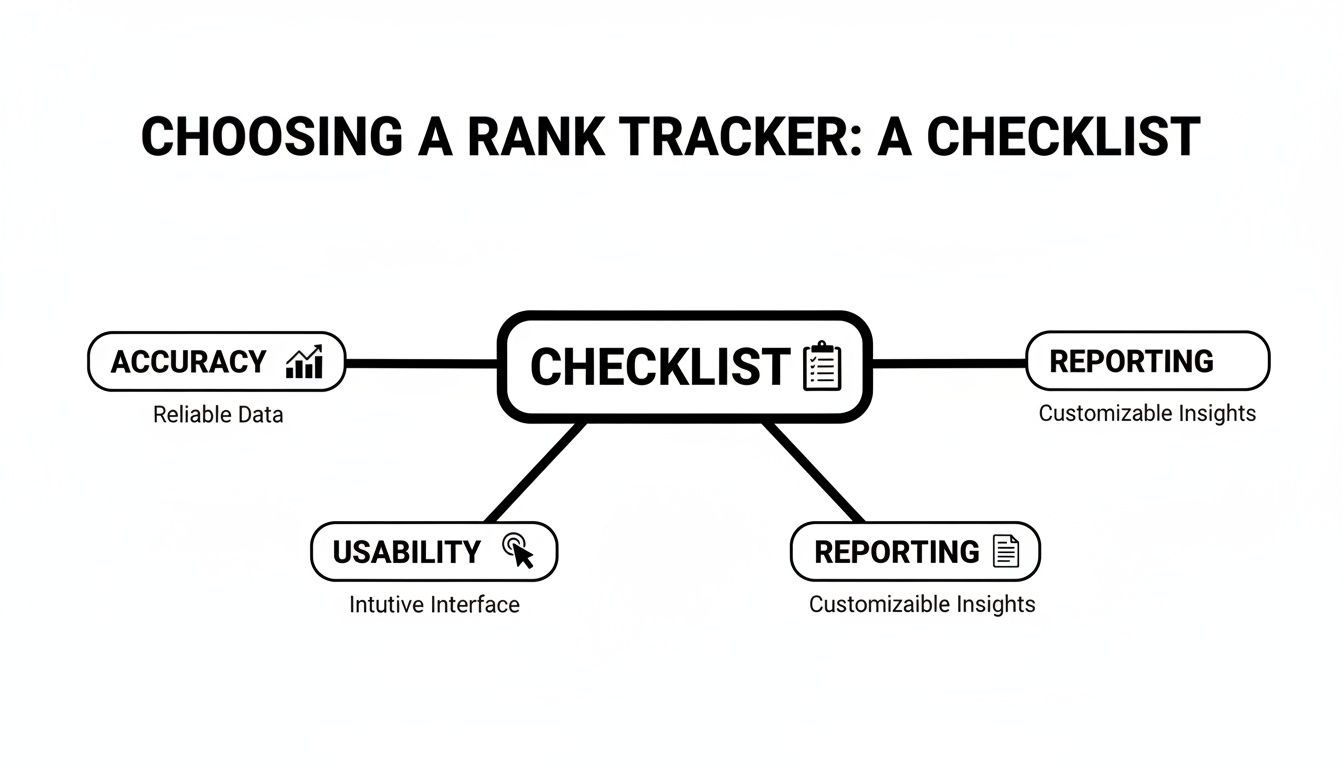
As the map shows, the best tools strike a balance between accuracy, usability, and robust reporting. This combination gives you the reliable foundation you need to act with confidence. By focusing on how to interpret this information, you can get a much clearer picture of your overall SEO ranking data and how it truly impacts your bottom line.
Got Questions About Rank Tracker Features?
Let's tackle some of the common questions that pop up when teams are trying to pick the right rank tracker. Here are a few quick, real-world answers to help you make a smarter decision.
How Often Should I Actually Check My Keyword Rankings?
For most businesses, checking your rankings weekly is the sweet spot. This rhythm is frequent enough to catch important trends and see if your SEO efforts are paying off, but not so often that you get bogged down by the daily SERP chatter, which is usually just noise.
Now, if you're in a hyper-competitive space or just launched a massive campaign, switching to daily checks makes a lot of sense. It gives you that immediate feedback loop to see what’s working and what your competitors are up to in real-time.
What’s the Real Difference Between a Rank Tracker and a Full SEO Platform?
Think of it this way: a rank tracker is a specialist, a laser-focused tool built to do one thing exceptionally well—monitor your keyword positions across different search engines, locations, and devices. It's the expert marksman in your SEO arsenal.
A full SEO platform, like Semrush or Ahrefs, is more like a Swiss Army knife. It has a rank tracker, but it's bundled with a ton of other tools for backlink analysis, site audits, and keyword research. While they offer a lot, their rank tracking component might not have the same depth or specialized features as a dedicated tool.
Can Rank Tracker Features Genuinely Help with Content Strategy?
Absolutely. A modern rank tracker is a goldmine for anyone planning content. When you start analyzing SERP features, you can spot all sorts of opportunities—like how to structure your content to win a featured snippet, what questions to answer for the 'People Also Ask' box, or if you should create a video to get into the carousel.
Competitor benchmarking features are where the magic really happens. They show you the exact keywords and topics sending traffic to your rivals. This gives you a data-backed roadmap to create content that plugs the gaps in your own strategy and pulls in an audience that’s ready to convert.
Ready to see how your brand shows up in the new world of AI-driven search? Sight AI monitors your visibility across models like ChatGPT and Gemini, turning insights into actionable content opportunities. Discover what you've been missing at https://www.trysight.ai.