Finding the right keywords for content isn't about chasing the highest search volume anymore. That's old-school SEO. The real game is understanding the why behind a search query. It's about digging into user intent and building real topical authority to create content that genuinely helps people. That's how you truly connect with an audience.
Beyond Volume: Finding Keywords for Content Today

Let's be blunt: the old SEO playbook is dead. For years, the strategy was painfully simple. Find a keyword with massive search volume, stuff it into an article a few times, and wait for the traffic to magically appear. It was a numbers game, plain and simple.
But that volume-first approach is a losing battle in a world of conversational AI and zero-click search results. When you just target high-volume terms, you often create content that completely misses the point of what the user actually needs. The result? Sky-high bounce rates and content that never really lands.
The Shift to Intent and Authority
The modern approach to finding keywords for content requires a complete mental reset. Stop asking, "what are people searching for?" and start asking, "why are they searching for it?" This obsession with user intent is the new foundation of any solid content strategy. You have to get inside the user's head and figure out their end goal.
This whole shift is powered by smarter search algorithms and the rise of AI search. Search engines are better than ever at understanding context, nuance, and how different topics relate to each other. Because of this, they reward sites that build deep topical authority—a comprehensive library of content that covers a subject from every conceivable angle. If you want to go deeper on this, check out our guide on what a keyword search truly means today.
The goal isn't to rank for one keyword. The goal is to become the go-to resource for an entire topic, answering every possible question your audience has.
Adapting to the New Content Landscape
So what does this actually mean for your day-to-day work? It means you have to move beyond basic keyword tools and adopt a much more holistic strategy. Your process now has to factor in:
- Conversational Queries: People are asking longer, more natural questions, especially with voice search and AI assistants on the rise.
- Zero-Click Searches: A ton of queries get answered right on the search results page. This makes grabbing attention in featured snippets and "People Also Ask" boxes absolutely critical.
- AI Model Visibility: Your brand needs to be the source for answers from models like ChatGPT and Gemini. That requires content that's clear, authoritative, and easy to cite.
This new reality is exactly why platforms like Sight AI were built. They're designed to help you turn AI visibility insights into real content opportunities that solve actual user problems. It's about shifting from a reactive, keyword-chasing model to a proactive, authority-building one.
Uncovering Hidden Keyword Opportunities

The standard keyword tools are a great starting point, but they rarely show you the full picture. Your biggest content opportunities aren't hiding in an Ahrefs export; they’re tucked away in the places automated tools can’t scrape.
The most powerful keywords for content come directly from the source: your audience. They're buried in customer support tickets, sales call transcripts, and niche online communities where people are talking about their problems in their own words.
This is where you find the raw, unfiltered language of real-world pain points, not just algorithmically generated suggestions. Mining these sources gives you a direct line into user intent. You'll uncover the exact phrases people use right before they’re ready to pull the trigger on a solution—phrases that are often long-tail keywords with sky-high conversion potential.
Think about a SaaS company selling project management software. A keyword tool will spit out "project management software," a term with massive volume and even bigger competition. But digging into support chats reveals customers asking, "how to track multiple client deadlines in one view." That’s not just a keyword. It’s a content goldmine.
Listen to Your Audience First
Finding these hidden gems starts with creating a system for listening. You need to be actively collecting and analyzing the language your customers and prospects use every single day.
Customer Support Tickets: Your support team is on the front line. Set up a shared document or a dedicated Slack channel where they can drop recurring questions or unique phrasing they hear from customers. These are literally direct requests for content.
Sales Call Transcripts: Use a call recording tool to capture how prospects describe their challenges. What words do they use? What features are they asking about first? These insights are perfect for building out bottom-of-funnel content that speaks their language.
Online Communities: Dive into forums like Reddit, Quora, or niche industry groups on Facebook or Slack. Search for your competitors' brand names or the core problems your product solves, then just sit back and observe the conversations. It's an invaluable source of unfiltered discussion.
The goal is to stop guessing what your audience wants and start creating content that answers what they are explicitly asking for. This simple shift moves your strategy from broadcasting to genuine problem-solving.
Perform Smarter Competitor Analysis
Once you have a handle on your audience's language, you can look at your competitors with a much more strategic eye. Don't just export a list of their top-ranking keywords and call it a day. Instead, your mission is to find the gaps they've missed.
Analyze their content and ask some critical questions. Are they only targeting broad, high-volume terms? Is their content thin and fails to actually answer a user's question completely? These weaknesses are your opportunities. To really dig in and analyze your content gaps, using some of the best free SEO tools can give you a much clearer picture.
This is where you'll see the true power of long-tail keywords. In fact, a staggering 91.8% of all search queries are long-tail, meaning they contain more than three words. People are getting more specific with their searches, and these detailed queries almost always show stronger intent to buy.
From Insight to Actionable Content Ideas
Let's circle back to our SaaS example. After analyzing customer conversations and competitor content, the team has identified several high-intent, low-competition keyword opportunities.
| Keyword Source | Raw Insight | High-Intent Keyword for Content |
|---|---|---|
| Support Ticket | "Can I integrate your app with Slack for project updates?" | "how to set up slack notifications for project milestones" |
| Sales Transcript | "We're a small agency and need a tool that's not too complex." | "simple project management tool for creative agencies" |
| Reddit Forum | "Airtable vs. your tool for managing content calendars?" | "best airtable alternative for content marketing teams" |
Each of these keywords represents a specific need from a highly qualified audience segment. Creating content around these terms attracts visitors who are much further along in their buying journey. They aren't just browsing; they are actively looking for a solution to a problem your product solves.
Our guide on https://www.trysight.ai/blog/low-competition-keyword offers even more tactics for this process. Ultimately, this customer-centric approach to finding keywords for content builds a foundation for a strategy that doesn’t just chase traffic—it drives real, sustainable business growth.
Decoding Search Intent for Better Content
So, you’ve gathered a list of promising keywords. That’s a great start, but it's only half the battle. Now comes the most critical part: understanding the why behind each search.
Simply stuffing a keyword into a piece of content doesn’t work anymore. You have to align what you create with the user’s underlying goal—what we call search intent. Getting this wrong is like showing up to a five-star restaurant in swim trunks. You’ve completely misread the room, and your audience will click away in seconds.
Nailing intent is what separates content that just exists from content that actually performs. It’s how you solve a user’s core problem, not just answer a surface-level question. And that deep alignment is precisely what search engines are built to reward.
The Four Main Types of Search Intent
Search intent typically boils down to four distinct categories. Once you learn to spot the signals for each, you'll know exactly which keywords for content to target and how to craft the perfect response.
Informational Intent: The user wants to learn something. They have a question and are hunting for an answer. These keywords often look like "how to," "what is," or "why." Think of a search like "how to fix a leaky faucet"—it’s purely about finding information.
Navigational Intent: The user already knows where they want to go and is just using the search engine to get there faster. Searches like "Twitter login" or "Sight AI blog" are classic examples. They aren't looking for alternatives; they have a specific destination in mind.
Commercial Intent: This is the investigation phase before a purchase. The user is comparing products, reading reviews, and trying to figure out the best option for them. Keywords are often packed with modifiers like "best," "top," "review," or "vs." A search for "best CRM for small business" falls squarely in this bucket.
Transactional Intent: The user has their wallet out and is ready to buy. They’re looking for a specific product page or a place to complete a purchase. These keywords will include terms like "buy," "price," "discount," or a specific product name like "buy iPhone 15."
If you want to go deeper on this, we've got a whole guide that explores the nuances of what search intent in SEO really means.
How to Confirm Intent Using the SERP
Forget fancy, expensive tools. Your best resource for figuring out search intent is right in front of you: the search engine results page (SERP).
Google has already invested billions into figuring out what users want to see for any given query. All you have to do is pay attention to its conclusions.
Go ahead, type your target keyword into Google and just look at what's ranking on the first page. What kinds of content do you see?
- Is it a sea of blog posts and how-to guides? That’s a clear signal for informational intent.
- Does one brand’s homepage dominate the top results? That’s navigational.
- Are you seeing a bunch of listicles, comparison articles, and review sites? You're looking at commercial intent.
- Is it all e-commerce product pages? That’s undeniably transactional.
By analyzing the SERP, you’re basically letting Google give you the cheat codes. You eliminate the guesswork and see exactly what type of content is already winning for your target keyword.
Mapping Keyword Intent to Content Type
Once you’ve cracked the intent code, the final step is to pair it with the right kind of content. This strategic mapping ensures that every piece you create serves a distinct purpose and directly meets user expectations. A mismatch here is one of the most common reasons why perfectly good content fails to rank.
This table breaks down how to translate different types of intent into concrete content formats that actually work.
Mapping Keyword Intent to Content Type
| Search Intent Type | Primary User Goal | Example Keywords | Optimal Content Format |
|---|---|---|---|
| Informational | "I want to learn something." | "how to start a podcast," "what is SaaS" | In-depth blog post, step-by-step guide, video tutorial, or a detailed infographic. |
| Commercial | "Help me choose the best option." | "mailchimp vs constant contact," "best noise-canceling headphones" | A comprehensive comparison article, a "best of" listicle, or a detailed product review. |
| Transactional | "I'm ready to buy this." | "buy airpods pro 2," "bluehost pricing" | A clear and concise product page with pricing, specifications, and a prominent call-to-action. |
| Navigational | "Take me to a specific site." | "youtube," "linkedin login" | Your homepage or a specific landing page (like a login or contact page). |
Think about it this way: if someone searches for "best project management software for startups," their commercial intent is screaming loud and clear. They aren't looking for a Wikipedia-style history of project management. They want a detailed, unbiased comparison of top tools, complete with features, pricing, and honest pros and cons.
Creating a generic blog post would completely miss the mark. But a well-researched comparison guide directly satisfies their need, building trust and nudging them closer to making a decision. That's the power of matching intent with the right content format.
Building Topic Clusters for SEO Authority
Chasing individual keywords is an exhausting, dead-end game. If you're still doing it, you're playing by rules that are a decade old. The real way to secure high rankings and build lasting trust with search engines today is to stop thinking in single phrases and start building comprehensive topical authority.
This is where the topic cluster model comes in, and it’s a total game-changer.
The concept is brilliantly simple. Instead of writing dozens of disconnected articles, you create a central "pillar" page covering a broad subject. Think of it as your ultimate guide. Then, you surround that pillar with "cluster" content—hyper-focused articles that explore specific subtopics. Crucially, all these cluster pages link back to the main pillar page, creating an organized, interconnected web of content.
This structure does more than just keep your site tidy. It sends a powerful signal to search engines: you are an expert on this subject. By covering a topic from every conceivable angle, you build a content hub that answers every user question, making your site the definitive resource.
From Keywords to Content Hubs
Let's say you're running a company that sells project management software. A massive, high-value topic for you would be "agile project management." A single blog post could never do that term justice.
So, you build an ultimate guide—your pillar page—that covers the fundamentals. From there, you brainstorm all the related keywords your audience is actually searching for. This is where you find the gold for your cluster pages.
Your cluster content might look something like this:
- "What are scrum ceremonies"
- "How to write effective user stories"
- "Kanban vs Scrum methodology explained"
- "Calculating story points for sprints"
- "Best agile tools for remote teams"
Each of these posts dives deep into one specific area, providing a ton of value on its own. The magic happens when each one links back to your main "agile project management" pillar. This internal linking is the glue that holds everything together, passing authority up to the pillar and helping both users and search engines navigate your expertise. For a deeper dive, you can check out how keyword clustering works to build authority.
This model fundamentally shifts your strategy from "ranking for a keyword" to "owning a topic." When you build a strong cluster, Google starts to see your entire domain as an authoritative source on that subject, which helps lift all your related pages in the rankings.
Prioritizing Your Keywords for Content
Once you have a big list of potential pillar and cluster topics, you need a smart way to prioritize them. Not all keywords are created equal, and your time is valuable. A simple framework based on relevance, search volume, and difficulty will help you focus your energy where it'll make the biggest splash.
Relevance: How closely does this keyword align with what you actually sell? High-relevance keywords attract people who are likely to become customers. An article on "agile tools for remote teams" is way more valuable to our SaaS example than a generic post on "team building activities."
Search Volume: How many people are searching for this term each month? High volume is tempting, but it almost always means insane competition. The sweet spot is often in those mid-range volume keywords that still have significant traffic potential but aren't impossible to rank for.
Keyword Difficulty: How hard will it be to crack the first page for this keyword? SEO tools give you a score for this by analyzing the authority of the sites already ranking. Targeting lower-difficulty keywords first is a great way to build momentum before you take on the heavy hitters.
This kind of strategic thinking is critical. Old-school tactics like keyword stuffing are long dead. In fact, a comprehensive analysis of over 1,500 Google results found no real correlation between keyword density and ranking, proving the focus has shifted to topical authority. The same study found that 73% of companies waste resources on low-impact keywords, costing them over $50,000 monthly.
By focusing on building these interconnected topic clusters around well-chosen keywords, you create a content engine that builds on itself. Each new article reinforces your authority, making it easier to rank for the next one and establishing a long-term, defensible advantage in the SERPs.
Scaling Your Content Engine with Automation
A brilliant keyword strategy is just a starting point. You can spend weeks unearthing the perfect keywords for content, but if those brilliant ideas just sit in a spreadsheet, they're not doing you any good. The real challenge isn't finding opportunities—it's actually turning them into high-quality, published articles at a pace that puts you ahead of the competition.
This is where automation stops being a "nice-to-have" and becomes a flat-out necessity. Trying to manually research, write, optimize, and publish every piece of content is a recipe for burnout; it simply doesn’t scale. Modern tools are built to connect your keyword research directly to tangible results, creating a content engine that works for you, not the other way around.
From Insight to Published Article, Automatically
Imagine a workflow that doesn't need you to manually nudge it along at every single step. Tools like Sight AI are designed to connect the dots in your content process. It all starts by monitoring how your brand and target keywords are being talked about and positioned within AI models like ChatGPT and Gemini. This gives you a live feed of high-value content gaps you need to fill.
Instead of guessing what to write next, the system shows you exactly where competitors are visible and you're not. From there, its specialized AI agents can take over.
- AI-Powered Drafting: The system can handle the heavy lifting of researching, outlining, and producing fully SEO-optimized articles, often between 2,500 and 4,500 words, complete with relevant images.
- CMS Integration: Once an article is ready, it can be pushed directly to your CMS, whether that’s WordPress, Webflow, or another platform.
- Technical SEO Handling: The automation also takes care of tedious but crucial tasks, like updating your sitemap and submitting new pages to IndexNow, which helps Google and Bing discover your content faster.
This streamlined approach means your team can publish consistently—even daily if you use an Autopilot mode—without the manual grind. To truly get your content engine humming, understanding which 5 tasks to automate is key to unlocking maximum efficiency.
This flowchart gives you a high-level look at how individual content pieces work together to build real authority on a topic.
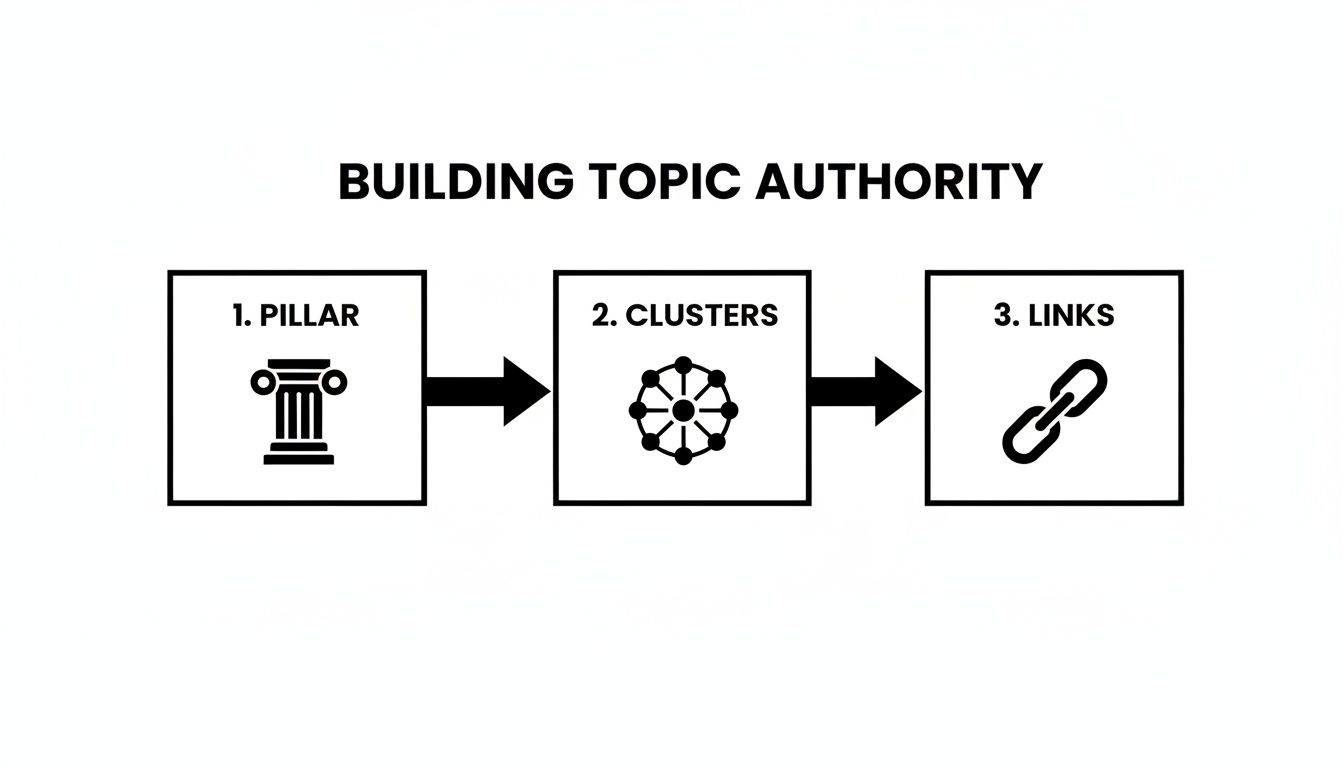
As you can see, a central "pillar" page is supported by smaller "cluster" content, all tied together with internal links to signal your expertise to search engines.
Building a Sustainable Content Workflow
The end goal is a system that builds on itself over time. When you automate the repetitive parts of content creation, you free up your team to focus on what really matters: high-level strategy, like refining your topic clusters and digging into performance data. You can get a more detailed breakdown in our guide on how to scale your SEO content production.
A truly sustainable engine thrives on a continuous feedback loop.
Automation isn't about replacing strategists; it's about empowering them. By handling the heavy lifting of production, it allows marketing teams to focus on the creative and analytical work that drives real growth.
Think of your keyword list as the fuel and an automation platform as the engine. The platform takes each keyword opportunity, runs it through a production pipeline, and spits out a finished, optimized article ready for your audience to find. This direct line from insight to action is what makes a modern content strategy so powerful.
Measuring Performance and Refining Your Strategy
A winning keyword strategy is never "set it and forget it." It’s a living, breathing thing that needs to adapt based on what the real-world data is telling you. Just tracking rankings and traffic is a vanity game; real success is measured by the metrics that actually move the needle for your business.
The focus needs to shift to the key performance indicators (KPIs) that tell the full story of your audience's journey. Are the people coming from organic search actually turning into leads? Are they sticking around to read what you've written, or are they bouncing right away? Answering these questions is how you start making meaningful improvements.
Key Metrics That Actually Matter
Don't get lost in a sea of data. Instead, zero in on a handful of KPIs that truly reveal the health of your content strategy. These are the numbers that will give you a clear picture of what’s working and what needs your immediate attention.
- Organic Conversion Rate: This is the big one. It's the ultimate measure of whether your content is doing its job. This metric tracks how many visitors from search engines complete a desired action, like signing up for a demo or downloading a whitepaper.
- Lead Quality from Organic Search: Not all leads are created equal. Are the leads coming from your content a good fit for your business? This is where you need to partner up with your sales team to figure out which articles are bringing in the most qualified prospects.
- Time on Page and Engagement: A high time on page is a fantastic signal that your content is hitting the mark and providing real value. Low engagement, on the other hand, is a major red flag that you’ve misunderstood the search intent behind the keyword.
A keyword strategy without a feedback loop is just guesswork. Use performance data to create a cycle of continuous improvement, where every piece of content you publish gets smarter than the last.
Conducting Regular Content Audits
A content audit is your secret weapon for uncovering hidden optimization opportunities. Put a recurring reminder on your calendar—quarterly is a great place to start—to systematically review your content and identify any underperforming pages.
The goal here is simple: find content that has slipped in the rankings or isn't hitting its conversion targets. This isn't about pointing fingers at past efforts; it's about spotting quick wins. You’d be surprised how often a simple refresh—like updating stats, adding new examples, or sharpening the on-page SEO—can breathe new life into an old post.
Creating a Powerful Feedback Loop
Your analytics tools are the engine that drives this whole feedback loop. Google Search Console is absolutely invaluable here. It shows you the exact queries that are driving impressions and clicks to each page, helping you find new keywords for content you might be ranking for without even trying.
Platforms like Sight AI take this a step further by connecting performance data directly to new content opportunities. By monitoring your brand’s visibility and keyword positions in AI models, you can spot gaps and fine-tune your strategy based on real-time insights, which is key for sustainable, long-term growth.
It's no secret that keyword research can feel daunting—39% of SEO pros find it difficult. But the ROI is impossible to ignore. A small tweak like optimizing a meta description can boost click-through rates by 43%. And when the first position on desktop search results gets an average 34% CTR, nailing your keyword strategy is non-negotiable. You can find more on these trends and Google search statistics here.
Answering Your Keyword Questions
When you get deep into keyword research, a lot of questions pop up. It happens to everyone. Let's tackle some of the most common ones I hear from content teams and SEOs.
How Often Should I Do Keyword Research?
Think of keyword research in two speeds. First, you have your deep-dive sessions, which should happen quarterly to sync up with your bigger content planning. But you also need to keep your finger on the pulse. I recommend a monthly check-in to see what competitors are up to and catch any shifts in the SERPs.
This isn't just a routine task. You have to stay alert. For example, if you see a sudden explosion of questions about a new software feature popping up on Reddit, that’s your signal. You jump on it and create content now, not wait for the next planned research cycle.
What Is a Good Keyword Difficulty Score?
Honestly, there’s no magic number here. A "good" score is completely relative to your own website's authority. If you're running a brand-new site, you should be hunting for keywords with a difficulty score under 20 on most tools. This is how you get those crucial early wins.
On the flip side, an established domain with a killer backlink profile can swing for the fences and target keywords in the 40-60 range. The whole game is about matching your effort to your site's current strength.
Don't get fixated on a single number. I've seen teams chase low-difficulty keywords with vague, informational intent and get nowhere. A slightly harder keyword that perfectly matches your audience's commercial intent is almost always more valuable.
How Many Keywords Should I Target per Article?
Keep it focused. For each article, aim for one primary keyword and maybe two to three secondary keywords that are very closely related. This forces you to create a deep, focused piece of content on a specific topic, which is exactly what search engines want to see.
If you try to stuff ten different keywords into one post, you’ll just dilute your message. It becomes impossible to satisfy the search intent for any of them. For every single piece of content you create, always choose depth over breadth.
Ready to turn all those keyword insights into published content, automatically? With Sight AI, you can monitor your AI visibility, surface high-value content gaps, and let AI agents create SEO-optimized articles for you. See how it works at https://www.trysight.ai.