Content calendar marketing is all about planning, scheduling, and organizing your content ahead of time. Think of it as the blueprint that turns random acts of content—a blog post here, a social media update there—into a focused, goal-driven marketing machine. It’s how you make sure you’re delivering the right message to the right audience, every single time.
What Is Content Calendar Marketing and Why It Matters

Have you ever tried to build a house without a blueprint? You'd probably end up with walls in the wrong places, a roof that doesn’t quite fit, and a structure that’s chaotic at best. That's exactly what marketing feels like without a plan. Content calendar marketing is the strategic blueprint for your entire digital presence.
It’s the shift from reactive, last-minute scrambles to a proactive strategy that methodically builds your brand's authority. Your calendar becomes a mission control center, coordinating every piece of content—from blog posts and videos to social media updates and email newsletters—ensuring they all launch on time and on target.
From Simple Scheduler to Strategic Powerhouse
At its most basic, a content calendar answers the simple questions: "What are we posting?" and "When are we posting it?" But its real power lies in its strategic depth. A well-built calendar is so much more than a schedule; it’s a growth engine that gets your entire team on the same page and drives real, measurable results.
To really get it, it helps to understand what is a content calendar in its foundational role. It acts as the single source of truth for your entire team, providing total clarity on goals, who’s responsible for what, and when everything is due.
This strategic alignment is a huge reason the global content marketing market is booming. It recently hit approximately $600 billion, and projections show it soaring toward $1,956.5 billion by 2032. This incredible growth is fueled by calendars that turn haphazard posting into a science, which is why 54% of businesses are now hiking their content budgets. This data, shared by InfluenceFlow.io, highlights just how critical strategic planning has become.
The Core Pillars of an Effective Calendar
A truly effective content calendar isn't just a document; it's an operational asset built on a few key pillars. These components provide the structure you need for consistent, high-impact content that actually moves the needle.
A great content calendar goes beyond just listing dates and topics. It incorporates strategic elements that tie every activity back to a business goal. This summary table breaks down the core components that transform a simple schedule into a powerhouse tool.
Core Components of a Strategic Content Calendar
| Component | Function | Business Impact |
|---|---|---|
| Publication Dates & Times | Sets the schedule for when content goes live. | Ensures consistent brand presence and predictable delivery for your audience. |
| Content Topics & Titles | Defines the core ideas and headlines, often based on keyword research. | Attracts the right audience by addressing their specific pain points and interests. |
| Target Channels | Specifies where content will be distributed (e.g., blog, LinkedIn, YouTube). | Maximizes reach and engagement by meeting your audience where they are. |
| Content Formats | Dictates the media type (e.g., blog post, video, infographic, podcast). | Diversifies your content mix to keep your audience engaged and cater to different preferences. |
| Assigned Roles & Status | Clarifies who is responsible for each stage (writing, design) and tracks progress. | Improves team efficiency, eliminates bottlenecks, and ensures accountability. |
These pillars work together to create a system that not only keeps you organized but also drives your content strategy forward with purpose.
A great content calendar doesn't just organize your posts; it organizes your thinking. It forces you to connect every piece of content back to a larger business objective, ensuring nothing is created without a purpose.
By laying this groundwork, you create a system that fosters consistent brand messaging, makes your team far more efficient, and delivers results you can actually measure. For anyone looking to see this in practice, checking out a few powerful content marketing strategy examples can be incredibly inspiring.
Next, we'll dive into the tangible benefits of adopting this approach.
The Strategic Benefits of a Well-Planned Calendar
Let's move past the theory. A well-planned content calendar delivers real, business-driving results that connect your planning efforts directly to your bottom line. It’s the difference between merely hoping for success and actually engineering it.
Without this strategic blueprint, teams often get stuck in a reactive loop, scrambling to put out fires. This leads to missed opportunities, inconsistent messaging, and a whole lot of unnecessary stress.
A unified calendar immediately boosts team efficiency by getting rid of those frantic, last-minute scrambles for content. When everyone knows what’s due, who’s responsible, and how each piece fits into the bigger picture, the entire workflow becomes smoother and far more predictable. This proactive approach also prevents those awkward, costly content gaps where your audience hears nothing but crickets from you.
Fostering Brand Consistency and Trust
Consistency is the absolute bedrock of audience trust. A content calendar is your single source of truth, ensuring your brand's story, voice, and values are communicated uniformly across every single channel—from your blog and LinkedIn profile to your weekly email newsletter. This cohesive narrative is crucial for building a brand identity that people actually remember.
When your audience sees a consistent message everywhere they look, they start to understand who you are and what you stand for. Over time, that reliability builds incredible loyalty and transforms casual followers into dedicated brand advocates.
Think of your content calendar as a musical score for an orchestra. Each instrument (or channel) has its part to play, but they all work together to create a single, harmonious symphony. Without the score, you just have noise.
This organized approach isn't just a nice idea; it's proven to work. Research shows that content calendars are powerful growth tools, with 60% of marketers who use them reporting higher engagement rates. In fact, firms that measure their calendar's ROI achieve 2.3x better results.
Consistent scheduling can also spike follower growth by as much as 35% across platforms. It's worth taking a moment to explore more about how a social media content calendar works and drives these kinds of metrics.
Fueling Your SEO and Driving Organic Growth
One of the biggest wins from strategic content calendar marketing is its direct impact on your search engine optimization (SEO). Search engines like Google absolutely reward websites that publish high-quality, relevant content on a regular, predictable schedule. A calendar is the perfect tool to establish and maintain this steady rhythm.
By planning your content around target keywords and core topics, you systematically build authority in your niche. Each blog post, case study, or video becomes another asset that answers your audience's questions and signals your expertise to search engines.
This consistent output of keyword-targeted content is a powerful ranking signal that leads to:
- Improved Visibility: A steady flow of fresh content tells search engines your site is active and relevant, helping you rank higher for important terms.
- Increased Organic Traffic: As your rankings improve, you naturally attract more qualified visitors who are actively searching for the solutions you provide.
- Stronger Topical Authority: Planning content in clusters around pillar topics demonstrates deep expertise, making you the go-to resource in your industry.
Turning Organization into Measurable Results
Ultimately, the goal of any marketing effort is to drive business growth. A content calendar provides the framework to make that happen by connecting every single activity to a measurable outcome.
By planning ahead, you can perfectly align your content with specific campaigns, product launches, or seasonal sales cycles. This strategic alignment means you aren't just creating content for the sake of it. Instead, you're building a content engine that directly supports lead generation, customer acquisition, and revenue.
For example, a B2B software company could plan a series of blog posts, a webinar, and several social media updates all centered around a single pain point their product solves. This coordinated effort, all managed from the content calendar, creates multiple touchpoints that guide a potential customer through the buyer’s journey, turning initial interest into a qualified lead. This is how a simple organizational tool becomes a powerhouse for sustainable growth.
How To Build Your Content Calendar From Scratch
Building a powerful content calendar is less about finding the perfect, color-coded template and more about creating a strategic process that works for your team. It’s a journey that starts with one simple question: "Why are we even creating this?" and ends with a living document that keeps your entire content engine running smoothly.
So, let's walk through how to build one from the ground up. No fluff, just the essential steps.
The end goal is a system that takes you from simple efficiency gains to powerful storytelling, which ultimately fuels your SEO growth. This isn't just a theory; it's a proven path to turning content into a real asset.
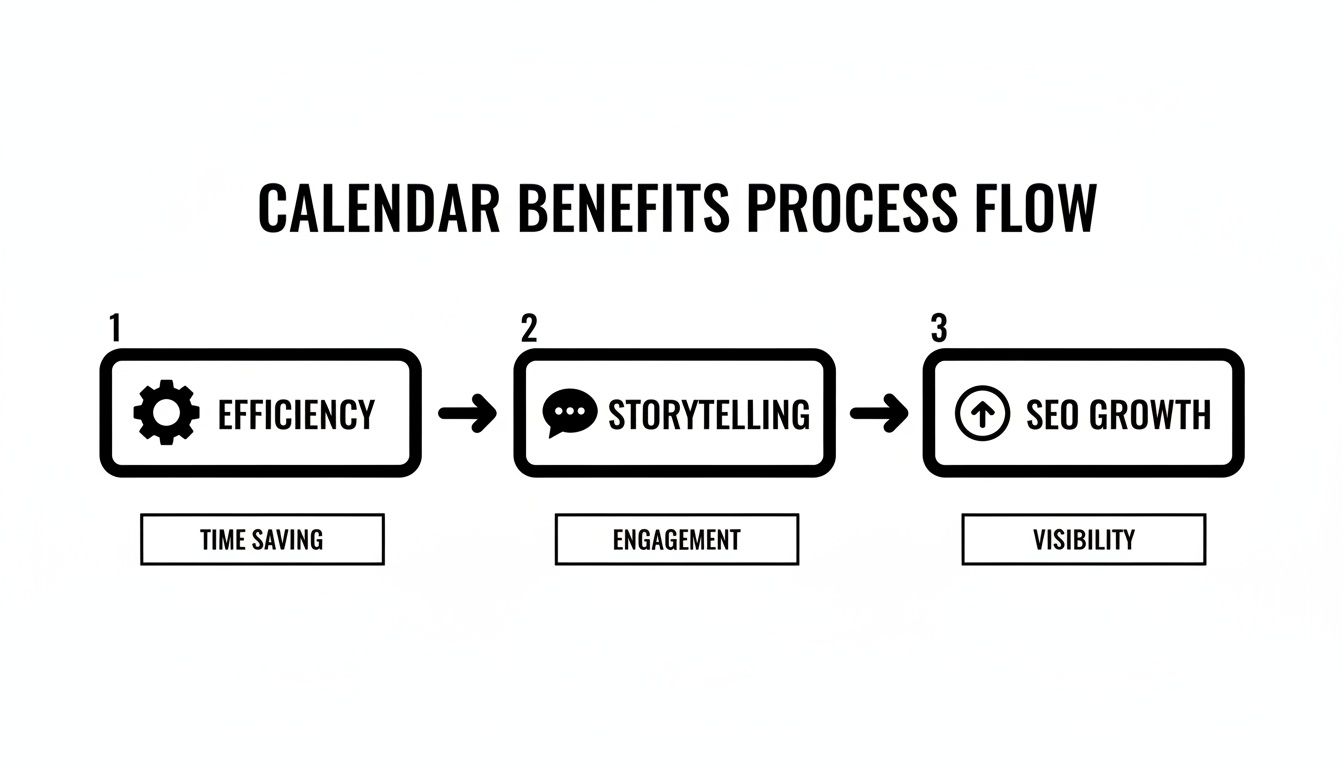
Think of it this way: better efficiency buys you the time and headspace to craft compelling narratives. Those stories build an engaged audience, which sends all the right signals to search engines, leading directly to better visibility.
Start With Goals and Audience Insights
Before you even think about dates and topics, you have to define what success looks like. Your content calendar should be a direct reflection of your bigger marketing goals. Are you trying to boost organic traffic, generate qualified leads, or just get your brand name out there?
Each goal demands a completely different content playbook. A lead generation goal might prioritize webinars and downloadable guides, while a traffic goal will lean heavily on SEO-driven blog posts. Get this wrong, and you’ll just be creating content for content's sake.
Once your goals are crystal clear, turn your attention to your audience. Who are you talking to? Knowing their biggest headaches, the questions they're secretly Googling, and where they hang out online is the key. This ensures every piece you plan is genuinely helpful, not just more noise.
Audit Your Existing Content
Don't start with a blank page—that's a rookie mistake. Your existing content is a goldmine of data waiting to be discovered. Running a content audit helps you see what's already crushing it, what's falling flat, and where the obvious gaps are.
Look for patterns in your best-performing pieces:
- High-Traffic Posts: Which topics and keywords are already bringing people to your site? Do more of that.
- High-Engagement Content: What gets the most shares, comments, or time on page? That's what resonates.
- Content Gaps: What are your customers constantly asking that you haven't written about yet? That's low-hanging fruit.
This audit stops you from reinventing the wheel and lets you double down on what’s already proven to work. You can update old winners or create new content to fill the gaps you’ve found. For a deeper look at this process, our guide on effective content planning strategies offers some great frameworks.
Choose Your Format and Core Pillars
With your goals and audit insights in hand, it’s time to decide where this calendar will live. The best tool isn't the fanciest one—it's the one your team will actually use every single day.
A content calendar's value isn't in its complexity, but in its adoption. A simple, consistently used spreadsheet is infinitely more effective than a powerful, neglected software subscription.
Plenty of teams get started with a simple spreadsheet using tools like Google Sheets or Excel. As your team and complexity grow, you might graduate to a project management tool like Trello, Asana, or a specialized content platform.
Next, you need to define your content pillars. These are the 3-5 core topics your brand is going to own. For an SEO software company, these pillars might be "Keyword Research," "Technical SEO," and "Content Strategy." Every single piece of content you create should tie back to one of these pillars, which keeps your message focused and builds your authority.
Pick the Right Tool for the Job
Choosing where your calendar will live is a crucial step. The options range from simple and free to complex and feature-rich. It all depends on your team's size, workflow, and budget.
Here’s a quick breakdown to help you decide:
Content Calendar Tool Comparison
| Tool Type | Examples | Best For | Key Features |
|---|---|---|---|
| Spreadsheets | Google Sheets, Excel, Airtable | Small teams, startups, or those on a tight budget. | Highly customizable, free or low-cost, familiar interface. |
| Project Management | Trello, Asana, Monday.com | Growing teams that need to manage multiple projects beyond content. | Kanban boards, task assignments, deadline tracking, integrations. |
| Content Marketing Platforms | CoSchedule, Contently, Kapost | Established marketing teams and enterprises needing an all-in-one solution. | Editorial workflow automation, analytics, asset management, social scheduling. |
| Note-Taking & Wikis | Notion, Coda | Teams that value flexibility and want to integrate their calendar with other docs. | Database functionality, nested pages, collaborative editing, templates. |
Don't overthink it at the start. You can always migrate to a more powerful tool later. The most important thing is to pick something and get started.
Define Your Essential Calendar Fields
To make your calendar a true command center, it needs the right information. Customizing it is fine, but there are a few non-negotiable fields every calendar needs to function properly. These fields provide at-a-glance clarity for everyone involved.
Here are the must-have components:
- Publish Date: The exact date the content goes live. No ambiguity.
- Topic/Title: The working title or a clear, concise description of the piece.
- Content Owner: The single person responsible for getting the piece across the finish line.
- Target Keyword: The primary SEO keyword you're aiming to rank for.
- Content Format: Is it a blog post, video, infographic, or case study?
- Distribution Channels: Where will this be promoted? (e.g., LinkedIn, Twitter, email newsletter).
- Status: The current stage of the workflow (e.g., Ideation, Drafting, In Review, Scheduled, Published).
Including these basics turns a simple list of dates into a dynamic tool that keeps your team aligned and accountable. This is how you build a content machine, not just a content list.
Developing Your Content Workflow and Cadence
A content calendar is just a pretty document until you pair it with a solid workflow. The workflow is your operational playbook—it’s the engine that turns your grand strategy into consistent, high-quality content that actually gets published. Without a clear process, even the best-laid plans will collect digital dust, leading to blown deadlines and a frustrated team.
Think of it like a restaurant kitchen during the dinner rush. Every chef has a specific station, every dish follows a precise order of operations, and the result is a smooth, efficient service. Your content workflow does the same thing, making sure every idea moves from concept to publication without hitting a wall.
Defining Roles and Responsibilities
The first step in building that seamless workflow is assigning crystal-clear ownership. When everyone knows exactly what they’re responsible for, accountability skyrockets, and tasks stop falling through the cracks. This simple act puts an end to the classic "I thought you were doing that" problem that torpedoes so many content plans.
A well-oiled machine usually has a few key roles. In a smaller team, one person might wear several hats, but it’s still critical to assign responsibility for each distinct function.
Key roles in a typical content production cycle include:
- Strategist/Manager: This person owns the calendar, ensures content aligns with business goals, and gives the final green light.
- Writer/Creator: The boots on the ground who researches and produces the actual content, whether it's a blog post, video script, or social copy.
- Editor/Reviewer: The quality control expert who checks for grammar, style, accuracy, and adherence to brand voice.
- Designer/Visual Specialist: The creative force who builds the graphics, illustrations, or video assets that make the content pop.
- Publisher/Distributor: The final link in the chain who schedules and publishes the content on the right channels and kicks off promotion.
By mapping out these responsibilities, you build a system where handoffs are frictionless and everyone is empowered to do their best work. For a deeper dive, our guide on creating a workflow has practical steps to get your team perfectly aligned.
Establishing a Realistic Publishing Cadence
Okay, roles are set. Now for the big question: "How often should we publish?" The answer isn't about churning out as much as possible—it’s about finding a rhythm you can actually maintain. A realistic publishing cadence is one you can hit consistently over the long term without burning out your team or letting quality slide.
A flurry of daily posts followed by a month of radio silence is way less effective than a steady, predictable schedule of two great articles a week. Consistency builds trust with your audience and signals reliability to search engines.
To find your sweet spot, think about these factors:
- Team Capacity: Let's be honest. How much top-notch content can your team really produce with their other duties?
- Audience Expectations: What does your audience want? Dive into your analytics to see if engagement drops off when you post too often.
- Content Complexity: A deeply researched whitepaper isn’t the same as a quick tweet. A 2,000-word blog post takes a lot more horsepower than a 200-word newsletter blurb, so factor that into your planning.
Start with a conservative schedule you know you can nail. You can always ramp things up later once your workflow is humming.
Managing Different Content Types and Channels
Your content calendar marketing strategy probably isn't a one-trick pony. You’re likely juggling blogs, videos, social media, and newsletters—and each one has its own production quirks. A truly robust workflow needs to account for all of them.
For instance, a blog post might follow a straightforward write-edit-publish cycle. But a video? That needs scripting, filming, editing, creating a thumbnail, and writing a description. You'll want to map out these unique sub-workflows within your main process to keep everything moving.
This is also where you get smart about repurposing. One big content piece can fuel your channels for days.
| Original Asset | Repurposed For | Purpose |
|---|---|---|
| Blog Post | LinkedIn Article | Reaches a professional audience with key takeaways. |
| Blog Post | Twitter Thread | Breaks down the main points into digestible, shareable bites. |
| Blog Post | Infographic | Visualizes key data or steps for platforms like Pinterest. |
| Blog Post | Email Newsletter | Delivers a summary directly to your most engaged subscribers. |
Building this repurposing step right into your workflow is how you squeeze every last drop of value out of each piece of content.
Building in Flexibility for Timely Opportunities
Finally, the best workflows aren't rigid—they're resilient. While your calendar gives you structure, you have to leave some breathing room to jump on timely trends, breaking news, or unexpected opportunities. This agility is what lets you join relevant conversations and create content that feels immediate and current.
A great way to do this is to designate a few "flex" slots in your calendar each month. These are your wild cards, ready to be deployed for reactive content that capitalizes on a trending topic. This approach gives you the best of both worlds: the stability of a long-term plan and the nimbleness to stay relevant right now.
Integrating AI to Enhance Your Content Calendar
Your content calendar gives you structure, but let's be honest—it can feel a bit static. What if you could turn it into a dynamic, data-driven growth engine? That's where artificial intelligence comes in. AI isn't here to replace the strategist; it's here to be your co-pilot. It automates the tedious stuff and uncovers insights that would take days or weeks to find by hand.
This is all about working smarter, not harder. By weaving AI tools into your workflow, you can pack your content calendar with more relevant, timely, and impactful ideas with way less manual effort. The entire content calendar marketing process gets a serious upgrade, from the first spark of an idea to the final click of the "publish" button.
Supercharging Research and Ideation
Every great piece of content starts with a solid foundation: knowing your audience and what your competitors are up to. This is where AI first shows its true power, turning hours of mind-numbing research into minutes of automated discovery.
Instead of guessing what your audience wants, AI can analyze massive amounts of data to tell you exactly what they’re searching for right now. You get data-backed topics that already have built-in demand.
- Audience Analysis: AI can comb through social media conversations, forum discussions, and search trends to build detailed profiles of your audience, shining a light on their biggest pain points and questions.
- Competitor Gap Analysis: These tools can crawl competitor sites to see what keywords they rank for and, more importantly, what they’re missing. This is how you find golden opportunities—content gaps just waiting for you to fill.
- Trend Identification: AI algorithms are great at spotting emerging trends in real-time. This lets you jump on a topic and create content that captures interest before it peaks and fades away.
With this level of insight, every slot on your calendar is filled with a topic that has a real shot at performing. You're moving away from educated guesses and toward a strategy built on solid evidence.
AI doesn't just give you more ideas; it gives you better ideas. It systematically de-risks your content strategy by validating topic relevance before you invest a single minute in creation.
Streamlining Content Creation and Optimization
Once your calendar is packed with promising ideas, the next hurdle is actually creating high-quality content consistently. This is another spot where AI can be a massive help, acting as a tireless assistant for your writers and editors.
Platforms like Sight AI go way beyond simple brainstorming. They can take a validated topic and generate a comprehensive, SEO-optimized first draft, complete with on-page best practices built right in. You can see exactly how this works in our guide on content creation with AI.
This frees up your human experts to do what they do best: add unique insights, refine the story, and make sure the final piece perfectly captures your brand's voice. The AI does the heavy lifting, while your team provides the strategic polish. To get the most out of AI, it's worth exploring the principles of Generative Engine Optimisation (GEO) as a framework for winning in the AI era.
Automating Distribution and Indexing
Even the most brilliant piece of content is useless if no one ever sees it. The final, crucial step in your workflow—distribution—can also be massively improved with automation. This makes sure your hard work gets in front of the widest possible audience with minimal fuss.
AI-powered platforms can connect directly to your content management system (CMS) to handle publishing and promotion automatically, creating a seamless path from creation to discovery.
- Automated Publishing: Schedule posts to go live on your blog or website without anyone needing to be there to click "publish."
- Social Media Scheduling: Automatically generate and schedule promotional posts for platforms like LinkedIn, X, and others.
- Instant Indexing: Submit new URLs directly to search engines like Google and Bing, helping your content get discovered and ranked much faster.
By automating these final steps, you close the loop on your content marketing process. Your team can move on to planning the next big thing while the system ensures your completed work gets the visibility it deserves.
How to Measure and Optimize Your Calendar's Performance
A great content calendar doesn't just get filled; it gets smarter. Think of it as a living document, something that should evolve based on what’s actually working with your audience. Creating this powerful feedback loop is the final, crucial step in mastering your content strategy, turning a simple plan into a system that consistently delivers better results.
This whole process kicks off by tracking the right metrics. Without data, you’re just guessing what resonates. You need to connect your content efforts to real business outcomes, making sure every blog post, webinar, or social update you schedule has a clear purpose and a way to measure its impact.
Identifying Your Key Performance Indicators
Before you can tell if your calendar is working, you have to define what success actually looks like. Your Key Performance Indicators (KPIs) should tie directly back to the goals you set in the planning stage. It's easy to get lost in vanity metrics, so focus on the data that signals real business value.
Here are the essential metrics to track, broken down by common goals:
- For SEO and Traffic Growth: Keep a close eye on organic traffic, keyword rankings for your target terms, and backlinks acquired. These numbers tell you if your content is gaining traction on search engines.
- For Audience Engagement: Track metrics like time on page, bounce rate, social media shares, and comments. This data reveals how compelling and valuable your audience finds what you're creating.
- For Lead Generation and Conversions: This is where the money is. Measure conversion rates on your calls-to-action (CTAs), form submissions, and the number of marketing qualified leads (MQLs) your content generates.
Building a Simple Performance Dashboard
You don’t need fancy, expensive software to get started. A simple dashboard in a spreadsheet or a tool like Google Looker Studio can give you an at-a-glance view of what's hitting the mark and what's falling flat. By centralizing your data, you make it much easier to spot trends over time.
Your dashboard should visualize the KPIs listed above for each piece of content on your calendar. This lets you quickly see how a blog post performed versus a webinar, or which topics are consistently driving the most engagement. That kind of clarity is what fuels smarter decisions.
A dashboard transforms raw data into a story. It tells you which content your audience loves, which formats they prefer, and where your biggest opportunities for improvement lie.
Turning Insights into Actionable Improvements
Data is useless if you don't do anything with it. The final step is to schedule regular reviews—monthly or quarterly—to analyze your performance and translate those insights into real improvements for your next content calendar. As you dive in, our guide on measuring content marketing ROI can provide some deeper context for these conversations.
During your review, ask yourself and your team some tough questions:
- Which content formats are driving the highest engagement? Action: Let's prioritize creating more of that format.
- What topics consistently bring in the most organic traffic? Action: Time to double down on that topic cluster with more in-depth content.
- Which pieces are failing to perform? Action: We need to decide whether to update them with fresh info or archive them and focus our energy elsewhere.
This continuous cycle of measuring, analyzing, and optimizing is what separates a static to-do list from a strategic content engine. It ensures your efforts become more effective over time, consistently driving sustainable growth for your business.
Got Questions About Content Calendars? We’ve Got Answers.
Even the best-laid content plans run into real-world questions. When you start putting your content calendar into action, a few things are bound to pop up. Let's tackle some of the most common ones so you can keep moving forward without a hitch.
How Far in Advance Should I Plan My Content?
This is a classic question, and the answer is a balancing act. For most teams, planning your content calendar one to three months in advance is the sweet spot. This gives you enough breathing room to be strategic and create high-quality work without locking you into a plan that can't adapt to new trends.
Of course, for those bigger, cornerstone campaigns or major industry events, you might want to sketch out ideas six to twelve months ahead. The goal is to have a long-term vision while staying nimble enough to react in the short term.
Think of your content calendar less like a stone tablet and more like a living blueprint. It's there to guide you, but it needs to be flexible enough to welcome new opportunities or handle a sudden shift in priorities.
What’s the Difference Between a Content Calendar and a Social Media Calendar?
Great question. It’s best to think of it like one of those Russian nesting dolls.
Your content calendar is the big, outer doll—it’s the master plan for everything you create. This includes the heavy hitters like:
- Blog posts and long-form articles
- Videos and webinars
- Email newsletters
- Case studies and whitepapers
A social media calendar is one of the smaller dolls inside. It's a specialized tool that focuses only on what's happening on your social channels. It details the specific posts, captions, images, and videos for platforms like LinkedIn or Instagram, making sure they all tie back to the bigger content pieces you're pushing.
How Do I Handle Unexpected News or Trends?
This is where a smart content calendar really shines. The trick is to build flexibility right into your schedule from the start. A fantastic way to do this is by penciling in "flex slots" every week or month.
These are empty spots you intentionally leave open for reactive content. When breaking news hits your industry or a meme goes viral that’s actually relevant to your brand, you can jump on it using these slots. This way, you get to join the conversation without blowing up the entire schedule you so carefully planned. It's the perfect way to be both proactive and timely.
Ready to stop guessing and start building a high-performing content calendar with AI-powered insights? Sight AI gives you the tools to find competitor gaps, generate SEO-ready articles, and automate your publishing workflow. Start growing your brand at https://www.trysight.ai.