A persuasive writing technique isn't some dark art or a form of manipulation. Instead, think of it as the skill of building a compelling argument that guides a reader toward a specific conclusion. It's an absolutely essential skill for anyone in marketing, sales, or communication who needs to influence beliefs, attitudes, or actions.
Unpacking the Art of Persuasion

Persuasive writing is so much more than just throwing words on a page and hoping for the best. It's a structured skill, one that's deeply rooted in understanding human psychology.
Imagine a really good tour guide. They don't just shove you in front of a landmark and tell you to be impressed. Instead, they lead you down a carefully chosen path, pointing out interesting details and building anticipation. By the time you arrive at the stunning vista, it feels like a personal discovery.
That's exactly how every effective persuasive writing technique works. It aligns your message with the reader's own needs, desires, and ways of thinking. The goal is to build a bridge between your goal and their motivation, making your call-to-action feel like the most natural, beneficial next step they could possibly take.
The Foundational Pillars of Persuasion
At the heart of it all are three core principles first laid out by Aristotle more than 2,000 years ago. These timeless concepts—Ethos, Pathos, and Logos—are still the bedrock of any truly compelling message today. Getting a handle on them gives you a powerful framework for crafting any argument.
Here’s a quick look at how Aristotle’s big three apply to the work we do every day.
The Three Pillars of Persuasion at a Glance
| Pillar | What It Means | How to Use It in Your Writing |
|---|---|---|
| Ethos | Credibility & Trust | Showcase testimonials, expert endorsements, data from trusted sources, and professional credentials. Answer the question: "Why should I listen to you?" |
| Pathos | Emotion & Feeling | Use storytelling, vivid language, and relatable scenarios to connect with your reader's hopes, fears, and desires. Answer the question: "How does this make me feel?" |
| Logos | Logic & Reason | Present hard data, statistics, case studies, and a clear, structured argument to prove your point. Answer the question: "Does this make logical sense?" |
Let's break these down a bit further.
Ethos (Credibility)
This is all about building trust and establishing your authority. Ethos is what makes someone decide you're worth listening to in the first place. You can build it by:
- Demonstrating your expertise on a subject.
- Citing credible, well-respected sources.
- Showcasing social proof like customer testimonials or case studies.
- Aligning your brand with other respected figures or companies.
When you have strong ethos, your audience is far more receptive to your message right from the get-go.
Pathos (Emotion)
This is where you connect with your audience on a human level. Pathos taps into their feelings, using storytelling, evocative language, and relatable anecdotes to trigger emotions like joy, excitement, relief, or even fear of missing out. A 2023 study confirmed that content registering high emotional value is significantly more likely to be shared.
Logos (Logic)
Finally, logos is your appeal to reason. It satisfies the reader's need for a rational justification for their decision. You bring in logos when you use:
- Hard data and statistics.
- Clear evidence and facts.
- Well-structured, logical arguments.
Logos provides the undeniable proof that your claims are valid and that your solution is the most sensible choice.
When you master the blend of these three pillars, your writing transforms. It goes from being a simple statement of fact to a structured, compelling argument. Each pillar reinforces the others, creating a message that isn't just emotionally resonant but is also trustworthy and logically sound. That synergy is what makes any persuasive writing technique truly powerful.
The Psychology Behind Why People Say Yes

To really get good at any persuasive writing technique, you have to look past the words on the page. It's about understanding the deep-seated human drivers that actually make people act. It has less to do with crafting the perfect sentence and far more to do with tapping into the mental shortcuts we all use to make decisions.
Think of these psychological principles like invisible currents in a river. You can try to paddle against them, sure, but you'll get exhausted fast. Or, you can learn how they flow and use them to reach your destination with way less effort.
Dr. Robert Cialdini’s work is basically the map to these currents. His principles of influence are the bedrock of persuasion, explaining the core reasons people say "yes"—and they are incredibly powerful when you apply them to your writing.
The Principle of Reciprocity
Ever feel like you have to do something nice for someone who just did something for you? That’s reciprocity. It's the powerful social obligation to give back what you’ve received, and it's a deeply ingrained human instinct.
When a software company gives away a genuinely useful free ebook, they're not just being nice—they're triggering this principle. You get real value upfront, which creates a subtle psychological nudge to reciprocate, maybe by signing up for a webinar or giving their trial a shot.
This isn't about manipulation. It's about leading with generosity to build goodwill that naturally encourages a positive response.
"The key to using the Principle of Reciprocity is to be the first to give and to ensure that what you give is personalized and unexpected." - Dr. Robert Cialdini
The Principle of Scarcity
Let’s face it: people want what they can’t have. Scarcity is one of the most powerful psychological triggers because it taps directly into our fear of missing out (FOMO). When something is limited, our brain automatically assigns it a higher value.
This is the engine running behind "limited-time offer" or "only 3 left in stock." But it’s not just about time or quantity. You can also create scarcity through uniqueness. Highlighting what makes your product, service, or information exclusive is a potent form of this principle.
- Time-Based Scarcity: "This discount ends Friday."
- Quantity-Based Scarcity: "We only have 100 spots available."
- Access-Based Scarcity: "Get this exclusive report for subscribers only."
By framing your offer as a fleeting opportunity, you prompt people to act now instead of putting it off for later.
The Principle of Social Proof
When we're unsure about a decision, what do we do? We look to see what everyone else is doing. We're social creatures, and we instinctively trust the wisdom of the crowd.
This is exactly why testimonials, case studies, and customer reviews are absolute must-haves, not just nice decorations. Showing that others—especially people your reader can relate to—have already said "yes" provides a massive mental shortcut. It slashes the perceived risk and makes the decision feel safe and validated.
A simple stat like "95% of customers gave this product a 5-star review" is a powerful signal that choosing this product is the "correct" social decision. As you shape your message, it’s also key to understand the different tones of voice you can use to build that trust and connect with your audience.
The Principle of Liking
This one’s pretty straightforward: we are way more likely to be influenced by people we like. What makes us like someone? Things like similarity, compliments, and seeing them as a partner we're cooperating with.
In your writing, you build this likability by being relatable and authentic. Share your brand's mission, show the real people behind the company, and write in a way that reflects your audience's own language and values. When your readers feel like you "get" them, they're far more open to hearing what you have to say.
Weaving these psychological triggers into your writing creates a message that connects on a much deeper level. It aligns your argument with the reader’s natural way of thinking, making your call-to-action feel less like a sales pitch and more like a helpful next step.
Turning Logic Into an Unforgettable Narrative
Logic and psychological triggers are great for building a solid foundation, but the real magic happens when you wrap everything in a compelling story. Humans are just wired for narrative. It’s how we’ve made sense of the world for millennia, connecting with each other and remembering complicated stuff. A good story can completely sidestep a reader’s natural skepticism and forge an instant emotional bond.
Think about it this way: a spreadsheet packed with data proving your product’s effectiveness is pure logic. It’s solid, but it’s also forgettable. Now, what about a story of a single customer who was struggling with a specific, relatable problem—and how your product helped them score a massive win? That’s both logical and emotionally powerful. The data is the proof, but the narrative is what makes it stick.
The Science of Narrative Transportation
This isn’t just a hunch from a writer; it’s backed by some fascinating science. When a reader gets completely lost in a story, they experience something psychologists call narrative transportation. This is a state of total immersion where they’re so engrossed in the plot and characters that the real world just kind of fades away.
While they’re in this state, they’re far less likely to argue with or pick apart the message you’re trying to send. The story acts as a Trojan horse, lowering their defenses and making them way more open to the ideas you’ve woven inside. This is exactly why a well-told story can be infinitely more persuasive than a direct sales pitch. It lets the audience reach your desired conclusion on their own, making it feel like their discovery.
The impact is huge. Research from Stanford University's Graduate School of Business found that people are roughly 22 times more likely to remember a fact when it’s presented as part of a story. You can learn more about how stories shape memory in their groundbreaking research on persuasive speaking.
From Vulnerability to Victory: A Simple Story Structure
You don’t have to be a novelist to pull this off. One of the most reliable storytelling structures for marketing is the "Vulnerability-to-Victory" framework. It’s a simple way to turn a boring old case study into a hero’s journey that people actually want to read.
Here’s the breakdown:
- Introduce the Hero (Your Customer): Kick things off by introducing your customer and the specific, frustrating problem they were up against. Get detailed and empathetic. What did their "before" state feel like? This is their moment of vulnerability.
- Introduce the Guide (Your Product/Service): Your product isn’t the hero of this story—your customer is. Your offering is the wise guide or the powerful tool that helps the hero succeed. How did they find your solution? What was that "aha!" moment?
- Detail the Journey (The Transformation): Walk the reader through the process of using your product. Show the small wins and the progress they made along the way. This part is crucial for building credibility and showing how your product works in the real world.
- Reveal the Victory (The Outcome): End with the triumphant "after" state. Don’t just spit out metrics; describe the tangible, emotional benefits of their success. How did their life or work get better? This is the victory.
This simple but powerful framework gives your story a clear, compelling arc. For a deeper look at building these kinds of narratives, check out our guide on the importance of structure in writing.
By framing your customer as the hero, you make the story about them, not you. Your product becomes the enabling force in their success story, a role that is far more persuasive than being the center of attention. This shift in focus is a cornerstone of great narrative marketing.
Actionable Frameworks for Persuasive Copy
Knowing the psychology behind a "yes" is one thing. Actually writing copy that gets that "yes" is another. To do it consistently, you need a blueprint. That’s where persuasive writing frameworks come in.
Think of them less like rigid rules and more like a trusted recipe from a master chef. You still bring your own unique ingredients—your brand’s voice, your specific offer, your audience’s inside jokes—but the recipe ensures the final dish actually works. It gives your message a logical and emotional flow that guides your reader from "What's this?" to "I need this."
Two of the most reliable and powerful recipes in any writer's cookbook are AIDA and PAS. Let’s break them down.
AIDA: The Classic Funnel for Grabbing Attention
The AIDA model is a copywriting classic for a reason. It mirrors the natural journey a customer takes, making it a four-step process designed to grab someone's attention and lead them smoothly toward a decision.
It’s the perfect framework when you need to build awareness from scratch, like for a top-of-funnel blog post or a scroll-stopping social media ad. Each step builds on the last, creating a seamless path for your reader.
- Attention: This is your hook. It has to be sharp. A startling statistic, a provocative question, or something incredibly relevant that makes them slam on the mental brakes.
- Interest: Okay, you've got their attention. Now you have to hold it. This is where you drop intriguing facts, juicy details, or a relatable story that makes them lean in and want to know more.
- Desire: Here’s the pivot. You shift from just sharing interesting information to making them want what you have. Connect the dots between your features and their deepest needs. Paint a vivid picture of the better life or solved problem they’ll enjoy.
- Action: It’s time to close. You have to tell them exactly what to do next. Your call-to-action (CTA) needs to be crystal clear, direct, and ridiculously easy to follow. No guesswork allowed.
Let’s see it in action.
AIDA Before & After Example Before: "Our new project management software has Gantt charts and real-time collaboration features to help your team." After:
- (A) Are your projects constantly derailed by missed deadlines and sloppy communication?
- (I) Imagine a single dashboard where every task is visible, and your team collaborates effortlessly in real-time. No more chasing people for updates.
- (D) Picture launching projects on time, every time. Feel the relief of crushing your goals without the usual chaos and stress.
- (A) See exactly how it works—start your free trial today.
PAS: The Problem-Solver’s Secret Weapon
While AIDA is fantastic for building desire from the ground up, the Problem-Agitate-Solution (PAS) framework is a masterclass in turning pain points into motivation. This technique is an absolute killer for bottom-of-funnel content like landing pages or sales emails where the reader is already painfully aware of their problem.
PAS is so effective because it starts by validating the reader's struggle, making them feel seen and understood. Then, it gently pokes the bruise, making the need for a solution feel urgent.
- Problem: State your audience's core problem simply and clearly, using the exact words they would. Show them you get it.
- Agitate: This is the magic step. Don't just state the problem—twist the knife a little. Describe the real-world frustrations, the annoying consequences, and the negative emotions it causes. What happens if they don't solve this?
- Solution: Now that they're practically begging for a fix, you swoop in. Introduce your product or service as the clear, logical, and immediate relief to all that pain you just reminded them of.
Here's how that looks.
PAS Before & After Example Before: "Our email marketing platform offers automation and segmentation to save you time." After:
- (P) Manually sending your weekly newsletter eats up hours you just don't have.
- (A) Every minute you spend wrestling with that clunky email list is a minute you're not spending on growing your business. It's a frustrating bottleneck that kills your productivity and stalls your momentum.
- (S) Our platform automates the entire process, sending the right message to the right person without you lifting a finger. Get your time back—instantly.
Storytelling is the secret sauce that makes these frameworks so memorable and effective. It's the bridge that connects your message to your reader's memory.
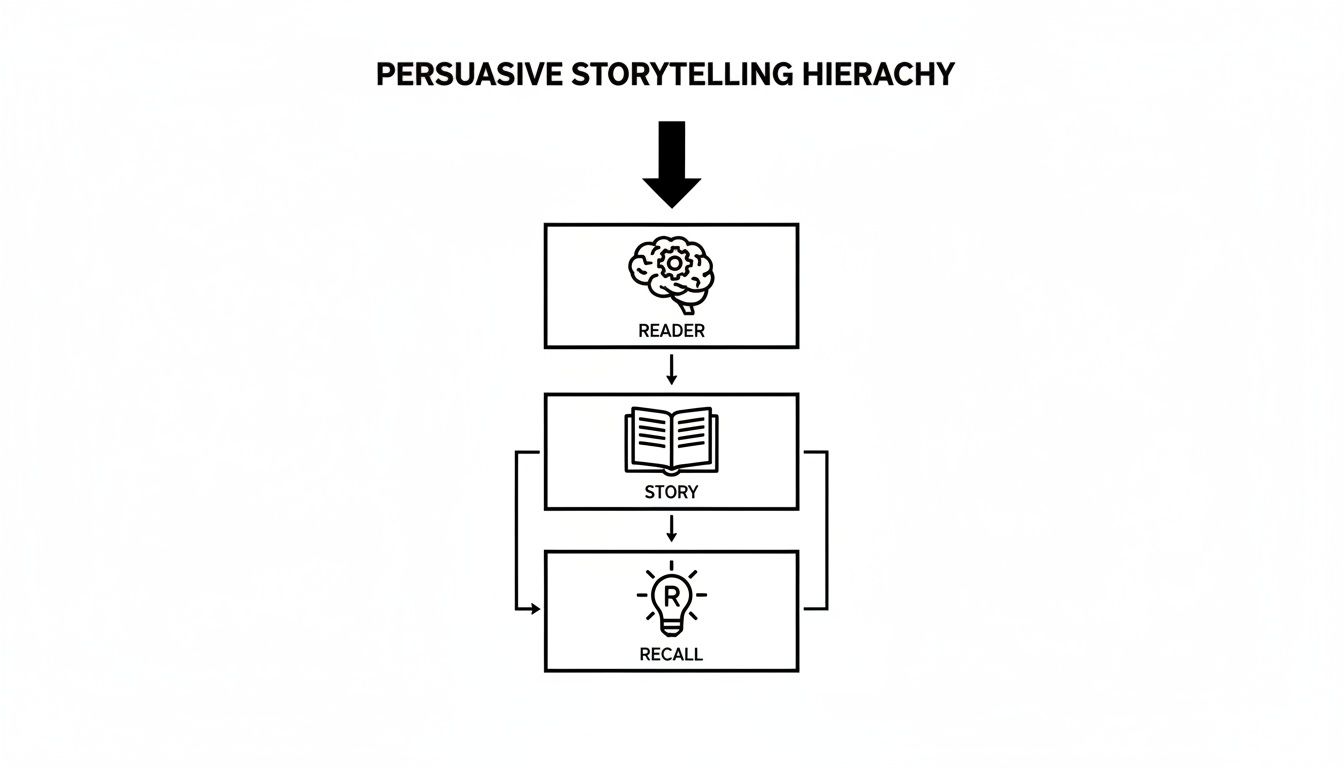
This hierarchy shows that a good story is what makes your message stick long after the reader has moved on. It’s what separates forgettable copy from persuasive copy.
So, how do you choose? It really comes down to your audience's state of mind. Are they unaware of the problem or solution? AIDA is your go-to. Do they already feel the pain and just need a push? PAS will drive them to action.
To give you a clearer picture, here’s a quick comparison of some of the most popular copywriting formulas out there.
Choosing Your Persuasive Writing Framework
| Framework | Best For | Core Strength |
|---|---|---|
| AIDA | Top-of-funnel content (ads, social posts, awareness blogs) | Grabs attention and builds desire from a cold start. |
| PAS | Bottom-of-funnel content (landing pages, sales emails, case studies) | Uses pain points to create urgency and motivate action. |
| 4 P's | Sales pages, product descriptions, email campaigns | Creates a vivid picture of the promise and proves it can be delivered. |
| FAB | Website copy, product feature lists, sales collateral | Clearly connects product features to real customer benefits. |
Each of these frameworks offers a powerful way to structure your message.
Mastering these formulas gives you a reliable method for structuring any piece of copy for maximum impact. A well-organized blog post outline template can help you bake these frameworks into your content right from the start. And don't forget that in today's world, sometimes the quickest way to grab attention and agitate a problem is with perfectly placed marketing memes—a modern twist on a classic technique.
Building Your Persuasive Writing Workflow
Turning persuasive theory into actual results isn't about stumbling upon a clever turn of phrase. It requires a repeatable system. An effective persuasive writing technique is the end result of a structured process, one that builds a bridge from your reader’s natural skepticism to a genuine belief in your message.
This workflow breaks down that creative process into a clear, step-by-step system you can use for any project. Think of it like building that bridge: a solid foundation of research and a strong blueprint ensure your reader arrives exactly where you want them to go, every single time.
Step 1: Define Your One Core Message
Before you write a single word, you need absolute clarity on your goal. What is the one single idea you need your reader to believe by the time they finish reading? Trying to convince them of five different things at once will only create confusion and weaken your impact.
Your core message needs to be distilled into one powerful sentence. For example, instead of something vague like, "Our software is good," a sharp core message would be, "This software eliminates the manual data entry that is killing your team's productivity." This level of focus becomes your north star, guiding every word you write.
Step 2: Profile Your Reader’s Emotional Triggers
With your core message locked in, it’s time to get inside your reader's head. Real persuasion happens on an emotional level long before logic ever shows up to justify it. You have to map out the emotional landscape your audience is living in.
To get there, you need to answer a few critical questions:
- What are their biggest frustrations or pain points related to this topic? Don't just stick to surface-level problems; dig into the real, day-to-day annoyances.
- What are their deepest aspirations or desires? What does that ideal "after" state look like for them?
- What are their hidden fears or objections? What skeptical thoughts will you need to disarm?
This emotional profile allows you to pick language and frame arguments that connect on a much deeper, personal level. Your message starts to feel less like a sales pitch and more like a genuine solution to their specific problem. Creating this kind of structured system is fundamental. To learn more, check out our guide on creating a workflow that delivers consistent results.
Step 3: Choose the Right Framework
Now you can pick your blueprint. Based on your core message and your reader’s emotional state, you can select the persuasive framework that best fits the situation.
Is your audience mostly unaware of the problem or your solution? Use AIDA (Attention-Interest-Desire-Action) to build awareness from the ground up.
Are they already feeling the pain of their problem and actively searching for a fix? Use PAS (Problem-Agitate-Solution) to validate their struggle and present your solution as the immediate relief they’ve been hoping for.
Choosing the right framework isn’t about forcing your message into a box. It’s about selecting the most effective path to guide your reader’s thought process from where they are now to where you want them to be.
Step 4: Weave in Narrative Elements and Power Words
With your structure in place, it’s time to bring it to life. This is where you infuse logic with emotion by telling a story. You can use the "Vulnerability-to-Victory" model to frame a customer's journey or share a simple, illustrative anecdote. Stories make abstract benefits feel real and relatable.
Next, sharpen your language. Swap out passive, generic words for active, emotionally charged power words. Instead of "good," try "effortless." Instead of "makes things better," use "eliminates frustration." These small shifts can dramatically boost the impact of your writing.
To make sure your writing process is efficient, tools can play a huge role. You can easily boost your workflow with an online Markdown editor for real-time previews and seamless content creation. This systematic approach ensures every single element of your content serves a persuasive purpose.
Testing and Optimizing Your Persuasive Content
Even the most perfectly crafted message is just a good guess until you test it. A truly powerful persuasive writing technique isn't just about the initial draft; it’s about refining your work with real-world data. This is where the art of writing meets the science of marketing, turning good copy into a high-performing asset.
The goal here is to get past the feel-good "vanity metrics" like page views or social media likes. Sure, they can be encouraging, but they don't tell you if your writing is actually getting people to do something. You need to focus on the numbers that directly impact your goals.
Key Metrics for Persuasive Writing
To measure real effectiveness, you have to zero in on the data points that show a clear cause-and-effect relationship between your words and your reader’s actions.
- Conversion Rate: This is the big one. What percentage of readers actually did the thing you asked them to do—sign up, buy the product, or download your guide?
- Click-Through Rate (CTR): For headlines, email subject lines, and calls-to-action, your CTR tells you how compelling that initial hook really is.
- Time on Page: A longer visit can be a great sign that your story and arguments are grabbing and holding your reader's attention.
- Heatmaps: These are fantastic visual tools. They show you exactly where people are clicking, moving their mouse, and scrolling, revealing which parts of your copy are catching their eye and which parts are getting skipped.
Tracking these numbers turns writing from a one-and-done task into a continuous cycle of improvement. For a deeper dive into these strategies, our guide to improving website conversion rates lays out more actionable steps.
A Simple A/B Testing Framework
You don't need a massive, complicated setup to start getting better results. A/B testing, sometimes called split testing, is a straightforward way to compare two versions of your copy and see which one performs better.
By systematically testing one variable at a time—a headline, a call-to-action, or a key benefit statement—you can gather clean, actionable data on what truly resonates with your audience. This iterative process is the fastest way to refine your persuasive writing.
Start by picking a single, high-impact element to test. For example, you could pit two different landing page headlines against each other: one that leads with a benefit versus one that creates a sense of urgency. Simply send 50% of your traffic to Version A and the other 50% to Version B. Once you have enough data, you can confidently declare a winner and make that version the new standard.
Got Questions About Persuasive Writing?
As you start using these strategies, a few questions are bound to pop up. Think of this section as a quick-reference guide to tackle the most common hurdles, helping you use every persuasive writing technique with confidence and integrity.
How Can I Be Persuasive Without Sounding Manipulative?
This is the most important question you can ask, and getting it right is everything. The line between persuasion and manipulation is drawn with your intent and empathy.
True persuasion is about creating genuine value. You're guiding someone to a solution that you truly believe solves their problem. Manipulation, on the other hand, is about pushing for a self-serving outcome, often by twisting facts or preying on emotions. To stay on the right side of that line, always lead with empathy. Make your reader the hero of the story.
The core of ethical persuasion is simple: if you genuinely believe your product or service will improve your customer's life, your writing will reflect that. Your goal is to guide, not to trick.
What Is the Best Persuasive Technique for Beginners?
It’s easy to get overwhelmed by all the different frameworks and psychological triggers out there. If you’re just starting, the single most effective place to begin is with the "Problem" and "Agitate" stages of the PAS (Problem-Agitate-Solution) framework.
Seriously, that's it. If you can master the art of deeply understanding and articulating your audience's core problem—using their exact language and reflecting their true frustrations—your message will instantly connect. This skill alone makes every other technique you learn later ten times more powerful because you’ve built a foundation of relevance and trust.
How Quickly Can I Improve My Persuasive Writing Skills?
Think of persuasive writing less like a class you take once and more like a muscle you build over time. Your improvement comes down to consistent practice, being willing to test your work, and learning from what works and what doesn't.
The good news? You can see real, noticeable improvements in your copy’s performance within weeks, not years. By focusing on one technique at a time—like nailing your headlines or strengthening your calls-to-action—you'll make steady, measurable progress. With dedicated effort, your ability to connect with and convert readers will grow faster than you think.
Ready to turn AI insights into persuasive content that ranks? Sight AI provides the data-driven content gaps and AI-powered writing tools to create high-performing articles without the heavy lifting. Start building your content engine today at https://www.trysight.ai.