
Calculating the ROI of content marketing can sometimes feel like trying to catch smoke with a net. It's a common headache for marketers because the real value of great content rarely fits neatly into a single cell on a spreadsheet. To truly get it, you have to look beyond the immediate numbers.
Let's reframe the problem.
Why Content Marketing ROI Is More Than Just Numbers
Imagine you have two ways to get your brand noticed. The first is renting a massive billboard on the busiest highway in town. It definitely works—thousands of people see it every day, and a good number might even stop by your store. But the second you stop paying that monthly rent, the billboard comes down. Poof. Your visibility is gone. That’s paid advertising in a nutshell: it’s temporary, transactional, and completely dependent on what you spend.
Now, think about the second option: planting a forest. It starts small, with just a few saplings that need a bit of patience and care. You won't see a huge, immediate impact. But given time, those saplings grow into towering trees, creating a rich, self-sustaining ecosystem. This forest starts attracting wildlife (your organic traffic), provides shelter (builds trust with your audience), and eventually becomes a permanent, valuable landmark that people seek out.
This is the very essence of content marketing.
Content is not an expense; it's a compounding business asset. Each article, video, or guide you publish is like planting a tree that can generate traffic, leads, and authority for years to come.
This long-term mindset is absolutely critical to understanding its true ROI. A direct sale is a clear win, of course, but the less tangible returns are often where the real magic happens.
These include things like:
- Enhanced Brand Equity: When you consistently publish helpful content, you become the go-to authority. Your brand becomes synonymous with trust and expertise in your industry.
- Audience Trust and Loyalty: Solving your audience's problems and answering their questions builds a genuine relationship. That's something a banner ad simply can't buy.
- Long-Term Organic Growth: An article you write today can climb the search engine rankings and stay there for years, pulling in qualified traffic and leads long after you’ve forgotten about the initial investment.
And the data tells the same story. Content marketing isn't just a feel-good strategy; it delivers hard results. A solid 41% of marketers report that it drives a better return than their paid advertising efforts. In fact, companies that maintain a blog generate 55% more website traffic and a staggering 67% more leads than companies that don't.
If you’re interested in digging deeper, you might want to read our article on why brand awareness is so important for sustainable growth. In this guide, we'll walk you through how to measure both the tangible and intangible returns, setting you up for success that lasts.
The Billboard vs The Forest: A Content Value Comparison
To really drive the point home, let's compare the short-term burst of paid ads with the long-term, compounding power of content.
| Attribute | Paid Advertising (The Billboard) | Content Marketing (The Forest) |
|---|---|---|
| Impact Timeline | Immediate but temporary | Gradual but long-lasting |
| Value Over Time | Depreciates; stops when you stop paying | Appreciates; value compounds over time |
| Audience Relationship | Transactional; based on interruption | Relational; built on trust and value |
| Cost Dependency | High; requires continuous investment | Upfront investment with decreasing cost-per-lead |
| Primary Goal | Direct response and immediate sales | Building authority and sustainable growth |
| Asset Type | Rented media space | Owned business asset |
This table makes it clear: while paid ads offer a quick fix, content marketing is about building something permanent and valuable for your business. It's a strategic investment, not just a line item expense.
The Practical Formulas for Measuring Content ROI
Alright, let's move from the high-level strategy down to the nitty-gritty of the spreadsheet. If we're going to prove the roi of content marketing, we need to get comfortable with the math. And don't worry, the core calculation is refreshingly simple. It gives you a clear percentage that tells the story of the value you've created.
Here’s the fundamental formula:
(Return - Investment) / Investment x 100 = Content Marketing ROI %
The formula itself is easy enough, right? The real work, the part that separates a fuzzy guess from a number you can confidently take to your CFO, is in how you define and tally up what goes into 'Return' and 'Investment.'
Defining Your Total Content Investment
Your investment isn't just what you paid a freelance writer. To get an honest ROI, you need a complete picture of your costs. Think of it like baking a cake—you have to account for every single ingredient, not just the flour.
Your total investment is a mix of a few key things:
- Content Creation Costs: This is the most obvious piece of the puzzle. It’s what you pay your freelance writers, designers, video producers, or the fees for your content agency.
- Software and Tools: Don't forget the subscriptions that make it all happen. This includes your SEO tools (like Ahrefs or SEMrush), analytics platforms, email marketing software, and any project management systems you rely on.
- Promotional Spend: Did you put money behind a social media post or run some ads for that new ebook? All of that ad spend is a direct part of your investment.
- Internal Team Time: This is the cost almost everyone misses. You need to calculate the hourly rate for your team members (factoring in salary and benefits) and multiply it by the time they pour into content strategy, writing, editing, and management.
When you track all these costs, the "Investment" part of your formula becomes a true reflection of the resources you've committed.
Quantifying Your Content Return
Now for the other side of the equation. Calculating the return is usually trickier because content creates value in so many different ways. It’s rarely a straight line from a single blog post to a big sale. To really nail this, you have to understand the different paths to revenue, including how to calculate conversion cost to maximize ROI.
Let's break down the main components that make up your return.
1. Direct Revenue from Conversions
This is the most straightforward return you can measure. Using your analytics and CRM, you can directly track when someone reads a piece of content and then makes a purchase. Simply set up conversion goals for actions like "demo requests" or "product purchases" that originate from specific content pages.
2. Monetary Value of New Leads
Not every conversion is an immediate sale, and that's okay. A lot of great content is designed to generate leads. To put a dollar value on these leads, you just need two key numbers:
- Lead-to-Customer Conversion Rate: Out of all the leads you get, what percentage actually become paying customers?
- Average Customer Lifetime Value (CLV): On average, how much total revenue does a single new customer bring in over their lifetime with your business?
With those figures, the formula is simple: (New Leads x Lead-to-Customer Conversion Rate) x Average CLV = Value of Leads
This is where you see how an initial investment in content can grow into a compounding business asset over the long haul.
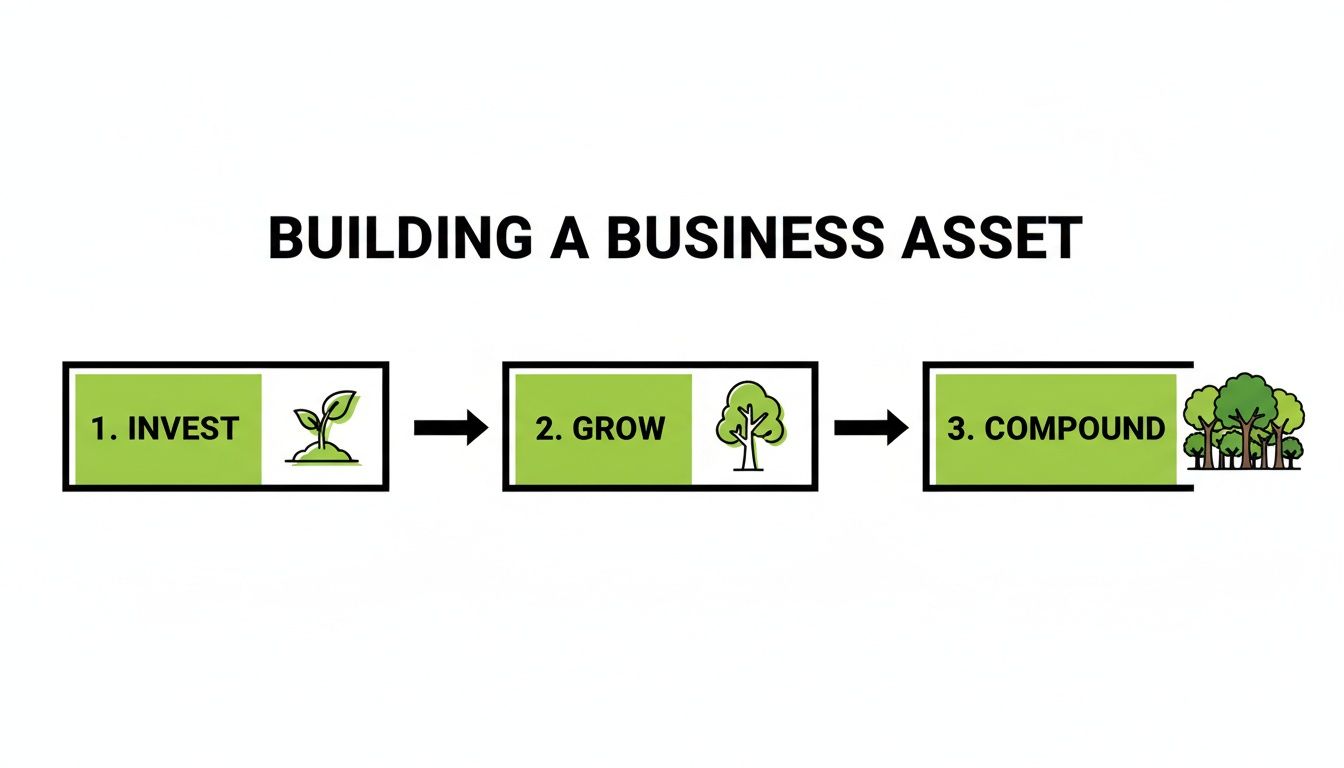
This graphic perfectly shows the journey: small, consistent investments (the seedling) lead to steady, reliable growth (the tree) and eventually create a powerful, self-sustaining asset that delivers returns you couldn't have imagined at the start.
3. SEO Value and Organic Traffic
The fact that your content can rank on Google and pull in traffic has real, tangible value. One of the best ways to quantify this is to figure out what that same traffic would have cost you if you’d paid for it with search ads (PPC). You can find the estimated cost-per-click (CPC) for your target keywords in any decent SEO tool.
Here's the formula: (Organic Clicks per Month x Keyword CPC) = Monthly SEO Value
By pulling together direct revenue, the value of your leads, and the SEO value of your organic traffic, you start to build a complete picture of your total return. This approach captures the full impact of your work, helping you make a case for content that even the most skeptical finance leader can get behind. To get even sharper with your numbers, it's worth exploring the key website metrics you should be tracking to feed into these calculations.
Choosing an Attribution Model That Tells the Full Story

You've tallied up your investment and can see the return. Great! But this is precisely where so many ROI calculations go wrong. Without the right context for how a customer converted, you risk giving credit to the wrong marketing efforts and completely misreading your own success.
That critical context comes from attribution modeling.
Think of a customer's journey as a road trip. Before they reached their destination (your product), they made several stops along the way—a blog post here, a webinar there. Attribution models are simply different ways of reading the map to decide which stops were the most important.
Was it the first scenic overlook they saw (an awareness blog post) that started the whole trip? Or was it the final, clear sign pointing to your exit (a PPC ad) that sealed the deal? The model you choose determines which touchpoints get credit for the sale.
Common Attribution Models Explained
Getting a handle on the most common models is the key to an accurate picture of your ROI of content marketing. Each one tells a slightly different story, and frankly, some are far more useful for content marketers than others.
Let's break down the main players.
First-Touch Attribution: This model gives 100% of the credit to the very first interaction a customer had with you. It’s fantastic for figuring out which content is best at sparking initial awareness and bringing new people into your orbit. The big downside? It completely ignores everything that happened afterward to actually nurture that lead.
Last-Touch Attribution: The polar opposite of first-touch, this model assigns 100% of the credit to the final touchpoint before conversion. It's the simplest to track and is often the default setting in analytics platforms. Its major flaw is that it overlooks all the blog posts and case studies that built trust along the way, often over-valuing bottom-funnel activities like branded search ads.
Linear Attribution: This model takes a more democratic approach, distributing credit equally across all touchpoints. If a customer read three blog posts and then clicked a demo link, each of those four interactions gets 25% of the credit. It’s a fairer model but can sometimes dilute the impact of the truly pivotal moments that really moved the needle.
Choosing an attribution model isn't just a technical decision; it's a strategic one. It defines what success looks like for your team and directly influences where you invest your budget and effort. A last-touch model will always make bottom-funnel content look like the hero, potentially leading you to underinvest in the top-funnel content that starts the entire conversation.
Selecting the Right Model for Your Business
So, which map should you use? The answer isn't one-size-fits-all. It depends entirely on your business model and how long your sales cycle is. The "best" option is simply the one that most accurately reflects how your customers actually behave.
For an e-commerce brand focused on quick, impulse buys, Last-Touch Attribution might be perfectly fine. The customer journey is short, and that final click often has the most direct influence. It’s clean, simple, and works well for high-volume, short-cycle sales.
However, a B2B SaaS company with a six-month sales cycle needs a much more nuanced view. The journey involves multiple decision-makers, tons of research, and dozens of touchpoints. Here, a Multi-Touch Model (like Linear or even more complex U-shaped or W-shaped models) is essential. These models give credit where it's due—to the initial awareness-building content, the mid-funnel educational pieces, and the final conversion drivers.
For a deeper dive into more advanced options, our guide on AI attribution tracking methods can shed more light on the topic.
Ultimately, by selecting a model that mirrors your customer's real journey, you can get a true picture of how your content influences revenue, from the first hello to the final handshake.
Focusing on Metrics That Actually Drive Business Growth
It’s dangerously easy to drown in a sea of data. You’ve got dashboards for days, showing everything from page views to social shares. It’s tempting to chase the numbers that look good on a chart, but many of them do absolutely nothing for the bottom line. If you want to actually measure the ROI of content marketing, you have to cut through that noise and zero in on the key performance indicators (KPIs) that really move the needle.
Think of it like flying a plane. The pilot doesn't need to know the wind speed on every square inch of the wing. They need to know their altitude, airspeed, and heading. Your content metrics should work the same way—guiding you toward your business destination, not just tracking every bit of turbulence along the way.
Traffic and Engagement Insights
The first layer of metrics tells you a simple story: are people finding your content, and are they sticking around? Raw traffic alone is a classic vanity metric, but it becomes powerful when you add context. The real goal here is to measure the quality of your audience, not just the quantity.
- Organic Traffic: This is the lifeblood of your content's long-term health and a direct report card on your SEO efforts. Keep a close eye on sessions coming from search engines in a tool like Google Analytics.
- Time on Page & Scroll Depth: These metrics tell you if people are actually reading what you wrote. A high time-on-page for a long-form article is a fantastic sign that your content is hitting the mark.
- New vs. Returning Users: You want a healthy mix here. New users mean your content is expanding your reach, while a strong base of returning users proves you're building a loyal community.
These foundational numbers are your first signal that people are showing up to the party.
Lead Generation and Conversion Metrics
This is where your content starts to feel real. An engaged audience is nice, but a successful content program has to eventually guide that audience to take a meaningful step. This is where you shift the conversation from eyeballs to potential revenue.
The KPIs in this category are the bridge connecting your content to the sales pipeline. They prove your content is more than just words on a screen—it's an engine for growth.
Key metrics to have on your dashboard include:
- Conversion Rate: What percentage of visitors are taking the action you want them to? This could be downloading an ebook, signing up for a webinar, or requesting a demo. We've got more tips on this in our guide to improving website conversion rates.
- Cost Per Lead (CPL): A simple but powerful calculation: divide your total content investment by the number of leads it generated. This tells you how efficient your content is compared to other channels, like paid ads.
- Marketing Qualified Leads (MQLs): This is all about lead quality. How many of the leads from your content are good enough to get passed over to the sales team? This metric separates the curious from the serious buyers.
Sales Outcomes and Revenue Impact
Ultimately, the most powerful way to prove content ROI is to tie it directly to dollars and cents. This requires getting your marketing analytics to talk to your Customer Relationship Management (CRM) system, whether that's HubSpot or Salesforce.
Once those systems are connected, you can follow a customer’s entire journey—from the very first blog post they read to the moment they sign a contract. This unlocks bottom-line metrics like customer acquisition cost (CAC) and customer lifetime value (CLV) that can be directly attributed back to your content.
New tech is also changing the game. AI is making a huge impact, with 70% of marketers who use it for personalization reporting returns over 200%. These strategies are boosting overall ROI by 68%. As you plan, keep an eye on what's working; short-form video is expected to be a major player in 2025-2026, but website and SEO content still holds the top spot. You can find more of these insights in recent content marketing statistics on seoprofy.com.
Brand Authority and Visibility
Finally, don’t ignore the metrics that are a little harder to pin down but just as important for long-term growth. Brand authority is a massive asset, and content is one of the best ways to build it.
- Keyword Rankings: Keep track of your position in search results for your most important keywords. When you see your rankings climb, it's a direct result of creating valuable content.
- Backlinks: The number of quality websites linking back to your articles is a huge vote of confidence. It tells search engines you're an authority worth listening to.
- Brand Mentions in AI Search: In the new era of AI-driven search, tracking how models like ChatGPT or Gemini talk about your brand is vital. Tools like Sight AI are designed to measure this new form of visibility, helping you understand your content's influence in emerging channels.
Learning from Real World ROI Benchmarks and Examples
Knowing the formulas for content marketing ROI is a great start, but how do your results actually stack up? Without real-world benchmarks, your numbers are just floating in a vacuum. Context is everything—it helps you set realistic goals and see what’s truly possible.
The return on your content investment isn’t a flat line. Think of it like a plant: its growth depends on the climate it's in. A tech company's content journey will look completely different from a healthcare provider's, and the value of that content will compound at a different rate.
When you look at ROI over a few years, the differences really pop. High-performing B2B campaigns, for example, can pull in an average of $984,000 a year. That adds up to $1.4 million in new revenue over three years, delivering an 856% ROI. The financial services world sees even wilder growth, starting at $0.6 million in year one and exploding to $2.3 million by year three for a massive 1,433% ROI. You can dig deeper into these industry-specific content ROI statistics at firstpagesage.com.
Content Marketing ROI Trajectory by Industry (3-Year Outlook)
The following table shows how content marketing ROI isn't just a one-time win; it's an investment that builds on itself. Notice how the returns often more than double from the first year to the third as content assets mature and gain authority.
| Industry | Average Year 1 ROI | Average Year 3 ROI |
|---|---|---|
| Financial Services | $0.6 million | $2.3 million |
| B2B Tech/SaaS | $0.5 million | $1.4 million |
| Healthcare | $0.4 million | $1.1 million |
| Manufacturing | $0.3 million | $0.9 million |
| Real Estate | $0.2 million | $0.7 million |
This compounding effect is why a long-term perspective is crucial. The initial investment lays the groundwork for exponential returns down the road, making patience a key ingredient for success.
A SaaS Company Content Case Study
Let's ground these numbers in a real-world scenario. Meet "InnovateTech," a B2B SaaS startup jumping into content marketing for the first time. Their goal is straightforward: drive more organic traffic and get more demo requests for their project management software.
They put $15,000 on the table for the first quarter, which covered:
- Freelance Writers: To produce eight deep-dive, SEO-focused blog posts.
- SEO Software: Subscriptions for keyword research and rank tracking.
- Internal Time: The marketing manager's salary for the time spent on strategy and edits.
After three months, the results were… okay. A small bump in traffic, a few keywords lingering on page three of Google, and only five demo requests they could trace back to the new blog posts. A quick ROI calculation would have looked pretty bleak, likely showing a loss.
But that's the thing about content—it's just getting started.
The Compounding Effect Over One Year
Now, let's fast forward nine more months. Those first eight articles have had time to marinate, climb the rankings, and build authority. Two of them are now sitting in the top three spots for high-intent keywords, and the rest are reliably bringing in traffic.
Here’s the picture after a full year:
- Organic Traffic: Skyrocketed by 400%, becoming their number one source of website visitors.
- Lead Generation: The blog is now consistently pulling in 30 qualified demo requests every single month.
- Brand Authority: Other industry blogs are now linking back to their content, supercharging their domain authority.
By focusing on evergreen content that genuinely solved customer problems, InnovateTech turned a small initial investment into a powerful, sustainable growth engine. The quarterly report didn't tell the whole story, but the annual review proved the incredible long-term ROI of content marketing.
This case study drives home a critical lesson: Content ROI is a lagging indicator of success. The value you create in Q1 often won't show up on a spreadsheet until Q3 or Q4. Patience and consistency aren't just virtues here—they're requirements.
Using Modern Tools to Automate and Amplify Your ROI

Calculating the ROI of content marketing shouldn't feel like a manual, backward-looking accounting exercise. The right tools can transform this process from a quarterly headache into a real-time, strategic advantage that actually guides your decisions. Platforms like Sight AI are designed to bridge the gap between theory and execution, connecting all the dots we've discussed.
Instead of wrestling with disconnected spreadsheets and analytics dashboards, these platforms centralize your data and surface the insights that matter. This is a huge shift. You move from simply measuring what happened last month to proactively optimizing for what will happen next, ensuring every dollar you invest is put to its best possible use.
Turning Insights into High-Return Content
One of the biggest drags on ROI is guesswork. Every piece of content you create based on a hunch is an expensive gamble. Modern platforms take the uncertainty out of the equation by analyzing performance data to pinpoint exactly what your audience is searching for.
Sight AI, for instance, helps you build that compounding "forest" of content we talked about by identifying high-impact opportunities. Its tools reveal the topics and questions where you can realistically win, making sure your "Investment" is always spent on content that will deliver long-term value.
This data-driven approach means you're no longer just creating content; you're engineering assets designed to perform from day one.
Modern tools automate the discovery of content gaps, turning a complex research process into a clear roadmap for what to publish next. This targeted approach is fundamental to maximizing the ROI of your content marketing efforts by focusing resources on guaranteed wins.
Measuring Visibility in New Search Environments
The definition of "Return" is getting bigger. As AI chat models like ChatGPT and Gemini become go-to sources for information, your brand's visibility within these platforms is a new, critical metric. But trying to track this manually is nearly impossible.
This is where specialized tools become essential. For example, Sight AI's visibility dashboard is designed specifically to monitor how these AI models talk about your brand. It keeps an eye on:
- Brand Mentions: Discovering when and how your company shows up in AI-generated answers.
- Source Citations: Identifying when your content is used as a credible source to back up AI responses.
- Sentiment Analysis: Understanding the context and tone of how your brand is being portrayed.
This adds a powerful, previously invisible layer to your ROI calculations.
From Creation to Amplification
Finally, a truly effective platform doesn't just give you insights—it helps you act on them. The final piece of the ROI puzzle is efficient execution. After you've identified a high-value topic, you still need to create and publish high-quality content at a scale that can compete.
Platforms like Sight AI streamline this entire workflow, from research and outlining to writing and publishing directly to your CMS. For teams looking to scale their efforts, an automated SEO platform can dramatically reduce the "Investment" side of the ROI equation by slashing manual work.
By automating the tedious parts of content creation and measurement, you free up your team to focus on pure strategy. This makes a tool like Sight AI essential for any marketer who's serious about proving and maximizing their content marketing ROI.
Common Questions About Content Marketing ROI
Even with a solid framework in place, some practical questions always pop up when it's time to actually measure the ROI of your content marketing. Let's walk through some of the most frequent hurdles to nail down these concepts and give you the confidence to put this guide into action.
How Long Does It Take to See a Positive ROI?
It’s the question every stakeholder asks. While you might see some quick wins, a significant, positive ROI from content marketing typically takes 6 to 12 months to really show up. Think of it like a financial investment—its value compounds over time, but it needs a runway first.
Those initial months are all about building a foundation. You're gaining traction in search rankings, building authority, and earning your audience's trust. The first things you'll notice are leading indicators, like a steady climb in organic traffic or better keyword rankings. True ROI, measured in actual leads and sales, usually becomes clear only after your content has had enough time to rank and attract a consistent flow of qualified visitors. Patience isn't just a virtue here; it's a requirement.
What Are the Biggest Mistakes to Avoid?
A few common missteps can derail even the most brilliant content strategies. Steering clear of these pitfalls is crucial if you want your ROI calculation to be accurate and meaningful.
The biggest error I see is forgetting that content ROI is a lagging indicator of success. The value you create in the first quarter often won't show up on a spreadsheet until the third or fourth. Judging its performance too early is a recipe for abandoning a strategy just as it's about to pay off.
Here are the top mistakes to watch out for:
- Relying on Last-Touch Attribution: This model is outdated. It completely ignores the crucial role top- and middle-funnel content plays in starting conversations and nurturing prospects along their journey.
- Forgetting Hidden Costs: It's easy to just count the invoice for a freelance writer, but what about employee time for editing and promotion? Or the subscription cost for your SEO tools? Failing to include these leads to an artificially inflated and misleading ROI figure.
- Ignoring Non-Financial Returns: If you only look at sales, you're missing a huge part of the picture. Overlooking the immense value of brand authority, improved domain rating, and audience trust means you aren't seeing the full return.
- Inconsistent Tracking: If you don't track metrics consistently over time, it's impossible to spot trends or truly appreciate the powerful compounding effect of your content efforts.
Can I Measure the ROI of a Single Blog Post?
Yes, you absolutely can, but it’s often more insightful to measure the ROI of a content cluster or a broader campaign.
To track a single post's ROI, you'd pit its specific investment (the time and money it took to create) against the direct return it generates. This could be leads from a unique call-to-action on that page or sales directly attributed to it. Another great way to look at it is to calculate its SEO value—figure out what you would have paid in PPC ads for the organic traffic it brings in every month.
But remember, content works as an ecosystem where one post supports another. Measuring the ROI of a strategic topic cluster frequently provides a more accurate and holistic view of your content’s true business impact.
Ready to stop guessing and start proving the value of your content? Sight AI provides a unified dashboard to monitor your brand's visibility across AI and search, surface high-value content opportunities, and automate production so you can scale your ROI. Discover how leading brands are driving measurable growth.