Think of any great piece of writing like a well-designed building. It has a solid foundation, clear pathways from room to room, and a memorable destination. That’s the real power of structure in writing—it’s the invisible architecture that turns a confusing maze of ideas into a clear, persuasive journey for your reader.
Why Structure in Writing Is Your Secret Weapon

Without a solid structure, even the most brilliant ideas can get lost in a sea of disorganized thoughts. It’s the framework that holds your content together, guiding your audience from one point to the next in a logical, almost intuitive way.
For writers, mastering structure is like a chef mastering knife skills. It’s a foundational element that elevates the final product from mediocre to masterful.
This guide isn’t about boring, academic rules. It’s about revealing how you can use structure as a strategic tool. We’ll dive into actionable frameworks you can apply to everything from essays to killer blog posts, ensuring your message not only gets heard but actually sticks.
The Blueprint for Reader Engagement
A well-structured piece does more than just present information; it creates a positive, effortless experience for the reader. With over 600 million blogs out there all competing for eyeballs, a clear and predictable flow is what keeps people from clicking away. It builds trust and makes your content feel authoritative.
This clarity is a win-win for both humans and search engines. A logical hierarchy of headings and ideas makes your content easier for Google to crawl and understand, which can seriously improve your rankings.
So, what are the core benefits here?
- Enhanced Clarity: It organizes your thoughts, making your arguments a breeze for readers to follow.
- Increased Persuasiveness: A logical progression of ideas builds a stronger case, making your message far more convincing.
- Improved Readability: Short paragraphs, headings, and lists break up text, making it less intimidating and easy to skim.
- Better Retention: When information is presented logically, readers are way more likely to remember your key points.
A well-structured blog leads the reader from one point to the next in a logical way that’s easy to follow and understand. It turns a monologue into a guided conversation.
Building Your Structural Foundation
Ultimately, the goal of structure in writing is to eliminate friction. You want to remove any obstacle that stops your reader from understanding and connecting with your core message.
Think of it as paving a smooth road for their thoughts to travel on. By the end of this guide, you’ll have a complete toolkit for building that road, no matter the topic or format.
The Unbreakable Foundation of Good Writing
Every single piece of powerful writing—from a quick email to a deep-dive report—stands on the same three pillars. Getting a handle on these components is the first real step toward creating content that’s clear, persuasive, and actually sticks with your reader.
Think of it like this: the introduction is your handshake. It's your one shot to hook them, set the scene, and lay out a clear map of where you're about to take them. This is where you promise your reader that their time will be well spent.
Then come the body paragraphs, which do all the heavy lifting. Each one should tackle a single, self-contained idea that backs up your main point. Sticking to this one-idea-per-paragraph rule is absolutely critical for keeping things clear and preventing your reader from getting lost.
The Three Pillars of Written Structure
To build an argument that holds up, you need to understand how these three parts work, both on their own and together. Each has a very specific job to do in guiding your reader through your thoughts without any friction.
The Introduction (The Hook): This is it—your first and only chance to grab someone's attention. It needs to state the purpose of the piece right away and give a quick preview of the main points you'll cover. It’s a mini-map for their journey.
The Body (The Evidence): Here's the heart of your content. This is where you lay out your arguments, back them up with evidence, and provide real examples. It needs to be organized logically, with each paragraph flowing naturally into the next to build a case that’s impossible to ignore.
The Conclusion (The Takeaway): Your conclusion is so much more than a simple summary. It’s your final opportunity to drive your main message home, tie all the threads together, and leave the reader with a powerful final thought or a clear call to action. Make it count.
A well-structured piece of writing doesn’t just present facts; it orchestrates them. It creates a seamless experience that feels intuitive to the reader, making complex ideas feel simple and accessible.
This isn’t just some dusty academic rule; it has massive real-world value. In fact, the global content-writing services market is projected to hit USD 35.63 billion by 2032, and a huge chunk of that comes from things as simple as product descriptions. This explosion shows just how much businesses rely on standardized structures to guide users and, ultimately, drive sales. You can dig into the numbers in this content writing market analysis.
Core Structural Components and Their Purpose
Let's quickly break down these pillars to see exactly what each one is responsible for. When you know the specific job of each component, you can craft content that feels polished, professional, and powerful.
| Component | Primary Function | Key Elements |
|---|---|---|
| Introduction | To engage the reader and set expectations | Hook, background context, thesis statement, or main purpose |
| Body | To develop the main argument with supporting details | Topic sentences, evidence, examples, analysis, and transitions |
| Conclusion | To summarize and provide a lasting impression | Restated thesis, summary of main points, final thought, or CTA |
Getting this basic framework down gives you the discipline to organize your thoughts clearly. It's a universal blueprint that works whether you're writing an email, a landing page, or a detailed article.
For writers focused on search performance, these principles are a core part of effective SEO copywriting best practices that help both people and search engines make sense of your content. When you build on this solid foundation, you make sure your message isn’t just heard—it’s understood and remembered.
Choosing The Right Blueprint For Your Content
Think of a writer's structure like a chef choosing the right knife. You wouldn't grab a massive cleaver for a delicate garnish, right? In the same way, you can't just slap a storytelling format onto a technical guide and expect it to work. The framework you pick is a strategic choice, one that completely shapes how your reader experiences your message.
A good structure is like a flowchart, guiding your reader seamlessly from your opening hook all the way to your final point.
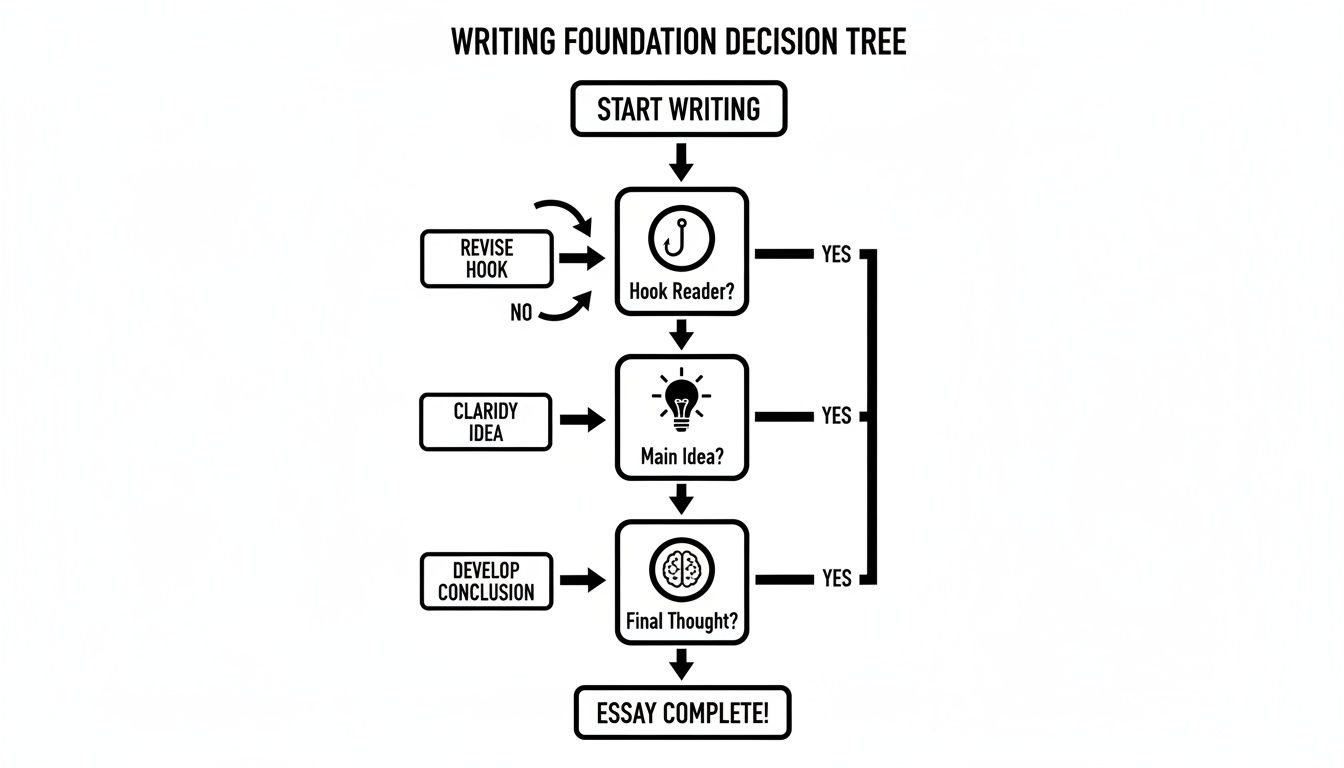
This visual captures the basic journey every piece of writing has to take. Let’s look at the specific blueprints you can use to make that journey a smooth one for your audience.
The Classic Five-Paragraph Essay
For most of us, this was the first formal structure we ever learned in school, and for good reason. It’s the absolute bedrock of clear, argumentative writing. The whole point is to introduce a thesis and then defend it with three solid, distinct points.
The logic is beautifully simple: an introduction lays out your big idea, three body paragraphs each tackle a single piece of supporting evidence, and the conclusion neatly ties it all together. This predictable rhythm makes it incredibly easy for readers to follow along.
Best for:
- Academic papers and school assignments
- Short persuasive or argumentative articles
- Opinion pieces where you need to build a straightforward case
It might feel a bit rigid, but its real power is in its clarity. Before you even start writing, crafting a powerful outline for research is a must, and this model gives you a perfect skeleton to build upon.
The Inverted Pyramid For Immediate Impact
In the hyper-fast world of online content, you have seconds—mere seconds—to grab someone's attention. The Inverted Pyramid was born in journalism to solve this exact problem. It essentially flips the classic essay on its head.
You lead with the most critical information right away: the who, what, when, where, and why. From there, each paragraph adds progressively less vital details, like background info and extra context. This front-loading means even the most dedicated skimmers will walk away with your main point.
This structure respects the reader's time. If they only read your first paragraph, they should walk away with the core message. Anything after that is a bonus.
This model is a cornerstone of modern digital communication and a key element in many successful blog writing and content strategies that put reader engagement first.
Persuasive Models That Drive Action
When your goal is to sell or persuade, your structure needs to do more than just inform. It has to connect emotionally and steer the reader toward a specific action. Two frameworks are absolute masters at this.
1. PAS (Problem-Agitate-Solve) This is a copywriting powerhouse.
- Problem: Start by hitting on a pain point your audience knows all too well.
- Agitate: Then, you poke the bruise. You explore the frustrations and consequences of that problem, making it feel urgent.
- Solve: Finally, you swoop in with your product or idea as the perfect solution.
2. AIDA (Attention-Interest-Desire-Action) AIDA is basically a classic marketing funnel in written form.
- Attention: Snag them with a bold headline or a shocking statistic.
- Interest: Keep them hooked with information that genuinely speaks to their needs.
- Desire: Make them want what you have by focusing on the incredible benefits and outcomes.
- Action: End with a crystal-clear, no-nonsense call to action (CTA).
Both of these are engineered to take a reader on a psychological journey, turning them from a passive browser into an active participant.
The Narrative Arc For Storytelling
At our core, humans are wired for stories. The narrative arc—often called the Hero's Journey—is the oldest and most potent structure for forging an emotional connection. And it’s not just for novels; it’s perfect for case studies, brand histories, and personal essays.
The basic flow looks like this:
- Exposition: Set the scene and introduce the main character (or your customer).
- Rising Action: Introduce a conflict or a major challenge they have to overcome.
- Climax: This is the turning point, where they face their biggest hurdle head-on.
- Falling Action: The immediate aftermath of that climactic moment.
- Resolution: The final outcome, showing the "new normal" and what was learned along the way.
By choosing the right blueprint—whether for clarity, urgency, persuasion, or connection—you take control of your message and create a purpose-built experience for your reader.
Comparison of Common Writing Structures
To make the choice even clearer, here's a quick comparison of the frameworks we've discussed. This table breaks down where each structure shines, helping you match the right blueprint to your writing goal.
| Framework Name | Best For | Core Strengths |
|---|---|---|
| Five-Paragraph Essay | Academic writing, simple arguments, and formal opinion pieces. | Unbeatable clarity, logical flow, and ease of following the argument. |
| Inverted Pyramid | News articles, blog posts, press releases, and any digital content. | Delivers the most important information first, ideal for skimmers. |
| PAS (Problem-Agitate-Solve) | Sales pages, email marketing, and persuasive ad copy. | Creates emotional urgency and positions the solution as a clear relief. |
| AIDA (Attention-Interest-Desire-Action) | Landing pages, marketing funnels, and calls to action. | Guides the reader through a psychological journey from awareness to action. |
| Narrative Arc | Storytelling, case studies, brand origin stories, and personal essays. | Builds a deep emotional connection and makes the content memorable. |
Ultimately, the best structure is the one that serves your reader and your message most effectively. Don't be afraid to experiment and even combine elements to see what works best for you.
Applying Structure in the Real World
Knowing the blueprints is one thing, but the real magic happens when you start building. The structural framework you choose isn't just a container for your words; it directly shapes how your message lands with your audience.
Whether you're writing a nail-tight academic argument, an engaging blog post, or persuasive ad copy, each format has its own set of rules and reader expectations. Let's shift from theory to practice and see how these principles work in different real-world scenarios. We'll look at tangible examples and practical checklists to help you build with confidence, no matter what you're writing.

Structuring an Airtight Academic Essay
In the academic world, clarity and logic are king. Your goal is to present a thesis and then back it up with such a solid chain of evidence that your reader has no choice but to follow your reasoning. The classic five-paragraph essay is the gold standard here for a reason—its rigidity is its greatest strength.
The introduction has three critical jobs: set the stage with context, state your thesis clearly, and briefly map out the points you'll use to prove it. Each body paragraph then becomes a mini-argument, dedicated to a single piece of evidence. This keeps your argument from getting muddy and ensures each point hits home with maximum impact.
Finally, the conclusion brings it all full circle. It restates the thesis, recaps your evidence, and leaves the reader with one last, powerful thought. This predictable, logical flow is what gives an academic argument its authority.
Academic Essay Structure Checklist:
- Introduction: Is the thesis statement crystal clear and does it preview the main points?
- Body Paragraphs: Does every paragraph tackle one single idea with its own supporting evidence?
- Transitions: Do your paragraphs flow smoothly from one to the next?
- Conclusion: Does it summarize the argument and restate the thesis without introducing new information?
Building a Blog Post for Readability and SEO
Blog posts play by a totally different set of rules. You're fighting for attention in a sea of content, and your readers are usually just skimming for fast answers. Here, structure in writing needs to be all about scannability and search engine optimization (SEO).
The Inverted Pyramid model is your best friend. Start with the most important stuff—the main takeaway—right at the top. This respects the reader's time and gives them value even if they only read the first few lines. Then, you can flesh out the details with examples and context.
Great blog post structure also leans heavily on visual organization.
- Short Paragraphs: Aim for 1-3 sentences max. This creates white space and makes reading on a phone much easier.
- Descriptive Headings (H2, H3): Break your content into logical chunks with headings. It helps skimmers find what they need and tells search engines what your article is about.
- Bulleted and Numbered Lists: These are perfect for breaking down complex ideas into bite-sized, digestible points.
- Bold Text: Use bolding to make key terms and takeaways pop, guiding the reader's eye to what matters most.
This approach creates a much better user experience, which keeps people on your page longer. If you really want to nail this, our guide on how to write a blog post for SEO offers a complete roadmap for creating content that ranks and resonates.
A well-structured blog post isn’t just easier for people to read; it's also a clear roadmap for search engine bots. That clarity is a direct line to better rankings.
Crafting Marketing Copy That Converts
When it comes to marketing copy on a landing page or in an ad, the structure has one job: get the user to take a specific action. You need a persuasive flow that taps into a reader's problem and positions your product as the only logical solution.
The PAS (Problem-Agitate-Solve) framework is dynamite for this. You start by identifying a pain point your reader is feeling. Think of a headline like, "Struggling to Keep Your Team Organized?"
Next, you agitate that problem. You poke the bruise. This is where you dive into the frustrations of missed deadlines and chaotic communication, making the issue feel urgent.
Finally, you sweep in with the solution—your product or service. You detail exactly how it solves the pain and offers relief. This structure takes the reader on a psychological journey from frustration to hope, making them far more likely to click that call-to-action button.
Marketing Copy Structure Checklist:
- Clear Pain Point: Does the headline instantly connect with a problem the reader has?
- Emotional Connection: Does the copy dig into the problem to create a sense of urgency?
- Strong Solution: Is your product presented as the clear, obvious answer?
- Single Call-to-Action (CTA): Is there just one clear, compelling action you want the user to take?
By consciously choosing the right structure for the job—whether it’s to argue, inform, or persuade—you elevate your writing from a simple collection of words into a powerful and effective communication tool.
How AI Is Changing the Way We Structure Content
Artificial intelligence is quickly becoming an indispensable partner for writers. It’s not here to replace us, but to act as a skilled collaborator. Think of AI as an architect's assistant—it can’t dream up the final design, but it can draft the initial blueprints in a fraction of the time, freeing you up to focus on the creative vision.
This modern workflow is a game-changer for getting past common hurdles like writer's block or just the sheer intimidation of a blank page. An AI writing assistant can instantly generate a logical outline, suggest a clear hierarchy of headings, and give you a solid foundation to build your ideas upon. This lets you pour your energy into what really matters: critical thinking, telling a great story, and infusing the piece with your unique voice.
The Rise of the Hybrid Workflow
The smartest way to work with these tools is what's known as a “human-in-the-loop” approach. You’re the strategist. You provide the core ideas and the nuanced arguments, while the AI does the heavy lifting of getting the initial organization on the page. This partnership doesn't just save time; it helps you build better, more thoughtful structures from the get-go.
This isn’t just a theory—it’s a trend we’re seeing take hold. Recent academic surveys show a major shift in writing habits. For essay support, AI-only use plummeted from 46% in 2023 to just 28% in 2025. Meanwhile, the use of combined AI and human services shot up from 24% to 44%. The data is clear: writers are increasingly using AI to sketch out the framework, then bringing in human expertise for the depth and polish.
AI is fantastic at generating a logical skeleton for your content. Your job is to add the heart, soul, and brain—the storytelling, empathy, and critical analysis that machines just can't replicate.
Practical Ways to Use AI for Structuring
Weaving AI into your process can make a huge difference in how efficiently you can structure a piece. Instead of battling a blank screen, you can start with a solid, machine-generated framework that you can then shape, refine, and elevate. It’s a workflow that respects your expertise while giving you back valuable time.
Here are a few practical ways to get started:
- Brainstorm Outlines: Got a topic? Feed it to an AI tool and ask for five different blog post outlines. You can then pick and choose the best ideas from each to create your own master structure.
- Generate Subheadings: If you have a main point but aren't sure how to break it down, ask the AI to suggest logical sub-topics. This is a great way to make sure your arguments flow well and you cover all your bases.
- Refine Flow and Transitions: Once you have a rough draft, paste it in and ask the AI to suggest smoother transitional phrases between paragraphs. This can instantly make your writing feel more connected and professional.
As search technology continues to evolve, understanding how AI is changing content creation is more important than ever. This is especially true when optimizing content for generative AI search, where clarity and authority are paramount. A well-organized piece isn't just easier for people to read; it's also more easily understood by the AI crawlers shaping the future of how we find information.
Common Structural Mistakes and How to Fix Them
Even the most brilliant idea can fall flat if its structure is weak. Think of it as serving a gourmet meal on a wobbly, mismatched table—the presentation ruins the entire experience. Spotting and fixing these common structural mistakes is a game-changing skill for any writer who wants their work to be clear, persuasive, and memorable.
Many writers unknowingly sabotage their own work with a few simple, recurring errors. These slip-ups disrupt the reader's journey, muddy the waters, and ultimately gut the core message of its power. The good news? Once you know what to look for, these issues are surprisingly easy to fix.
Getting this right isn't just about good writing; it's about real-world value. The global essay-writing service market is on track to hit USD 4.35 billion by 2032, and that growth is fueled by clients paying for documents that nail these structural fundamentals. That statistic alone shows how much proper structure impacts everything from grades to readability and success. You can see the full data by discovering more insights about the essay writing market.
Disorganized and Wandering Paragraphs
One of the most frequent offenders is the wandering paragraph. This is what happens when a single paragraph tries to juggle too many ideas at once, losing focus and leaving the reader completely disoriented. The fix is refreshingly simple: enforce the one idea per paragraph rule.
Every paragraph needs a single, clear purpose, usually announced by a strong topic sentence right at the start. Everything else in that paragraph—your evidence, examples, or analysis—must directly support that one point. If you feel yourself starting to drift toward a new topic, that’s your cue. It's time to hit "Enter" and start a fresh paragraph.
Weak or Missing Transitions
Another common problem is the "jump cut" effect, where your writing leaps from one idea to the next without any kind of logical bridge. It creates a jarring, disconnected experience for the reader. Your job is to guide them smoothly from point to point, not force them to jump across gaps in your logic.
To fix this, you need to become a master of transitional phrases. Think of them as signposts that clearly show the relationship between your ideas.
- To add information: Use words like additionally, furthermore, or in addition.
- To show contrast: Employ phrases like however, on the other hand, or conversely.
- To provide examples: Kick off sentences with for instance or for example.
Weaving these connectors into your writing creates a seamless flow that makes your arguments feel cohesive and far more professional. For a deeper dive into improving flow, check out our guide on essential SEO content writing tips.
Structure isn't about restricting creativity; it's about providing a clear path for it. A solid framework ensures your best ideas are seen, understood, and remembered by your audience.
By learning to spot and correct these fundamental mistakes, you can dramatically elevate the clarity and impact of your writing. It all comes down to being intentional about how you organize your thoughts, making sure every sentence and paragraph serves a clear purpose in guiding your reader to your final point.
Of course. Here is the rewritten section, designed to sound completely human-written and natural, following all the provided guidelines and matching the expert, approachable style of the examples.
Your Questions About Writing Structure, Answered
Even when you get the theory, putting it into practice brings up a whole new set of questions. Let's tackle some of the most common hurdles writers face when trying to give their work a solid backbone.
Can My Writing Be Too Structured?
Absolutely. It's a classic case of following the rules so closely you forget the point. This usually happens when a writer clings to a formula—like the classic five-paragraph essay—so rigidly that the writing feels stiff, predictable, and frankly, a bit robotic.
Think of structure as the invisible skeleton holding your work together. It provides shape and strength, but it shouldn't be a cage that traps your ideas. Your goal is to guide the reader along a clear path, not march them down a formulaic hallway.
A great structure should be felt but not seen. It guides the reader effortlessly from one point to the next without ever screaming, "Hey, look at me! I'm a framework!"
If your writing starts to sound like it was assembled from a kit, it's time to loosen up. Focus on making your transitions smoother and injecting more of your authentic voice. The framework is there to support you, not replace you.
How Do I Pick the Right Structure for My Piece?
This is simpler than it sounds. The perfect structure always flows from your primary goal. Before you even think about outlines, just ask yourself one question: What do I want my reader to do, think, or feel when they’re done reading?
That single answer is your compass. It will point you straight to the right framework:
- Want to teach or inform? Use the Inverted Pyramid to get the most important information out first. For tutorials, a simple chronological or sequential structure is your best bet.
- Need to persuade or sell something? This is where formulas like PAS (Problem-Agitate-Solve) or AIDA (Attention-Interest-Desire-Action) shine. They're designed to take your reader on an emotional journey that ends with a specific action.
- Trying to argue a point? The classic Five-Paragraph Essay structure gives you a logical blueprint for presenting a thesis and backing it up with evidence.
- Hoping to connect or entertain? A Narrative Arc is perfect for storytelling. Use it for case studies, personal anecdotes, or brand stories where building an emotional bond is key.
What's the Best Way to Build an Outline?
The most effective outlines don’t start with a million little details. They start with one big idea and grow from there.
First, nail down your core message or thesis statement. This is the single, overarching point your entire piece is built to support. Write it down.
Next, figure out the 3-5 main arguments or points you need to make to prove that core message. These become the major sections of your article or the body paragraphs of your essay.
Finally, you can start fleshing out each of those main points. This is where you add your supporting details—the data, the examples, the stories, the quotes. This tiered approach ensures everything you write is focused, logical, and powerfully aligned to deliver your message.
Ready to stop worrying about structure and start publishing content that ranks? IndexPilot uses trainable AI Agents to handle your entire SEO workflow, from keyword research and outlining to writing and publishing. Automate your content strategy and watch your traffic grow.


