
A low competition keyword is a search term that doesn't have a ton of websites fighting tooth and nail to rank for it. This simple fact makes it significantly easier for newer or smaller sites to actually show up on the first page of Google, pulling in targeted traffic without having to go head-to-head with the industry giants.
Why Low Competition Keywords Are Your Secret SEO Weapon
Forget trying to battle for those hyper-competitive, high-volume keywords. The big, established players already have those on lockdown. The smartest move you can make, especially if you're growing a business, is to zero in on the low-hanging fruit. Think of a low competition keyword as your strategic backdoor into the search landscape, letting you rack up some quick wins and build real momentum.
This isn't about aiming lower; it's about being tactical. When you target these less crowded search terms, you're not just getting traffic—you're getting a highly qualified audience. The person searching for "best ceramic non-stick pan without teflon" is way further down the buying path than someone just typing in "cooking pans." You're catching people who are much closer to making a decision.
Build Authority and Gain Traction
Every single piece of content you publish for a low competition keyword is like laying another brick in your website's foundation of authority. As you start ranking for these super-specific terms, Google takes notice. It begins to see your site as a credible voice in your niche.
This early success creates a snowball effect. Once Google trusts you on smaller topics, it's much easier to start ranking for more competitive keywords down the road. It's like building a reputation. You can't just declare yourself a champion on day one; you have to win the smaller games first. A deep, comprehensive guide on a specific, targeted topic is a cornerstone of an effective https://www.trysight.ai/blog/seo-keyword-strategy.
And this strategy is more accessible than you might think. A staggering 94.74% of all keywords get just 10 or fewer searches each month. That's a massive, untapped ocean of opportunity where you can completely sidestep the brutal competition and connect directly with your audience.
The goal is to become a big fish in a small pond. By dominating a series of smaller, related topics, you gradually expand your influence and establish yourself as an authority, making your site more powerful overall.
The Path to Quicker Rankings
The biggest win here is speed. While trying to rank for a massive, broad-head term could take years of constant effort and a colossal backlink profile, you can often see results for low competition keywords in a matter of weeks or months.
This gives you that crucial early momentum and proves your content strategy is working. By targeting these less competitive terms, you dramatically improve your odds of climbing the search results. For a bigger picture on how to secure top spots, you can check out these strategies to rank #1 on Google. Nailing these initial rankings gives you the confidence—and the data—you need to scale up your efforts.
How to Find High-Value Low Competition Keywords
Alright, time to roll up our sleeves and actually find these golden opportunities. Unearthing a great low-competition keyword is part art, part science. It’s a blend of creative thinking, using the right tools strategically, and having a real grasp on what your audience is actually looking for. The good news? There are repeatable systems you can follow to find these gems over and over again.
This whole process is about playing the long game. You start with quick wins, which build momentum and drive qualified traffic. Over time, this strategy helps you establish rock-solid topical authority in your niche.
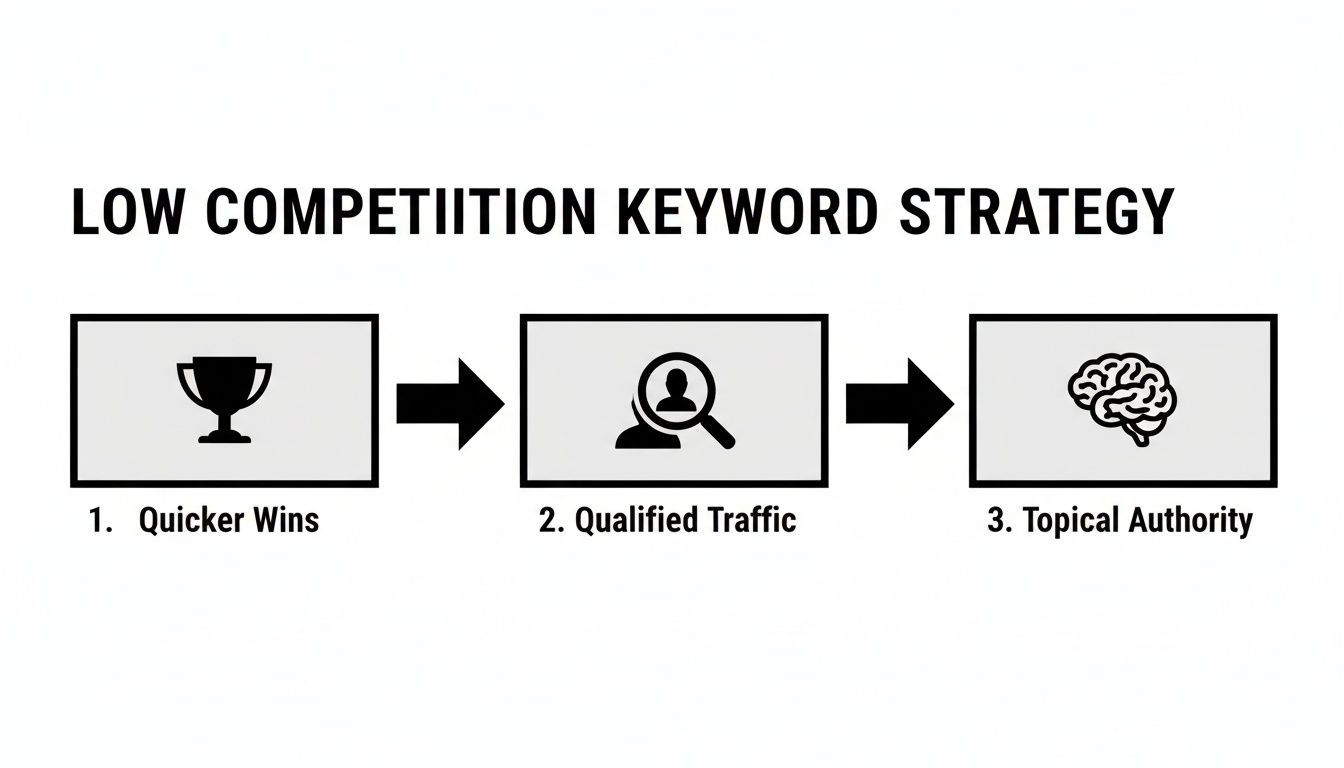
Think of it this way: targeting these terms isn't just a short-term play. It's a foundational strategy that builds on itself, leading to much bigger SEO gains down the road.
Tapping into Community Conversations
One of the most powerful—and weirdly overlooked—methods is to just listen to people talk. Online communities like Reddit, Quora, and niche-specific forums are treasure troves of raw, unfiltered customer language. People aren’t trying to optimize their questions for Google; they’re just asking for help and describing their problems in their own words.
Pay close attention to the thread titles and the exact phrasing people use in their posts.
- Look for phrases that kick off with "How do I..." or "What's the best..."
- Identify recurring problems or pain points that keep popping up in discussions.
- Jot down the specific product names, features, or jargon they use.
These conversations are a direct line into user intent. A keyword like "is [software] good for remote team collaboration" is a massive signal that someone is deep in the consideration phase, making it an incredibly high-value term to target.
Leveraging Google's Own Clues
You don't always need fancy tools, because Google itself leaves a trail of breadcrumbs. The "People Also Ask" (PAA) boxes and the "Related Searches" section at the bottom of the results are direct hints from the mothership about what users are looking for next.
Next time you search for a broad topic in your industry, click on a few of those PAA questions. You'll see the list expand, revealing even more related queries. A lot of these long-tail questions are perfect candidates for a low-competition strategy because they represent super-specific user needs.
Don't just glance at these suggestions—actively explore them. Each one represents a potential content idea that Google has already validated as being relevant to a user's search journey.
Similarly, use Google's autocomplete feature like a pro. Start typing a "seed" keyword and see what suggestions pop up. Then, try adding modifiers like "for small business," "without," "alternative," or "vs" to uncover more specific, long-tail variations that almost always have lower competition.
Analyzing Competitor Content Gaps
Your competitors have already done some of the legwork for you. By digging into their content, you can find the keywords they're already ranking for and, more importantly, the ones they've completely missed. Using a good SEO tool, just plug in a competitor's domain and get a list of their top-ranking organic keywords.
The trick is to filter this list to find terms with a low Keyword Difficulty (KD) score—ideally under 30. This metric gives you a quick snapshot of how tough it will be to crack the first page.
Beyond just copying their successes, look for their weaknesses. Is there a topic they only skimmed the surface of? Could you create a far more in-depth, genuinely helpful resource on a keyword they rank for but don't truly own? This is how you strategically siphon traffic from the bigger players. You can go much deeper on this entire process in our guide on keyword research for organic SEO.
Once you've got a list of potential keywords, you need to make sure they're worth your time. The table below is a quick checklist I run through to qualify any new keyword before committing resources.
Low Competition Keyword Qualification Checklist
This simple checklist helps you quickly evaluate whether a keyword is a genuine opportunity or a potential waste of time.
| Metric/Factor | Ideal Threshold | Why It Matters |
|---|---|---|
| Keyword Difficulty (KD) | Under 30 | A lower score means you have a realistic shot at ranking without a massive backlink profile. |
| Search Volume | 50-1,000+ monthly | Ensures there's enough existing demand to make your content creation efforts worthwhile. |
| Search Intent | Informational or Commercial | The keyword should align with your business goals—either educating prospects or driving sales. |
| SERP Quality | Weak, outdated, or thin content | If the top results are low-quality (e.g., forum posts, thin articles), you can easily create something better. |
| Business Relevance | High | The topic must directly relate to the products or services your business offers. |
Running your list through these filters helps separate the wheat from the chaff, ensuring your efforts are focused on terms that will actually move the needle for your business. It's this validation step that separates a decent strategy from a great one and confirms you're hitting all the right keywords for your content.
Validating and Prioritizing Your Keyword List
So, you've got a big list of potential keywords. That's a great start, but it's really just raw material. The real work starts now: turning that list into a strategic roadmap by figuring out which terms are actually worth your time.
This is where you stop being a data collector and start being a detective. It involves rolling up your sleeves and manually inspecting the Search Engine Results Pages (SERPs) like a seasoned pro. You’re hunting for signs of weakness, gaps you can exploit, and solid proof that a given low competition keyword is a genuine opportunity.
Manually Vet the SERP Landscape
SEO tool metrics are a good starting point, but they never tell the full story. The only way to truly understand the competitive landscape is to dive in and look at it yourself. For every promising keyword on your list, open an incognito window, run a search, and critically analyze the top 10 results.
What you're really looking for are vulnerabilities. Keep an eye out for these signals:
- Low Domain Authority (DA) Sites: Is the first page filled with sites that have a DA under 40 or 50? This is a massive green light. It tells you Google is willing to rank pages that don't have a fortress of backlinks.
- Outdated Content: Look at the publication dates. If the top-ranking articles are from two, three, or even five years ago, you have a golden opportunity to swoop in with something fresh and up-to-date.
- Thin or Low-Quality Content: Do the top articles feel a bit shallow? If you're seeing posts with low word counts, clunky formatting, or a clear lack of depth, you can easily create something far more valuable.
- User-Generated Content: Are forum posts from places like Reddit and Quora, or other Q&A sites, ranking on page one? This is one of the strongest indicators that there's a serious lack of authoritative, dedicated content on the topic.
This manual check is what separates a keyword that looks low-competition in a spreadsheet from one that's genuinely vulnerable to a new, high-quality article. Getting comfortable with the nuances of the live search results is a core part of working with rank data for SEO effectively.
Align Keywords with Business Goals
Not all traffic is created equal. A keyword might have decent search volume and look easy to rank for, but if it doesn't attract the right audience—people who might actually buy from you—it's a complete waste of effort. Prioritization is all about balancing the SEO opportunity with real-world business relevance.
To do this, I recommend setting up a simple scoring framework in a spreadsheet. It doesn't need to be some complex, multi-tab monster; a basic system is usually all you need.
The best keyword strategy isn't just about finding easy wins; it's about finding the right easy wins. Every piece of content should serve a clear purpose, whether that's attracting new leads, educating existing customers, or supporting a product launch.
Your scoring model should weigh three simple factors to generate a final "Priority Score."
- Relevance Score (1-5): How closely does this keyword align with your product or service? A 5 means it directly addresses a pain point your solution solves. A 1 means it’s only loosely related.
- Difficulty Score (1-5): Based on your manual SERP review, how hard will it actually be to rank? A 5 means the SERP is full of weak competitors and outdated content. A 1 indicates strong, established sites dominate the page.
- Volume Score (1-5): What’s the potential traffic payoff? A 5 represents the higher end of your volume threshold (e.g., 800-1,000 searches/month), while a 1 is for lower-volume but still valuable terms (e.g., 50-100 searches/month).
Just add those three scores together. This gives you a simple, effective priority number for each low competition keyword. Sort your list by this final score, and you’ll have a clear, data-informed plan of attack, ensuring you invest your valuable time and resources on the terms most likely to move the needle.
Creating Content That Dominates Low Competition SERPs
Alright, you've done the hard work of finding, validating, and prioritizing your keywords. Now for the fun part: actually creating the content that's going to rank. This is where you move from spreadsheets and data to building the asset that will pull in traffic.
When you're targeting a low competition keyword, the goal isn't just to write an article. It's to create the undisputed, go-to resource for that specific query. You want to build something so comprehensive and genuinely helpful that Google has no choice but to put you at the top. The aim is to satisfy user intent so completely that the reader never thinks about hitting the back button.

Architecting a Winning Content Brief
Before a single word gets written, you need a blueprint. A detailed content brief is easily the most critical document in this whole process. It’s what keeps your writer—even if that’s you—laser-focused on the specific goals for the article, ensuring every sentence has a purpose.
A solid brief is more than just a keyword and a word count; it's a strategic document that lays out exactly how you plan to win that SERP.
I never start a piece of content without a brief that includes these core components:
- Primary Keyword: The main low-competition term we're after.
- Secondary Keywords: A tight list of 3-5 related terms and LSI keywords to weave in naturally.
- Target Word Count: This isn't a guess. I base it on the average length of the top 5 ranking articles.
- Search Intent: What is the user really looking for? Is it a how-to guide, a comparison, or just raw information?
- Key Topics to Cover: This is a non-negotiable list of subheadings and questions the article absolutely must answer to be complete.
This simple structure removes all the guesswork. It turns content creation from a purely creative exercise into a strategic, repeatable process.
A well-crafted content brief is your insurance policy against thin, unfocused content. It ensures your final article is a direct answer to the user's query, not just a collection of loosely related ideas.
Answering Every Conceivable Question
To truly own a low-competition SERP, you have to get inside the searcher's head and anticipate their next move. Your content needs to be so thorough that it answers follow-up questions they haven't even thought to ask yet.
A great place to find these questions is right back on the SERP. Look at the "People Also Ask" boxes and scroll down to the "Related Searches." Google is literally handing you a list of the user's broader journey.
Incorporate these questions directly into your content as H2 or H3 subheadings. For example, if your keyword is "best silent mechanical keyboard," your content absolutely should address topics like:
- What makes a keyboard "silent"?
- Are silent switches good for gaming?
- How to make a mechanical keyboard even quieter.
This approach does two things: it builds serious topical authority, and it signals to Google that your page is a one-stop-shop. It's also becoming critical for visibility in new search formats. In fact, over 68% of terms that trigger AI Overviews have 100 or fewer monthly searches, putting them squarely in low-competition territory. This insight comes from a great analysis by the team at Elementor.
Leveraging AI for Research and Outlining
Let's be real: creating deeply comprehensive content takes time. This is where AI tools can be a massive help, dramatically speeding up the research and outlining phase without gutting the quality. The key is to use them as a research assistant, not a ghostwriter.
For instance, you can feed an AI tool the top 10 ranking URLs for your keyword and ask it to generate a "content gap analysis." It can quickly flag common themes, unique angles, and crucial topics your competitors completely missed.
Here’s a practical workflow I use all the time:
- Generate a Topic Cluster: I'll ask the AI to brainstorm a list of related sub-topics and questions around my primary keyword.
- Create a Structural Outline: I give the AI my list of topics and have it organize them into a logical flow with H2s and H3s. This is a huge time-saver.
- Summarize Key Research: I can drop in links to dense, high-authority articles or studies and ask for bullet-point summaries of the key findings.
This hybrid approach gives you the best of both worlds—the raw speed of AI combined with your human expertise and critical thinking. You can build a robust, data-backed outline in a fraction of the time, which frees you up to focus on what really matters: writing brilliant, engaging prose.
If you want to go deeper on this, we've put together a full guide on how to write SEO-friendly blog posts. Following this method ensures your content for any low competition keyword is not only well-structured but also deeply informative and built to win from day one.
Amplifying Your Content with Smart Linking Strategies

Getting a piece of content published is a huge step, but the real work begins after you hit publish. A strategic promotional push is what gets your article a seat at the winner's table. And while a low competition keyword requires far less off-page muscle than a high-volume term, a smart linking strategy can lock in your top rankings and get you there much faster.
This isn't about launching some massive, time-sucking backlink campaign. It’s about being precise. You want to focus on a handful of high-impact activities that signal authority to Google without draining all your resources. The right links—both from your own site and others—act as powerful votes of confidence for your content.
Weaving a Powerful Internal Linking Web
Your own website is probably your most overlooked promotional asset. A strong internal linking structure does way more than just help users find their way around; it builds a web of context that screams to Google which of your pages are the most important.
So, the moment you publish a new article targeting a low competition keyword, your first move should be to link to it from other relevant, high-ranking pages on your own site. This is a direct way to pass authority from your established content to your new piece, giving it an immediate boost.
- Pillar Pages: Pinpoint your core, high-traffic "pillar" articles. Find a few natural opportunities to link from these heavy-hitters to your new, more specific post.
- Topical Clusters: Start thinking about your content in clusters. If you just published an article on "silent mechanical keyboards," it should absolutely be linked from broader posts like "best keyboards for work" or "home office setup ideas."
This process is how you build powerful topical authority. It shows search engines that you have deep expertise on a subject, not just one random article. Running a quick internal linking audit every now and then can uncover a goldmine of high-value opportunities you might have missed.
Clever Outreach That Actually Works
When you're running a lean team, you can't afford to spend weeks begging for backlinks. The key is to focus on low-effort, high-return methods that leverage your expertise. Forget the generic cold outreach emails and give these tactics a try instead.
One of the best approaches is contributing to expert roundups. These are articles where a publisher gathers quotes from several industry professionals on a single topic. You can find them with simple Google searches for phrases like "expert roundup" + [your industry] or "expert tips" + [your topic].
When you contribute a genuinely valuable quote, you almost always get a backlink to your site or social profile in return. It’s a simple, symbiotic relationship that positions you as an authority and builds quality links at the same time.
Don't just chase links; chase opportunities to be genuinely helpful. Answering a question on HARO or contributing to a roundup provides real value, and the link becomes a natural byproduct of that value exchange.
Another fantastic source is HARO (Help a Reporter Out). This free service sends you daily emails with queries from journalists and bloggers looking for expert sources. Skim the emails for relevant requests, shoot back a concise and insightful response, and you can land mentions and links in major publications.
Repurpose Your Content to Attract Natural Links
Your blog post is just the starting line. The core ideas and research within it can be atomized and repurposed across different platforms. This creates multiple new avenues for discovery and, more importantly, natural link acquisition. This strategy maximizes the return on every ounce of effort you put into the original content.
Start thinking about how you can transform your article into other formats:
- LinkedIn Article: Post a slightly tweaked version of your article or a key section of it directly on LinkedIn. The platform has high domain authority and is great for driving both traffic and brand visibility.
- Infographic: Turn key statistics or a step-by-step process from your post into a simple, shareable infographic. Visual assets are incredibly linkable and often get picked up by other bloggers.
- Twitter Thread: Break down the main arguments of your article into a compelling Twitter thread. A thread that gains traction can attract serious attention from journalists and other content creators in your space.
Each piece of repurposed content acts as a new "hook" in the water, multiplying the chances that someone will discover your work and link back to the original, more comprehensive article on your site. This kind of smart amplification makes every low competition keyword you target work that much harder for you.
Answering Your Questions About Low Competition Keywords
Even with a solid game plan, you might still have a few lingering questions. It's natural. Chasing after keywords with less traffic can feel a bit backward at first, especially when the whole industry seems obsessed with massive search volume.
Let's clear up some of the most common points of confusion. Think of this as a quick cheat sheet to sharpen your strategy and get past any hurdles you hit during your keyword research.
What Is a Good Search Volume for Low Competition Keywords?
There's no single magic number here. "Good" volume is completely relative to your industry, your niche, and what a new customer is actually worth to you. That said, a solid starting range for most businesses is between 50 and 1,000 monthly searches.
For a specialized B2B software company, a keyword with just 70 highly targeted monthly searches could be pure gold. Those searchers might be exactly the decision-makers you need. But for a broader consumer blog, aiming for terms in the 300-800 range is probably a better use of your time. The trick is to find the sweet spot between search demand and genuine business relevance.
The real power of a low-competition keyword isn't the volume—it's the intent. A keyword with 50 searches from people ready to buy is infinitely more valuable than one with 5,000 searches from people just browsing.
How Long Does It Take to Rank for These Keywords?
This is where the strategy really shines: speed. While big, competitive head terms can take a year or more to even crack the top 20, you can often see real movement for low-competition keywords in just a few weeks to a couple of months.
Of course, a few things will influence that timeline:
- Your Site's Authority: An established website with some domain authority will naturally climb the ladder faster than a brand-new one.
- Content Quality: If you publish a truly exceptional, comprehensive resource that blows the current top results out of the water, Google will take notice quickly.
- SERP Weakness: The weaker the competition (think outdated articles, forum posts, or thin content), the faster you can swoop in and take a top spot.
The whole point is to build momentum. Nailing these quicker wins proves your strategy is working and builds the authority you need to eventually go after those bigger, more challenging keywords.
Are Low Competition Keywords the Same as Long-Tail Keywords?
Not exactly, but they are very close cousins. There's a massive overlap between the two concepts, but they describe different things.
Here's the easiest way to think about it:
- Long-Tail Keyword: This describes the length of the phrase, usually three or more words. Think "how to clean white leather sneakers."
- Low Competition Keyword: This describes the difficulty of ranking for the term, no matter how long or short it is.
The vast majority of long-tail keywords are naturally low-competition simply because they're so specific. But you can sometimes find shorter, two-word phrases that are surprisingly low-competition, especially in very specific industries. In practice, when you go hunting for low-competition terms, you’ll end up finding a ton of high-value long-tail keywords.
How Do I Know If a Keyword Is Truly Low Competition?
Metrics from SEO tools are a fantastic starting point, but they never paint the full picture. The only way to be 100% certain is to do a manual SERP analysis. You have to actually look at the search results with your own eyes.
Before you commit to writing a single word, pull up the search results and look for these telltale signs of weakness on the first page:
- Multiple sites with low Domain Authority (DA/DR under 40).
- Content that is obviously outdated (published years ago).
- Forum posts (like Quora or Reddit) or other user-generated content in the top spots.
- Thin articles that barely scratch the surface of the topic.
If you spot two or more of these signals, you've almost certainly found a keyword that's ripe for the picking.
At Sight AI, we turn these keyword opportunities into tangible results. Our platform helps you uncover high-value content gaps and then uses specialized AI agents to create comprehensive, SEO-optimized articles that are built to rank. Stop guessing and start dominating your niche. Discover how Sight AI can automate your content creation and drive measurable growth at https://www.trysight.ai.