Writing an SEO-friendly blog post isn't just about stuffing in keywords. It’s about creating something that satisfies both the people reading it and the search engine algorithms that find it. This means diving deep into strategic keyword research, building a clear content structure, and nailing every detail of on-page optimization to earn visibility and drive real, organic traffic.
A Blueprint for High-Ranking Content
Let’s skip the guesswork and get straight to a proven workflow for creating blog posts that Google and your readers will love. This is where your ideas start turning into content that actually ranks. We'll kick things off with the absolute foundation of any solid SEO strategy: figuring out what your audience is really searching for.
Think of this guide as the roadmap that connects every step, from uncovering what your audience wants to know all the way through to promoting your finished piece. It’s the high-level view that ties everything together, ensuring every move you make is a deliberate step toward better rankings.
The Core Pillars of SEO Content Creation
To write blog posts that consistently rank, you need a repeatable system. It’s less about some stroke of creative genius and more about a strategic process that covers all the important bases. The journey from a simple idea to a top-ranking article requires a plan—one that anticipates what both search engines and human readers need to see.
A solid workflow makes sure nothing important gets missed. It directly connects your initial research to the final, fully-optimized article, making the whole process more efficient and effective. This systematic approach is what separates randomly ranking for a few keywords from building sustainable, long-term organic growth. You can dive deeper into this process by checking out our guide on developing an SEO content strategy.
The visual below breaks down our simple, 4-stage process for creating an SEO-friendly blog post.
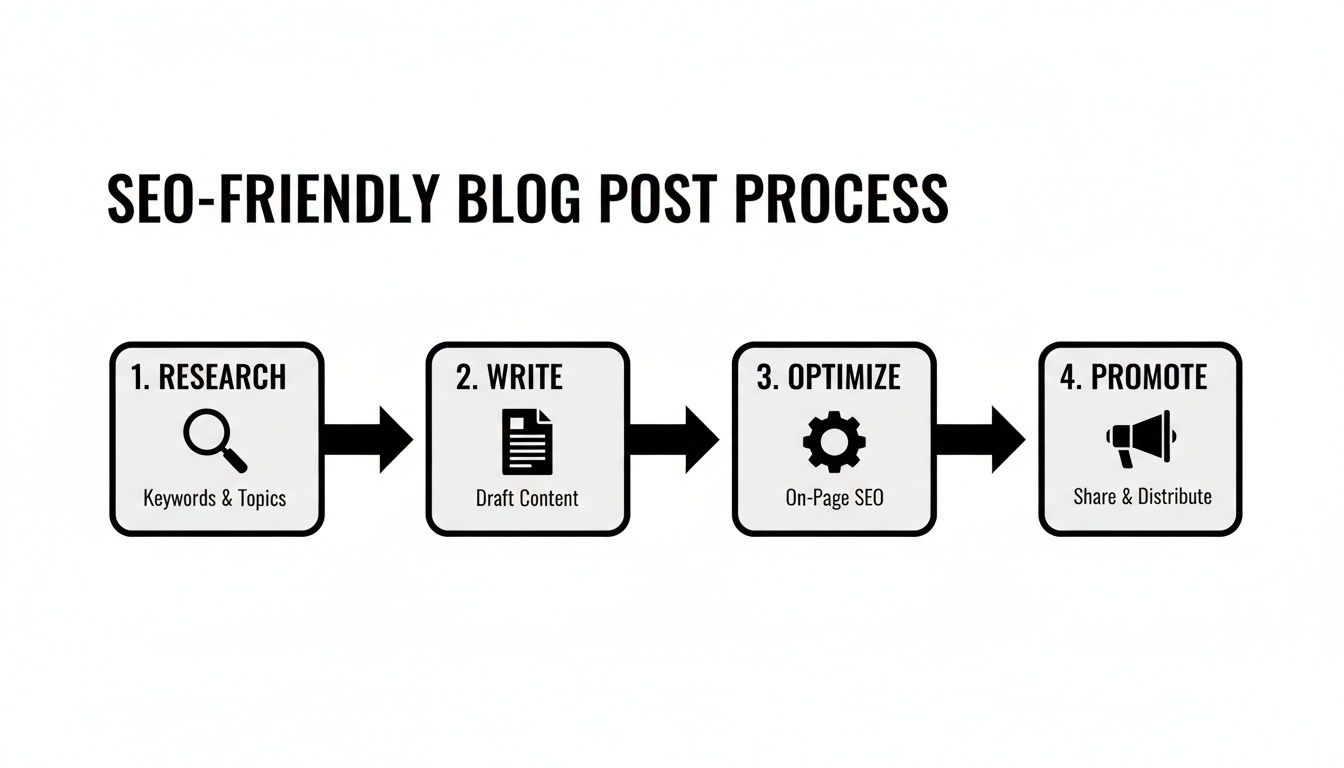
The key takeaway here is that writing is just one piece of a much larger puzzle. The research you do before you write and the optimization you handle after are just as critical to your success.
Why This Workflow Matters
Following a structured process takes the ambiguity out of content creation and gives you the confidence to produce high-quality work every single time. It keeps you focused on the activities that actually move the needle instead of getting bogged down in minor details. A solid blueprint is the key to scaling your content efforts and seeing predictable results.
Before we dive into the specific steps, let's quickly review the core elements that make a blog post truly "SEO-friendly."
Core Components of an SEO-Friendly Blog Post
This table provides a quick-glance summary of the essential elements that every optimized blog post should have.
| Component | Why It Matters for SEO | Best Practice |
|---|---|---|
| Keyword Strategy | Targets what users are actively searching for, connecting your content to audience intent. | Focus on a primary keyword and a handful of related secondary keywords. |
| High-Quality Content | Satisfies user intent, which Google rewards with higher rankings. | Write comprehensive, well-researched content that fully answers the user's query. |
| Title Tag | The most critical on-page element for telling search engines what your page is about. | Include your primary keyword near the beginning and keep it under 60 characters. |
| Meta Description | Influences click-through rate from search results, even if it's not a direct ranking factor. | Write a compelling summary (~155 characters) that includes your keyword. |
| Headings (H1, H2, H3) | Creates a clear structure for both readers and search engine crawlers. | Use your H1 for the title and H2s/H3s for subtopics, including keyword variations. |
| Internal Links | Helps Google understand your site structure and passes authority between pages. | Link to at least 2-3 relevant pages on your own website. |
| Image Optimization | Improves page speed and provides another opportunity for keyword relevance via alt text. | Compress images and use descriptive, keyword-rich alt text. |
Mastering these components is the first step toward creating content that performs. Each one plays a role in signaling relevance and quality to search engines.
Mastering Keyword Research and Content Planning
Amazing, SEO-friendly blog posts aren't born from creative genius alone. They're built on a solid foundation of smart research. Before you even think about writing, you have to get inside your audience's head. What are they searching for? Why are they searching for it? What kind of content will actually solve their problem?
This planning stage is where the battle for rankings is truly won or lost.

Forget just picking one main keyword. The real goal is to create a "keyword cloud" that surrounds your topic. This includes your primary keyword, of course, but also long-tail variations, related questions, and all the semantically similar phrases that show you've covered a topic from every angle. This is a massive quality signal to search engines.
Decoding Search Intent
If you only take one thing away from this section, let it be this: you must understand search intent. It’s the "why" behind every single search query. Get this wrong, and I can almost guarantee your post will never see the light of day on page one, no matter how beautifully written it is.
Think about it. Someone searching for "best running shoes for flat feet" is in shopping mode. They have commercial intent and are looking for reviews and comparisons. But someone searching "how to tie running shoes"? They have informational intent. They need a simple, step-by-step guide. Two very different needs.
Key Takeaway: The easiest way to nail search intent is to just look at the SERP. Google the keyword you want to rank for and see what's already there. If the entire first page is filled with "how-to" guides, your product listicle is dead on arrival. Google is literally telling you what kind of content it wants to see.
We can break intent down into a few common types:
- Informational: The user wants to learn something ("what is SEO").
- Commercial Investigation: The user is weighing their options before a purchase ("Sight AI vs Clearscope").
- Transactional: The user is ready to pull out their wallet ("Sight AI pricing").
- Navigational: The user is trying to get to a specific website ("Sight AI blog").
Matching your content to the dominant intent isn't just a good idea—it's non-negotiable.
Building Your Keyword Cloud
Okay, so you've got a solid primary keyword with the right intent. Now it's time to build out your supporting cast. This is where you find all the rich, detailed subtopics that will make your content truly comprehensive.
Your mission here is to gather a list of related keywords that will become the H2s and H3s in your article outline. For a much deeper dive on how to do this, check out our full guide on keyword research for bloggers.
A quick and dirty way to find these gems is right on the Google results page. Just look at the "People Also Ask" box and the "Related searches" at the bottom. These are pure gold—direct insights into what real people are asking about your topic.
Analyzing Your Competition
Before you start outlining, you have to do some recon. You need to analyze the top-ranking articles for your keyword. This isn't about copying them; it's about competitive intelligence. You need to understand what the current standard of excellence is so you can figure out how to blow it out of the water.
Take a hard look at the top 3-5 results and ask yourself:
- How is it structured? What are the main H2 and H3 headings they're using?
- How deep does it go? What's the approximate word count? How much detail do they provide on each subtopic?
- What's their unique angle? Do they have original data? Expert quotes? Custom graphics?
- Where are the gaps? What questions did they fail to answer? Where was their explanation a bit thin?
This analysis tells you the "table stakes"—the bare minimum you need to even have a shot at competing. Your big opportunity to rank is in filling those content gaps and providing way more value than what’s currently out there.
Creating a Content Brief
Finally, it's time to pull all this research together into a simple content brief. Think of this as your blueprint. It keeps the writing process focused and efficient, ensuring all the strategic pieces you just uncovered actually make it into the final draft.
A good brief should include:
- Primary Keyword: The main term you're targeting.
- Secondary Keywords: 3-5 important related terms.
- Target Audience: A quick note on who you're writing for.
- Search Intent: Informational, commercial, etc.
- Target Word Count: An estimate based on your competitor analysis.
- Draft Outline: A skeleton of your post using H2s and H3s from your research.
As you get better at this, a great next step is learning how to create a content calendar to plan your publishing schedule. A solid brief and a strategic calendar are the twin engines that power a truly successful SEO content machine.
Right, you've done your homework, nailed down your keywords, and have a solid content brief ready to go. Now comes the fun part: actually writing the thing.
The goal here is to create a piece of content that doesn't just tick a bunch of SEO boxes. We're aiming to build a genuine asset—something that provides real value, solves a problem, and becomes a go-to resource for your audience. The days of awkwardly stuffing keywords into thin articles are long gone. Today, search engines reward comprehensive, authoritative content that leaves no stone unturned.
This is where you build the foundation that will earn you rankings for years to come. In-depth, long-form posts almost always outperform shorter ones because they demonstrate true expertise. They give you more room to satisfy user intent and, just as importantly, attract those juicy backlinks from other websites.

Why Comprehensive Content Wins in SEO
The idea that "longer is better" isn't just a hunch; the data backs it up. While quality will always be king, comprehensive content naturally results in a higher word count. Deeper articles let you explore more subtopics, answer more follow-up questions, and provide the kind of detail that positions your piece as the definitive guide on the subject.
Look at the numbers. The average Google first-page result clocks in at 1,447 words. But the real magic happens when you look at backlinks. Posts between 3,000 and 10,000 words attract way more referring domains than shorter articles.
Why? Because when a piece is that thorough, it becomes a linkable asset. It's so good that other people can't help but reference it, which is how these long-form pieces naturally attract 77% more backlinks—a massive ranking signal.
Key Takeaway: Don't just add words for the sake of it. Aim for depth. Your goal is to cover the topic so completely that the reader has zero reason to hit the back button and look for another answer. That's how you win.
Structuring Your Post for Readability
Even the most brilliant, in-depth article is worthless if it’s just a giant, intimidating wall of text. How you structure your content is just as important as the words you use. Online readers are scanners first, readers second. Good formatting makes your writing approachable and easy to digest, which keeps people on your page longer.
The cardinal rule? Break things up.
Short paragraphs are your best friend. Seriously, stick to a maximum of three sentences. This creates precious white space, making the page feel less crowded and far more scannable. Our guide on the importance of structure in writing dives deeper into how organization can make or break reader retention.
Here are a few formatting tricks to keep in your back pocket:
- Headings and Subheadings: Use H2s for your main sections and H3s for the points within them. This creates a clear visual hierarchy that guides both readers and Google through your article's logic.
- Bullet Points and Numbered Lists: Got a complex idea, a list of steps, or a set of features? Break it down into a list. It’s one of the easiest ways to make information digestible.
- Bold Text: Use bolding strategically to make key terms, stats, or important takeaways pop. It catches the scanner's eye and helps them pull out the most critical info.
Crafting a Powerful Introduction
You’ve got about three seconds to hook someone. Your intro has to grab them by the collar and convince them to stick around.
A great introduction does three things: it shows you understand the reader's problem, it promises a clear solution, and it tells them exactly what they're about to learn.
Ditch the generic openers like, "In this article, we will discuss..." Get straight to the point. Start with a relatable scenario, a shocking statistic, or a direct question that hits on their specific pain point. For example, instead of something bland, try: "Struggling to get your blog posts noticed? You're not alone. Here's the exact framework we use to turn content into a traffic-generating machine."
Developing the Body and Conclusion
The body of your post is where you deliver on the promise you made in the intro. Each section, guided by your H2s and H3s, should tackle a specific subtopic from your outline. Make your points, back them up with data or real-world examples, and use visuals like images or charts to break up the text and illustrate complex ideas.
When you get to the conclusion, don't just rehash everything you just said. A good conclusion reinforces the single most important takeaway and tells the reader what to do next. What's the one thing you want them to remember? What action should they take?
End with a clear call-to-action (CTA). Ask a question to spark comments, suggest they read a related article, or invite them to try your product. Give them the next step.
Optimizing On-Page Elements Like a Pro
Once your high-value draft is ready, it's time to put the finishing touches on the technical elements search engines use to understand what you've written. Think of this as your pre-publish checklist. You're polishing every detail to signal relevance and authority to Google.
Getting these on-page factors right is what turns a great piece of writing into a high-performing SEO asset. It’s all about making it dead simple for Google to crawl, understand, and rank your content where it belongs.
Crafting an Irresistible Meta Description
While it’s not a direct ranking factor, your meta description is your sales pitch on the search engine results page (SERP). Seriously. It’s your one chance to convince someone to click your link over the nine others staring back at them. A killer meta description can dramatically boost your click-through rate (CTR), which is a huge signal to Google.
A great meta description should:
- Be around 155 characters so it doesn't get awkwardly cut off.
- Naturally weave in your primary keyword.
- End with a clear, compelling call-to-action (CTA) like "Learn how" or "Discover the steps."
Let's say your post is about "how to write seo-friendly blog posts." A weak meta would be something like: "This article is about writing blog posts for SEO." Yawn.
A much stronger version? "Learn how to write SEO-friendly blog posts that actually rank. Our guide covers keyword research, on-page optimization, and promotion to drive organic traffic. Start writing better content today!"
It’s a small detail with a massive impact. If you need a hand getting started, our guide on how to generate meta tags can give you a solid framework.
Perfecting Image Optimization
Images make your content readable and engaging, but if they're not optimized, they will absolutely kill your page speed—a critical ranking factor. Every single image you upload needs to be prepped for both your readers and search engines.
First up, file compression. Huge image files are the usual suspects behind slow-loading pages. Use a tool to shrink the file size without turning your beautiful visuals into a pixelated mess. I always aim to keep images under 100kb.
Next, nail your file names and alt text.
- File Name: Don't upload
IMG_8432.jpg. Rename it to something descriptive that tells Google what it is, likeseo-friendly-blog-post-outline.jpg. This gives search engines context before they even crawl the page. - Alt Text: This is the text that describes the image for screen readers and search engines. It’s a perfect spot to include your keyword naturally. For that same image, alt text could be: "A writer's desk showing an outline for an SEO-friendly blog post."
Pro Tip: Properly optimized images don't just help with page speed and user experience. They can also rank in Google Image Search, opening up a whole new channel for organic traffic to find you.
The Power of Smart Internal Linking
Internal links—the ones pointing to other pages on your own website—are probably one of the most underrated on-page SEO tactics out there. They're essential for helping search engines map out your site's structure and for building up your topical authority.
When you link related articles together, you're essentially creating a content hub. This tells Google you have deep expertise on a subject, which can help all the linked pages rank higher. For example, in a post about on-page SEO, it's a no-brainer to link out to other articles you've written on keyword research or content strategy.
Strategically placed internal links also keep your readers on your site longer. They guide them to discover more of your valuable content, which is great for reducing bounce rates and boosting engagement.
Demystifying Schema Markup
Schema markup sounds super technical, but it's really just a form of structured data you add to your site's code to help search engines understand your content on a deeper level. It’s a simple way to get a real competitive edge in the SERPs.
By adding specific schema tags, you can tell Google, "Hey, this piece of content is a 'HowTo' guide," or "This is a recipe," or "This article has an FAQ section." In return, Google might reward you with rich snippets—those eye-catching search results with extra flair, like star ratings, images, or accordion-style FAQ dropdowns.
These rich snippets make your listing pop on the results page, grabbing more attention and almost always leading to a higher CTR. For a tool that helps streamline all of this, the Rank Math SEO plugin is a fantastic resource. Implementing schema is a simple step that directly changes how your content shows up to potential readers.
Your Post-Publish Playbook for Promotion
Hitting "publish" on a perfectly optimized post feels like the finish line, but it’s really just the starting whistle for promotion. An amazing article that no one sees is like a masterpiece locked away in a vault—its value is purely theoretical. Now, the real work begins: getting it in front of the right people.
The next steps are all about building momentum and signaling to Google that your content is a credible, authoritative resource worth ranking. This is where off-page SEO, particularly the art of earning backlinks, takes center stage.

Why Most Content Fails to Get Backlinks
Ever pour hours into a post, only to watch it vanish into the digital abyss? If it has no backlinks, that's almost guaranteed to happen. This isn't a minor hiccup; it’s a massive barrier to SEO success.
A staggering 94% of blog posts have zero backlinks. Let that sink in. This essentially makes them invisible to search engines. Why? Backlinks act as votes of confidence from other sites. It's no coincidence that pages in the #1 Google position have 3.8 times more backlinks than those in positions 2-10. You can see just how critical this is from recent blogging statistics research.
This doesn't happen by accident. Most content fails because it's not promoted, isn't link-worthy in the first place, or both. Your job now is to break that cycle with a deliberate promotion strategy.
Actionable Strategies for Earning Backlinks
Earning quality backlinks isn't some mysterious process. It starts with strategic, targeted outreach to people who have a genuine reason to care about what you’ve written. This isn't about spamming hundreds of generic emails; it’s about building relationships and providing real value.
Here are two effective tactics to start with:
Targeted Source Outreach: Did you quote an expert, cite a study, or mention a specific tool in your article? These are your warmest leads. Send a brief, personalized email letting them know you featured their work. Don't ask for a link directly. Simply share the post and thank them. If your article is genuinely good, many will be happy to share it with their audience or link to it from a relevant page.
Unlinked Brand Mention Monitoring: People might already be talking about your brand without linking to you. Set up alerts for your brand name to find these "unlinked mentions." When you find one, reach out to the author with a friendly note. Thank them for the mention and politely suggest that linking to your homepage or a relevant blog post would provide helpful context for their readers.
A Quick Note on Outreach: Keep your emails short, personal, and focused on them, not you. A simple, "Hey [Name], just wanted to let you know I featured your [research/tool] in my latest post on [topic]. Thought you'd appreciate it!" is far more effective than a long, self-serving pitch.
Expanding Your Reach Beyond Backlinks
While backlinks are the cornerstone of off-page SEO, they aren’t the only way to get your new post off the ground. A multi-channel promotion strategy ensures your content reaches the widest possible audience, which in turn increases the chances of it being discovered and linked to organically.
Your promotion checklist should include:
- Email Newsletter Distribution: Your email list is your most valuable asset. These are people who want to hear from you. Announce your new post to them to generate an immediate surge of engagement.
- Strategic Social Sharing: Don’t just drop a link and run. Tailor your message for each platform. Create a visual for Instagram, a discussion question for LinkedIn, and a quick summary for X (formerly Twitter).
- Content Repurposing: Turn your blog post into other formats to extend its life and reach. Create a simple infographic from your key stats, a short video explaining a core concept, or a slide deck for SlideShare.
Accelerating Discovery with Google Search Console
Finally, don’t just sit back and wait for Google to find your new content. Give it a nudge.
Once published, head over to Google Search Console, paste the URL into the inspection tool, and click "Request Indexing." This simple step prompts Google to crawl your new page faster, getting it into the search results much sooner. It's one of the easiest and most direct ways to kickstart the process of increasing your organic traffic.
Common Questions About Writing for SEO
Even with a solid workflow, a few questions always seem to pop up when you're getting the hang of writing SEO-friendly content. Let's tackle the most common ones I hear.
Think of this as your quick-reference guide for those moments you're second-guessing a detail. Getting these small things right can honestly make a huge difference in your results down the line.
How Long Should a Blog Post Be for SEO?
Everyone wants a magic number, but there isn't one. What the data does show is that longer, more comprehensive content tends to win. The average post on the first page of Google is around 1,447 words.
But chasing a word count is the wrong way to think about it.
Instead, your goal should be to completely and utterly answer the user's question. Ask yourself, "Have I covered this so well that the reader has zero reason to hit the back button and click on another result?"
The right length is whatever it takes to be the most helpful, in-depth resource on the page. For competitive keywords, this often means writing 2,000 words or more. Shorter posts can still rank for less competitive, long-tail keywords if they are truly the best answer available.
How Often Should I Publish New Content?
Here's the deal: consistency beats frequency every time. Pushing out one deeply researched, high-quality post per week is infinitely better than publishing five thin, rushed articles. Search engines are looking to reward quality and authority, and that's something you build over time with consistently valuable content.
For most businesses, a good rhythm looks like this:
- Newer Blogs: Aim for 1-2 comprehensive posts per week. This helps you build topical authority and gain some initial momentum.
- Established Blogs: Publishing one high-value post per week, while also updating older content, is a sustainable and incredibly powerful strategy.
The real key is finding a schedule you can actually stick to. A content calendar is your best friend here—it helps you plan topics in advance and maintain that steady drumbeat of content that tells Google your site is an active, reliable source of information.
What Is the Difference Between a Title Tag and an H1 Tag?
This one trips people up all the time, but the distinction is super important for your on-page SEO.
- Title Tag (or SEO Title): This is the blue, clickable headline that shows up on the search engine results page (SERP). It's a huge signal to Google about your page's topic and needs to be optimized to get clicks. Keep it under 60 characters.
- H1 Tag: This is the main headline your readers see at the top of your actual blog post on your website. It's for them. While it’s often very similar to the title tag, you have a bit more room to be creative with the length.
The easiest way to remember it: the title tag is for Google and the H1 tag is for your readers. For the best results, both should include your primary keyword, but they don't have to be identical.
Can I Update Old Blog Posts for SEO?
Absolutely! In fact, you should. Updating and republishing old content is one of the highest-impact, lowest-effort SEO moves you can make. Google loves fresh, current information.
Go hunt for posts that are doing okay but have lost steam—maybe they're stuck on the bottom of page one or the top of page two.
You can give them a serious boost by:
- Adding new information and updated statistics.
- Expanding sections to make the content more thorough.
- Optimizing images and improving your internal links.
- Refreshing the intro and conclusion to be more engaging.
Once you've beefed it up, change the "last updated" date on the post and resubmit the URL to Google Search Console to be re-indexed. This simple process can breathe new life into your existing content and deliver a surprising jump in traffic.
Ready to turn these insights into high-ranking content without the heavy lifting? Sight AI is your all-in-one platform for AI-driven visibility and content creation. We help you uncover what your audience is searching for and then generate fully optimized, 2,500-4,500 word articles complete with images and on-page best practices. Start publishing consistently and accelerating your organic growth by visiting https://www.trysight.ai.