
Keyword research and analysis for SEO is how we find, vet, and choose the search terms people are actually typing into Google. The whole point is to create content that perfectly matches what your audience is looking for, which in turn brings the right kind of organic traffic to your site.
Your Foundation for Dominating Search Results

Let's get straight to it. Good keyword research isn't just a box to check; it’s the strategic heart of any SEO campaign that actually works. We're long past the days of simply stuffing a page with words that match a query. Today, winning at SEO means understanding the human being on the other side of the screen.
Modern keyword analysis is a sophisticated blend of hard data and a bit of psychology. It’s less about what people type and much more about why they’re typing it. This means you have to dig deep into user intent, keep a sharp eye out for gaps your competitors are missing, and see the bigger picture of the entire customer journey.
The Shift from Keywords to Conversations
Thinking of keywords as isolated terms is a fast track to becoming irrelevant. It’s better to see them as starting points for conversations your ideal customers want to have.
This mindset shift is everything. It’s what helps you create content that truly connects and, as a result, ranks. A smart strategy recognizes that one person might use dozens of different but related searches as they go from "just looking" to "ready to buy."
This means your process needs to be a continuous cycle, not a one-and-done task. It looks something like this:
- Discovery: Uncovering the full range of terms your audience is using.
- Analysis: Checking if these terms are relevant, have decent volume, and aren't impossible to rank for.
- Mapping: Strategically assigning keywords to specific pages or blog posts.
- Refinement: Watching performance and making adjustments based on real-world data.
The real goal of keyword research is to build a content roadmap that mirrors your customer's journey. When you answer their questions at each step, you're not just feeding an algorithm; you're building trust and authority with a real person.
Why This Foundational Work Matters
Trying to do SEO without this foundational work is like building a house with no blueprint. Sure, you might end up with something that stands, but it won’t be solid or useful.
Proper keyword research ensures every article, landing page, and product description you create has a clear purpose and a built-in audience. You can learn more about the role of content in SEO and its strategic importance in our detailed guide.
Mastering these fundamentals is what separates a scattered, "hope-for-the-best" approach from a focused, results-driven strategy. It gives you the framework to turn raw search data into a content plan that drives measurable growth. This is how you stop guessing what might work and start knowing what will.
Uncovering Your Most Valuable Keyword Opportunities

That initial list of "seed" keywords? That's just the starting line. The real art of keyword research and analysis for SEO is in the treasure hunt that follows—digging deep to find the high-impact terms your competitors have walked right past. This is where we graduate from broad ideas to tangible, traffic-driving opportunities.
Forget just staring at keyword tools. Real discovery means listening to the unfiltered language of your audience. Their questions, their frustrations, their forum threads... that's where the gold is.
Mining Your Competitors for Easy Wins
Your competitors have already done a lot of the heavy lifting for you. By seeing what's working for them, you get a clear roadmap of what resonates in your niche and, more importantly, where they've left gaps for you to fill. For this, tools like Semrush and Ahrefs are my go-to.
But don't just look at their highest-volume keywords. That's a rookie move. The real value is in their "Content Gap" or "Keyword Gap" reports. These features pinpoint the exact keywords that one or more competitors are ranking for, but you aren't. It's a direct route to proven topics you’ve completely missed.
Pro Tip: Don't just clone their top-performing pages. Look for keywords where they're stuck on page two, or where their content is thin, outdated, or just plain boring. These are prime targets for you to swoop in with a superior resource and steal the ranking.
Listening to the Voice of Your Customer
Often, the most powerful and conversion-focused keywords don't come from a tool at all. They come directly from the people you're trying to sell to. Their language is specific, filled with intent, and almost never what you'd find in a standard keyword database.
You have to become an expert listener. Go where your customers and prospects are already talking.
- Support Tickets & Sales Calls: What are the same questions that pop up over and over? Every one of those is a potential long-tail keyword begging for a piece of content.
- Online Forums (Reddit, Quora): Search for your main topics on these sites. The thread titles and top comments are literally the exact phrases real people use when they need help.
- Social Media Comments: Scan the comments on your own posts and, even better, your competitors' posts. What follow-up questions are people asking? What are they confused about?
I once worked with a B2B software company that struck gold by digging through their Zendesk tickets. They noticed customers kept asking how to integrate their tool with another specific app. So, they created a deep-dive guide targeting "how to connect [Our Tool] with [Their Tool]." It shot up the rankings and quickly became one of their top sources for qualified demo requests.
This method helps you find pain-point keywords, which are signals of incredibly strong commercial intent.
Leveraging SERP Features for Raw Insights
Google’s own search results page (SERP) is one of the most underrated keyword research tools out there. It’s dynamic, it's real-time, and it shows you exactly what else searchers are interested in. It’s a direct window into user psychology.
For every keyword you research, you need to be paying close attention to these SERP features:
- People Also Ask (PAA): These are the follow-up questions searchers have. Every single one is a potential H2 or H3 for your article, or even a topic for a new, dedicated post.
- Related Searches: This little section at the bottom of the page shows you how other people are phrasing their searches for the same topic. It’s perfect for finding semantic variations.
- Google Autocomplete: Just start typing your keyword into the search bar and watch what Google suggests. These are popular, real-time queries straight from the source.
This isn't just about finding more keywords to stuff into an article. It's about understanding the entire universe of questions and ideas surrounding a topic. Seeing a PAA box is Google telling you, "Hey, searchers need more detail on these specific points." Weave those answers into your content, and you’ll perfectly align with what both users and Google want.
For example, a search for "best project management software" will almost certainly bring up PAA questions like "What software do project managers use most?" and "Is Asana or Trello better?" These are massive clues, telling you to include a direct comparison and address those specific curiosities in your content. If you want to get even more tactical with this, our guide on how to find low-competition keywords that drive traffic is a great next step.
When you combine competitor analysis, customer listening, and SERP mining, your keyword research transforms from a simple data-entry task into a full-blown strategic intelligence operation.
Decoding Search Intent to Create Content That Converts
If you want a massive competitive advantage in SEO, you have to get inside your searcher's head. You need to understand why they're searching. A keyword is just a string of words, but the intent behind it reveals a specific human need. Satisfy that need better than anyone else on the SERP, and you’ll earn the ranking.
Simply put, search intent is the primary goal someone has when they type something into Google. Are they trying to learn a new skill? Find a specific website they already know? Compare a few products before pulling out their credit card? Or are they ready to buy right now?
Every single search query falls into one of these buckets. Your job is to make sure your content is a perfect match.
The Four Primary Types of Search Intent
The entire game of keyword research and analysis for SEO boils down to correctly identifying which bucket a keyword belongs to. If you get this wrong, even the most beautifully written, well-researched article on the planet will fail. It won't connect with the audience, and it definitely won't rank.
Let's break down the core categories you'll be working with:
Informational Intent: The user is on a quest for knowledge. They have a question and they need an answer, plain and simple. These keywords often look like "what is," "how to," "why does," or include terms like "guide," "tutorial," or "examples." Your goal here is to be the most helpful, comprehensive source of information you can be.
Navigational Intent: The user already has a destination in mind and is just using Google as a glorified address bar. Think of searches like "LinkedIn login," "Twitter," or "Sight AI blog." They're just trying to get to a specific site or page.
Commercial Intent: This is the crucial investigation phase right before a purchase. The user is sizing up their options, hunting for reviews, and trying to make the smartest decision. You'll see keywords with modifiers like "best," "top," "review," "comparison," or "vs." Content for these keywords must help the user evaluate their choices clearly and confidently.
Transactional Intent: The user is ready to act. The research is done, the decision is made, and they're looking for a place to buy. These keywords are laser-focused, often including terms like "buy," "price," "coupon," "for sale," or a specific product name.
A critical mistake I see all the time is treating a commercial keyword like an informational one. Someone searching for "best CRM for startups" doesn't want a 3,000-word history of customer relationship management. They want a clear, scannable comparison of the top contenders so they can make a choice and move on.
To help you get this right every time, I've put together a simple framework. This table breaks down the common clues for each intent type, from keyword modifiers to the kinds of results you'll see on Google.
Search Intent Classification Framework
| Intent Type | Common Modifiers | Typical SERP Features | Content Goal |
|---|---|---|---|
| Informational | who, what, how to, guide, tutorial, examples, why, learn | Featured Snippets, "People Also Ask" boxes, video carousels | Educate and be the most comprehensive resource. |
| Navigational | [brand name], [brand] login, [brand] pricing | Sitelinks, official website as #1 result, knowledge panel | Provide a direct path to the intended destination. |
| Commercial | best, top, review, vs, comparison, alternative, affordable | Product roundups, review sites (G2, Capterra), comparison tables | Help the user compare options and make an informed decision. |
| Transactional | buy, price, discount, coupon, for sale, deal, near me | Shopping ads, product pages, local map packs | Facilitate an immediate purchase or action. |
Using this framework helps take the guesswork out of the equation. By recognizing these patterns, you can align your content strategy directly with what the user—and Google—expects to see.
Letting the SERP Be Your Guide
So, how do you really know what a keyword's intent is? Don't guess. Google will literally show you the answer sheet. The Search Engine Results Page (SERP) is a living blueprint of what Google's algorithm has determined users want for that exact query.
For example, a search for "how to bake sourdough bread" (Informational) will probably show:
- A Featured Snippet with step-by-step instructions at the very top.
- Video carousels from YouTube showing the baking process.
- "People Also Ask" boxes filled with related questions.
Now, contrast that with a search for "buy stand mixer" (Transactional). The results page will look completely different:
- Shopping ads and product carousels dominating the top of the page.
- Links that go directly to e-commerce product pages.
- Local pack results showing nearby stores that sell mixers.
Analyzing these SERP features is your most reliable method for confirming intent. If Google is showing shopping ads, you can bet the intent is commercial or transactional. If the page is packed with in-depth guides and how-to videos, it’s clearly informational. Our detailed guide offers more insights on what search intent is in SEO and how to master its nuances.
By decoding these clues, you can create content that aligns perfectly with user expectations. This alignment is what drives higher engagement, lower bounce rates, and ultimately, better rankings and more conversions. It’s the difference between creating content that just exists and creating content that actually performs.
Using Historical Data for Smoter Keyword Predictions
A truly effective keyword strategy doesn't just react to what's happening now; it anticipates what's next. If you're only looking at a keyword's current search volume, you're just seeing a tiny snapshot in time. To make genuinely smart decisions, you have to dig into its history to understand its trajectory. It's the difference between investing in a growing asset and chasing a fading fad.
The core idea is pretty simple. A keyword with 50,000 monthly searches might look like a golden opportunity on the surface. But what if that same keyword had 100,000 monthly searches this time last year? Historical data instantly reveals that downward trend, saving you from pouring resources into a topic with dwindling interest. It’s how you separate the truly valuable keywords from the momentarily popular ones.
Reading the Trends in Your Data
When you dig into historical search volume, you’re on the hunt for distinct patterns. Nailing these trends lets you sync up your content strategy with real-world interest cycles, giving your content the best possible shot at success.
You'll generally run into three primary patterns:
Evergreen Keywords: These are the bedrock of a stable, long-term SEO strategy. Their search volume stays relatively consistent over time, with only minor bumps and dips. Think of foundational topics like "how to tie a tie" or "what is a Roth IRA." They represent sustained interest, year in and year out.
Seasonal Keywords: These keywords live and die by the calendar, with predictable peaks and valleys tied to specific times of the year. You see it with "best winter coats" spiking in the fall or "back to school supplies" surging in late summer. Recognizing these cycles is your cue to plan and publish content just ahead of peak demand for maximum impact.
Trending vs. Fading Keywords: Some topics absolutely explode in popularity, only to fade away just as quickly. Historical data is your crystal ball here, helping you tell a temporary fad from a genuine long-term trend. A keyword on a steady upward climb is a growth opportunity, while one on a consistent decline is a big red flag.
Turning Historical Data into Actionable Intelligence
So, where do you get this crucial intel? Tools like Google Keyword Planner have been absolute game-changers for SEOs. Since 2016, the tool has offered historical search volume data, basically acting like a time machine that lets you see monthly trends. Imagine eyeing a keyword with a juicy 50,000 monthly searches today, but a quick dive into its history shows it's been on a steady nosedive for years. That’s the kind of insight that saves budgets and prevents headaches.
This kind of analysis isn't just an interesting exercise; it has a direct impact on your content calendar and where you put your money.
Prioritizing keywords with stable or growing historical demand is one of the safest bets you can make in SEO. It ensures the content you create today will continue to attract an audience tomorrow, maximizing your return on investment.
For instance, a landscaping company might see a huge spike for "how to fix lawn bare spots" every single spring. By looking at the historical data, they know to update and promote their guide on this topic every February, right before search interest starts to climb. Conversely, if they see that interest in a niche gardening technique has been dropping by 20% year-over-year, they can wisely decide to focus their efforts somewhere else.
This predictive power helps you build a more resilient content strategy. By understanding the past behavior of a keyword, you get a much clearer picture of its future potential, ensuring your keyword research and analysis for SEO is both proactive and strategic. Your goal is to build a library of content that serves your audience not just today, but for months and years to come. Of course, tracking this performance over time is just as critical, which you can learn more about by exploring our guide on the importance of leveraging rank data for SEO.
Building a Strategic Content Plan with Keyword Mapping
Your meticulously researched keyword list is a treasure chest, but without a map, it's just a pile of gold. This is where we turn that raw data into a powerful, coherent content architecture. It's time to build the blueprint that will guide every single piece of content you create.
This process goes way beyond a simple spreadsheet of terms. We're going to organize your keywords into logical groups, a practice known as keyword clustering. The goal here is to target multiple related search queries with a single, comprehensive piece of content, which seriously maximizes your ranking potential.
From Individual Keywords to Powerful Topic Clusters
Instead of creating one page for "best running shoes for beginners" and another for "comfortable running shoes for new runners," you group them. These closely related terms form a cluster that can be targeted by one authoritative guide. This signals to Google that you're an expert on the topic, not just a one-off answer provider.
This strategic grouping is the very foundation of the topic cluster model. Here’s a quick breakdown of how it works:
- Pillar Page: Think of this as your cornerstone piece. It's a broad, comprehensive article that covers a core topic in depth (e.g., "The Ultimate Guide to Digital Marketing").
- Cluster Content: These are more specific articles that target long-tail keywords related to the pillar. Crucially, they all link back to it (e.g., "how to build an email list," "social media advertising tips").
By creating this interconnected web of content, you build topical authority. You're not just ranking for one keyword; you're demonstrating deep expertise across an entire subject area, and search engines love that. This approach also helps you sidestep keyword cannibalization, a frustrating issue where multiple pages on your own site compete for the same term, effectively diluting your SEO efforts.
If you want to go deeper on this, we break it all down in our guide on what keyword clustering is and how it works.
Mapping Keywords to the Marketing Funnel
Let's be real: not every keyword serves the same purpose. Some are meant to attract brand new audiences, while others are designed to push leads over the finish line. Mapping your keyword clusters to the different stages of the marketing funnel ensures every article has a clear, strategic goal.
A simple way to visualize this is by aligning keyword intent with the customer journey:
- Top of Funnel (Awareness): Target informational keywords. These users are just starting their journey, looking for answers and education. Think blog posts, guides, and infographics.
- Middle of Funnel (Consideration): Focus on commercial keywords. These folks are comparing their options. Content like product comparisons, case studies, and in-depth reviews works wonders here.
- Bottom of Funnel (Decision): Aim for transactional keywords. These searchers are ready to pull the trigger. Your content should be landing pages, product pages, and free trial sign-ups.
Creating a content plan without mapping keywords to the funnel is like sending sales reps to talk to people who aren't ready to buy. You're putting the right message in front of the wrong audience at the wrong time.
Using Predictive Data to Refine Your Map
A truly future-proof content map doesn't just look at the here and now. It involves looking at historical trends to anticipate what people will be searching for tomorrow. The right data can show you which topics are gaining momentum and which are yesterday's news.
This hierarchy diagram gives you a great visual for the primary keyword trends you should be monitoring.
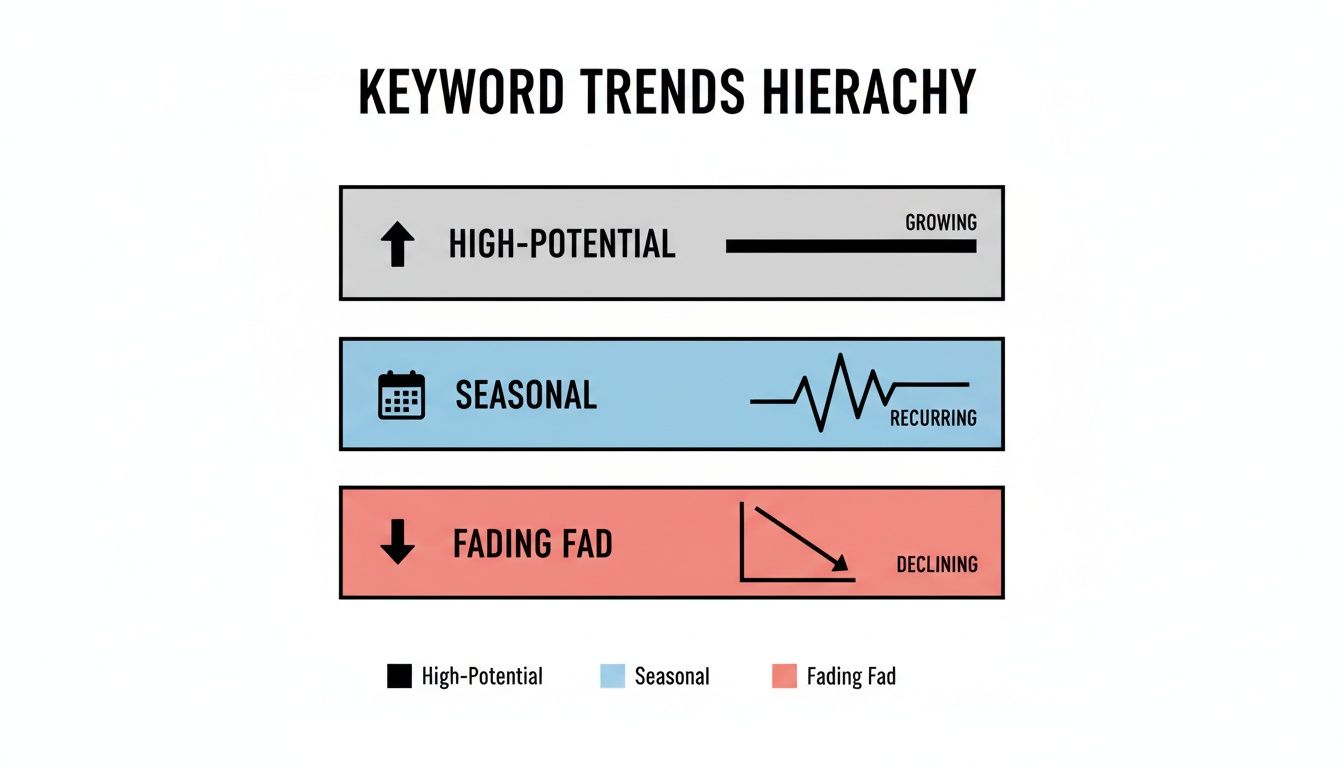
Understanding whether a keyword is high-potential, seasonal, or a fading fad is absolutely critical for prioritizing where you spend your time and resources.
Since 2019, advanced APIs have given SEOs access to incredibly detailed historical keyword data—monthly search volumes, competition levels, and CPCs across billions of keywords. Imagine a keyword shows a solid average of 10,000 monthly searches. That's good, right? But what if a deeper analysis reveals it's surging 30% year-over-year in the first quarter due to seasonal demand? That's a game-changer.
This level of detail uncovers rising topics (up 25-50% over quarters), robust growers, and seasonal juggernauts like 'Black Friday deals' that can spike 300% in November.
This data-driven approach transforms your content plan from a static document into a dynamic roadmap. It ensures that every single piece of content you publish has a specific purpose, a target audience, and a clear role in driving your business forward.
Frequently Asked Questions
Even with a killer strategy, some of the finer points of keyword research and analysis for SEO can get a little murky. Let's tackle a few of the questions I see pop up all the time from marketers trying to turn raw data into a real-world content plan.
Getting straight answers here can help you sidestep common mistakes that slow down your momentum. It’s all about making smarter, more confident decisions.
What Should I Do with Low Search Volume Keywords?
Don’t be so quick to toss a keyword just because its search volume is in the gutter. A term with only 10 or 20 searches a month might look useless on the surface, but these are often hyper-specific, long-tail queries screaming with intent.
Think about it. Someone searching for "best CRM for architecture firms with under 10 employees" knows exactly what they want. Landing that one visitor is infinitely more valuable than getting a thousand clicks from a vague, top-of-funnel query like "what is a CRM."
Before you ditch that low-volume keyword, ask yourself:
- Is the intent red-hot? If the query signals someone is ready to buy or make a decision, its conversion potential could be off the charts.
- Is it a competitive ghost town? Most competitors ignore these niche terms. That’s your opening to rank fast and completely own the conversation for that specific need.
- Does it build authority? Nailing these ultra-specific questions helps establish your site as an expert on the broader topic, which can give all your related pages a nice lift.
How Often Should I Update My Keyword Strategy?
Your keyword strategy is a living document, not a "set it and forget it" relic. The search world moves incredibly fast—trends shift, new players enter the game, and your own business goals change.
As a general rule, you should plan for a major review and refresh of your entire keyword strategy at least once a year.
But you can’t just go dark for 11 months. I strongly recommend setting up a quarterly check-in to:
- Track the performance of your current target keywords.
- Hunt for new opportunities and emerging content gaps.
- Cut loose any keywords that are no longer relevant or just aren't pulling their weight.
This steady rhythm keeps your SEO efforts tuned in to what’s happening in the market right now.
How Can I Measure the Success of My Keyword Research?
Success is about so much more than just rankings. Seeing your page hit the number one spot feels great, but it's a vanity metric if it doesn't actually drive business. The real measure of your keyword research and analysis for SEO is its impact on your bottom line.
Stop obsessing over position numbers alone. Instead, track the metrics that matter: organic traffic growth to your key pages, the number of qualified leads or sales coming from that traffic, and your overall conversion rate. These are the numbers that prove real ROI.
Digging into historical keyword ranking data is also a goldmine for understanding performance. Tools that track your position in the top 100 month-over-month can show you exactly how your changes—or major algorithm updates like Google's 2023 Helpful Content shift—affected your visibility. By analyzing this data, you can pinpoint the high-impact terms that cause major traffic swings and finally understand why you’re winning or losing in the SERPs. You can learn more about how historical SERP data works on seranking.com.
Turn your keyword insights into a powerful content engine with Sight AI. Our platform doesn’t just help you find high-value content gaps—it automates the creation of SEO-optimized articles, so you can publish consistently and start dominating the SERPs. It's time to turn AI visibility into measurable growth.