
Keyword clustering is all about grouping keywords that share a similar search intent. Instead of frantically creating a separate page for every little keyword variation, you build one comprehensive, powerhouse page that can rank for hundreds—sometimes thousands—of related queries. This isn't just a tactic; it's a fundamental shift that aligns your content with how modern search engines actually understand information.
What Is Keyword Clustering and Why It Matters

Remember the old days of SEO? It often felt like trying to find a specific book in a library where every single volume was just tossed randomly onto the floor. That's what keyword research was like before clustering brought some much-needed order to the chaos. Think of it as the ultimate Dewey Decimal System for your content.
But it's more sophisticated than just grouping words that sound alike. Keyword clustering digs deeper by grouping terms based on what people actually mean when they type them into a search bar. It uses the search engine results pages (SERPs) as the ultimate source of truth.
For example, if Google consistently shows the same top pages for "best running shoes for flat feet" and "supportive sneakers for overpronation," it’s practically shouting that these two queries share the same user intent. The signal is clear: a single, high-quality page can satisfy both searchers.
The Shift From Keywords to Topics
This represents a massive departure from the old-school "one keyword, one page" strategy. SEOs used to churn out dozens of thin, repetitive pages to target every minor keyword variation. This not only created a terrible user experience but also forced their own pages into a bizarre competition against each other for rankings.
Thankfully, search engines got a lot smarter. With updates like Hummingbird and RankBrain, Google started focusing on semantic search—understanding the context and relationships between words. The result? Studies quickly showed that top-ranking pages weren't just ranking for one keyword; they were ranking for hundreds of related terms. We've seen a single, well-optimized page rank for roughly 2,200 keywords and pull in over 183,100 organic visits every single month.
This shift is fundamental. Keyword clustering isn't just about organizing keywords; it's about aligning your content strategy with how search engines actually understand and rank information—based on topics, not just isolated terms.
Traditional Keyword Targeting vs Modern Keyword Clustering
The difference in both the approach and the results is night and day. A solid grasp of what keyword research in SEO is today makes it obvious that clustering is no longer just a "nice-to-have" for anyone serious about growth. It's a strategic necessity. This principle holds true across different platforms, where strategies like Amazon Search Engine Optimization (SEO) also rely on clustering to capture broad user intent and dominate competitive categories.
Let's break down the practical differences.
Traditional Keyword Targeting vs Modern Keyword Clustering
| Aspect | Traditional SEO (One Keyword Per Page) | Modern SEO (Keyword Clustering) |
|---|---|---|
| Content Focus | Targets a single, specific keyword. | Covers a comprehensive topic, satisfying multiple related queries. |
| Strategy | Create a new page for each keyword variation. | Create one authoritative page to rank for an entire group of keywords. |
| User Experience | Fragmented; users may need to visit multiple pages to get answers. | Cohesive; users find comprehensive answers on a single page. |
| SEO Risk | High risk of keyword cannibalization and thin content issues. | Eliminates keyword cannibalization and builds topical authority. |
| Efficiency | Inefficient and resource-intensive, requiring many articles. | Highly efficient, focusing resources on fewer, more impactful pages. |
| Traffic Potential | Limited to the search volume of one primary keyword. | Captures traffic from hundreds or thousands of long-tail variations. |
Ultimately, keyword clustering allows you to create less content while driving more traffic. It’s about working smarter, not harder, to build pages that search engines and users both love.
The Real-World Payoffs of a Keyword Clustering Strategy
Let's move past the theory. Putting a keyword clustering strategy into practice delivers tangible, bottom-line results for your business. It’s an approach that fundamentally rewires how you think about and create content, leading to better rankings, insane efficiency, and a powerful edge over the competition. Forget chasing individual keywords; this is how you start to own entire conversations.
This strategic shift unlocks three game-changing benefits. Each one feeds into the next, creating a powerful flywheel for sustainable, long-term SEO growth. Let's break down how clustering can transform your content efforts from a scattered mess of tactics into a cohesive, authority-building machine.
Build Unbeatable Topical Authority
In modern SEO, topical authority is the ultimate currency. It's your way of proving to search engines that you're not just a player—you're a genuine expert on a specific subject. When you build a single, monster page that answers dozens of related questions, you're not just optimizing for keywords anymore. You're building a content fortress.
This is exactly what keyword clustering was made for. By grouping all those semantically related queries together, you can map out and build a single piece of content that covers a topic from every possible angle. The depth and breadth you achieve send incredibly strong signals to Google.
Instead of publishing ten flimsy articles on similar topics, you create one definitive, go-to resource. That consolidated page naturally pulls in more backlinks, sparks more engagement, and becomes the unquestioned answer for an entire topic, cementing your site's authority. This is the very foundation of the topic-cluster model, which we dive into in our guide on what is a pillar page.
A single, well-clustered page tells Google, "We don't just know about this topic; we are the authority on it." This concentrated expertise gets rewarded with higher, more stable rankings across a huge range of related search queries.
Streamline Your Content Machine and Kill Cannibalization
One of the first things you'll notice after adopting clustering is a massive leap in content efficiency. The old "one keyword, one page" model was a surefire recipe for wasted resources and shooting yourself in the foot. It almost always leads to keyword cannibalization, where multiple pages on your own site end up fighting each other for the same spot in the search results.
Clustering stops that dead in its tracks. By mapping each group of keywords to a single, dedicated page, you create a crystal-clear content plan that eliminates overlap and redundancy. You can finally stop writing near-duplicate articles and instead pour your time, budget, and creative energy into producing fewer, but far more impactful, pieces of content.
This streamlined workflow has a huge impact on your bottom line. Instead of needing 50 articles to target 50 different keywords, you might only need five comprehensive pages to cover them all and then some. This frees up your team to:
- Focus on True Quality: Funnel resources into creating genuinely exceptional, in-depth content.
- Slash Redundancy: Stop wasting time writing and updating articles that are basically the same.
- Clarify Your Site Structure: Build a more logical and user-friendly site architecture that search engines love.
This isn't just about saving time. It's about reallocating your most valuable resources to the activities that actually drive growth.
Maximize Your Organic Reach from a Single Page
Finally, we get to the most powerful benefit of all: the massive expansion of your organic footprint. A single page built around a solid keyword cluster doesn't just rank for its main keyword; it starts pulling in traffic from hundreds, or even thousands, of long-tail variations you never even thought to target.
Think of it as fishing with a giant net instead of a single spear. A traditional page targets one "fish." A cluster-optimized page casts a wide net that catches an entire school of related queries.
The scale of this is well-documented. For instance, real-world data shows a single, well-optimized page targeting a cluster can rank for roughly 2,200 keywords and pull in over 183,100 monthly organic visits. By consolidating content this way, SEOs often slash their total page count by 20-40% while simultaneously increasing their total keyword coverage. This strategic consolidation means that successfully capturing just 10–20 high-value clusters can fundamentally change your entire website's share of voice in your market.
How Keyword Clustering Algorithms Actually Work
Let's pull back the curtain on the tech that makes keyword clustering so effective. It might seem like some kind of digital wizardry, but the logic behind it is surprisingly straightforward. At its core, it’s a data-driven system built to think just like a search engine by analyzing what’s already winning.
The engine driving most modern SEO tools is a method called SERP-based clustering. Think of the algorithm as a digital detective. Its only job is to sift through the top search engine results pages (SERPs) for thousands of your keywords, meticulously hunting for overlaps.
The premise is simple: if Google consistently ranks the same handful of URLs for two different searches, that's a massive signal. It tells us that Google sees those queries as sharing the same user intent. The algorithm just uses this public data to group keywords with a high degree of confidence, taking all the guesswork out of the equation.
Decoding the SERP Overlap
The whole process kicks off when you upload your big list of keywords. For every single term on that list, the tool runs a search and records the top-ranking URLs—usually the first 10 to 20 results. Then, the real work begins as it compares the list of URLs for one keyword against the URL list for every other keyword.
When it finds two keywords that share a critical number of the same ranking pages, it puts them in a group. That shared SERP DNA proves they belong together on a single page of content. This whole approach is a cornerstone of understanding what is semantic SEO, because it shifts the focus from simple keyword matching to the underlying meaning that search engines clearly recognize.
This is where a crucial setting comes into play: the clustering level or similarity threshold.
The clustering level is the minimum number of overlapping URLs required for two keywords to be grouped into the same cluster. It acts as the "strictness" setting for your analysis, directly controlling the size and specificity of your clusters.
Tweaking this number is like adjusting the focus on a camera. A lower setting gives you broad, inclusive clusters, while cranking it up produces tight, highly specific groups. Most tools look at the top 10 results, so if two keywords share a set number of those URLs—your clustering level—they get grouped.
Hard vs Soft Clustering Approaches
As these algorithms churn through all that SERP data, they typically use one of two main methods: soft or hard clustering. Both rely on the same SERP overlap principle, but they build the clusters differently, which can lead to slightly different outcomes for your content plan.
Soft Clustering: This is usually the faster method. It picks a "main" or "parent" keyword (often the one with the highest search volume) and then compares every other keyword only to that one main term. If another keyword shares enough ranking URLs with the parent, it's added to the group.
Hard Clustering: This approach is more thorough and computationally intense, but the results are often more precise. Instead of using a single parent term, it compares every single keyword against every other keyword on the list. This creates incredibly accurate topic boundaries because it confirms that every keyword in the cluster is strongly related to all the others, not just a central hub term.
The Impact of Clustering Level on Cluster Output
Choosing the right clustering level isn't a technical detail—it's a strategic decision that hinges on your content goals. A lower threshold is perfect for mapping out huge pillar pages, while a higher one is what you need for drilling down into specific sub-topics.
This table breaks down how changing the SERP similarity threshold impacts the final groups you get.
Impact of Clustering Level on Cluster Output
| Clustering Level | Cluster Characteristics | Best Use Case |
|---|---|---|
| Low (e.g., 3-4) | Fewer, larger, and broader clusters with many keywords. | Planning comprehensive pillar pages or entire content hubs. |
| Medium (e.g., 5-7) | A balanced output with moderately specific clusters. | Standard blog content and creating detailed, topic-focused articles. |
| High (e.g., 8+) | Many small, tightly-focused clusters with fewer keywords. | Targeting very specific long-tail queries or product feature pages. |
Ultimately, the clustering algorithm isn't magic; it’s just a logical system that interprets search engine behavior at a massive scale. Once you understand how it works, you can fine-tune its settings to build a content plan that's perfectly aligned with what search engines and users already love.
Your Step-By-Step Keyword Clustering Workflow
Okay, let's move from theory to action. This is where the real SEO magic happens. Having a repeatable workflow for keyword clustering takes all the guesswork out of your content strategy and gives you a clear roadmap from a messy spreadsheet of keywords to a calendar full of high-ranking content.
Following a set process means every article, guide, or landing page you create is backed by solid data about what users are actually looking for.
The whole thing can be broken down into just a few core phases. You start by gathering your raw materials—the keywords—and end with a strategic plan that can guide your entire content calendar.
This visual gives you a great overview of the SERP clustering process. It's a simple flow from research to the final grouping.
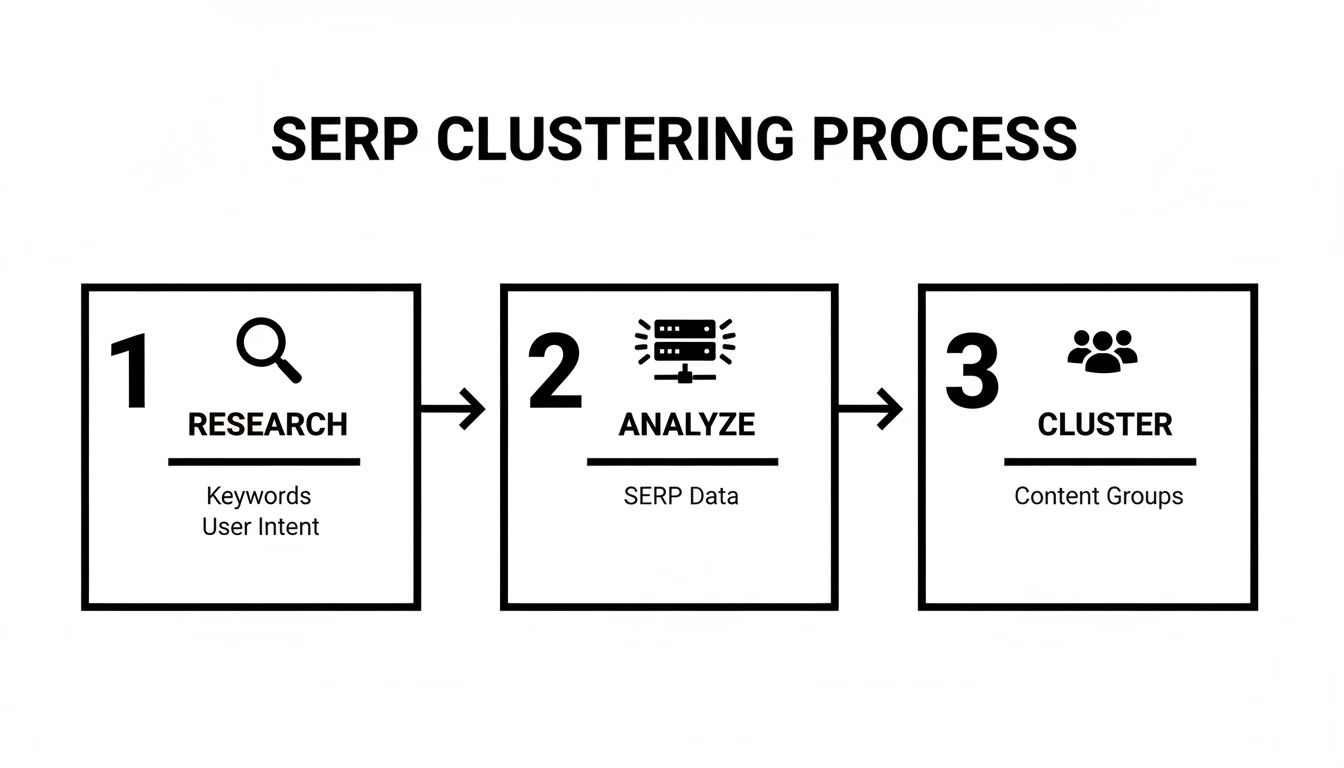
As you can see, it's not some overly complex, technical nightmare. It’s a logical progression: find the terms, see who ranks for them, and group them based on that SERP overlap.
Step 1: Compile Your Master Keyword List
The clusters you get at the end are only as good as the keywords you put in at the start. So, the first step is to build a massive, comprehensive list of every single query your audience might be typing into Google. Don't be shy here—the goal is to cast the widest net possible.
To make sure you don't miss anything, pull keywords from a bunch of different places. Don't just rely on one tool.
- Your Own Data: Start with Google Search Console. What are you already getting impressions for? It's a goldmine.
- Competitor Analysis: Use your favorite SEO tool to spy on your competitors. What keywords are they ranking for that you aren't?
- Good Ol' Brainstorming: Begin with your main "seed" topics and then branch out with related terms, questions, and long-tail variations.
- Specialized Tools: Fire up tools like Ahrefs, Semrush, or Google Keyword Planner to uncover new opportunities.
A solid approach to keyword research for organic SEO is the absolute foundation of this entire workflow. Once you have your list, just pop it into a spreadsheet and remove any duplicates to get a clean master file.
Step 2: Choose and Configure Your Clustering Tool
Look, you could try to cluster keywords manually, but it's a surefire way to lose your mind. It means checking the SERPs for thousands of terms and cross-referencing every URL. It's practically impossible to do accurately or quickly. This is where automated tools save the day.
You've got great options, from dedicated tools like Keyword Insights to features built right into bigger SEO suites like SE Ranking. Once you've picked one, you just need to set up your project.
- Select Your Target Region and Language: This is non-negotiable. Clustering for "running shoes" in the US will give you totally different results than in the UK. Get this right.
- Set Your Clustering Level: This number tells the tool how similar the SERPs need to be to group keywords together. A medium setting of 5-7 is a perfect starting point for most blogs. It creates a nice balance, giving you clusters that are broad enough for a full article but still specific.
Once it's configured, all you have to do is upload your master keyword list and let the tool work its magic analyzing the SERPs.
Step 3: Analyze the Output and Map Your Content Plan
After a few minutes, your tool will spit out its results, usually in a nice, clean spreadsheet. You'll see your original keywords neatly organized into distinct groups, or clusters. Each one of these clusters represents a single piece of content you can now create or improve.
This is the "aha!" moment. Your chaotic list of a thousand keywords suddenly becomes an organized, actionable content plan. Each row is no longer just a keyword; it’s a data-validated topic for a future article.
Your final job is to go through this list and map each cluster to a specific action.
- Create New Content: If a cluster represents a topic you haven't covered yet, boom—that’s a new blog post, landing page, or guide for your calendar.
- Optimize Existing Content: See a cluster that perfectly matches a page already on your site? Perfect. Use all the keywords and subtopics in that cluster to expand and optimize your existing page, making it the most comprehensive resource out there.
- Consolidate and Redirect: Find several old, thin pages on your site that all relate to a single cluster? This is a huge opportunity. Combine them into one powerhouse article and redirect the old URLs to the new one to consolidate all that link equity.
This last step is what turns a simple data report into a strategic content machine, ready to build topical authority and drive a ton of organic traffic.
Best Practices for Implementing Your Cluster Strategy

Creating your keyword clusters is a massive step, but the real magic happens in how you put them to work. A raw data export is just a list of possibilities; turning that list into a powerful content engine requires a smart, strategic approach. This is where we move from the "what" to the "how," implementing practices that squeeze every drop of value out of your content.
The most common mistake is to just start working through your cluster list from top to bottom. A truly great strategy, however, involves careful prioritization, matching your content format to user intent, and building a web of internal links that screams expertise to Google.
Prioritize Clusters for Maximum Business Impact
Let's be real: not all keyword clusters are created equal. You might be staring at hundreds of potential topics, but you don't have infinite resources. The whole point is to focus your energy where it will deliver the biggest payoff, which means blending classic SEO metrics with your actual business goals.
To nail this down, you need to score each cluster against three core criteria:
Business Value: How directly does this cluster relate to what you sell? For a plumber, a cluster around "emergency plumbing services" is pure gold, while "DIY faucet repair tips" is nice to have but won't pay the bills. Always prioritize topics that attract paying customers.
Search Volume: Don't just look at the head term. Add up the monthly search volume for all the keywords in the cluster. This gives you a much truer sense of the total traffic potential for a single, comprehensive piece of content.
Competitive Difficulty: Take a hard look at who's already ranking for the main keywords in the cluster. Are they industry giants or smaller blogs? Tackling low-competition, high-value clusters first can score you some quick wins and build momentum.
By evaluating each cluster this way, you can create a prioritized content plan that focuses on your biggest opportunities first, ensuring every article you publish moves the needle for your business.
Map Clusters to the Buyer's Journey and Content Formats
Understanding the why behind a search is everything. Each cluster represents a group of people at a specific stage of their journey, and your content format has to meet them where they are. A one-size-fits-all approach just doesn't cut it.
Start by sorting each cluster by its likely search intent:
- Informational (Top of Funnel): These users are looking for answers. Clusters like "how to fix a leaky pipe" are perfect for detailed blog posts, step-by-step guides, or how-to videos.
- Commercial (Middle of Funnel): People here are weighing their options. Clusters like "best tankless water heater reviews" demand comparison articles, product roundups, or detailed case studies.
- Transactional (Bottom of Funnel): These searchers have their wallets out. Clusters such as "plumber near me" or "sump pump installation cost" need to lead directly to your service pages or landing pages with a crystal-clear call-to-action.
By aligning the content format with the user's intent, you create a more satisfying experience that naturally guides them from awareness to conversion. It’s about giving people the right answer in the right format at the right time.
Build a Powerful Internal Linking Structure
Your keyword clusters are the perfect blueprint for a rock-solid internal linking strategy. Think of each cluster as a node on your website's topical map. By strategically connecting these pages, you guide both users and search engine crawlers through your site, showing off the depth of your knowledge.
This is how you build powerful topic hubs. Your biggest, most comprehensive cluster page becomes the "pillar," and the more specific, related cluster pages act as the "spokes."
For instance, a pillar page on "Home Plumbing Maintenance" would link out to spoke pages covering clusters like "how to winterize pipes" and "water heater maintenance tips." This structure accomplishes two critical things: it funnels authority between related pages and keeps visitors clicking around on your site longer.
A smart internal linking plan also helps you sidestep the dreaded issue of content overlap. By signaling which page is your main authority on a topic, you can avoid keyword cannibalization. To learn more, check out our detailed guide on what is keyword cannibalization and how to fix it.
Once you have your clusters defined, applying Podcast SEO best practices can amplify your content's reach even further. This interconnected approach is what builds true topical authority and locks in sustainable, long-term rankings.
Common Questions About Keyword Clustering
As you start weaving keyword clustering into your workflow, a few questions always pop up. It's totally natural. Getting these cleared up is the key to moving forward with confidence and avoiding any rookie mistakes. Let's tackle the most common ones I hear, covering everything from the nitty-gritty details to the bigger strategic picture.
How Is Keyword Clustering Different From Simple Keyword Grouping?
This is probably the most critical distinction to get right. While they both sound like they're about organizing keywords, the way they work—and how reliable they are—couldn't be more different.
Simple keyword grouping is what most of us did for years. It's a manual process, often based on gut feeling or how words look on the surface. You might group "running shoes" and "shoes for running" together because, well, they seem the same. It’s an approach built on assumptions about what people are looking for.
Keyword clustering, on the other hand, is completely data-driven. It has one single source of truth: Google’s search results. Keywords only get clustered together if Google is already ranking the same URLs for those queries, proving they share the same search intent.
The bottom line: Simple grouping relies on what you think users want. Keyword clustering is based on what Google's data proves they want. It swaps guesswork for certainty.
Imagine you have "best trail running shoes" and "waterproof hiking sneakers." Your gut might tell you those are two different articles. But if a clustering tool sees that 7 of the top 10 pages are identical for both search terms, it groups them. That's a direct signal from Google that one comprehensive guide can satisfy both of those needs.
What Are the Best Tools for Keyword Clustering?
The great news is you don't need a data science degree to do this anymore. Many of the big SEO platforms have powerful, built-in clustering features that make it incredibly accessible. The right one for you really just depends on your workflow and budget.
Here’s a quick breakdown of the most popular options:
- Integrated SEO Suites: Platforms like SE Ranking, Semrush, and Ahrefs have all baked clustering right into their keyword research tools. This is perfect if you like keeping everything under one roof.
- Specialized Clustering Tools: Then you have tools like Keyword Cupid and Keyword Insights that are built from the ground up just for clustering. They often give you more granular control and deeper analysis focused specifically on this task.
When you're picking a tool, think about how big your keyword lists are, how much you want to customize the clustering sensitivity, the SERP data accuracy for your country, and how easily you can export the results into your content plan.
Can I Do Keyword Clustering Manually Without a Tool?
Technically, for a tiny, tiny list of keywords? Yes. Realistically, for any serious SEO work? Absolutely not. It's a recipe for a massive headache and wasted time.
To do it by hand, you’d have to Google every single keyword, copy the top 10 or 20 URLs into a spreadsheet, and then painstakingly compare every single URL list to find the overlaps.
For a small list of just 100 keywords, you’re looking at thousands of tedious comparisons. For a more typical project with a few thousand keywords, it would mean millions of checks. Automated tools do this in minutes, and they do it perfectly every time. They're essential for doing this at any kind of scale.
How Often Should I Re-Cluster My Keywords?
Search results are never set in stone. Google is always tweaking its algorithm, and user behavior is always shifting. This means your keyword clusters will also change over time. What works as a single cluster today might need to be split into two distinct topics six months from now.
Because of this constant movement, it’s a smart move to refresh your keyword research and re-run your clusters on a regular basis.
For most businesses, doing this every 6 to 12 months is a good rhythm. It keeps your content strategy locked in with current search intent. But if you’re in a really fast-paced industry or you notice a big drop in rankings for a key topic, you might want to consider a quarterly check-in. This keeps you on the front foot, defending what you have while spotting new opportunities as they appear.
Ready to turn AI and search visibility into measurable growth? Sight AI is your all-in-one platform for monitoring your brand's presence across models like ChatGPT and Gemini, identifying high-value content gaps, and automating the production of long-form, SEO-optimized articles. Stop guessing and start ranking. Discover how our AI-powered insights and content automation can drive your strategy forward at https://www.trysight.ai.