Most blog posts never get read. Not because the topics are bad or the writers lack expertise, but because the content doesn't follow the structural and strategic patterns that help posts get discovered, skimmed, and ultimately acted on. A well-intentioned article buried on page four of search results or ignored by AI-powered discovery platforms might as well not exist.
Understanding what a strong example of blog writing actually looks like, at a structural level, is one of the most practical investments a marketer, founder, or agency can make. It's not about following rigid templates. It's about understanding why certain patterns work: why some intros grab attention while others lose readers in the first sentence, why some posts rank for years while others fade within weeks, and why some content gets cited by AI models while most gets overlooked entirely.
This article walks you through the anatomy of high-performing blog posts. You'll see the building blocks that make posts work, a step-by-step walkthrough of what effective blog writing looks like in practice, the formats that consistently drive organic traffic, and how modern blog writing needs to account for both traditional search engines and AI-powered platforms like ChatGPT, Claude, and Perplexity. By the end, you'll have a blueprint you can apply to every post you write or commission going forward.
The Building Blocks Every High-Performing Blog Post Shares
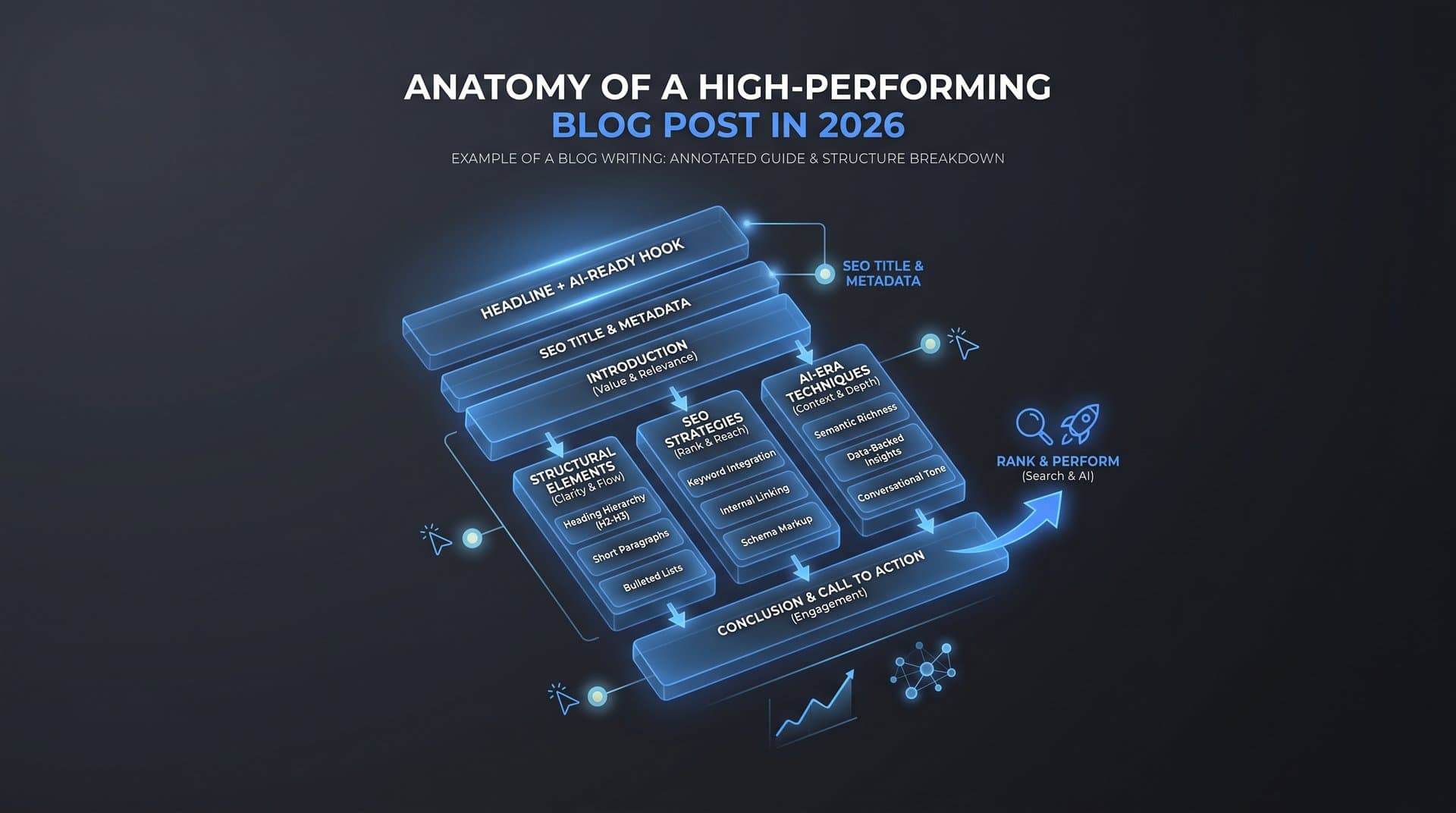
Strip away the topic, the industry, and the brand voice, and you'll find that most high-performing blog posts share the same core architecture. Understanding these elements isn't about writing by committee; it's about recognizing what readers and algorithms both respond to.
The Headline: Your headline is the single most important line in the entire post. It determines whether someone clicks from a search result, shares on social, or scrolls past. Strong headlines are specific, promise a clear benefit or outcome, and often include the target keyword naturally. "How to Write a Blog Post" is fine. "How to Write a Blog Post That Ranks and Gets Read" is better. Specificity signals value.
The Hook-Driven Introduction: Once someone clicks, you have a narrow window to keep them. The introduction needs to validate their reason for clicking, establish relevance, and create enough momentum that they want to keep reading. The best intros open with a problem, a surprising observation, or a direct statement of what the reader will gain. They don't start with "In today's digital landscape..." They start with something that matters to the reader right now.
The Scannable Body: Most readers don't read blog posts linearly. They scan first, then read the sections that interest them. This means your body content needs to work visually as well as verbally. H2 and H3 headings act as signposts. Short paragraphs, ideally two to four sentences, reduce cognitive load. Bold text draws the eye to key ideas. This isn't just about aesthetics: well-organized content signals topical authority to search engine algorithms, which look for clear structure as a quality indicator. Following proven SEO copywriting best practices ensures your structure works for both readers and crawlers.
The Purposeful Conclusion: Too many blog posts simply stop. They deliver information and then trail off without giving readers a clear next step. A strong conclusion briefly reinforces the key takeaway, acknowledges what the reader now knows or can do differently, and offers a specific call to action. Whether that's downloading a resource, reading a related post, or trying a tool, the CTA should feel like a natural continuation rather than a hard sell.
Formatting choices throughout the post also play a measurable role in performance. Short paragraphs reduce bounce rates because they feel easier to read. Bullet points and numbered lists help readers extract key information quickly. Visual breaks, whether through subheadings, bolded phrases, or strategic white space, keep readers moving through the content rather than abandoning it. Developing a solid approach to blog writing content strategies helps you make these formatting decisions consistently across every post.
Anatomy of an Effective Post: A Step-by-Step Walkthrough
Let's walk through what building a blog post actually looks like in practice. Imagine you're a B2B SaaS marketer and you want to write a post targeting the keyword "content calendar template." Here's how the process unfolds from concept to completion.
Step 1: Topic Selection and Keyword Research. Before writing a single word, you confirm there's search demand for the topic and understand the intent behind it. "Content calendar template" is informational: people want a resource they can use. This tells you the post should deliver practical value, not a sales pitch. You also look at related terms to build semantic depth into the post: "editorial calendar," "social media content calendar," "monthly content planning." Knowing where to find blog content ideas ensures you never run out of high-demand topics to pursue.
Step 2: Crafting the Title. You want the keyword in the title, but you also want it to be compelling. Something like "The Content Calendar Template That Actually Gets Used" works because it addresses a real frustration: most templates get abandoned. It's specific, it's benefit-driven, and it includes the keyword naturally.
Step 3: Writing the Hook. Your introduction should open with the problem. Something like: "Most content calendars look great on day one and get ignored by day ten." That's relatable. It validates the reader's experience and immediately establishes why this post is worth reading. Avoid starting with background context or company history. Start with the reader's reality.
Step 4: Building the Body with Evidence and Structure. Each H2 section should address a distinct sub-question the reader has. What should a content calendar include? How do you actually fill it in? How do you stick to it? Each section delivers a clear answer, supported by examples, frameworks, or practical advice. This is where vague writing kills posts: unsupported claims like "a good content calendar will transform your marketing" without explaining how or why leave readers unconvinced. Be specific. Be useful.
Step 5: Closing with a Clear Next Step. The conclusion shouldn't just summarize. It should propel the reader forward. "Download the template, start with next month's content, and revisit your strategy in 30 days" is a concrete next step. "We hope this was helpful" is not. The best endings leave readers with something to do immediately.
Common mistakes at each stage are worth naming explicitly. Vague intros that take three paragraphs to get to the point lose readers before they get to the value. Body sections that make claims without explanation or examples feel thin and untrustworthy. Abrupt endings that just stop without a CTA waste the momentum you've built. Reviewing practical SEO content writing tips can help you avoid these pitfalls at every stage of the drafting process.
Five Blog Formats That Consistently Drive Organic Traffic
Not every blog post should be structured the same way. Different search intents call for different formats, and diversifying your content calendar across formats helps you capture a wider range of keyword opportunities. Here are five proven formats and when to use each.
How-To Guides: These are the workhorses of content marketing. They target informational intent directly, answering "how do I do X?" questions with step-by-step instructions. How-to guides perform well because they're inherently useful, they're easy to structure clearly, and they tend to attract backlinks from people referencing the instructions. Use this format when your audience needs to accomplish a specific task and is actively searching for a process to follow.
Listicles: The listicle gets a bad reputation, but when done well, it's one of the most effective formats for capturing traffic and earning shares. "10 Tools for X," "7 Mistakes to Avoid When Y," "5 Ways to Z Faster" all follow a format that readers can scan quickly and extract value from without committing to a deep read. Listicles work best for topics where multiple options, tips, or examples exist and the reader benefits from seeing them organized side by side.
Explainer Articles: These target informational intent for conceptual questions: "What is X?" or "How does Y work?" Explainer articles build topical authority by demonstrating deep understanding of a subject. They're particularly valuable for brands in technical industries where educating the audience is part of the sales process. This article is itself an example of blog writing in the explainer format.
Comparison Posts: "X vs. Y: Which is Right for You?" posts target commercial intent, meaning readers who are evaluating options and getting closer to a decision. These posts work well for SaaS companies, agencies, and anyone in a competitive market. The key is genuine objectivity: readers can tell when a comparison is rigged, and they'll bounce. Understanding the differences explored in posts like AI content writing vs traditional methods shows how honest comparisons build trust even when they acknowledge competitor strengths.
Case Study Narratives: When you have real, documented results from a client or internal project, case study posts can be powerful for both SEO and conversion. They provide social proof, demonstrate capability, and often rank for long-tail keywords tied to specific problems or industries. The format follows a clear arc: here was the challenge, here's what we did, here's what happened. Without real data and named subjects, this format loses its credibility.
A well-planned content calendar mixes these formats strategically. A month might include one how-to guide targeting a high-volume keyword, two listicles targeting mid-funnel topics, and one comparison post targeting a commercial keyword. This variety ensures you're not just ranking for one type of query but building a content ecosystem that captures readers at multiple stages of their journey.
Writing for Search Engines and AI Models at the Same Time
Here's where blog writing strategy has evolved significantly. Optimizing for Google is no longer the only game in town. AI-powered platforms like ChatGPT, Claude, and Perplexity are increasingly the first place people go to get answers, and these platforms pull from and cite web content when generating responses. If your blog posts aren't written in ways that AI models can easily parse and reference, you're invisible to a growing segment of your audience.
This emerging discipline is called GEO, or Generative Engine Optimization. The core idea is that AI models favor content that is clear, structured, authoritative, and entity-rich. They're looking for content they can confidently quote or summarize without misrepresenting the source. That means your blog writing needs to do a few things that traditional SEO sometimes overlooks.
Provide direct answers to specific questions. AI models love content that answers questions concisely and clearly. If your post is about content calendars, include a sentence that directly defines what a content calendar is. Don't make the model infer it from context. Write as if you're answering a question someone just asked out loud.
Use clear, well-labeled sections. AI models parse structure. A post with descriptive H2 and H3 headings is easier for a model to navigate and cite accurately than a wall of text. Think of your headings as metadata that tells the model what each section is about. Leveraging an SEO content writing tool can help you optimize heading structure and keyword placement for both traditional and AI-driven discovery.
Write in an authoritative, factual tone. Hedging language and vague claims make content harder for AI models to cite with confidence. Statements like "research suggests" without a source or "many experts believe" without naming any experts are weak signals. Where you can, be specific and direct. Where you can't, use clear general language rather than false authority.
Build entity-rich content. Mention relevant people, tools, platforms, and concepts by name. Entity recognition helps AI models understand what your content is about and connect it to related topics. A post about SEO tools that mentions specific platforms, methodologies, and industry terms is more likely to surface in AI-generated responses than one that stays abstract.
The practical implication is that blog writing now needs to serve two audiences simultaneously: human readers who scan and skim, and AI models that parse for quotable, structured information. Fortunately, the practices that make content good for AI also tend to make it better for humans. Clarity, structure, and specificity are universally valuable.
From Draft to Published: The Optimization Phase
Writing the draft is only part of the job. What happens between "done writing" and "published" determines a lot about how the post performs. The optimization phase is where good posts become great ones.
Readability and editing: Run your draft through a readability check. Long sentences and dense paragraphs are common culprits for high bounce rates. Aim for a reading level that matches your audience: technical enough to be credible, accessible enough to be readable without effort. Cut filler phrases. Tighten transitions. Read the post out loud to catch awkward constructions. Exploring dedicated blog writing tools can streamline your editing and readability optimization workflow significantly.
On-page SEO elements: Make sure your target keyword appears in the title, the first paragraph, at least one H2, and naturally throughout the body. Write a meta description that accurately summarizes the post and includes the keyword. Add internal links to related posts on your site: this helps readers find more content and helps search engines understand your site's topical structure. Compress images before uploading to keep page load times fast.
Indexing speed matters more than most people realize. Publishing a post doesn't mean search engines will find it immediately. Submitting your URL through tools that support IndexNow, a protocol that notifies search engines of new content in real time, can meaningfully accelerate how quickly your post starts accumulating impressions and clicks. Platforms like Sight AI integrate IndexNow directly into the publishing workflow, so new content gets surfaced faster without manual submission steps.
Post-publish measurement: Track keyword rankings to see where your post lands and how it moves over time. Monitor organic traffic trends in your analytics platform. And increasingly, monitor AI visibility metrics: are AI models citing your post when users ask relevant questions? Tools that track brand and content mentions across AI platforms give you a clearer picture of your content's true reach beyond traditional search rankings.
Scaling Blog Production Without Losing Quality
For most marketers and agencies, the bottleneck isn't knowing how to write a good blog post. It's producing enough of them, consistently, without letting quality slip. Scaling content production is a real operational challenge, and it's one where AI-powered tools have genuinely changed what's possible.
AI content tools with specialized agents can handle different stages of the writing process: one agent focused on keyword research and topic ideation, another on drafting, another on SEO optimization, and another on formatting for readability. This division of labor mirrors how a skilled editorial team operates, but at a fraction of the time and cost. Platforms built on a multi-agent content writing system use specialized agents to produce SEO and GEO-optimized articles across formats including listicles, guides, and explainers.
The concept of autopilot content workflows takes this further. Rather than treating each post as a standalone project, autopilot workflows connect topic ideation to drafting to publishing in a continuous pipeline. With CMS auto-publishing integrations, approved content can move from draft to live without manual intervention at each step. Investing in blog writing automation is particularly valuable for agencies managing content production across multiple client sites.
Scaling works best, though, when it's paired with visibility tracking. Producing more content without knowing which posts are actually performing, which ones AI models are citing, and which topics are driving the most qualified traffic is like running faster without knowing if you're heading in the right direction. AI visibility tracking helps you understand which content is earning mentions across platforms like ChatGPT and Claude, so you can double down on the topics and formats that are generating real reach and inform future content strategy with actual signal rather than guesswork.
Putting It All Together
Great blog writing isn't a mysterious talent reserved for gifted writers. It's a repeatable set of structural and strategic decisions that anyone can learn and apply. A compelling headline. A hook that earns the reader's attention. A scannable body that delivers real value through clear sections, specific examples, and useful formatting. A conclusion that gives readers somewhere to go next.
Layer in the strategic elements: choosing the right format for the search intent, optimizing for both traditional search and AI-powered discovery, getting posts indexed quickly, and measuring performance across both keyword rankings and AI visibility metrics. These aren't advanced tactics for enterprise teams. They're accessible practices that any marketer, founder, or agency can implement starting with their next post.
Start by auditing your existing blog posts against the patterns covered here. Do your headlines promise specific value? Do your introductions earn the reader's attention in the first two sentences? Are your body sections clearly labeled and easy to scan? Do your conclusions give readers a concrete next step? Most posts have room to improve on at least one of these dimensions, and even incremental improvements compound over time.
For the content you haven't written yet, consider how AI-powered tools can help you move faster without sacrificing the quality that earns rankings and citations. And as AI search becomes an increasingly important discovery channel, make sure you're tracking not just where you rank on Google, but where your brand appears in AI-generated responses. Start tracking your AI visibility today and see exactly where your brand appears across top AI platforms, so every piece of content you publish has a clear path to being discovered, cited, and acted on.