You know the feeling. You open a blank document, type your working title, and then just... stare. You know your business needs blog content. You've read that consistent publishing drives organic traffic. But when it comes to actually producing a well-structured post, the whole thing feels vague and overwhelming.
The problem usually isn't a lack of ideas. It's a lack of a clear mental model for what good blog writing actually looks like. Most people have read hundreds of blog posts without ever stopping to analyze why certain ones kept them reading all the way to the end, while others felt like a chore to get through.
This article is your practical, example-driven guide to understanding the anatomy of effective blog writing. We'll deconstruct the structural elements that make posts work, walk through a real annotated example of a blog writing outline, and cover the strategies that help content rank on Google while also getting cited by AI models like ChatGPT and Perplexity. Whether you're a founder building your first content strategy, a marketer refining your team's workflow, or an agency professional training junior writers, this breakdown gives you a concrete template you can apply immediately.
The Building Blocks Every Blog Post Needs
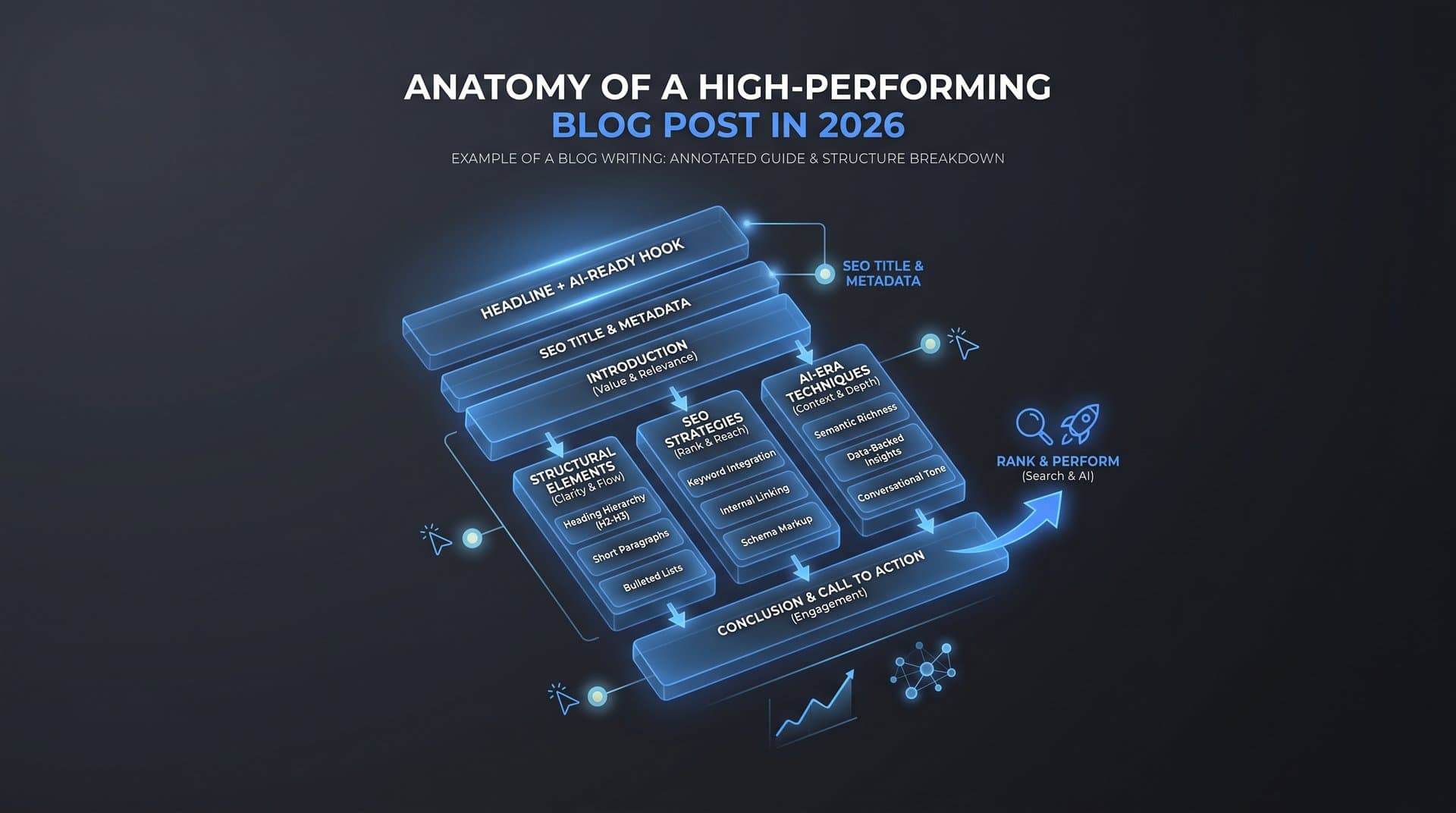
Before you can write a high-performing blog post, you need to understand its core architecture. Think of a blog post like a well-designed building: every structural element has a job to do, and when one is missing or weak, the whole thing becomes unstable.
The Headline: Your headline is the first and most critical element. It needs to accomplish three things simultaneously: communicate what the post is about, include your target keyword naturally, and give the reader a compelling reason to click. A headline like "Example of a Blog Writing: Anatomy of a High-Performing Blog Post" signals topic relevance to search crawlers while also promising practical value to human readers.
The Introduction Hook: The opening paragraph determines whether someone stays or bounces. A strong intro acknowledges a pain point the reader recognizes, previews the value they'll get from reading on, and establishes enough credibility to earn their trust. It doesn't need to be long. Three focused paragraphs are usually enough.
Body Sections with H2/H3 Hierarchy: The body of your post is where the actual value lives. Organizing it with H2 headings for major sections and H3 subheadings for supporting points serves two audiences at once. For readers, it creates a scannable structure that lets them navigate to what they need most. For search engines, heading tags signal topical relevance and help crawlers understand the semantic structure of your content. Following proven blog writing content strategies ensures your structure supports both readability and rankings.
Transitions and Internal Links: Each section should flow naturally into the next with a bridging sentence. Internal links, placed contextually within body paragraphs, help readers explore related content on your site and pass authority between pages, which matters for SEO.
The Conclusion with CTA: A strong conclusion does more than summarize. It reinforces the key insight, tells the reader what to do next, and includes a clear call to action. Whether that's subscribing, downloading a resource, or exploring a product, the CTA gives the post a purpose beyond information delivery.
It's worth distinguishing blog writing from other content formats. A landing page is built to convert, not educate. A whitepaper is dense and formal, designed for deep research. A social post is fragmented by design. Blog writing sits in a unique middle ground: it's long enough to provide genuine educational value, structured enough to rank in search, and approachable enough to build a relationship with the reader over time. Getting this balance right is what separates content that performs from content that just exists.
A Real Blog Post Example, Deconstructed Step by Step
Let's make this concrete. Below is a clearly labeled hypothetical example of a blog post outline on the topic of improving website speed. This isn't a real post, but it's structured exactly as a real high-performing post would be. Read through it, then we'll annotate why each element works.
Headline: "How to Improve Website Speed: 7 Fixes That Take Under an Hour"
Why it works: The keyword phrase "improve website speed" appears naturally at the front. The number "7" sets a concrete expectation, and "under an hour" addresses the reader's implicit concern about effort and time. It's specific, actionable, and immediately credible.
Introduction (3 paragraphs): Opens with a relatable scenario about slow-loading pages costing businesses visitors. Previews the 7 fixes and promises they're beginner-friendly. Ends with a single sentence that bridges into the first section.
Why it works: The intro hooks with a recognized problem, establishes stakes, and previews structure. The bridge sentence reduces cognitive friction by telling the reader exactly what comes next.
Body Section 1 (H2): "Why Website Speed Matters More Than You Think"
Why it works: Before jumping into solutions, this section earns trust by explaining the "why." It also gives search engines a second topically relevant heading to index. This is where you'd include a real, cited statistic if one is available, or use honest qualitative language if not.
Body Sections 2-5 (H2 each): Individual fixes with H3 subheadings for steps
Why it works: Breaking fixes into separate H2 sections rather than one long list creates natural internal structure. Each section is self-contained, which means a reader who only needs Fix #3 can jump straight there. This reduces bounce rate and increases time-on-page signals. Applying SEO copywriting best practices to each section ensures your content is optimized at every level.
Body Section 6 (H2): "How to Test Your Speed After Making Changes"
Why it works: This section addresses the reader's next logical question after implementing fixes. Anticipating follow-up questions within a single post reduces the need to leave the page, improving engagement signals.
Conclusion with CTA: Summarizes the core insight in two sentences. Encourages the reader to run a speed test today. Ends with a CTA linking to a relevant tool or service.
Why it works: The CTA feels earned because it follows genuine educational value. The post hasn't been pushing a product throughout; it's been solving a problem. The final CTA lands naturally as a "next step" rather than a sales pitch.
Notice how this example of a blog writing structure balances educational depth with subtle product relevance. The post teaches something real, and only at the end does it suggest a tool that can help. That sequence builds trust before asking for anything in return.
Writing for Search Engines and AI Models Simultaneously
Here's where modern blog writing gets more interesting. For most of the past decade, optimizing a blog post meant satisfying Google's ranking algorithm: keyword placement, backlinks, page speed, and structured content. That still matters. But in 2026, there's a second audience you're writing for: AI models.
When someone asks ChatGPT, Claude, or Perplexity a question, those models pull from content they've been trained on or, increasingly, content they can retrieve in real time. If your blog post is structured clearly, written authoritatively, and answers a specific question well, it becomes a candidate for AI citation. This practice of optimizing content so AI models can parse, summarize, and reference it is called Generative Engine Optimization, or GEO.
The good news is that what makes content good for GEO largely overlaps with what makes it good for traditional SEO. Clear structure, specific answers, and authoritative tone benefit both. But there are a few GEO-specific techniques worth understanding. For a deeper dive into optimizing your writing for search, explore these SEO content writing tips that apply to both traditional and AI-driven discovery.
Define terms explicitly: AI models favor content that defines concepts clearly rather than assuming prior knowledge. If your post is about a technical topic, include a plain-language definition early on. This gives AI models a clean, quotable explanation to reference.
Use structured, scannable formatting: AI models process structured content more reliably than dense prose. Short paragraphs, labeled sections, and bold-labeled lists give the model clear anchors for extracting and summarizing information.
Cite real sources when available: Authoritative content that references verifiable data is more likely to be treated as a trustworthy source by AI models. When you have a real source, cite it with the publication name and year. When you don't, use honest qualitative language rather than fabricating numbers.
Answer questions directly: Structure sections around specific questions your audience is asking. Framing a heading as a question and then answering it concisely in the first sentence of the following paragraph creates a format that AI models can easily extract as a direct answer.
Understanding whether your blog content is actually being referenced by AI models requires visibility into those platforms. AI visibility tracking tools, like those built into Sight AI, monitor how your brand and content are mentioned across platforms like ChatGPT, Claude, and Perplexity. This gives writers and marketers concrete feedback on which posts are earning AI citations and which topics represent untapped opportunities. It transforms GEO from a theoretical concept into a measurable content strategy.
Five Blog Writing Formats That Drive Organic Traffic
Not all blog posts are built the same. Different search intents call for different formats, and choosing the right structure for your topic is one of the most underrated decisions in content strategy.
Listicles: Posts structured around a numbered list, like "10 Tools Every Content Marketer Needs." These work well for informational and commercial intent searches. Readers know exactly what they're getting, and the format is naturally scannable. Listicles tend to earn featured snippets and are easy for AI models to parse into structured summaries.
How-To Guides: Step-by-step instructional posts that walk readers through a process. These are ideal for queries with clear procedural intent, like "how to set up Google Search Console." The sequential structure makes them strong candidates for both Google's step-by-step rich results and AI-generated walkthroughs. Understanding how content writing for organic SEO works helps you choose the right format for each query type.
Explainer Articles: In-depth posts that answer "what is" or "why does" questions. The article you're reading right now is an example of a blog writing format in the explainer category. Explainers work best for topics where the reader needs conceptual understanding before they can take action. They build authority and tend to attract backlinks from other content creators referencing your definitions.
Comparison Posts: Side-by-side analyses of tools, approaches, or products, like "SEO vs. GEO: What's the Difference?" These capture high-commercial-intent readers who are close to a decision. They're also highly cited by AI models when users ask comparison questions directly. Our guide on AI content writing vs traditional methods is a strong example of this format in action.
Case Study Narratives: Posts built around a real, documented example of a strategy in action. When written with a named company and verifiable source, these posts carry significant authority. They answer the "does this actually work?" question that readers at the decision stage are asking.
Matching format to intent is the key. Informational queries ("what is blog writing") call for explainers. Commercial queries ("best blog writing tools") call for comparison posts or listicles. Navigational queries ("Sight AI blog") are handled through your site architecture rather than individual post formats.
Producing all five formats consistently is where AI content tools become genuinely useful. Platforms with specialized agents for each format, like the 13+ AI agents in Sight AI's content writer, allow teams to generate format-specific drafts efficiently without sacrificing the structural quality that drives rankings and AI citations.
Common Blog Writing Mistakes That Kill Rankings
Understanding what good blog writing looks like is only half the equation. The other half is knowing what to avoid. Several common mistakes consistently undermine content performance, and most of them are entirely preventable.
Keyword Stuffing: Forcing a keyword into every other sentence doesn't help rankings and actively hurts readability. Search engines have become sophisticated enough to recognize natural language patterns. Write for the reader first, and let keyword placement follow naturally from that.
Thin Content: Posts that cover a topic superficially without providing genuine depth or original perspective rarely rank well. Search engines reward content that comprehensively addresses a topic. If your post on "example of a blog writing" only scratches the surface, a competing post that goes deeper will consistently outrank it. Leveraging AI blog writing workflows can help you produce the depth needed to compete without burning out your team.
Missing Internal Links: Every blog post should link to at least two or three related pieces of content on your site. Skipping this leaves authority stranded on individual pages and misses an opportunity to guide readers deeper into your content ecosystem.
No Clear Structure: Posts written as walls of unbroken text, with no H2 headings, no paragraph breaks, and no visual hierarchy, are difficult to read and difficult for crawlers to interpret. Structure isn't a design nicety; it's a ranking factor.
Ignoring Indexing: Publishing a post and waiting for Google to find it on its own can mean days or weeks of delay before your content appears in search results. Poor indexing practices are a silent killer of content performance, especially for newer domains.
Tools with IndexNow integration, like Sight AI's website indexing features, automatically notify search engines the moment new content is published. This accelerates the discovery process and reduces the gap between publishing and ranking.
Before you hit publish, run through this quick self-audit checklist:
1. Does my headline include the target keyword naturally?
2. Does my introduction hook address a real reader pain point?
3. Do I have at least three H2 sections with clear, descriptive headings?
4. Have I included at least two internal links to related content?
5. Is my conclusion followed by a clear, specific CTA?
6. Have I avoided fabricated statistics or unsupported claims?
7. Is my post submitted for indexing via sitemap or IndexNow?
Running through this checklist before every publish takes less than five minutes and catches the majority of structural issues that hold content back.
From Draft to Published: Making Your Blog Post Discoverable
Writing a great blog post is necessary but not sufficient. The post-writing workflow matters just as much for long-term performance, and many teams skip critical steps that determine how quickly and how well their content gets discovered.
The first step after finalizing a draft is an on-page SEO review. Confirm your target keyword appears in the headline, the first paragraph, at least one H2 heading, and naturally throughout the body. Check that your meta description accurately summarizes the post and includes the keyword. Using a dedicated SEO content writing tool can streamline this review process and catch issues you might miss manually.
Next, address indexing. Update your sitemap to include the new URL and submit it through Google Search Console. If you're using an IndexNow-compatible tool, the notification goes out automatically to participating search engines the moment you publish, which can significantly reduce the time between publication and first appearance in search results.
Automated publishing pipelines take this a step further. When your content workflow includes CMS auto-publishing with built-in indexing triggers, the gap between "draft approved" and "content indexed" shrinks from days to hours. For teams producing content at scale, exploring blog writing automation solutions can turn this time compression into a meaningful competitive advantage.
Once the post is live and indexed, monitoring begins. Track keyword rankings for your target term over the first 30, 60, and 90 days. Watch organic traffic trends in your analytics platform. And increasingly, track AI mentions: is your post being cited when users ask relevant questions on ChatGPT, Claude, or Perplexity?
AI visibility tracking closes the feedback loop that most content teams are missing. You might rank on page one for a keyword and still not be appearing in AI-generated answers on the same topic. Understanding that gap helps you refine your GEO strategy: adding clearer definitions, restructuring sections, or updating content to align more closely with how AI models are framing answers in your niche.
The combination of fast indexing, performance monitoring, and AI visibility tracking transforms blog publishing from a one-time act into a continuous optimization cycle. Each post gets smarter over time, and your overall content strategy gets sharper with every iteration.
Putting It All Together
Great blog writing isn't a creative mystery reserved for gifted writers. It's a repeatable system built on clear structure, strategic keyword placement, genuine educational value, and a disciplined post-publishing workflow.
We've covered the core building blocks every post needs, walked through a deconstructed example of a blog writing outline you can use as a template, explored how to write for both Google and AI models simultaneously, identified the five formats that drive organic traffic, highlighted the mistakes that quietly kill rankings, and mapped out the path from draft to discoverable.
The next time you open a blank document, you won't be staring at nothing. You'll have a structural blueprint: a headline that includes your keyword, an introduction that hooks with a real pain point, body sections organized with H2 hierarchy, internal links that connect your content ecosystem, and a conclusion with a clear CTA. Use the self-audit checklist before every publish and make indexing part of your standard workflow.
The brands that win in organic search and AI visibility in 2026 aren't the ones with the biggest budgets. They're the ones with the most consistent, well-structured, strategically optimized content pipelines.
If you're ready to move from guessing to knowing, Start tracking your AI visibility today and see exactly where your brand appears across top AI platforms like ChatGPT, Claude, and Perplexity. Combine that visibility with Sight AI's AI content agents and automated indexing tools, and you have everything you need to build a content engine that ranks, gets cited, and compounds over time.