Competitive content analysis is way more than just a buzzword. It's the process of looking over your competitors' shoulders—ethically, of course—to see what they're publishing, where, and how it's performing. The goal? To find the gaps, spot the opportunities, and use those insights to make your own content strategy smarter and more effective. It's how you create content that doesn't just add to the noise but actually captures your audience's attention.
Moving Beyond Basic Competitor Tracking
Let's be honest: a static list of your top rivals collecting dust in a spreadsheet isn't a strategy. Simply knowing who your competitors are doesn't cut it anymore.
Real competitive content analysis is a form of business intelligence, not just another SEO task to check off the list. It’s about digging deep into your rivals' entire content ecosystem. That means everything from their top-ranking blog posts and keyword strategy all the way to their visibility in AI tools like ChatGPT.
This is the key difference between being reactive and proactive. Instead of guessing what might work, you're using hard data to build a strategy that anticipates what the market wants and meets your audience's needs—ideally, before your competitors even know what's happening.
Why It's Essential for Survival
Ignoring what your competitors are up to is like trying to navigate a maze with a blindfold on. You might get there eventually, but you're going to hit a lot of dead ends and waste a ton of time and money along the way.
A proactive analysis helps you sidestep some common traps:
- Preventing Content Saturation: You can quickly spot the topics everyone is dogpiling on and find unique angles that nobody else has touched.
- Meeting Audience Expectations: By seeing what’s resonating with their audience (which is often your audience, too), you can create content that genuinely solves problems and answers questions.
- Improving Resource Allocation: Stop throwing your budget at low-return topics. Focus your team's energy on the high-impact opportunities you've uncovered.
The growth in this space is impossible to ignore. The global content analytics market is projected to explode from USD 11.22 billion in 2025 to a massive USD 54.66 billion by 2034. This isn't just random growth; it’s driven by the sheer volume of digital content that businesses now have to sift through to stay competitive. As you start refining your own approach, you can learn more about how advanced tools are changing the game of competitor rank tracking in this new environment. You can read more about the market growth in content analytics to see just how big this is getting.
The core idea is simple: You're turning your competitors' hard work into your strategic advantage. Every piece of content they publish is a free lesson in what works, what doesn't, and where the untapped potential lies.
Before we dive into the "how," it's helpful to understand the core pillars of a comprehensive analysis. This table breaks down the key areas you'll need to focus on.
Key Focus Areas in Competitive Content Analysis
| Analysis Area | What to Look For | Key Metric |
|---|---|---|
| Content & Topic Gaps | Topics they cover that you don't (and vice versa). | Keyword Rankings |
| Format & Media Analysis | Types of content used (e.g., video, blog, podcast). | Engagement Rates |
| SERP & AI Visibility | How they rank in Google and appear in AI answers. | Share of Voice |
| Backlink Profile | Who is linking to them and why. | Referring Domains |
| Audience Sentiment | How readers react to their content (comments, shares). | Social Shares/Mentions |
Each of these areas provides a different piece of the puzzle, giving you a holistic view of where you stand and where you can win.
The following diagram shows how you can move from just collecting raw data to building a truly proactive content strategy.
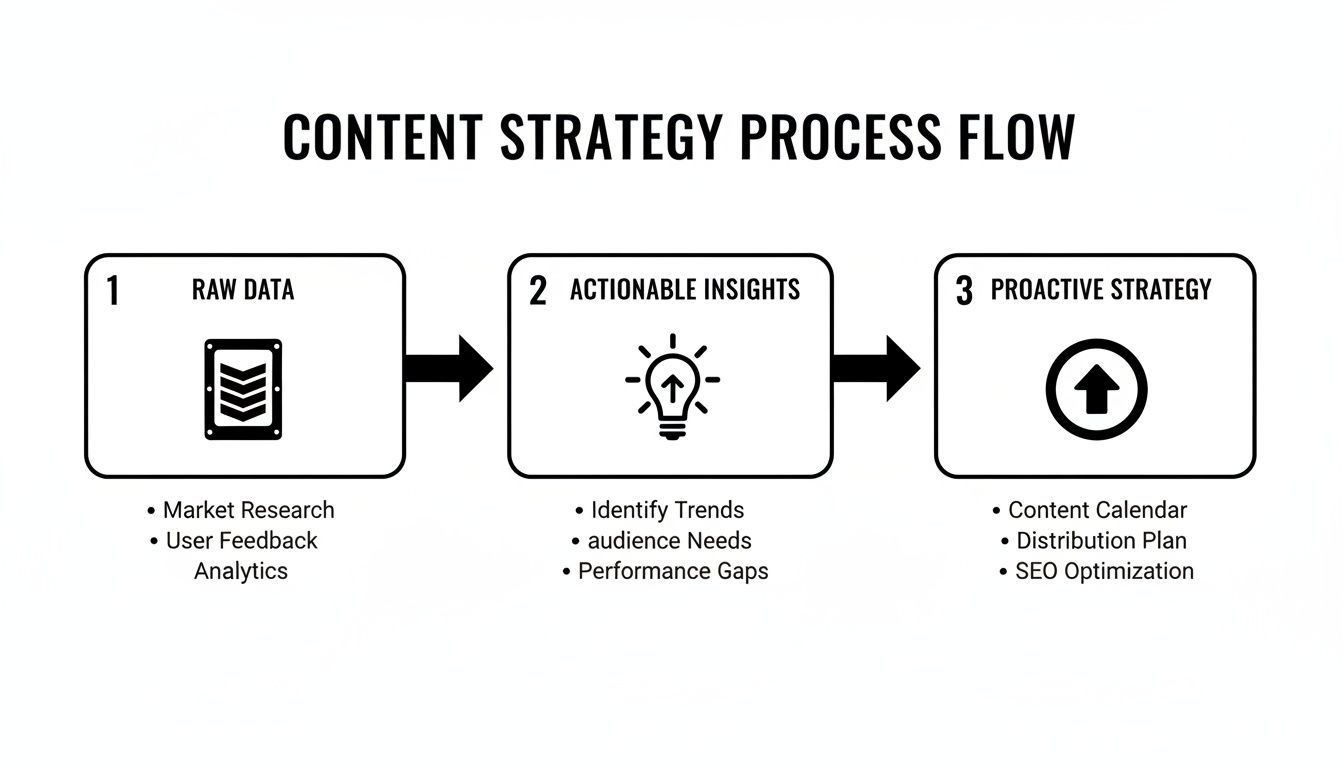
This process visualizes how modern tools can bridge the gap between raw data and actionable insights, setting the stage for a smarter approach to content marketing.
Nail Down Your Goals and Pinpoint Your Real Competitors
Jumping into a competitive content analysis without a clear goal is like driving in the dark with no headlights. You’ll collect a ton of data, sure, but you won't have any idea what to do with it or where you're headed. Before you even peek at a competitor's blog, you have to define what winning actually looks like for you.
So, what are you trying to accomplish here? Your answer to that question will steer the entire project. A fuzzy goal like "get more traffic" just won't cut it. You need sharp, measurable objectives that connect directly to what the business actually cares about.
Are you trying to steal market share for a critical topic? Or maybe your focus is on how your brand shows up in AI-generated answers, and you want to see more favorable mentions.
Think in terms of concrete outcomes, like these:
- Push our rankings for "project management software" keywords from the depths of page three to page one in the next six months.
- Become the most cited source in AI models like Perplexity for questions about "remote team collaboration tools."
- Find and fill three high-intent "alternative to" content gaps to grab 10% more comparison traffic by the end of the quarter.
When you set goals this clear, your analysis stops being a passive research task and becomes a strategic mission.
Business Competitors vs. Content Competitors: Know the Difference
This is a big one, and it’s where I see a lot of marketers go wrong. Your business competitors are not always your main content competitors. Grasping this distinction is probably one of the most important parts of a truly effective analysis.
Business competitors are the companies that sell a similar product or service to your audience. If you sell CRM software, other CRM companies are your direct business rivals. Simple enough.
Content competitors, however, are a completely different beast. They're any website, brand, or publication fighting for the same audience attention on the SERPs and in AI chats. The catch? They might not sell anything even remotely close to what you do.
A classic mistake is fixating only on direct business rivals. The real battlefield for your audience's attention is way bigger, packed with publications, affiliates, and experts all vying for the same eyeballs.
Let’s take a SaaS company that sells accounting software. Their direct business competitors are pretty obvious—other accounting software firms. But the moment they write a blog post on "how to calculate quarterly estimated taxes," their list of content competitors explodes. Suddenly, they're up against:
- Financial heavy-hitters like Investopedia or NerdWallet.
- Official government sites like the IRS.
- Blogs run by independent CPAs and financial advisors.
- Affiliate marketers who review tax software.
None of these sell the exact same product, but they are all in a dogfight for the top spot on that specific search query. If you ignore them, you're flying blind to most of your real competition.
A Simple Framework for Spotting Your Competitors
To get the full picture, you need to map out both types of competitors. The best way is to start with what you know and then let the data guide you to what you don't.
1. Uncover Your Business Competitors This part is usually straightforward. You probably know who these players are from sales calls, market research, and just being in your industry. Make a list that includes the big, established leaders and any up-and-comers who are starting to make noise.
2. Find Your Content Competitors Now, this requires a more data-driven approach. Fire up your keyword tool of choice—something like Ahrefs or Semrush—and plug in your main "seed" keywords. These are the core topics your business is built around. Then, just look at the domains that consistently show up at the top of the search results.
Those are your true content competitors. I've found that systematically digging into these sites consistently uncovers 40% more keyword opportunities than just spying on direct business rivals.
For example, a B2B project management tool might find its content competitors for "how-to" articles are productivity blogs, while its competitors for "alternative to" pages are software review sites. Different types of content often have entirely different competitive landscapes. A thorough analysis digs into that nuance to create a comprehensive map of who you're really up against.
How to Gather Actionable Data from SERPs and AI

Alright, you've got your goals locked in and you know who you're up against. Now for the fun part: rolling up your sleeves and digging into the data. This is where we look at two critical, interconnected arenas—the classic Search Engine Results Pages (SERPs) and the new frontier of AI visibility. Our mission is to turn a mountain of information into a handful of game-changing insights.
This isn't just busy work; it's big business. The Competitor Analysis Evaluation sector was valued at a whopping USD 4,316.55 million in 2021 and is on track to hit USD 6,600.18 million by 2025. That growth tells you how seriously companies are taking data-driven strategy. In fact, those who regularly check in on their competition see a 28% higher ROI on their content campaigns.
Dissecting Top-Ranking Content on SERPs
First stop, the traditional search engine. For any keyword you're targeting, the top-ranking pages are a treasure trove of clues. They're a living blueprint of what Google and its users find valuable right now. Your job is to pull these pages apart to figure out why they’re winning.
Start by zooming in on the top 3-5 results for your most important keywords. You need to look past the obvious and start cataloging specific attributes to spot the patterns.
- Content Formats: What are you seeing at the top? Are they exhaustive blog posts, ultimate guides, pages loaded with videos, or even interactive tools? The format that dominates is a huge signal about what users actually want.
- Word Count and Depth: While word count itself isn't a magic ranking bullet, it’s often a proxy for how comprehensive a piece is. Note the average length, but more importantly, gauge the depth of the topic coverage.
- Unique Angles and Hooks: What makes each piece pop? Did they use original research? Land an expert interview? Take a contrarian stance? Or maybe they just have exceptionally slick visuals?
- Backlink Profiles: Who is linking to this content? A quick peek at their backlinks reveals the kinds of websites—and by extension, audiences—that found their content useful enough to endorse.
Here's a pro tip from my own playbook: Create a dead-simple spreadsheet to track this. For each keyword, make columns for Competitor URL, Format, Word Count, Unique Angle, and Key Backlinks. After you've done this for just 10 keywords, I promise you'll start to see powerful trends jumping off the page.
Don’t forget to broaden your scope beyond just articles. Platforms like YouTube are massive discovery engines, so analyzing your competitors' YouTube content strategies can uncover audience pain points and engagement cues you'd otherwise miss. This gives you a much more complete picture of the competitive landscape.
Exploring the New Frontier of AI Visibility
SERP analysis tells you what's working today. Monitoring AI visibility, on the other hand, helps you see where things are headed. AI models like ChatGPT, Perplexity, and Grok are fast becoming the go-to search engines for a growing chunk of the population. Your brand’s presence—or lack thereof—in their answers is a huge deal.
This is a newer field, but the approach is pretty straightforward. You're essentially having conversations with these AI models to see how they talk about your industry, your company, and your rivals.
Here's a simple workflow to get you started:
- Craft Strategic Prompts: Go beyond basic questions. Use a mix of prompts that simulate different user intentions and scenarios.
- Analyze the Responses: Look for mentions of specific brands, any citations (links back to sources), and the general sentiment of the answer.
- Identify Sourcing Gaps: Pay close attention to the websites the AI models cite. These are gold-plated opportunities for outreach or for creating your own definitive content.
For example, a prompt like, "What are the best alternatives to [Competitor Brand] for small businesses?" quickly shows you who the AI considers top contenders. Asking something like, "Summarize the key trends in [your industry] for 2024," will reveal which publications the AI trusts as authoritative sources.
Interpreting the Data for Actionable Insights
Collecting all this data is just the first step. The real magic happens when you turn these raw observations into a concrete action plan. As you sift through your findings from both SERPs and AI, focus on connecting the dots.
Maybe you spot a competitor who ranks well in traditional search but is totally invisible in AI conversations. That's a weakness you can exploit. Or perhaps another competitor is constantly cited by AI models for their original research—a clear sign that investing in your own data-driven content could be a massive win. This is precisely where you can learn more about how to leverage rank data for SEO in today's environment.
The goal isn't to get lost in a sea of data. It's to surface a small number of high-priority opportunities. By methodically harvesting and interpreting these signals, you stop guessing what might work and start knowing what the market is already rewarding.
Finding Gaps and Prioritizing the Opportunities That Matter
You’ve gathered the SERP and AI visibility data. Now the real work begins. This is the point where you stop just tracking competitors and start sifting through the noise to find the gold—the high-impact opportunities that will actually drive growth. This is where your competitive analysis morphs from a research report into a strategic growth plan.
The goal here is to identify gaps, but not just the obvious stuff. A traditional SEO content gap analysis often stops at, "They rank for this keyword, and we don't." That's a decent starting point, but it's really just scratching the surface. To truly get an edge, you have to dig for the more nuanced openings.
Beyond Keywords: Uncovering Angle and Format Gaps
Winning in a crowded market isn’t about being slightly better; it's about being different. That means finding gaps in the way content is presented, not just the topics being covered. I always keep an eye out for two specific types of openings that competitors consistently overlook.
Angle Gaps
This is all about perspective. Your competitor might have a monster 3,000-word guide on a topic, but what if they wrote it from a generic, 10,000-foot view? An angle gap is your chance to swoop in with a unique take.
- Could you cover the same topic but for a super-specific niche? Think "Project Management for Non-Profits" instead of the broad "Project Management."
- Can you take a contrarian viewpoint or debunk a common industry myth that everyone else just parrots?
- Is there an opportunity to inject original data or a personal case study into a topic that everyone else only discusses in theory?
Format Gaps
This one is a gap in the medium. Look closely at the types of content dominating the search results. If the top five results for a key term are all text-heavy blog posts, you've just found a massive format gap waiting to be exploited.
- Could you create a detailed video tutorial or host a webinar on the topic?
- Would an interactive tool, like a calculator or a checklist, provide more tangible value?
- Is there room to launch a podcast episode where you discuss the topic with a recognized expert?
Spotting these gaps is so important because they let you enter a competitive conversation without just creating a carbon copy of what’s already there. You’re adding net-new value, and that’s something both users and search engines love to see.
A Practical Framework for Prioritizing Opportunities
Okay, so you've got a list of potential gaps—keywords, angles, and formats. Now what? The next challenge is figuring out where to point your limited resources. Not all opportunities are created equal, and trying to do everything at once is a surefire recipe for doing nothing well.
This is why you need a simple, effective prioritization framework. A scoring system helps take emotion and guesswork out of the picture, letting you zero in on the content ideas with the highest potential payoff.
The point of a prioritization framework isn't to be overly scientific. It's to force a structured conversation about what actually matters to the business. It turns a long laundry list of "could-dos" into a short, actionable list of "should-dos."
Here’s a straightforward model you can adapt. Score each content opportunity on a scale of 1-5 across three key criteria:
- Search Potential: How big is the audience for this topic? Look at monthly search volume and the potential for long-tail variations. A score of 5 represents a high-volume, high-intent topic.
- Business Relevance: How closely does this topic align with your product or service? Does it attract potential customers, or just curious browsers? A score of 5 means the topic is directly tied to a core business offering.
- AI Visibility Potential: How likely is this content to be cited or referenced by AI models? Topics that answer specific questions, provide clear data, or offer expert analysis tend to score higher.
By adding up the scores, you get a clear, data-informed priority for each content idea. This simple exercise is a cornerstone of effective competitive analysis, ensuring your efforts are always aimed at maximum impact.
Putting the Scoring Framework into Practice
Let's say you're running marketing for a B2B SaaS company selling project management software. Your analysis uncovers five potential content ideas. Here’s how you might score them:
| Content Idea | Search Potential (1-5) | Business Relevance (1-5) | AI Visibility (1-5) | Total Score |
|---|---|---|---|---|
| "What is Agile Methodology?" (Article) | 5 | 2 | 3 | 10 |
| "Best PM Software for Startups" (Comparison) | 4 | 5 | 5 | 14 |
| "How to Use Gantt Charts" (Video) | 3 | 4 | 4 | 11 |
| "Remote Team Productivity Tips" (Article) | 4 | 3 | 2 | 9 |
| "Competitor X vs. Our Tool" (Landing Page) | 2 | 5 | 4 | 11 |
Right away, the "Best PM Software for Startups" comparison jumps out as the highest-impact opportunity. It has strong search potential, is directly relevant to generating sales, and is the kind of content AI models love to surface for comparison questions. The "What is Agile Methodology?" article has the highest search volume, sure, but its low business relevance pushes it down the priority list.
The content marketing space, powered by this kind of analysis, is growing like crazy, with a projected value of USD 107,540.6 million by 2026. The teams that master these techniques are the ones who will grab their slice of that growth. To dig deeper into the market dynamics, you can explore the full research on the content market.
Turning Your Insights Into a Content Production Engine

Let's be honest. A prioritized list of high-impact opportunities is a fantastic start, but insights are worthless if they just sit in a spreadsheet. The real challenge in competitive content analysis isn't finding the gaps—it's systematically turning those discoveries into a steady stream of high-quality content that actually gets published.
This is where your analysis stops being a report and starts becoming a true content production engine. And the bridge between your brilliant insight and a published article is one critical document: the content brief. A weak brief will always lead to generic, off-target articles. But a great one is a blueprint for success, arming your writers with everything they need to win.
Crafting Briefs That Set Your Writers Up for Success
A well-structured brief does so much more than list a keyword and a word count. It translates your hard-won competitive research into a clear, actionable plan for a specific article. In my experience, it's the single most important document in any content workflow.
Your briefs need to be detailed enough to eliminate guesswork but flexible enough to give your writers room to be creative. Here are the absolute non-negotiables every brief must contain:
- Primary and Secondary Keywords: Go beyond the main target. List the core keyword cluster and a handful of related semantic terms you want included.
- The Unique Angle: This is crucial. What’s our unique take on this topic? Are we bringing original data to the table, offering a contrarian viewpoint, or simply creating a more practical, step-by-step approach than what's already out there?
- Target Audience and Intent: Who exactly are we writing for? What specific problem are they trying to solve right now? Get granular about their pain points and their level of expertise.
- Competitor Analysis Summary: This is pure gold for your writer. Provide links to the top 3-5 ranking articles. Briefly explain what they do well and, more importantly, where they fall short. This context is invaluable.
- Key Talking Points and Outline: Don't leave the structure to chance. Offer a solid outline with suggested H2s and H3s. This ensures the article covers all the necessary subtopics and maintains a logical flow.
A great content brief is an act of empathy for your writer. It anticipates their questions and gives them the strategic context needed to create something truly exceptional, not just another piece of content.
This detailed preparation is how you manually ensure every article aligns perfectly with your competitive analysis. It guarantees that every piece you create is a direct, calculated response to a specific opportunity you've identified in the market.
Scaling Production with AI-Powered Platforms
Manually creating dozens of these detailed briefs and managing a team of writers can quickly become a massive bottleneck, especially for lean teams. This is where modern AI platforms like Sight AI come in to dramatically accelerate your publishing velocity.
Instead of just generating text, these systems are built to operationalize your entire workflow. They connect the dots from competitive insight all the way to the final published post.
For instance, imagine you’ve identified a high-priority "format gap" where your competitors only offer text-based articles. An AI-powered platform can take that single insight and automatically generate a comprehensive article brief based on it. From there, it can assign specialized AI agents to research, outline, and write a complete 2,500–4,500 word SEO-optimized article, complete with images and on-page best practices.
This isn’t just about speed; it's about consistency and quality at scale. You can ensure that every single piece of content is built upon the same rigorous competitive analysis, maintaining a high standard and strategic focus across your entire calendar.
From Final Draft to First Page Ranking
The job isn't done until the content is live and indexed. A slow publishing process can cost you your first-mover advantage, giving competitors a chance to fill the gap you found. An integrated system solves this by connecting directly to your CMS.
With a platform like Sight AI, a fully optimized article can be pushed to your WordPress or Webflow site in a single click. The system can then automatically update your sitemap and use services like IndexNow to ping Google and Bing, signaling that new content is ready for crawling. This process can slash the time it takes for a new page to get indexed and start climbing the ranks.
This end-to-end workflow—from insight to brief to draft to a live, indexed article—is what separates teams that talk about competitive content analysis from those that profit from it. For a deeper dive, our guide on creating a workflow that scales offers even more practical tips.
By building a true engine, you can publish with confidence, knowing every article is a calculated move designed to capture territory from your rivals.
Measuring Success and Creating a Continuous Feedback Loop
Alright, your competitive analysis is done. You've turned those insights into a content engine, and new articles are starting to go live. You might be tempted to call it a day, but the most critical phase is just kicking off. Competitive analysis isn't a one-and-done project; it's a living, breathing cycle of improvement. Measuring the impact of your new content is the only way you’ll ever prove its ROI and keep your strategy sharp.
The real goal here is to create a simple, continuous feedback loop. Performance data from your new content should directly inform your next round of analysis. This turns a linear process into a self-improving system that gets smarter with every single article you publish. Without this loop, even the best insights will go stale.
Establishing Your Core Performance Metrics
To actually know if any of this is working, you need to track the right things. That means pinning down your key digital marketing performance metrics. The goals you set at the beginning should guide your KPIs, but a solid measurement framework will blend traditional SEO metrics with newer AI visibility indicators. This gives you the full picture of how you're stacking up against the competition.
Focus on a handful of metrics that directly reflect the opportunities you decided to chase:
- Organic Traffic and Keyword Rankings: This is the baseline. Track the specific pages you created from your analysis. Are they gaining traction for the keywords you targeted? Don't just watch the head term; monitor the entire cluster of related queries you were aiming for.
- Share of Voice (SOV): This metric is a game-changer because it moves beyond individual rankings. It shows your overall visibility for a strategic set of keywords compared to everyone else. A rising SOV is a crystal-clear sign your strategy is paying off.
- AI Model Mentions and Citations: Ready for the next frontier? Using a platform like Sight AI, you can track how often your brand and content get cited in AI responses. An increase here proves you're successfully shaping the answers in the next generation of search.
Your dashboard shouldn't be a data dump. It should tell a clear story: "We saw this gap, we created this content, and as a result, these specific metrics went up." That simple narrative is incredibly powerful for proving value to stakeholders.
Creating a Simple, Actionable Dashboard
Resist the urge to track every metric under the sun. A cluttered dashboard just creates noise, not clarity. Instead, build a simple view—a Google Looker Studio report or even a well-organized spreadsheet can work wonders—that focuses on your primary goals.
Your dashboard should answer three questions at a glance:
- What did we do? (e.g., "Published 5 articles targeting 'format gaps'").
- What was the result? (e.g., "Hit top 5 rankings for 3 of them, boosting organic traffic by 15%").
- What should we do next? (e.g., "Double down on video content; it's crushing our text-based guides").
This structure keeps everyone focused on outcomes, not just output. For a deeper dive into connecting these efforts to the bottom line, our guide on measuring content marketing ROI has some great frameworks.
Setting a Cadence for Re-evaluation
The competitive landscape is always shifting. A rival might launch a massive new content hub, or a Google update could completely reshuffle the SERPs. To stay ahead, you need a regular cadence for re-evaluating your competitors and refreshing your analysis.
A quarterly deep-dive is a fantastic starting point for a full-blown review. You can supplement that with monthly check-ins to monitor what your main competitors are publishing and watch for any major swings in your core metrics. This disciplined rhythm ensures your competitive analysis remains a core part of your strategy, keeping you agile, responsive, and miles ahead of everyone else.
Ready to turn competitive insights into a powerful growth engine? With Sight AI, you can monitor your brand's visibility across leading AI models, uncover high-impact content gaps, and automate the creation of SEO-optimized articles that drive measurable results. See how it works at https://www.trysight.ai.