
Let’s be honest: calculating the ROI of your content marketing is the process of figuring out if all that hard work is actually making you money. It’s about connecting the dots between the dollars you spend creating and promoting content and the revenue that comes back in.
This isn't about chasing vanity metrics like likes and shares. It's about proving, with hard numbers, how your content directly fuels business growth. Nailing this calculation is how you justify your budget and make smarter bets next quarter.
Why Measuring Content ROI Is No Longer Optional
The days of treating content as a purely creative side project are long gone. Every single marketing dollar is now under a microscope, and leadership wants to see a clear line from your team's work to the company's bottom line.
Measuring content ROI has shifted from a "best practice" to a fundamental requirement for survival. Without concrete numbers to back you up, your budget is the first on the chopping block when things get tight.
When you can confidently track your return, you transform content from a cost center into a predictable, performance-driven growth engine. That’s a powerful strategic advantage.
Justifying Budgets and Proving Value
Picture two content teams giving their quarterly updates. Team A proudly shows off impressive traffic spikes and sky-high engagement rates. Team B presents those same metrics, but then follows up by showing how their content generated $150,000 in pipeline and directly influenced $50,000 in closed-won deals—a 4:1 ROI.
Which team do you think is getting their budget approved (and probably increased) for the next quarter? It’s not even a question.
Proving ROI gives you the language to speak directly to the C-suite. It turns your department from an expense line into a respected driver of real business growth.
Sharpening Your Content Strategy
Measuring what works—and what flops—gives you the clarity to make smarter decisions. You stop guessing and start knowing.
You might discover that your in-depth case studies are lead-generation machines, far outpacing your top-of-funnel blog posts. Or maybe you'll find that video content pays for itself twice as fast as written articles. This is the kind of data that allows you to double down on your winners and allocate your resources for maximum impact. A data-driven approach like this is a core pillar of many modern content strategies for growth teams.
The core benefit of measuring ROI is clarity. It replaces assumptions with evidence, empowering marketers to build strategies that are not just creative but also financially sound and directly aligned with the company's most important objectives.
The numbers don't lie. When done right, content marketing is an incredibly efficient way to grow. Industry data shows that content marketing costs 62% less than traditional outbound marketing while generating three times as many leads.
Even more telling, companies that bother to document their strategy see a 60% higher ROI. This just goes to show the power of a structured, measurable approach. By embracing measurement, you unlock the ability to consistently prove and improve your team's impact on the business.
Building Your ROI Measurement Framework
Before you can prove your content is working, you need a system. A solid ROI measurement framework is what separates hopeful guessing from strategic certainty, giving you a clear, repeatable process for evaluating every single piece of content you publish. This isn't about getting lost in complicated spreadsheets; it’s about creating a direct line between your efforts and actual business results.
The whole thing starts with clarity. You have to know exactly what you want your content to achieve. Without specific, well-defined goals, you’re flying blind, and you'll never be able to tell the difference between a successful campaign and a total waste of money.
Setting SMART Goals for Your Content
Vague goals like "get more traffic" or "increase leads" just don't cut it. To measure anything meaningful, your objectives have to be SMART: Specific, Measurable, Achievable, Relevant, and Time-Bound. This simple acronym is your best friend for turning fuzzy wishes into concrete targets.
So, instead of "increase traffic," a SMART goal sounds more like this: "Increase organic blog traffic by 20%, from 10,000 to 12,000 monthly visitors, within the next quarter by publishing eight new search-optimized articles."
See the difference? It's specific (organic blog traffic), measurable (20%), achievable (based on your team's capacity), relevant (drives top-of-funnel awareness), and time-bound (next quarter). This is the level of detail you need to accurately calculate ROI down the road. For more ideas on what to track, our guide on the key website metrics to track offers a wider perspective.
Connecting Content to the Buyer’s Journey
Not all content serves the same purpose. A blog post has a different job than a pricing page. Mapping your content to the different stages of the buyer’s journey is crucial for measuring the right thing at the right time.
- Awareness Stage: Here, you're just trying to get on people's radar. Think blog posts, infographics, and social media updates. The metrics that matter are all about reach and initial engagement—like organic impressions, keyword rankings, and social shares.
- Consideration Stage: Now you’re building trust and nurturing interest. For content like case studies, webinars, or in-depth guides, you should be tracking metrics that signal deeper engagement, such as newsletter sign-ups, demo requests, or whitepaper downloads.
- Decision Stage: This is where the magic happens—turning prospects into paying customers. Content like pricing pages, testimonials, or comparison guides needs to be judged on its direct impact on the bottom line: conversion rates, sales-qualified leads (SQLs), and, of course, revenue.
This mindset shift is key. You stop judging a top-of-funnel blog post by its immediate sales impact, just as you wouldn't judge a pricing page by how many times it was shared on Twitter. Each piece has a role to play.
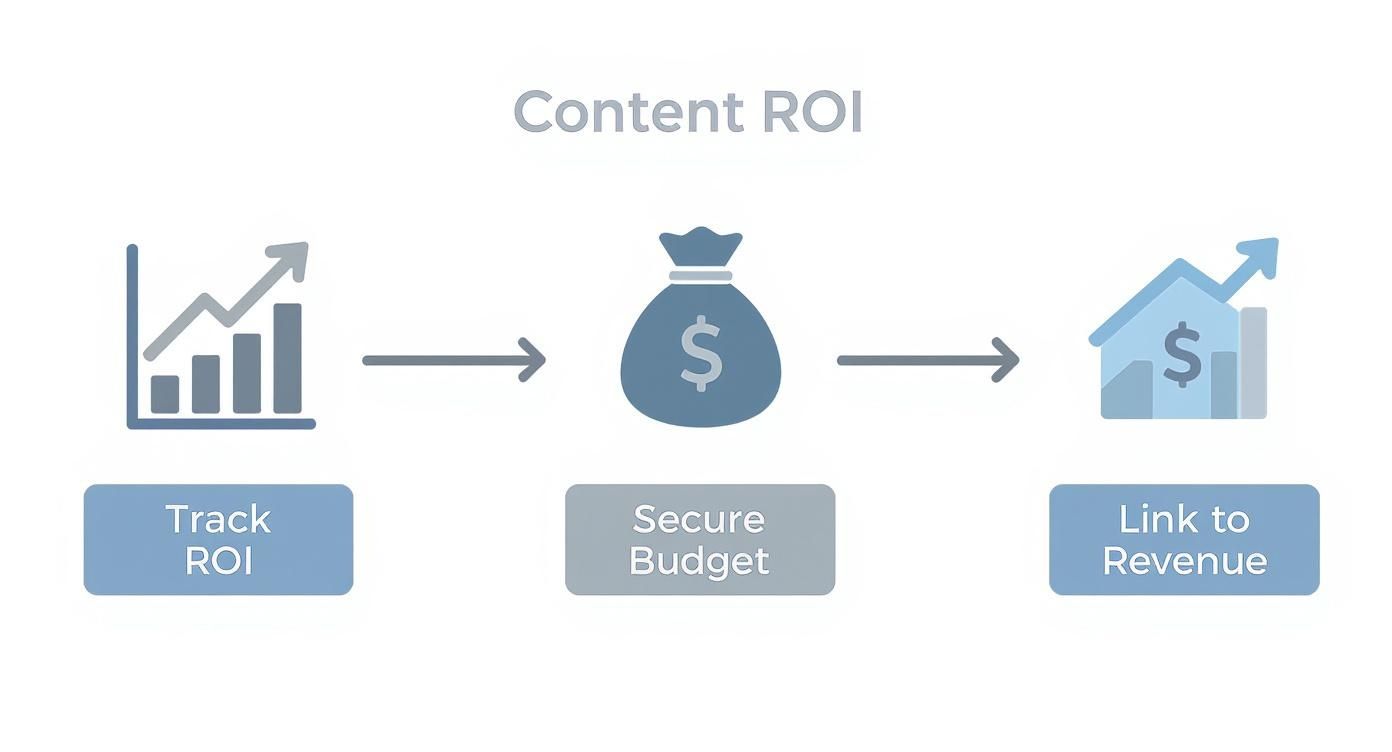
This infographic really drives home how tracking ROI secures your budget by connecting your marketing efforts directly to revenue.
 content marketing roi">
It's a great visual reminder that consistent measurement is how you prove your value and earn the resources you need to keep growing.
content marketing roi">
It's a great visual reminder that consistent measurement is how you prove your value and earn the resources you need to keep growing.
Tallying Up the Full Investment
To get to ROI, you first need a crystal-clear picture of your "I"—the investment. This is about so much more than what you paid a freelance writer. A true calculation of your Content Investment includes everything.
- Labor Costs: This covers salaries or freelance fees for your writers, editors, designers, videographers, and strategists. Just calculate their hourly rate and multiply it by the time they spent on a project.
- Tool & Software Costs: You need to attribute a portion of the cost of your tech stack—SEO tools like Semrush or Ahrefs, analytics platforms, design software like Canva or Adobe, and your CMS.
- Promotion & Ad Spend: Don't forget any money you put behind the content. This includes paid social promotion, search ads, or influencer collaborations used to get more eyeballs on your work.
Forgetting to account for "soft costs" like team salaries and software subscriptions is one of the biggest mistakes marketers make. A true ROI calculation requires you to capture every single dollar spent on the creation and distribution of your content.
Calculating Your Content Marketing ROI
Alright, with your goals defined and your costs tallied, you're ready for the main event. The fundamental ROI formula is simple but incredibly powerful:
Content ROI = ((Return - Investment) / Investment) * 100%
Let's walk through a real-world example. Imagine your B2B SaaS company just launched a new whitepaper.
Calculate Your Investment:
- Writer's Fee: $1,500
- Designer's Fee: $500
- LinkedIn Ad Spend: $1,000
- Total Investment: $3,000
Calculate Your Return:
- The whitepaper generated 50 marketing-qualified leads (MQLs).
- Looking at your historical data, you know that 10% of MQLs convert into customers. So, 50 MQLs x 10% = 5 new customers.
- The average lifetime value (LTV) of a customer is $2,000.
- Total Return: 5 customers x $2,000 LTV = $10,000
Calculate the ROI:
- ROI = (($10,000 - $3,000) / $3,000) * 100%
- ROI = ($7,000 / $3,000) * 100%
- ROI = 233%
Now you have a clear, defensible number that shows the real financial impact of your content. This is how you transform marketing conversations from subjective debates into data-backed strategy sessions.
Choosing Metrics That Actually Matter
Let's be honest: chasing vanity metrics like page views and social likes is a fast track to justifying a budget cut. Sure, those numbers might look pretty on a surface-level report, but they rarely tell the real story of your content's impact on the business.
Real success in measuring content marketing ROI comes from picking metrics that tie directly to revenue, customer acquisition, and genuine growth. The goal is to build a balanced scorecard that paints the full picture—from the first time someone stumbles upon your brand to the moment they become a paying customer. To do that, you need to understand two critical types of metrics.
Leading vs. Lagging Indicators
Think of your metrics like clues in a detective story. Some clues point you in the right direction, while others confirm you've solved the case.
- Leading Indicators are your forward-looking metrics. They're the early signals that predict future success and tell you if your strategy is actually working. We're talking about things like organic traffic growth, improved keyword rankings, and newsletter sign-ups. A steady climb here suggests revenue is likely to follow.
- Lagging Indicators are the backward-looking metrics that prove what you did in the past worked. These are your bottom-line results: new leads generated, demo requests, and, of course, closed-won deals. They confirm your earlier efforts paid off.
A classic mistake is focusing only on one type. A team obsessed with lagging indicators might miss the early warning signs that their content pipeline is drying up. On the flip side, a team that only ever reports on leading indicators will have a tough time proving their direct financial contribution when budget season rolls around.
The best measurement frameworks blend both. Use leading indicators to fine-tune your day-to-day tactics and lagging indicators to show leadership the ultimate value of your work.
This distinction is all about context. For example, a B2B SaaS company might see a whitepaper generate 500 downloads (a great leading indicator). But the real story is how many of those downloads turned into qualified demo requests (a crucial lagging indicator) three months down the line.

Building Your Balanced Scorecard
Your ideal set of metrics isn't a one-size-fits-all checklist; it depends entirely on your business model and goals. An e-commerce brand and a B2B software company should measure success very differently.
Scenario 1: An E-commerce Brand An online retailer's main goal is driving direct sales. Their content—whether it's a style guide or a product-focused blog post—needs to be measured on its ability to drive immediate purchases.
- Top Leading Metric: Conversion rate from blog traffic. How many people read a post, click through to a product, and actually buy it?
- Top Lagging Metric: Average order value (AOV) from content-driven customers. Are people who read your content spending more than other customers?
Scenario 2: A B2B SaaS Company A B2B company with a long, complex sales cycle needs to measure how content influences high-value leads over several months.
- Top Leading Metric: Marketing Qualified Leads (MQLs) from gated assets like webinars or ebooks. This shows the content is pulling in the right crowd.
- Top Lagging Metric: Content-influenced pipeline. This tracks how many sales opportunities were "touched" by one or more pieces of your content before a deal closed.
As you can see, choosing the right metrics is all about aligning measurement with your specific business objectives. For a deeper look at this, our guide on how to measure SEO success offers a solid foundation for tracking performance from the ground up.
Moving Beyond Simple Metrics
As you get more sophisticated, understanding the difference between ROI vs. ROAS becomes incredibly important. ROI (Return on Investment) measures profit, while ROAS (Return on Ad Spend) measures revenue. Getting this right is critical for accurately reporting on your content's profitability.
The pressure to prove financial impact isn't going away. In fact, it's growing. A recent report found that 83% of marketing leaders now see demonstrating ROI as their top priority. The problem? Only 36% feel they can measure it accurately, with nearly half struggling to connect the dots across different channels.
This gap shows just how badly we need a more thoughtful approach to measurement—one that moves beyond simple vanity metrics and embraces a model that truly reflects the complex journey of today's buyer.
Attributing Value: The Final Piece of the Puzzle
Once you've defined what to measure, you have to figure out how to assign credit. This is where attribution modeling comes in. An attribution model is just a set of rules that determines how credit for a conversion is assigned to different touchpoints in a customer's journey.
Getting this right is crucial because it directly impacts how you value each piece of content. Here's a quick rundown of the most common models.
Comparing Attribution Models for Content Marketers
| Attribution Model | How It Works | Best For | Potential Pitfall |
|---|---|---|---|
| First-Touch | Gives 100% of the credit to the very first piece of content a user interacted with. | Marketers focused purely on top-of-funnel awareness and demand generation. | Ignores all the content that nurtured the lead toward a final decision. |
| Last-Touch | Gives 100% of the credit to the final touchpoint before conversion. | Teams focused on bottom-of-funnel, decision-stage content. | Devalues the initial content that introduced the customer to your brand. |
| Linear | Spreads credit evenly across every single touchpoint in the customer's journey. | Companies with long sales cycles where every touchpoint is considered equal. | Can dilute the impact of truly influential pieces of content. |
| U-Shaped | Gives 40% of the credit to the first touch, 40% to the last, and divides the remaining 20% among the middle touches. | Businesses that value both the initial awareness-driver and the final conversion-driver. | May undervalue important mid-funnel educational content. |
Choosing an attribution model isn't a "set it and forget it" task. The best model for you depends on your sales cycle, your marketing strategy, and what you're trying to prove. For most content marketers, a multi-touch model like Linear or U-Shaped gives a more realistic view than a single-touch model. It acknowledges that content plays a role throughout the entire buyer's journey, not just at the beginning or the end.
Using Technology for Accurate Tracking
Let's be honest: you can't calculate a precise return on investment with guesswork and a messy spreadsheet. If you want real accuracy in measuring content marketing ROI, you need to build a solid tech stack where data flows smoothly from one platform to another, telling the complete story of a customer's journey.
This isn't about collecting a random pile of software. It’s about strategically connecting your analytics platforms, customer relationship management (CRM) systems, and SEO tools to create a single source of truth. The goal is to follow a user from their very first interaction with a blog post all the way through to becoming a paying customer.

This dashboard in GA4 gives you a great high-level snapshot of where your users are coming from and how they're engaging. From here, you can start digging deeper to connect these initial touchpoints to the specific content that brought them in.
Creating a Seamless Data Flow
The real power of your tech stack is in how well it's integrated. Each piece of software has a distinct job, but they all need to work together to track your content's path to revenue.
- Analytics Platforms (like Google Analytics 4): This is your foundation for understanding what happens on your site. GA4 is non-negotiable for monitoring traffic, user engagement, and—most importantly—conversions. It tells you which content pieces are pulling people in and keeping them around.
- CRM Systems (like HubSpot or Salesforce): Your CRM is where leads turn into actual customers. By integrating it with your analytics, you can finally attribute real dollars back to the content that first attracted a lead. This is the crucial final link in the ROI chain.
- SEO Tools (like Semrush or Ahrefs): These tools give you the "before" picture. They help you figure out which keywords are driving valuable traffic and how your content is performing in search, giving you leading indicators of what’s to come.
The magic really happens when these systems talk to each other. For example, when a user lands on your blog from an organic search, that data is in GA4. If they later fill out a demo request form, that data should flow seamlessly into your CRM, tagging that new lead with its original content source.
Practical Steps for Accurate Tracking
Getting this data flow right requires some deliberate setup. It’s not automatic, but a few key practices can ensure your tracking is clean, consistent, and reliable.
One of the simplest yet most powerful tools in your arsenal is the consistent use of UTM parameters. These are just small snippets of code you add to a URL that tell your analytics exactly where a visitor came from. By tagging every single link in your email campaigns, social media posts, and ads, you eliminate the guesswork and get crystal-clear attribution.
Another must-do is setting up custom conversion goals in GA4. Don't just track the final sale. You need to create goals for micro-conversions, too—things like newsletter sign-ups, PDF downloads, or video plays. This helps you measure the value of your top-of-funnel content that doesn't lead directly to a purchase but plays a vital role in nurturing the buyer.
A well-configured tech stack does more than just collect data; it provides a narrative. It shows you precisely how a top-of-funnel blog post published six months ago contributed to a major sale that closed today, making the value of your content undeniable.
Of course, the quality of your insights is only as good as the quality of your data. To get the most accurate tracking and trustworthy ROI reports, you have to proactively address and solve potential data integrity problems that can silently throw off your analytics. Without reliable data, even the best tools will lead you to the wrong conclusions.
Ultimately, getting a handle on your tech stack is about turning abstract marketing activities into concrete financial results. When you can confidently show stakeholders exactly how your content is performing, you stop having to justify your budget and start proving your value as a growth driver. For agencies looking to build out their reporting capabilities, exploring a range of SEO reporting tools is a great next step in creating a powerful and effective tech stack.
Analyzing and Reporting Your Content ROI
Pulling all that data together is one thing, but it's only half the battle. The real magic happens when you can turn those raw numbers into a story that actually means something to stakeholders—a story that justifies your budget and helps steer the ship for what comes next. A spreadsheet packed with metrics is just noise until you give it a narrative.
Your job is to move past simply showing data points and start delivering real, actionable insights. A solid ROI report is the bridge connecting your team’s hard work, like publishing blog posts or hosting webinars, to the big-picture goals your leadership team obsesses over, like revenue growth and grabbing more market share.
Crafting a Narrative with Your Data
The most impactful reports don’t just say what happened; they explain why it happened and what you’re going to do about it. Think of yourself as a data storyteller. Your report needs a clear beginning, middle, and end that guides stakeholders through your performance, from the high-level wins down to your strategic recommendations.
This means giving your numbers some much-needed context. Instead of just stating, "organic traffic increased by 15%," you need to connect it to an action. Something more like: "Our strategic focus on long-tail keywords for the 'Project Management Basics' content cluster drove a 15% increase in organic traffic this quarter, bringing in a highly relevant, top-of-funnel audience." See the difference?
Building Your Monthly or Quarterly ROI Report
Having a standardized report structure creates consistency and makes it much easier for everyone to track progress over time. The exact details will shift based on your specific goals, but any strong content ROI report needs these core elements.
- Executive Summary: Start with a single, punchy paragraph right at the top. This is for the C-suite folks who might not read anything else. Hit them with the overall ROI, the biggest wins, and the main takeaway.
- Performance Against Goals: Circle back to those SMART goals you set. Don't just list them; use clean visuals like charts and graphs to show exactly where you stand on each target.
- Key Wins and Highlights: This is where you bring the data to life. Did one particular blog post absolutely crush it and generate a massive lead? Did a case study get mentioned by an industry influencer? Call out these specific victories.
- Challenges and Learnings: Don’t be afraid to be transparent about what flopped. Talking about what didn't work builds trust and shows you’re committed to learning and adapting, not just chasing vanity metrics.
- Strategic Recommendations: This is the most important part of the whole document. Based on everything you've just shown, what’s the plan? Propose concrete actions, like shifting budget to a channel that's overperforming or doubling down on a content topic that's clearly hitting a nerve.
A great report doesn't just look backward; it uses past performance to build a data-driven roadmap for the future. It answers the question, "What should we do next?" with concrete evidence, not just opinions.
Getting this right is more important than ever. The average return for content marketing is now $5.20 in revenue for every $1 spent, but the top teams can see returns as high as $13 for each dollar invested. On top of that, content now influences a staggering 67% of B2B purchase decisions before a sales rep even enters the conversation. That's a ton of impact.
Turning Negative ROI into an Opportunity
Look, it’s going to happen. You’ll launch a campaign or publish a piece of content that ends up with a negative ROI. This isn’t a failure—it’s a data point. How you frame these results is what separates the pros from the amateurs and is critical for keeping stakeholder trust.
Don’t try to bury bad results. Tackle them head-on. A negative ROI is just data telling you that your initial hypothesis was off the mark. Use it as a chance to show what you've learned and how you're going to pivot.
For example, you could frame it this way: "Our webinar campaign came in at a -15% ROI because the cost-per-lead was higher than we projected. Our analysis showed the topic, while interesting, was ultimately too niche to draw a large enough audience. Moving forward, we'll focus our webinars on broader themes that have already proven successful on our blog, ensuring we attract a larger, more qualified audience from the start."
This kind of response shows strategic thinking and a commitment to getting better. Of course, catching these issues early is crucial. Adopting the best practices for SEO performance monitoring gives you the early warning signs needed to adjust your course before a small dip becomes a big problem. When you treat every outcome—good or bad—as a strategic lesson, you prove your team's value and build a resilient, data-driven content machine.
Common Questions on Measuring Content Marketing ROI
Even with a solid framework in hand, measuring content marketing ROI can sometimes feel like you're trying to nail Jell-O to a wall. A few questions pop up over and over, especially when you’re dealing with the messy realities of long B2B sales cycles or top-of-funnel content that doesn't scream "immediate sale!"
Let's break down some of the most common hurdles marketers run into. Think of this as your field guide for those tricky scenarios that don't fit neatly into a spreadsheet.
How Do I Measure the ROI of Top-of-Funnel Content?
This is the big one, isn't it? A blog post or an infographic rarely makes someone pull out their credit card on the spot. So, how do you prove its value? The trick is to stop looking for a direct sale and start measuring influence and initial engagement.
You're not tracking the final purchase; you're tracking the first handshake.
Start by focusing on the metrics that tell you you're attracting the right crowd. These are your leading indicators:
- Organic Traffic Growth: Is this content actually bringing new, relevant eyeballs to your website?
- Keyword Ranking Improvements: Is your brand becoming more visible for the search terms that matter?
- Newsletter Sign-ups: Is your content compelling enough for someone to say, "Yes, I want to hear more from you"?
From there, you can dig into your analytics to trace the user journey. Look for assisted conversions. This is where someone first finds you through a blog post, leaves, and then comes back later through another channel to finally convert. Each of those sign-ups has a dollar value, which you can calculate based on historical data. This gives your top-of-funnel content a tangible, if indirect, ROI.
What Is a Realistic Timeframe for Positive Content ROI?
In the world of content marketing, patience isn't just a virtue—it's a requirement. If you’re used to the instant feedback loop of paid ads, content can feel painfully slow. Expecting a massive financial return in the first few months is just setting yourself up for failure.
While every strategy is different, a good rule of thumb is to look for real traction in your leading indicators within 6 to 9 months. By then, you should see a clear upward trend in your organic traffic, keyword rankings, and maybe even lead flow.
But for a significant, positive monetary ROI—especially if you're banking on an SEO-driven strategy—you’re often looking at a 12 to 18 month timeline. That's usually the point where content has had time to mature, attract backlinks, and consistently pull in high-intent organic traffic that actually turns into customers.
How Does a Long Sales Cycle Affect ROI Calculation?
When a deal takes six months, a year, or even longer to close, last-touch attribution is basically useless. A B2B buyer might read a dozen blog posts, attend two of your webinars, and download three case studies before they ever talk to a sales rep.
In this scenario, you have to track the micro-conversions that happen all along that winding buyer's journey. A whitepaper download, a webinar registration, or even a visit to your pricing page are all crucial signals that someone is moving in the right direction.
This is where a multi-touch attribution model is non-negotiable. Using a model like linear or U-shaped inside your CRM allows you to give credit to all the different content touchpoints that influenced the deal. It gives you a much more accurate picture of how your entire content library works as a team to nurture leads and close those big, high-value deals.
Ready to stop guessing and start proving your content's value? IndexPilot is the AI-powered SEO platform that turns keywords into compounding traffic and measurable ROI. Automate your entire workflow—from strategy and writing to optimization and publishing—so you can focus on the results that matter. See how it works at https://www.indexpilot.ai.