Competitor rank tracking is all about keeping tabs on your rivals' keyword positions in the search results. It’s a core SEO practice, but I like to think of it less as a task and more as a live roadmap of the competitive battlefield. It shows you exactly what's working for them so you can build a smarter strategy to get ahead.
This isn't just about playing defense; it’s about turning potential threats into your next big win.
Why Competitor Rank Tracking Is Your Secret Weapon

Let's be real for a second. Simply knowing where you rank is only half the picture. Without the context of what your competitors are doing, you’re flying blind. You have no way of knowing if a drop in rankings is due to a market-wide algorithm shift or a specific weakness in your own strategy.
Think of it like this: when a competitor suddenly shoots up the rankings for one of your money keywords, that’s not just bad news—it’s an intelligence report dropped right in your lap. It’s a massive signal that something they did is resonating with search engines, and it’s your job to figure out what it was. This is where the practice transforms into your secret weapon for a real strategic advantage.
Uncovering Hidden Content Gaps
One of the first things you'll notice is the content gaps you never even knew you had. It’s easy to get tunnel vision, focusing only on your commercial, bottom-of-funnel pages. Meanwhile, your competitors could be quietly dominating all the informational queries that attract customers much earlier in their journey.
I saw this happen with an e-commerce store selling high-end coffee grinders. They were obsessed with their rankings for terms like "buy burr coffee grinder," but they noticed a competitor’s new, in-depth guide on "how to dial in espresso" was outranking everything. That wasn’t a failure; it was a revelation. The data was screaming at them, showing a clear need for top-of-funnel content to build authority and capture a whole different audience segment.
This kind of insight lets you:
- Spot lucrative topics your audience is actively searching for that you're completely ignoring.
- Understand the real user intent Google is rewarding for key terms, which is often different from what we assume.
- Broaden your content strategy to build a more resilient organic presence that isn’t just propped up by a few high-stakes keywords.
Anticipating Market Trends and Keyword Opportunities
The SERPs are a living, breathing thing, always in flux. By consistently watching your rivals, you can catch the early signs of emerging trends and jump on valuable keywords before they become saturated. If you see two or three competitors suddenly start targeting a new long-tail keyword or a topic cluster, that’s a huge indicator of growing market interest.
By keeping a close eye on your competitors’ movements, you’re not just reacting to the market—you’re learning to predict it. This proactive stance allows you to allocate resources to high-potential areas before they become hyper-competitive battlegrounds.
This forward-looking intelligence helps you stay agile. Instead of waiting for a quarterly report to show a traffic decline, you can see competitive shifts happening in real-time and adjust your content and SEO priorities on the fly.
The Next Frontier: AI Visibility
The whole concept of "ranking" is evolving past traditional search engines. The new frontier is visibility inside AI models like ChatGPT, Gemini, and Perplexity. Tracking how often your brand—and your competitors'—are mentioned or cited in AI-generated answers is the next phase of competitive intelligence.
Monitoring brand presence in these systems is quickly becoming just as vital as tracking SERP positions. It shows who is being positioned as the go-to authority on specific topics within the AI ecosystem. Getting in early gives you a massive opportunity to build a presence and shape the narrative in these influential new channels, ensuring you don’t get left behind as user behavior continues to shift.
Setting Goals and Identifying Your Real SERP Competitors
Effective competitor rank tracking doesn't start when you plug a keyword into a tool. It begins long before that, with a crystal-clear understanding of what "winning" actually means for your business.
Just aiming to "rank higher" is a vague wish, not a strategy. It's a recipe for wasted effort and results you can't even properly measure. You need specific, measurable objectives that tie directly back to your bigger marketing goals.
Think of it this way: a vague goal has no finish line, but a specific one gives you a target to hit. A SaaS company, for instance, might aim to "increase organic visibility for 'financial planning tools' by 20% over the next six months." An e-commerce brand could set a goal to "capture three featured snippets from Competitor X for our top product categories this quarter."
Goals like these bring clarity. They focus your efforts and make it dead simple to measure success, turning passive monitoring into an active, strategic game plan.
Defining Your Competitive Landscape
Here’s a critical mistake I see all the time: businesses assume their biggest rivals in the market are also their main competitors on the SERP. That’s rarely the case.
The brand you fight for market share with might be a ghost in the search results for your most important keywords. Your true competitors are the domains that consistently show up and battle for the same digital real estate you want.
Finding these players is pretty straightforward. Start by running incognito searches for your top 10-15 commercial and informational keywords. The domains that pop up most often? Those are your real SERP competitors. This step is non-negotiable—it shows you exactly who you need to study and outperform.
For a deeper dive, our complete guide on how to conduct a thorough SEO competitor analysis walks you through the entire process.
Once you have your list, don't treat them all as equal threats. You'll want to categorize them into tiers to focus your energy where it'll actually move the needle.
How to Tier Your Competitors for Focused Tracking
You can't analyze every single rival with the same intensity—you'll drown in data. A simple tiering system is the key to a more nuanced and effective tracking strategy, helping you prioritize your analysis and actions.
Here’s a simple framework to help you organize your competitors.
Competitor Tiering Framework
| Competitor Tier | Definition | Tracking Focus | Example Action |
|---|---|---|---|
| Primary | Direct rivals with similar products/services, consistently ranking for your main keywords. | Daily keyword movements, new content, and SERP feature ownership. | Analyze their new top-ranking blog post to create a more comprehensive version. |
| Secondary | Indirect rivals solving the same user problem with a different solution or targeting a broader topic. | Monthly trend analysis, content formats, and backlink strategies. | Notice they are gaining traction with video; add video content to your strategy. |
| Aspirational | Market leaders or major publications who dominate the space, even if they aren't direct competitors. | High-level content strategy, site structure, and brand authority tactics. | Study how they structure their topic clusters to improve your own site architecture. |
This tiered approach ensures you don't get lost in the noise. It lets you dedicate your most intense tracking to primary competitors while learning from the broader strategies of the big players.
The goal of competitor tiering isn't just to make a list; it's to create a strategic filter. It tells you who to watch daily for tactical threats and who to study quarterly for strategic inspiration.
Ultimately, this methodical approach to goal-setting and competitor identification lays the foundation for a powerful tracking system. It’s important to remember that the digital landscape is dynamic; a study in early 2025 found that e-commerce sites monitoring up to 20 competitors saw a 22% increase in organic traffic within just six months. Discover more insights about the impact of detailed rank tracking.
Building Your Automated Tracking System
Alright, you've got your goals mapped out and a tiered list of competitors. Now it's time to build the engine that will actually power your strategy. A well-configured competitor rank tracking system should work for you, delivering critical data without demanding hours of manual checks. This is all about setting up a proactive, automated workflow that surfaces insights while you focus on execution.
The first move is selecting a balanced mix of keywords. Don't just dump a list of high-volume, head terms into your tool and call it a day. A smart keyword portfolio reflects the entire customer journey.
- Commercial Keywords: These are your high-intent, bottom-of-the-funnel terms. Think things like "best project management software for small teams." They're usually super competitive but absolutely essential for tracking direct revenue opportunities.
- Informational Keywords: This is where you capture people before they're even thinking about buying. These are the questions and topics your audience searches for, like "how to improve team collaboration." Winning here builds authority and gets you on their radar early.
- Long-Tail Keywords: These are the hyper-specific queries that reveal exactly what a user needs. Something like "Gantt chart software with time tracking integration" might have lower search volume, but the conversion rates are often incredible.
This balanced approach gives you a complete picture of the competitive landscape, not just one small, crowded corner of it.
This process really boils down to three core stages, which is the foundation for everything that follows.
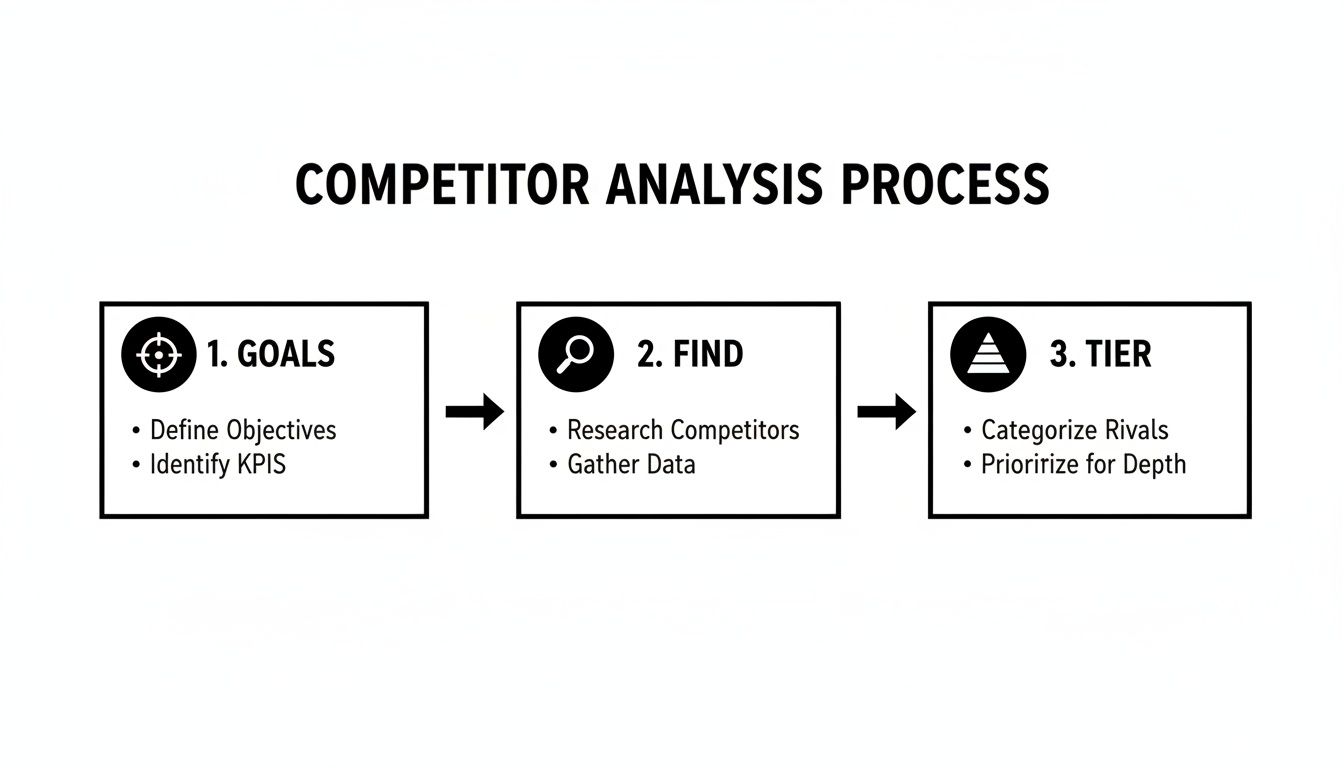
As you can see, a solid tracking strategy always starts with clear goals before you even think about identifying and tiering your true SERP competitors.
Configure Your Tracking Parameters
Generic, global tracking is one of the most common mistakes I see. It produces data that looks impressive in a spreadsheet but is practically useless for making real-world decisions. For your competitor rank tracking to be truly actionable, you have to configure it to mirror how your target audience actually searches.
Get specific with your setup.
First, think about device segmentation. Rankings can swing wildly between desktop and mobile, especially for local searches. If your Google Analytics shows that 70% of your traffic is coming from mobile devices, you absolutely need to prioritize mobile rank tracking. Otherwise, you aren't seeing what most of your customers see.
Next up is geographic location. Tracking from a generic US-based server does you no good if your primary market is in London. You need to set up location-specific tracking projects for every single city, state, or country that matters to your business. This is the only way to monitor the SERPs that are relevant to your actual audience. Many modern platforms offer deep customization here; it's worth learning about the essential rank tracker features you should expect from any tool you use.
Setting up granular tracking isn't just a best practice; it's a strategic necessity. It prevents you from making decisions based on inaccurate data and reveals localized opportunities your competitors might be completely missing.
Create Smart Alerts for Proactive Insights
This is where your tracking system goes from a passive dashboard to an active, early-warning system. Let's be honest, manually checking rankings every day is inefficient and completely unsustainable. The real game-changer is automation through smart alerts, which lets you act on changes as they happen.
Instead of drowning in a sea of meaningless notifications, you create alerts for specific, high-impact events. These triggers turn raw data into a clear signal that screams, "Pay attention to this!"
Here are a few high-value alerts you should set up right now:
- New Top 3 Entrant: Get an email the second a competitor breaks into the top three spots for one of your core commercial keywords. This is a major threat that requires an immediate deep dive.
- Significant Rank Drop: Set a notification if any of your key pages drop more than five positions. This could be a sign of a technical issue, a lost backlink, or a competitor's content update that just hit the mark.
- SERP Feature Ownership Change: Create an alert for when a competitor snatches a featured snippet you previously owned. Reclaiming that valuable SERP real estate should become an immediate priority.
- New Keyword Discovery: Some of the best tools can alert you when a competitor you're tracking starts ranking in the top 10 for a brand-new keyword. This is a goldmine for discovering emerging topics and content opportunities before they become saturated.
By setting up these automated monitors, you fundamentally shift from a reactive to a proactive SEO posture. You're no longer just reporting on what happened last month; you're ready to respond to competitive threats and opportunities in near real-time.
Finding Actioned Insights in Your Ranking Data
A dashboard crammed with colorful charts is just noise until you learn how to read it. The real magic of competitor rank tracking is turning that raw data into a clear strategic direction for your team. It’s all about moving past the simple “who went up or down” and digging into the far more important question of why.
Think of it as detective work. A sudden shake-up in the SERPs is a clue, and your job is to follow the evidence to figure out what happened. Was it a recent Google algorithm update that sent everyone scrambling? Or did a competitor just drop a massive new content hub that’s clearly hitting the mark with both users and search engines?
Pinpointing the cause behind any big ranking change is the first, crucial step toward building an effective counter-strategy. Without this analysis, you’re just chasing symptoms instead of getting to the root cause of a competitor's win.
Pinpointing Critical Keyword Gaps
One of the first and most valuable things you'll uncover is the keyword gap. These are the money terms your competitors are ranking for that you’ve completely overlooked. It’s like discovering they’ve set up shop on a busy street you didn't even know existed.
A keyword gap analysis shows you the exact language your target audience is using that isn't showing up anywhere in your content strategy. For instance, your tracking might reveal a secondary competitor is consistently landing in the top five for "project management templates for startups," a long-tail keyword you've never even tried to target.
This isn’t just a missed keyword; it’s a direct signal of user intent and a crystal-clear content opportunity. It tells you that a specific slice of your audience wants practical, ready-to-use resources, not just another high-level guide. You can dig deeper into this process by checking out our guide on leveraging SEO ranking data.
A keyword gap is more than a missing term on a spreadsheet. It's a strategic blind spot. Every gap you find is a new chance to join a conversation with your audience and pull in traffic that was previously going straight to your rivals.
Uncovering Winning Content Formats
Beyond just the keywords, your competitor data tells you which types of content are actually winning in the SERPs. Are your competitors dominating with deep, long-form how-to guides? Or are they grabbing top spots with short, snappy explainer videos?
Take a hard look at the URLs that consistently rank for your target queries—it’s a blueprint for what works. If you see a competitor’s case study pages are outperforming your product pages for commercial terms, that's a huge insight. It means that for this particular search, users want proof and real-world examples, not a sales pitch.
Consistently watching these patterns helps you:
- Spot high-performing formats like listicles, calculators, or "ultimate guides."
- Grasp the user intent Google is rewarding for specific groups of keywords.
- Tweak your content calendar to create assets with a proven track record in your niche.
This kind of analysis is non-negotiable if you want to stay competitive. For example, recent data from Ahrefs showed that e-commerce teams benchmarking against rivals found they were underperforming on 37% of their target keywords. Simply closing these content gaps resulted in an average ranking jump of 14 positions. You need these granular insights to stay ahead. Learn more about the competitive marketing benchmarks.
Tracking and Dominating SERP Features
Finally, modern rank tracking is about so much more than the classic blue links. A massive chunk of visibility now comes from owning valuable SERP features. These are the special result formats that jump off the search page—things like featured snippets, People Also Ask (PAA) boxes, image packs, and video carousels.
Your tracking tool has to give you a clear picture of who owns this prime real estate. If a competitor consistently nails the featured snippet for a high-volume question, they basically become the default answer for that topic. That’s a huge visibility boost and immediately frames them as an authority.
By tracking these features, you can set sharp, actionable goals. Instead of just aiming to "rank higher," you can get specific: "steal the featured snippet for 'how to choose a CRM' from Competitor X." This targeted approach lets you create content that’s perfectly structured to win these spots, maybe by using a clean Q&A format or a concise numbered list. Owning these elements gives you a powerful competitive advantage that a simple ranking position just can't match.
Turning Competitive Insights into Winning Content

This is where the real magic happens. All that meticulous competitor rank tracking goes from being interesting data points on a dashboard to real-world business impact. Insights are only as valuable as the action they inspire, and right now, we’re going to bridge that crucial gap between your rank tracking tool and your content calendar.
The goal is to build a seamless, repeatable workflow. One that takes a freshly discovered content gap and turns it into a high-quality article your team can knock out of the park. Too often, teams just admire the data without a clear process to act on it. You spot a competitor ranking for a keyword you've missed, make a mental note, and get pulled into something else. To actually win, you need a system that funnels that discovery straight into your content pipeline.
From Content Gap to High-Impact Brief
Let’s imagine a real-world scenario. You get an alert: a key competitor just broke into the top 5 for "enterprise data security best practices." You check out their new article and see it's a comprehensive guide hitting multiple user intents. This is your cue.
Your first move isn't just to write your own version. It's to dissect their success. What's the structure of their article? What subtopics are they covering? How are they using visuals? What SERP features did they manage to capture? This initial analysis is the bedrock of your content brief.
A truly powerful brief needs to include:
- Primary and Secondary Keywords: Go deeper than the main term. What related questions and long-tail keywords are helping them rank?
- Target Audience and Intent: Who is this for, really? Are they after a high-level overview or a detailed technical checklist for their team?
- Competitor URL for Analysis: Give your writer a direct link to the piece they need to beat. Context is everything.
- Key Topics to Cover: List the essential subheadings and questions your article must answer to be more thorough and helpful.
Creating a structured brief like this arms your writers with everything they need to produce content that isn't just competitive—it's superior. For a much deeper dive into this, check out our guide on performing a complete SEO content gap analysis.
Your goal isn't just to match your competitor's content. It's to create the piece of content that makes theirs obsolete by being more thorough, more helpful, and better optimized for the user's entire journey.
Accelerating Content Creation with AI
Let's be honest, manually researching, outlining, and writing comprehensive content is a massive bottleneck. It can leave your competitors enjoying their rankings for weeks, even months, while you play catch-up. This is exactly where AI-powered platforms can step in to close the loop from analysis to publication almost instantly.
Modern systems can take the insights from your rank tracking and immediately put them to work. For example, platforms like Sight AI use specialized AI agents to take a topic like "enterprise data security" and do all the heavy lifting, creating an incredibly efficient workflow.
This approach is similar to how teams monitor AI models like ChatGPT, where tracking positions can reveal citation gaps and drive sustainable growth. With 13+ specialized AI agents that can research, outline, and produce 2,500–4,500 word SEO-optimized articles, teams can publish consistently without the manual grind. The best platforms can even push the finished content straight to your CMS, keep your sitemap fresh, and speed up discovery with automatic IndexNow submissions to Google and Bing.
Common Questions About Competitor Rank Tracking
Diving into competitor rank tracking always brings up a ton of questions. It's one thing to get the theory, but actually putting it into practice is where the real head-scratchers pop up. I get it. You're trying to figure out how to make this work without getting lost in the weeds.
So, let's tackle some of the most common questions I hear. Think of these answers as practical advice from the trenches to keep your competitive analysis sharp, focused, and genuinely useful.
How Often Should I Check Competitor Rankings?
For most businesses, the sweet spot is a mix of daily automated tracking and a weekly manual review.
Daily automated checks are your early warning system. They're what power your smart alerts, so you catch any sudden, critical SERP movements the second they happen. You'll know immediately if a rival snags a featured snippet or jumps into the top three for a money keyword. You can't afford to miss that stuff.
Then, once a week, set aside time for a deeper, manual analysis. This is where you zoom out to spot the bigger trends. It stops you from overreacting to tiny daily fluctuations that don't mean much. Of course, if you're in a super-competitive space like e-commerce or travel, you might need to check in more often, but good automation is what keeps you from drowning in data.
What Metrics Matter Besides Keyword Rank?
Just looking at a simple ranking position is like only knowing the final score of a game—you miss all the important plays that led to it. To really understand what's happening on the SERP, you need to track a few other key metrics.
- Share of Voice (SoV): Sometimes called a Visibility Score, this metric shows your overall market presence against your competitors for your target keywords. It answers the question: "Who's really owning the conversation here?"
- SERP Feature Ownership: Look beyond the standard blue links. Pay close attention to who's winning the featured snippets, image packs, "People Also Ask" boxes, and video carousels. These features dominate the screen and often get more clicks.
- Ranking URLs: This is a big one. Don't just track the keyword; track the specific URL that's ranking. This tells you exactly what kind of content is winning for a given query—is it a blog post, a product page, or a category page?
Focusing only on rank is like watching the scoreboard without seeing the game. Metrics like Share of Voice and SERP feature ownership reveal the strategic plays that are actually winning in the search results.
How Do I Choose the Right Competitors to Track?
Here's a crucial point: your biggest business rival might not be your main SERP competitor. You need to track the companies that consistently show up in the search results for the keywords you care about most.
A simple way to find them is to open an incognito window, search for your top 10-15 keywords, and jot down the domains you see over and over. Those are your true digital competitors.
From there, I've found it incredibly helpful to group them into tiers:
- Direct Competitors: They sell similar stuff and target the same audience. They're your top priority.
- Indirect Competitors: They solve the same problem for your customer but with a different solution (e.g., a meal kit service vs. a recipe blog).
- Aspirational Competitors: These are the market leaders. You might not compete with them head-to-head today, but you can learn a ton from their strategy.
A Competitor's Ranking Suddenly Spiked. What Now?
First off, don't panic. A sudden spike is a learning opportunity, not a catastrophe.
Your first move is to investigate. Pinpoint the exact URL and the specific keywords that saw the jump. Then, put on your analyst hat and dig into that page. Did they just publish a massive 5,000-word guide? Did they completely overhaul an old post with fresh data, new images, and better internal links?
Also, check their backlink profile. Did they just land a few killer links from authoritative sites? Understanding the "why" behind their win is everything. Once you've diagnosed the cause, you can build a counter-strategy—like creating an even better, more comprehensive piece of content. Our complete guide on how to track keyword rankings can walk you through more of the nitty-gritty here.
Ready to turn competitive insights into measurable growth? Sight AI monitors your brand's visibility across AI and search, surfaces high-value content gaps, and uses specialized AI agents to create SEO-optimized articles that get you ranking. Start winning your market today.