
An SEO content gap analysis is all about figuring out what valuable keywords and topics your competitors are ranking for, but you aren't. It's a smart, methodical way to spot those missed opportunities and sharpen your entire content strategy.
What Is An SEO Content Gap Analysis And Why It Matters

Think of a content gap analysis as your competitive blueprint. It goes way beyond basic keyword research because you’re directly comparing your website's content footprint against your biggest rivals. The whole point is to find the specific "gaps"—those queries, questions, and themes where your audience is finding them instead of you.
This process is the bedrock of any solid content strategy because it swaps guesswork for actual data. Instead of throwing ideas at the wall and seeing what sticks, you can systematically pinpoint proven concepts that are already driving traffic for others in your space.
Beyond Just Creating New Content
A huge misconception is that this kind of analysis only tells you what new content to create. Sure, that’s part of it, but a much more powerful application is finding your own underperforming pages.
You might discover a competitor is sitting in the top three for a keyword where your own article is stuck on page two. That "gap" isn't a missing topic; it's a gap in depth, authority, or relevance.
Frankly, tons of marketers miss out on massive SEO wins because they ignore these content update opportunities. They get fixated on the churn of publishing new posts. A proper analysis puts maximizing your existing assets first, which often leads to huge performance lifts without having to start from zero.
The Tangible Business Impact
When you get right down to it, doing an SEO content gap analysis delivers real, measurable business value. It connects the dots between content creation and strategic company goals.
- Steal Competitor Traffic: You can go after the exact keywords that are already sending qualified visitors to your competitors.
- Cover the Full Buyer Journey: The analysis often uncovers gaps at different stages of the funnel. Maybe you're missing comparison content for people ready to make a decision.
- Build Topical Authority: By methodically filling in gaps around a core subject, you signal to Google that your site is a comprehensive resource. This can lift rankings for your entire topic cluster.
This isn't just another audit; it’s an offensive strategy. It gives you a precise roadmap showing where to focus your resources to capture market share, answer user questions better than anyone else, and drive real organic growth.
Assembling Your Toolkit and Identifying True Competitors
Before you can even think about finding content gaps, you've got to get your house in order. That means gathering the right tools for the job and—this is a big one—getting crystal clear on who you're really competing against in the search results. I’ve found that a smart mix of free and paid platforms usually gives the most complete picture.
First up, and this one’s non-negotiable, is Google Search Console (GSC). It's a free, direct line to how Google sees your website. Its real superpower for this kind of analysis is digging up what we call "striking distance" keywords. These are the queries where your pages are already getting impressions—they're showing up, just buried on page two or beyond, earning you next to no clicks. Using GSC this way is the cornerstone of a targeted strategy because it hands you a list of topics where there's a clear disconnect between your content and what users are actually looking for.
Distinguishing SERP Rivals from Business Competitors
Here's a classic mistake I see all the time: assuming your direct business competitors are your only SEO competitors. They’re usually not. A true SERP competitor is any domain that consistently ranks for the keywords you want to own, plain and simple. It doesn't matter if they sell the same thing you do.
Let's say you're a B2B SaaS company with a great project management tool. Your biggest business rival is probably another software company. But when you look at the search results for "how to improve team productivity," you're suddenly up against:
- Huge business publications like Forbes or Harvard Business Review.
- Niche productivity blogs running on affiliate revenue.
- Consulting firms that don't even have a software product.
If you ignore these players, you're flying blind. Your analysis has to be grounded in the reality of who Google is actually showing people, not just who you think your rivals are. To really nail this, you need to know how to properly conduct competitive analysis.
The key is to shift your mindset from "Who are my business rivals?" to "Who is my audience finding when they search for solutions I provide?" The answer to the second question defines your real SEO competition.
Building Your Core Analysis Toolkit
While GSC is your foundation, pairing it with a heavy-hitting third-party SEO platform is where the magic really happens. Tools like Ahrefs and Semrush are industry standards for good reason. They deliver the competitive intelligence GSC can't. You can just plug in a competitor's domain and instantly see the keywords they rank for that you don't. This is the bread and butter of a traditional content gap analysis. For a deeper dive, our guide on how to do SEO competitor analysis is a great place to start.
Here’s the toolkit I recommend to get started:
| Tool Category | Recommended Tools | Primary Function in Analysis |
|---|---|---|
| Foundational Data | Google Search Console | Identify your "striking distance" keywords and see how users find you. |
| Competitive Intel | Ahrefs, Semrush, Moz | Find keywords competitors rank for that you don't. |
| Data Organization | Google Sheets, Excel | Consolidate and compare keyword exports from various tools. |
With these tools ready and a clear list of your true SERP competitors, you've laid the groundwork. You’re no longer just guessing; you're now equipped to systematically uncover the specific content gaps holding back your organic growth. Now it's time to put this toolkit to work and start pulling the data.
Putting the Analysis into Practice: A Step-by-Step Workflow
Alright, you’ve got your tools lined up and you know who your real SERP competitors are. Now it's time to roll up your sleeves and get into the data. This is the point where all that strategic prep work turns into a practical, repeatable workflow. We're moving past the theory to pinpoint the exact, tangible opportunities that will shape your content strategy.
The core of this process is pretty straightforward: you'll be pulling keyword data from your tools for your own site and for your top competitors. Then, you'll meticulously compare these datasets to find different kinds of content gaps. The trick is to keep everything organized, usually in a simple spreadsheet, to make what can be a mountain of data feel manageable and actionable.
This flow chart breaks down the core data-gathering process: start with your own site, then your competitors, and finally, a deep dive into the SERPs themselves.
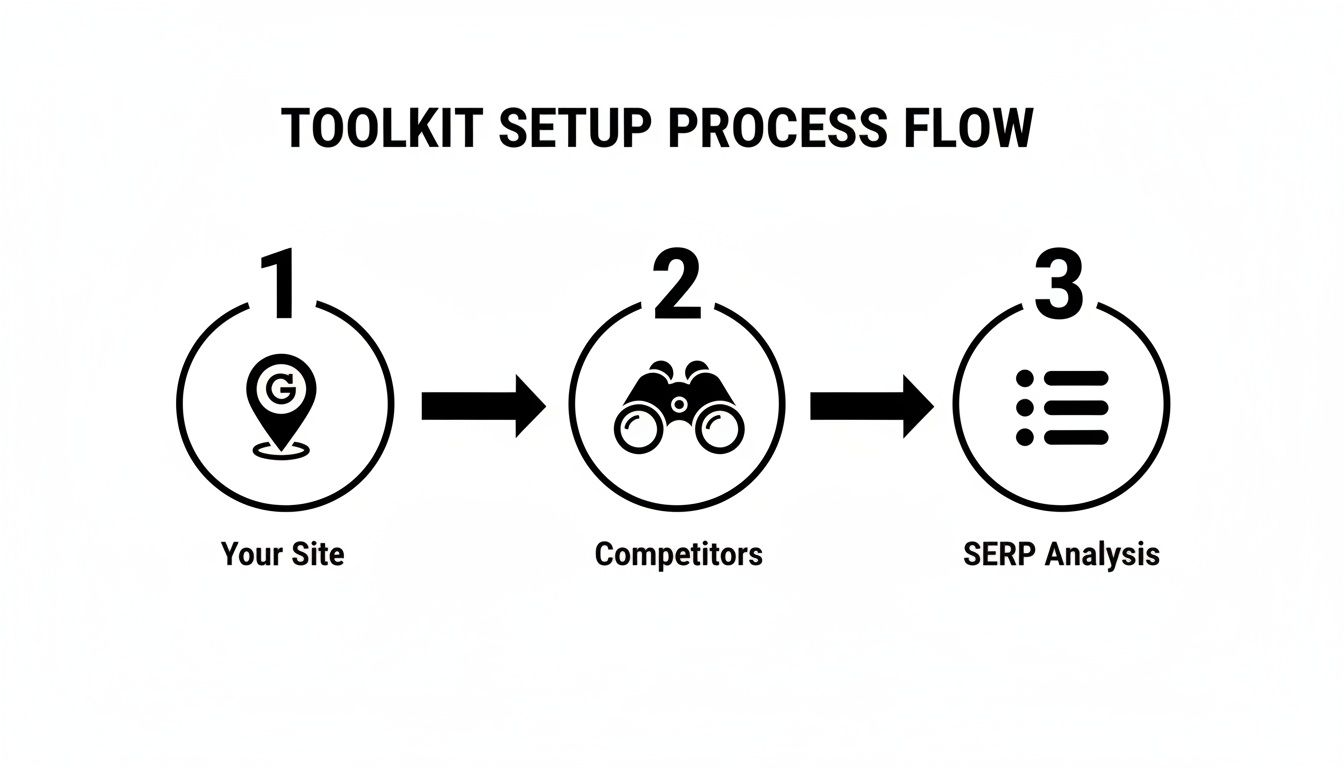
Each of these stages gives you another critical layer of data. By the end, your analysis will be built on a solid foundation of your own performance metrics and hard competitive intelligence.
Finding Competitor-Dominated Keywords
The easiest place to start is by finding the keywords your competitors are ranking for where you have zero visibility. These are the classic "missing" topics—the low-hanging fruit of content gap analysis.
Using a tool like Ahrefs or Semrush, you can pop in your domain and up to three competitors to generate this list almost instantly.
Let's say you're a B2B SaaS company with project management software. Your analysis might spit out a cluster of high-intent keywords like "Asana alternative," "Trello vs Asana," and "best project management tool for small teams." If all your rivals are ranking well for these and you're nowhere in sight, you've just found a massive, commercially valuable content gap.
This is all about identifying areas where your content is either missing entirely or just not hitting the mark. A fundamental skill here is knowing how to build a keyword list that drives traffic, as this ensures the keywords you're analyzing have real potential from the get-go.
Pro Tip: A huge part of this step is filtering out the noise. Your competitors will rank for all sorts of branded terms and topics that are totally irrelevant to your business. Your job is to sift through the raw export to find the keywords that actually align with your business goals.
Uncovering "Weak Spot" Keywords
The next layer down is finding your "weak spots." These are the keywords where you do rank, but you’re getting trounced by one or more of your competitors. Honestly, these can be even more valuable than the "missing" keywords because you already have a foot in the door.
Google clearly sees your page as relevant, but it's not satisfying user intent nearly as well as the pages at the top. This is where your Google Search Console data becomes your best friend. Look for pages that are stuck on page two (positions 11-20) but are racking up a ton of impressions. These are your prime candidates for a content refresh.
- Scenario: Your blog post on "team collaboration tips" is lingering at position 15, while two competitors are sitting pretty in the top five.
- Action: Go analyze their pages. What are they doing that you're not? Do they have more practical examples? A free template download? Quotes from industry experts? The gap here isn't the topic; it's the depth, quality, and utility of the content.
- Result: Updating and relaunching an existing post is almost always faster and yields quicker ranking improvements than creating a brand-new article from scratch.
By zeroing in on these underperforming assets, you can often score some big wins with a lot less effort.
Identifying Shared Keyword Opportunities
A third, and crucial, type of opportunity comes from keywords that multiple competitors rank for, especially when they all show up on the first page. This is a massive signal from Google that these terms are fundamentally important to your topic cluster.
If two or three of your biggest SERP rivals all have a dedicated piece of content for a specific query, it validates that topic's importance. It’s Google telling you that to be seen as a comprehensive authority in your niche, you need a competitive piece of content on that subject.
This approach helps you build topical authority methodically. Instead of just chasing random keywords, you're strategically filling gaps that the search engine has already flagged as vital for demonstrating expertise in your field. This part of the SEO content gap analysis is all about pattern recognition—seeing where the leaders in your space consistently show up and making sure you have a strong presence there, too.
Of course, understanding all the nuances of SERP performance is key. If you need a refresher, you can learn more about it in our guide explaining what is rank tracking. Integrating these insights will help you build a much more robust and effective content roadmap.
Prioritizing Opportunities for Maximum SEO Impact
Finding a long list of content gaps is the easy part. The real challenge—and where most strategies either succeed or fail—is figuring out which opportunities to tackle first.
A raw list of keywords is just noise. You need a system to turn that noise into a clear, prioritized action plan that actually lines up with your business goals.
Chasing high search volume alone is a classic rookie mistake. Imagine you run a B2B software company. A keyword like "what is project management" has massive volume, but the search intent is purely informational. In contrast, "best project management tool for small construction firms" has a fraction of the search volume but signals strong commercial intent. Prioritizing the second keyword will drive far more qualified leads, even with less traffic.
This is why a simple but effective prioritization framework is non-negotiable for any serious SEO content gap analysis. It forces you to think like a strategist, not just a content producer.
A Simple Scoring Model for Smart Decisions
To move beyond gut feelings, I always recommend using a scoring system. It’s a straightforward way to quantify each opportunity based on three core pillars: business relevance, realistic traffic potential, and the effort required to create the content. This approach helps you compare everything apples-to-apples.
The idea is to score each factor on a simple scale, like 1 to 5, where 5 is the highest value.
- Business Relevance (1-5): How closely does this topic align with your products or services? A score of 5 means it directly addresses a pain point your product solves. A 1 might be a tangentially related, top-of-funnel topic.
- Traffic Potential (1-5): This isn't just raw search volume. Think of it as a blend of volume and keyword difficulty. A high-volume, low-difficulty keyword gets a 5, while a low-volume, high-difficulty term gets a 1.
- Effort to Create (1-5): How much time and resources will this piece of content require? A simple FAQ-style blog post might be a 5 (low effort). On the other hand, an in-depth guide with original data and custom graphics would be a 1 (high effort).
Just add these scores together. The total gives you a number that represents the overall value of pursuing that specific content gap. The high-scoring items? Those are your quick wins and strategic priorities. This method brings a much-needed layer of objectivity to your planning.
The goal isn't just to rank for more keywords. It's to rank for the right keywords—the ones that attract customers, solve real problems, and contribute directly to your bottom line. A scoring framework keeps your entire team focused on that objective.
Putting the Framework into Practice
So, how does this actually play out? Let's go back to our B2B software company. Say they've identified two potential content gaps. We can pop them into a simple scorecard to make an informed decision.
Here’s a sample scoring model that helps you objectively evaluate and prioritize content opportunities based on business value and effort.
Content Gap Prioritization Scorecard Example
| Keyword/Topic | Relevance (1-5) | Traffic Potential (1-5) | Effort (1-5) | Total Score |
|---|---|---|---|---|
| "Project management tips" | 2 | 5 | 4 | 11 |
| "Asana alternative for agencies" | 5 | 3 | 3 | 11 |
In this case, both topics end up with the same total score of 11. So, which one do you choose?
This is where the strategic thinking comes in. The "Asana alternative for agencies" topic has a much higher relevance score (5 vs. 2). This means it's far more likely to attract users actively looking for a new software solution—people who are ready to buy.
Even though its traffic potential is lower, the quality of that traffic is significantly higher. This data-informed approach allows you to justify choosing the lower-volume keyword because it has a clearer path to conversion.
Building a solid content roadmap is just one part of a much bigger puzzle. For more on this, check out our complete guide to developing a powerful keyword strategy for SEO. Armed with this scoring model, you can confidently build a content calendar that maximizes your return on investment and drives meaningful business growth.
From Insights to Actionable Content Briefs
All that data is worthless if it doesn't lead to better content. Seriously. The final, and arguably most critical, piece of a content gap analysis is translating your prioritized list of opportunities into crystal-clear instructions your content creators can actually use. This is where you build the bridge from raw data to a published, ranking article.
That bridge is the content brief.

A well-structured brief isn't just a suggestion; it's a strategic blueprint. It's designed from the ground up to give your content the best possible shot at ranking for its target keywords. It completely removes the guesswork, ensuring every article gets created with a specific purpose rooted in your analysis.
Without a solid brief, you’re just hoping for the best. You're leaving success up to chance, risking writers missing crucial subtopics, misinterpreting user intent, or ignoring the internal links that build your site's authority.
Core Components of a High-Impact Content Brief
Think of an effective content brief as providing the guardrails for a road trip. It ensures the writer reaches the destination without you having to dictate every single turn. It should be comprehensive enough for clear direction but flexible enough to let a writer’s creativity shine.
Every brief should have a few non-negotiable elements pulled directly from your competitor research and keyword prioritization. This is how you close the loop.
- Primary and Secondary Keywords: State the main target keyword and a handful of related secondary keywords. This gives the writer a clear SEO bullseye.
- Search Intent: Define the user's goal. Are they looking for information (what is X), a comparison (X vs. Y), a transaction (buy X), or a tutorial (how to do X)? This decision dictates the entire article's structure and tone.
- Required Subheadings: List the key H2s and H3s the article must include. You'll pull these by analyzing what the top-ranking articles are covering. The goal is to be just as comprehensive, if not more so.
- Internal Linking Opportunities: Provide a list of 2-3 relevant, existing articles on your site for the writer to link out to. This is so important for passing authority and helping Google connect the dots on your site structure.
- Target Word Count: Give a realistic word count range based on the average length of the pages already ranking on page one. This helps ensure your content has enough depth to actually compete.
The content brief is your quality control. It guarantees the strategic insights you worked so hard to uncover during your analysis are baked directly into the final product, dramatically increasing its odds of success.
Building a Brief from Your Analysis
Let's make this real. Imagine your analysis for a project management SaaS company uncovers a high-priority gap for the keyword "Asana alternative for agencies." Your scoring sheet showed high business relevance, so it's a top target.
Time to build the brief. The first thing you'd do is analyze the top 3-5 articles currently ranking for that keyword. What questions are they answering? What unique angles do they take? What subtopics do they all seem to cover?
From that intel, the brief starts to take shape:
1. Define the Core Elements:
* Primary Keyword: "Asana alternative for agencies"
* Secondary Keywords: "best project management for agencies," "Asana vs [Your Tool]," "agency workflow software"
* Search Intent: Commercial Investigation. The searcher knows their problem and is actively comparing solutions before making a purchase.
2. Structure the Content:
* Outline: Based on what's already winning, you know the article needs sections like "Why Agencies Need a Specialized Tool," "Key Features to Look For," a direct comparison table, and customer testimonials. Each of these becomes a required subheading in the brief.
3. Provide Strategic Direction:
* Call-to-Action (CTA): The brief must tell the writer what the next step for the reader is. Is it "Start a Free Trial" or "Book a Demo"? Be specific.
* Unique Angle: Instruct the writer to lean into your tool's specific features that solve agency pain points, like client portals or white-label reporting. This is your competitive edge.
This process ensures your writer isn’t just creating another generic listicle. They are building a highly targeted asset designed to outrank specific competitors for a keyword that drives revenue.
To make this even smoother, you can work off a proven SEO content brief template that covers all these essential elements in detail.
What a Real-World Content Gap Win Looks Like
Theory is great, but seeing a content gap analysis pay off in the real world is where the magic really happens. This isn't just about ticking off a list of keywords; it's about stealing market share and driving actual revenue from competitors who weren't paying attention.
Let's look at a prime example. The children's footwear brand Bartek was struggling, losing serious ground to more established online retailers. Their team dug deep with an analysis and found a massive hole in their strategy around the long-tail, high-intent keywords that parents were constantly typing into Google.
The Opportunity They Uncovered
The analysis laid it all bare: there were huge gaps in content that spoke directly to parental worries and questions. Competitors were cleaning up in the SERPs for informational queries like "orthopedic shoes for children" and practical guides on things like how to size a kid's foot correctly.
Bartek had the perfect products to meet these needs, but they had absolutely no content to attract, educate, and build trust with these potential customers. It was a classic content gap scenario—their products were invisible because the educational content that brings people in simply wasn't there.
The brand had a lightbulb moment: they were completely invisible during the most critical part of the buyer's journey—the research phase. By not answering these basic questions, they were just handing customers over to the competition on a silver platter.
The Impact of Taking Action
By methodically creating high-quality, targeted content to plug these holes, the results were staggering. In one of the most striking examples from the project, after publishing the new content, the brand’s organic traffic shot up by 45%.
Even better? Their online sales exploded by an incredible 71%. You can dig into the full breakdown of this impressive content gap analysis case study on Insightland.org.
This story is the perfect proof that a content gap analysis isn't just some academic task for your SEO team. It's a direct lever for business growth with a clear, measurable impact on the bottom line. It also drives home just how vital it is to be measuring content marketing ROI to demonstrate the real value of your work.
Of course, here is the rewritten section, crafted to sound like an experienced human expert and following all the specified requirements.
Common Questions I Get Asked About Content Gaps
Even with the best workflow, you're bound to hit a few head-scratchers when you're swimming in keyword data. I've been there. Here are some of the most common questions that come up and my straight-to-the-point answers.
How Often Should I Be Doing This?
For a full, top-to-bottom site analysis, I recommend getting it on the calendar once a quarter. That’s the sweet spot for spotting big shifts in what competitors are doing or what the market is demanding, without driving yourself crazy.
But for your absolute most important topics—your money-making service pages or core product categories—a more targeted check-in every month is a smart move. It keeps you on top of the keywords that matter most and prevents you from falling behind.
What's the Biggest Mistake People Make with This?
Hands down, the most common mistake is tunnel vision. People get hyper-focused on finding keywords their competitors rank for that they don't have any content for. Finding those completely missing topics is definitely part of the goal, but it's only half the picture.
A truly powerful SEO content gap analysis also highlights where your existing content is just plain underperforming. Finding those pages and giving them a serious refresh often brings in much faster, bigger wins than creating something from scratch. You’re building on an asset that Google already knows and has given some authority to.
The most impactful "gaps" are often not missing pages, but pages that are simply not good enough to win. Prioritizing content updates is a sign of a mature SEO strategy.
Can I Run a Content Gap Analysis Without Expensive Tools?
You absolutely can. Look, premium tools like Ahrefs or Semrush make life a lot easier and give you deeper data, no question. But you can still get surprisingly far with a free toolkit.
By piecing together the performance data from your own Google Search Console with some manual digging in Google's search results, you can spot high-value opportunities. It’ll mean more time spent in spreadsheets, for sure, but the fundamental insights are still there for the taking, no matter your budget.
Turn your content gaps into a powerful growth engine. Sight AI uses AI visibility insights to uncover high-value content opportunities and then creates SEO-optimized articles to fill them, putting your content production on autopilot. Learn more at https://www.trysight.ai.