
A keyword SEO strategy is all about getting inside your customers' heads. It's the process of figuring out the exact words and phrases they type into a search bar, then building your entire content plan around those terms. We're moving way beyond just chasing traffic; the goal here is to pull in the right visitors who are ready to convert.
Why Your Old Keyword Strategy Is Failing
Let's be real for a moment: the old playbook for keyword SEO is broken. For years, the game was all about volume—find the keywords with the biggest search numbers, stuff them into a page, and hope for the best. This approach treated Google like a simple machine you could trick by repeating a phrase enough times.
That era is long gone.
Search engines today are incredibly sophisticated. They're not just matching keywords anymore; they're on a mission to deeply understand and satisfy what a user is truly looking for. This fundamental shift means that strategies built on keyword volume alone just don't cut it. They might bring in some traffic, but it's often low-quality, unengaged, and it definitely doesn't convert.
The Critical Shift to Topical Authority
The new gold standard in SEO is topical authority. Instead of pouring all your resources into ranking for one massive, high-competition keyword, the modern strategy is to own an entire topic. This means creating a rich ecosystem of content that covers a subject from every conceivable angle, answering every question a user might have along the way.
This approach perfectly mirrors how search engines now measure expertise. They reward websites that prove they have deep, credible knowledge in a specific area. Building this kind of authority requires a much more thoughtful plan. For example, instead of just targeting "project management software," you'd create content around related, more specific queries like:
- "best project management tools for small teams"
- "how to choose project management software"
- "project management software vs spreadsheets"
- "Gantt chart features in project management tools"
By covering these subtopics, you're sending strong signals to Google that you are a definitive resource on the subject. This makes it far easier to eventually rank for those broader, more competitive terms. If you want to go deeper on this, learning about how semantic SEO connects related ideas to build authority is a great next step.
A winning keyword SEO strategy isn't about collecting keywords; it's about building a library of answers. You're not just optimizing for a search term; you're optimizing for a person's entire problem-solving journey.
Understanding the User Journey Is Non-Negotiable
Ultimately, the biggest failure of outdated keyword strategies is that they completely ignore the user. A truly successful strategy is built on empathy. It demands that you map out your audience's entire journey, from the moment they first realize they have a problem all the way to their final purchase decision.
Each stage of that journey maps to a different type of search intent. Someone searching for "what is content marketing" is in a completely different headspace than someone searching for "HubSpot vs Marketo pricing." Your strategy has to account for these nuances, delivering the right content to the right person at exactly the right time. This audience-first mindset is the bedrock of a strategy that doesn't just attract visitors, but creates loyal customers.
Mastering Keyword Research And User Intent
If you want your keyword strategy to work, you need a fundamental shift in how you think about it. The old way—exporting massive lists of high-volume terms and chasing vanity metrics—is dead.
Today, it's all about understanding the human behind the search query. What problem are they trying to solve? What’s their end goal? This is where the real magic happens, right at the intersection of data and empathy. It’s about digging up the specific phrases that tell you someone is ready to learn, compare options, or pull out their credit card.
Beyond Volume Lies User Intent
Search intent is simply the 'why' behind a search query. It's the most critical factor in modern keyword research, and ignoring it is a surefire way to fail. You can pour resources into creating the perfect sales page, but if you're targeting an informational keyword like "how to choose a CRM," it's going to fall flat. The user isn't ready to buy; they're in learning mode.
This is why aligning your content with intent is completely non-negotiable for ranking. Want a deeper dive into the nuts and bolts? Check out our complete guide on keyword research for organic SEO.
The graphic below perfectly illustrates how SEO has evolved from just stuffing keywords to a more nuanced, intent-driven strategy that attracts much higher-quality traffic.
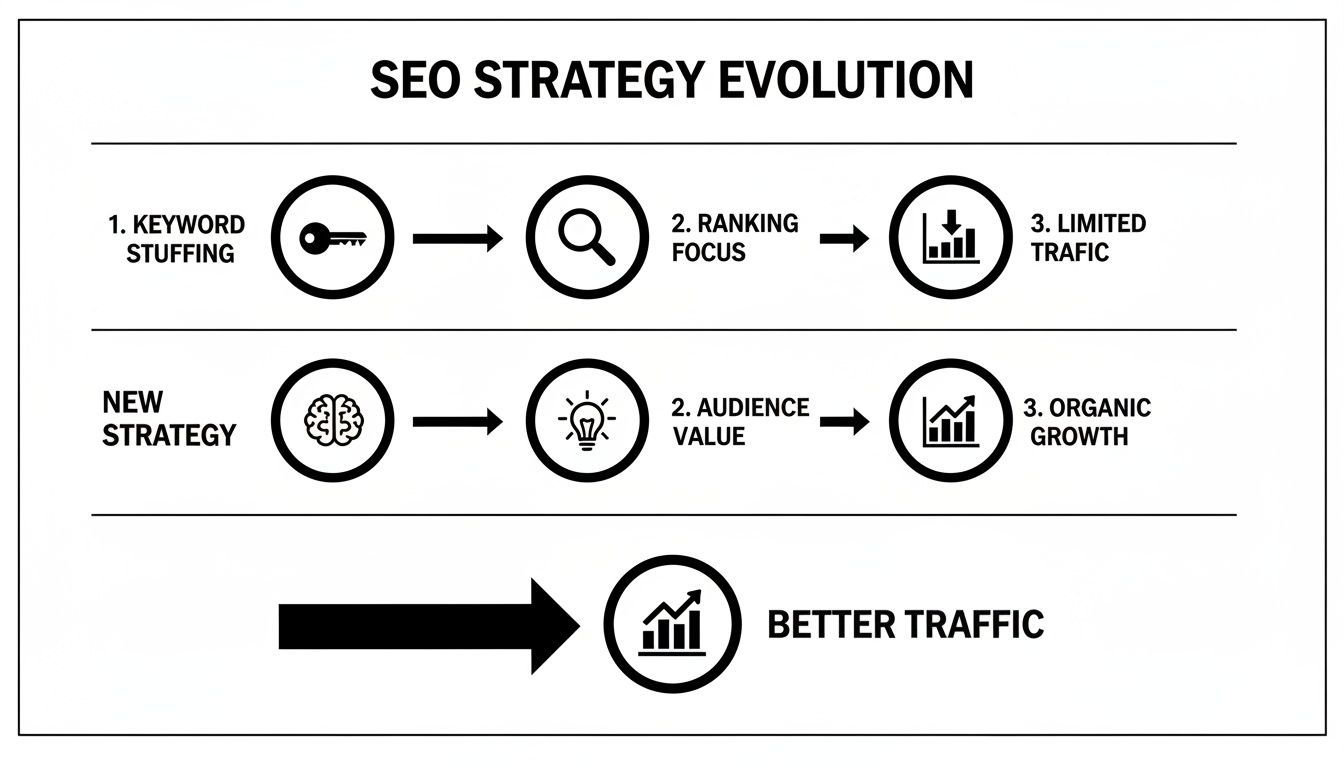
This shift isn't just a trend; it's about attracting a better, more qualified audience by understanding their needs first.
To get practical, we can map keywords to intent. I use a simple framework to classify terms and decide what kind of content to create for them. It helps keep the entire team aligned on the why behind each piece.
Keyword Intent Mapping Framework
A practical framework for classifying keywords based on user intent and aligning them with appropriate content types to guide your strategy.
| Intent Type | User Goal | Keyword Examples | Optimal Content Format |
|---|---|---|---|
| Informational | I want to know something. | "what is CRM," "how to improve sales," "project management guide" | Blog posts, how-to guides, checklists, explainer articles |
| Commercial | I want to compare options before I decide. | "best project management software," "Mailchimp vs. Constant Contact," "HubSpot alternative" | Comparison articles, product reviews, listicles, case studies |
| Transactional | I want to buy something now. | "buy Salesforce CRM," "project management software pricing," "Airtable discount" | Product pages, pricing pages, free trial sign-up pages, demos |
Mapping your keywords this way prevents you from creating content that’s misaligned with what the searcher actually wants. It’s a simple step that saves a ton of wasted effort down the line.
Uncovering Lucrative Content Gaps
Once you have a solid handle on intent, it’s time to play detective. The goal is to find where your competitors are dropping the ball. This involves a deep dive into the search engine results pages (SERPs) for the keywords you’re targeting.
Look for weaknesses. Are the top-ranking articles thin on details? Do they leave critical questions unanswered? Is the information horribly outdated? These are your openings. To really get good at this, a comprehensive competitive analysis is non-negotiable.
This analysis helps you spot content gaps—valuable subtopics and questions that the current top pages just don't cover. For instance, if every article for "best project management software" just lists features, you could swoop in with a piece that focuses on ease of use for non-technical teams. You've just filled a huge gap in the market.
A content gap isn't just a missing keyword; it's a missing piece of the user's puzzle. Your job is to find it and provide the most complete, satisfying answer on the web.
The reason this matters so much is that the rewards for getting it right are massive. The first organic result on Google desktop gets a jaw-dropping 34% click-through rate (CTR). That traffic drops by 4x between the first and fifth positions. In an age of zero-click searches, landing that top spot is everything. This data just confirms that a laser-focused keyword strategy is how you win.
Building Your Content Roadmap From Keyword Data
A massive, unsorted list of keywords is just noise. It’s the strategic organization and prioritization of this data that transforms raw research into an actionable content roadmap—the blueprint for your entire keyword SEO strategy.
Without this step, you risk wasting months creating content that delivers minimal business impact. Let's fix that.

The first challenge is deciding what to tackle first. Not all keywords are created equal, and chasing the highest search volume is a common but costly mistake. A balanced approach is absolutely essential for sustainable growth.
Prioritizing Keywords With A Scoring Model
To bring order to the chaos, you need a simple, repeatable framework for prioritization. This means scoring each potential keyword against a set of business-critical criteria. This moves you away from gut feelings and toward data-driven decisions about where to invest your precious content resources.
A straightforward scoring model can make this process incredibly efficient. It helps you find that sweet spot between audience demand and real business value.
Here are the four key pillars to build your scoring model on:
- Search Volume: The estimated number of monthly searches for a keyword. While it's not the only metric, it gives you a sense of the potential audience size.
- Keyword Difficulty (KD): A score (usually 0-100) that estimates how hard it will be to rank on the first page of Google. This helps you find realistic targets and early wins.
- Business Relevance: How closely does this keyword align with your core products or services? A high-relevance keyword attracts potential customers, not just casual readers.
- Conversion Potential: Based on search intent, how likely is a user searching this term to take a desired action (e.g., sign up, request a demo, make a purchase)?
By scoring each keyword from 1-5 across these four categories, you create a "Priority Score." This simple calculation instantly reveals your low-hanging fruit—the keywords with a powerful combination of achievable ranking potential and high business impact.
From Keywords To Topic Clusters
Once your keywords are prioritized, the next step is to group them into logical topic clusters. This is the architectural foundation of building topical authority. Instead of creating isolated articles for individual keywords, you'll build an interconnected web of content around a central theme.
Each cluster has two main components:
- Pillar Page: A comprehensive, long-form piece of content that covers a broad topic in depth (e.g., "social media marketing"). This page targets a high-volume, competitive head term. To learn more, read our guide on what is a pillar page and how to create one.
- Cluster Content: A series of shorter, more specific articles that target long-tail keywords related to the pillar topic (e.g., "how to create a social media calendar," "best tools for social media analytics").
These cluster posts link back to the pillar page, signaling to search engines that you have deep expertise on the entire subject. It's a powerful signal.
For example, a software company might create a pillar page on "Project Management Methodologies" and then support it with cluster content on "Agile vs. Scrum," "Kanban Board Examples," and "Waterfall Project Management Guide."
This structure doesn't just organize your content; it creates an internal linking powerhouse that funnels authority to your most important pages. It’s how you systematically build the credibility needed to rank for highly competitive terms over time, turning individual content pieces into a strategic asset that dominates search results for an entire topic. This is the essence of a modern keyword SEO strategy.
Turning Keywords Into High-Ranking Content
This is where the rubber meets the road. All the meticulous keyword research and strategic planning won't mean a thing if you can't translate that data into high-quality content that actually ranks. A prioritized list of keywords is just a list; now it's time to create something tangible that both Google and your audience will love.

The crucial link between your keyword strategy and a published article is a well-crafted content brief. This isn't just a simple assignment; it's the blueprint for a successful piece of content. It gives writers everything they need to produce perfectly optimized articles right from the start, taking the guesswork out of the equation and ensuring the final draft hits every strategic mark.
Crafting The Perfect Content Brief
Let's be honest: a vague brief gets you vague, generic content. If you want an article that can truly dominate the search results, you need to arm your writers with a detailed, data-informed brief. This document should be their single source of truth, leaving no room for interpretation about who they're writing for or what a winning article looks like.
Every great content brief should include these essentials:
- Primary Keyword & Search Intent: Nail this down. Is the user trying to learn something, compare products, or make a purchase? Be explicit.
- Secondary & Semantic Keywords: Give your writer a list of related terms and LSI keywords. This helps them build topical depth without sounding like a robot.
- Target Audience Profile: Who is this for? Describe their pain points, their level of expertise, and what they hope to achieve.
- Competitor Analysis: Link to the top 3-5 ranking articles. Add a few notes on their strengths and weaknesses. How can we one-up them?
- Key Talking Points & Outline: Suggest a basic H2/H3 structure based on your SERP analysis. This ensures all the critical subtopics get covered.
- Internal Linking Opportunities: Suggest 2-3 relevant articles on your site to link to. This is huge for building topic clusters.
When you provide this level of detail, you empower your writers to stop guessing what you want and start focusing on creating the absolute best piece of content for the user.
Moving Beyond Simple Keyword Mentions
The days of obsessing over keyword density are long gone. Stuffing your main keyword into a page a specific number of times is an outdated tactic that will do more harm than good. Modern search engines are far more sophisticated; they prioritize semantic relevance and topical completeness above all else.
Recent analysis confirms this shift, showing zero consistent link between keyword stuffing and better rankings. What really moves the needle now is topical authority, especially as we all work to create content that stands out from a flood of generic AI articles.
The real wins are in the long-tail variations and related terms. Did you know that 34.71% of search queries are four or more words long? And pages that include keywords in their URL see a 45% higher click-through rate.
Think of your content not as a container for keywords, but as a complete answer to a user's problem. Your goal is to create a resource so thorough that the user has no need to click the back button and visit another result.
This means covering a topic from every angle, answering follow-up questions, and weaving in synonyms and related concepts naturally. If your primary keyword is "keyword seo strategy," your article should organically touch on things like "user intent," "topic clusters," "long-tail keywords," and "content briefs" without it feeling forced. For more hands-on advice, our guide on how to write SEO-friendly blog posts that readers love is a great place to start.
Structuring Content For E-E-A-T and Readability
How you structure your content is just as important as the words you write. Google's E-E-A-T guidelines (Experience, Expertise, Authoritativeness, and Trustworthiness) are at the core of how it evaluates content quality. A well-structured, easy-to-read article sends powerful signals of expertise and trust.
Always organize your content with a clear, logical hierarchy using H2 and H3 subheadings. This doesn't just help search engine crawlers understand your page structure; it massively improves the reader experience. Most people skim online content, so make it easy for them.
Break up those big walls of text with:
- Short paragraphs (1-3 sentences)
- Bulleted and numbered lists
- Blockquotes for key insights
- Bold text for important terms
By creating a visually scannable and logically organized article, you're killing two birds with one stone—satisfying both your human readers and the search engine bots. That dual focus is the secret to turning your keyword research into content that consistently ranks and drives your business forward.
Alright, you've done the heavy lifting with your keyword research and created a killer piece of content. High-five. But don't pop the champagne just yet—that's only half the battle.
Now it's time to make sure people and search engines can actually find and understand it. This is where on-page and technical SEO come in, turning your great article into something that actually gets seen.
A solid keyword seo strategy is built on getting these fundamentals right. Think of them as the signals you send to Google that explain what your content is about and why it deserves a top spot. Without them, even the most brilliant writing can just fade into the background.
Nailing The On-Page Essentials
Let’s get into the basics that still pack a massive punch. These on-page factors are your most direct line of communication with search crawlers, telling them exactly what your page is all about.
- Compelling Title Tags: Your title tag is arguably the single most important on-page element. It needs to include your primary keyword (ideally near the front) and be written to make someone want to click on it from a crowded search results page. It's your content's headline for Google.
- Intriguing Meta Descriptions: While it won't directly affect your rank, the meta description is your 3-second sales pitch in the SERPs. A good one that teases the value inside and includes your keyword can make a huge difference in your click-through rate.
- Clean URL Slugs: Keep your URLs short, sweet, and descriptive. A clean slug like
/keyword-seo-strategyis worlds better and more user-friendly than something clunky like/p=123?category=blog.
These three things work together to make a powerful first impression. They're surprisingly easy to get right, but you'd be shocked how many sites mess them up, which creates a perfect opportunity for you to pull ahead.
Building A Smart Internal Linking Web
Internal linking is one of the most powerful—and most overlooked—levers you can pull in your SEO strategy. It’s how you guide both users and search engine bots through your site, showing them how your content is all connected and spreading authority around.
Whenever you publish a new article, your first move should be to find older, relevant posts to link from. At the same time, your new post should link out to other helpful, authoritative pages on your site. This is how you build strong topic clusters, pass "link equity" to your most important pages, and prove to Google that you have deep expertise on a subject.
Think of internal links as the threads that weave your individual articles into a tapestry of topical authority. Each link strengthens the overall structure, making your entire site more powerful and easier for search engines to understand.
Don't Forget The Technical Foundation
All the on-page work in the world won't matter if your site is a technical mess. A poor technical setup can completely sabotage even the best content. These elements are non-negotiable for making sure your site is accessible and offers a great user experience—both of which are huge for rankings.
Here are three technical areas that directly support your keyword goals:
- Page Speed: Nobody waits for a slow website. If your page takes more than a few seconds to load, visitors will bounce, sending negative signals to Google about your site's quality.
- Mobile Experience: The majority of searches happen on phones, so a responsive, mobile-friendly design isn't optional anymore. Google uses mobile-first indexing, meaning it primarily evaluates the mobile version of your site for ranking purposes.
- Schema Markup: This is a bit of code you add to your site to give search engines more context about your content. It’s what powers those "rich snippets" in search results, like star ratings or FAQ dropdowns, which can seriously boost your visibility and clicks.
Beyond what's on the page, technical factors like site performance are critical. Getting a handle on the connection between SEO and website speed is a must if you want your site to succeed. And as search evolves, it's becoming more important to optimize content for AI search engines, which lean heavily on structured data and fast-loading pages to deliver answers.
Got Questions About Your Keyword SEO Strategy?
Even with the best blueprint in hand, you’re bound to run into questions as you start executing and tweaking your keyword SEO strategy. Let's walk through some of the most common ones that come up.
Think of your strategy less like a concrete plan you set in stone and more like a garden. It needs regular tending and adjustments to keep producing results.
How Often Should I Update My Keyword Strategy?
Your keyword SEO strategy should absolutely not be a "set it and forget it" kind of deal. A full, top-to-bottom review is a good idea every 6 to 12 months. This is your chance to zoom out, re-evaluate your core topic clusters, see how the market has shifted, and make sure your big-picture roadmap still makes sense for your business goals.
But the smaller, tactical adjustments? Those need to happen way more often. You should be digging into your data monthly or at least quarterly to see what's working. Search trends change on a dime, new competitors pop up out of nowhere, and you never know when an algorithm update is going to shake things up.
The best keyword strategies aren't static; they're dynamic. Constant monitoring and periodic overhauls are what keep your efforts sharp and effective in a search landscape that’s always in flux.
Staying agile lets you pivot fast. You can double down on the winners and course-correct the duds before they drag you down. This cycle of review and iteration is what separates a strategy that fizzles out from one that builds serious, long-term momentum.
What's The Difference Between Primary And Secondary Keywords?
Getting a handle on primary versus secondary keywords is fundamental to creating the kind of comprehensive content that ranks. They’re a team, working together to give search engines the full picture of what your page is about.
Your primary keyword is the star of the show for a single page. It’s the main topic, the phrase you're aiming to rank #1 for. For the article you’re reading right now, our primary keyword is "keyword seo strategy." Simple enough.
Secondary keywords are the supporting cast. They’re all the related terms, synonyms, subtopics, and long-tail questions that add depth and context. For this guide, our secondary keywords would be things like:
- "user intent analysis"
- "keyword research tools"
- "how to build a keyword strategy"
- "topic cluster model"
Weaving in a healthy mix of both is how you signal to Google that you’ve built a truly thorough resource. It helps you avoid sounding like a robot by stuffing the same phrase over and over, and it's exactly what modern search algorithms—which are all about topical authority—want to see.
How Do I Know If My Keyword Strategy Is Actually Working?
Measuring success is about so much more than just checking your rank for a handful of terms. A real winning strategy moves the needle on actual business goals, and that's where your focus should be. A solid measurement plan looks at a mix of leading and lagging indicators.
Your go-to key performance indicators (KPIs) should be:
- Organic Traffic Growth: Are more people finding your site through search? You should see a steady climb in non-paid visitors, both to your site overall and to the specific pages you’re targeting.
- Keyword Rankings: Keep an eye on your position for your most important primary and secondary keywords. Seeing upward movement across an entire topic cluster is a fantastic sign.
- Click-Through Rate (CTR): Pop into Google Search Console and check the CTR for your target pages. If it’s going up, it means your title tags and meta descriptions are grabbing searchers' attention.
- Conversion Rate: This is the bottom line. Is the traffic you're getting from your SEO efforts actually turning into sign-ups, leads, or sales? This tells you if you're attracting the right kind of visitor.
To get a little more advanced, you can also track how many total keywords a single page ranks for and what your overall "share of voice" is for your main topics. A successful strategy will show clear, positive trends across these metrics, proving you're not just driving clicks, but delivering real business value.
Ready to turn AI and search insights into a repeatable growth engine? Sight AI is your all-in-one platform for monitoring your brand's AI visibility, uncovering high-value content gaps, and automating the production of long-form, SEO-optimized articles. Stop guessing and start ranking by visiting https://www.trysight.ai.