
So, what exactly is content marketing ROI?
Think of it as the ultimate report card for your content. It’s the hard number that shows you how much revenue you’re bringing in from all your content efforts, measured against what you spent to create and share it. This isn't just a vanity metric; it’s the critical number that proves your content is a valuable business asset, not just a creative expense.
Why Measuring Content Marketing ROI Is Non-Negotiable

Let's be honest—in a world obsessed with the instant gratification of paid ad metrics, proving the value of content can feel like an uphill battle. But flying blind on content ROI is like trying to navigate a ship without a compass. You’re busy, sure, but you have no idea if you’re actually getting closer to your destination.
Here’s a better way to think about it. Paid advertising is a lot like day trading stocks. You pump in cash, see a quick result, and the second you stop paying, the activity flatlines. Content marketing, on the other hand, is like investing in real estate. It takes more upfront effort and a bit of patience, but over time it builds equity, appreciates in value, and starts generating a steady, compounding return.
A single blog post can keep attracting organic traffic and generating leads for years, long after you’ve paid off that initial investment.
Securing Budgets and Building Trust
In the boardroom, a clear handle on your content marketing ROI is your most powerful argument. When you can draw a straight line from your content to the company's revenue, budget talks change completely. Suddenly, you’re not just asking for money; you’re presenting a solid business case for growth.
Bringing data-backed results to the table does a few key things for you:
- Justifies Your Budget: It gives you concrete proof that what you're doing is working, making it far easier to keep—and even grow—your resources.
- Builds Stakeholder Confidence: Showing a positive return builds trust with leadership. It proves your team isn't just creating content for content's sake but is focused on business outcomes.
- Aligns Marketing with Business Goals: This approach frames content as an integral part of the company's revenue engine, not some isolated creative activity.
Without data, you’re just another person with an opinion. A solid ROI calculation replaces opinions with facts, empowering you to lead with authority and make decisions that drive real impact.
Making Smarter Strategic Decisions
Beyond just getting the budget you need, understanding your content's performance is the key to refining your strategy. It’s how you get answers to the questions that should guide your every move. Which topics are actually resonating with your best customers? Are long-form guides outperforming short video clips? Which channels are delivering the most qualified leads?
By tracking ROI, you stop guessing and start operating from a place of evidence. This data-driven approach lets you double down on what’s working and cut what isn’t, creating a system for improving your results over time. To really appreciate why ROI is so crucial, you first have to understand the fundamental principles of Content Marketing.
Ultimately, measuring content ROI isn’t just a reporting chore. It’s the engine that powers strategic optimization, turning your creative work into a predictable and scalable source of business growth.
The Simple Formula for Calculating Content ROI

Alright, let's move from theory to practice. Figuring out your content marketing ROI isn't nearly as intimidating as it might seem. At its core, it all boils down to a simple formula that turns the fuzzy, abstract value of your content into a hard number.
Here’s the fundamental equation:
[(Return - Investment) / Investment] x 100 = Content Marketing ROI
This little formula is your best friend for seeing how many dollars you get back for every dollar you put in. For instance, an ROI of 200% means you pocketed two dollars in profit for every single dollar you spent. Simple.
But to get to that clean percentage, you first have to get a firm grip on what "Return" and "Investment" actually mean for your business.
Defining Your Investment
Your investment is the total cost of bringing a piece of content to life and getting it in front of people. It’s easy to let certain expenses slip through the cracks, so getting detailed here is key to an accurate calculation. This isn’t just about the checks you write; it’s also about the time and resources your team pours into the process.
Common investment costs usually include:
- Content Creation Costs: This covers salaries or freelance fees for your writers, designers, video producers, and editors.
- Software and Tools: Think about your subscriptions for SEO tools, analytics platforms, project management software, and your Content Management System (CMS).
- Promotional Spend: This is the cash you put behind paid social media ads, search engine marketing (SEM), or influencer campaigns to get your content seen.
For a deeper dive into all the potential cost factors, you can check out our detailed guide on the true ROI of content marketing.
Defining Your Return
The "Return" side of the equation is all about the money your content generates. This is often the trickiest part to measure because content influences customers at so many different points in their journey. The secret is to connect content consumption to actions that actually drive revenue.
You can measure your return through things like:
- Direct Revenue: Sales that come directly from a call-to-action in your content, like someone clicking a product link in a blog post and buying.
- Lead Generation Value: Calculate this by multiplying the number of qualified leads from your content by your average lead-to-customer conversion rate and the average customer lifetime value (LTV).
- Sales Team Data: Your CRM is a goldmine. Use it to track how many leads who read a specific blog post or downloaded an e-book eventually became paying customers.
Going beyond the basic formula, mastering Cost Per Acquisition for Higher ROI is a crucial next step for getting an even more precise handle on your content's financial performance.
To make this crystal clear, let's break down the variables you need to track.
Table: Key Variables in the Content ROI Formula
Here's a breakdown of the essential components needed to accurately calculate your content marketing return on investment.
| Component | What It Includes | Example |
|---|---|---|
| Return (Revenue) | Revenue directly attributed to content efforts. | $25,000 in new sales from leads generated by an e-book. |
| Investment (Cost) | All costs associated with content creation and promotion. | $6,500 for writing, design, and ad spend for the e-book. |
| Formula | The mathematical equation used to find the ROI percentage. | [(Return - Investment) / Investment] x 100 |
Getting these components right is the difference between a vague guess and a number you can confidently take to your next leadership meeting.
A Real-World Calculation Example
Let's walk through a practical scenario. Imagine a B2B tech company that creates a detailed e-book to generate leads for its new software.
The Investment:
- Freelance Writer for E-book: $3,000
- Graphic Designer for Layout & Graphics: $1,500
- Paid Social Ads to Promote E-book: $2,000
- Total Investment = $6,500
The Return:
- The e-book brings in 100 qualified leads.
- The sales team has a 10% close rate on these leads, resulting in 10 new customers.
- The lifetime value (LTV) of each new customer is $2,500.
- Total Return = 10 customers x $2,500 LTV = $25,000
Now, we just plug these numbers into our formula:
ROI = [($25,000 - $6,500) / $6,500] x 100 ROI = [$18,500 / $6,500] x 100 ROI = 284.6%
That 284.6% ROI tells a clear story: the e-book was a massively profitable project. This is the kind of hard evidence that silences skeptics and justifies future budget requests.
It's numbers like these that show why content marketing consistently delivers. On average, content marketing costs 62% less than traditional outbound tactics but generates three times as many leads. That's a powerful argument for any marketing team.
Tracking KPIs That Actually Drive ROI
Figuring out your return is a huge step, but that final percentage is only as good as the numbers you plug into the formula. To get a real grip on your content marketing ROI, you have to look past the shiny "vanity metrics" like page views or social media likes. Sure, those numbers might look impressive on a report, but they don't tell you if your content is actually moving the needle for the business.
The real story comes from Key Performance Indicators (KPIs) that are directly tied to business growth. Think of it this way: vanity metrics are like the speedometer in your car—they prove you're moving, but they don't tell you if you're headed in the right direction. Actionable KPIs are your GPS, guiding you straight to your destination: revenue.
So, let's build a dashboard that tells the whole story, organizing our KPIs by where they fit in the customer journey.
Top-of-Funnel Traffic and Engagement KPIs
This is where your audience first discovers who you are. The goal isn't just to get eyeballs on your content, but to attract the right eyeballs and actually keep them interested. These KPIs show how well your content is reeling in a relevant audience.
- Organic Traffic and Search Visibility: This is all about how many people are finding you through search engines like Google. When organic traffic climbs steadily, it’s a fantastic sign that your content is building long-term authority, which means you can rely less on paying for ads.
- Time on Page and Bounce Rate: These two metrics give you a clear picture of how engaging your content really is. A high Time on Page means people are genuinely reading and finding value. A low Bounce Rate shows they're intrigued enough to click around and see what else you have to offer.
- Backlinks: When another reputable site links to your content, it’s a massive vote of confidence. Tracking new backlinks shows that others see you as a go-to resource, which gives your search rankings and referral traffic a serious boost.
These top-of-funnel metrics are the leading indicators of future success. They prove your content is capturing attention—the crucial first step before you can even think about generating leads. For a deeper dive, check out our guide on the key website metrics to track for success.
To make this distinction crystal clear, it helps to see these metrics side-by-side.
Vanity Metrics vs. Actionable KPIs for ROI
This table helps you distinguish between metrics that feel good and metrics that actually drive business decisions.
| Metric Type | Vanity Metric (Example) | Actionable KPI (Example) | Why It Matters for ROI |
|---|---|---|---|
| Traffic | Total Page Views | Organic Traffic Growth | Shows sustainable, long-term audience building, not just fleeting clicks. |
| Engagement | Social Media Likes | Time on Page / Scroll Depth | Indicates if the audience is truly consuming and valuing the content. |
| Reach | Follower Count | New vs. Returning Visitors | Helps you understand audience loyalty and content stickiness. |
| Conversion | Clicks on a CTA button | Lead Generation Rate (e.g., eBook downloads) | Directly measures how well content turns anonymous visitors into prospects. |
Focusing on actionable KPIs ensures you're measuring what truly contributes to growth, not just surface-level activity.
Mid-Funnel Conversion and Lead Generation KPIs
Once you’ve grabbed their attention, the next challenge is to turn that anonymous traffic into actual, identifiable leads. This is where your content marketing ROI starts to feel a lot more real. These KPIs measure how persuasive your content is at getting readers to take that next step.
A lead isn't just an email address; it's a signal of intent. The goal of mid-funnel content is to nurture that intent by providing value, building trust, and gently guiding prospects toward a solution.
Here are the key conversion KPIs to watch:
- Lead Generation Rate: This is the percentage of visitors who convert on an offer, like downloading an e-book or signing up for a webinar. This metric shows you exactly how effective your content is at turning traffic into potential customers.
- Marketing Qualified Leads (MQLs): Let's be honest, not all leads are created equal. An MQL is someone who not only showed interest but also fits your ideal customer profile, making them ready to be handed off to the sales team. This KPI is critical for making sure marketing and sales are on the same page.
- Cost Per Lead (CPL): Simply divide your total content investment by the number of leads you generated, and you've got your CPL. A low CPL means you have an efficient content engine that’s bringing in leads without breaking the bank.
Bottom-of-Funnel Revenue and Customer KPIs
This is where the rubber meets the road. These are the KPIs that connect your content directly to the bottom line, offering undeniable proof of its business value. They answer the ultimate question: is our content helping close deals and create loyal customers?
- Sales Qualified Leads (SQLs) and Conversion Rate: This KPI tracks how many of those MQLs your content generated are accepted by the sales team and eventually become paying customers. A high conversion rate here proves your content is attracting high-quality leads who are ready to buy.
- Customer Acquisition Cost (CAC): This is the total sales and marketing cost required to bring in a new customer. By attributing new customers back to the content they engaged with, you can see how efficiently your content is driving growth compared to other channels. A well-oiled content machine will consistently lower your overall CAC.
- Customer Lifetime Value (CLV): Great content doesn't just win one sale. It helps create loyal fans who stick around longer and spend more over time. Tracking the CLV of customers who interacted with your content reveals its long-term impact on profitability.
Connecting Content to Revenue with Attribution Models
Knowing your bottom-of-the-funnel KPIs is a great start, but how do you trace a final sale all the way back to the specific blog post or video that first caught a customer's eye? That’s the million-dollar question, and attribution models are the answer. These are the frameworks that assign credit to the different touchpoints a customer interacts with on their journey to becoming a paying customer.
Think of your content marketing as a soccer team. A customer might discover your brand through a blog post (the first pass), then sign up for a webinar (a midfielder advancing the ball), and finally click a link in an email to make a purchase (the striker who scores the goal). Who really deserves the credit for that sale? Attribution models help you decide.
This entire process is about mapping the journey from initial traffic and lead generation to the revenue that follows.
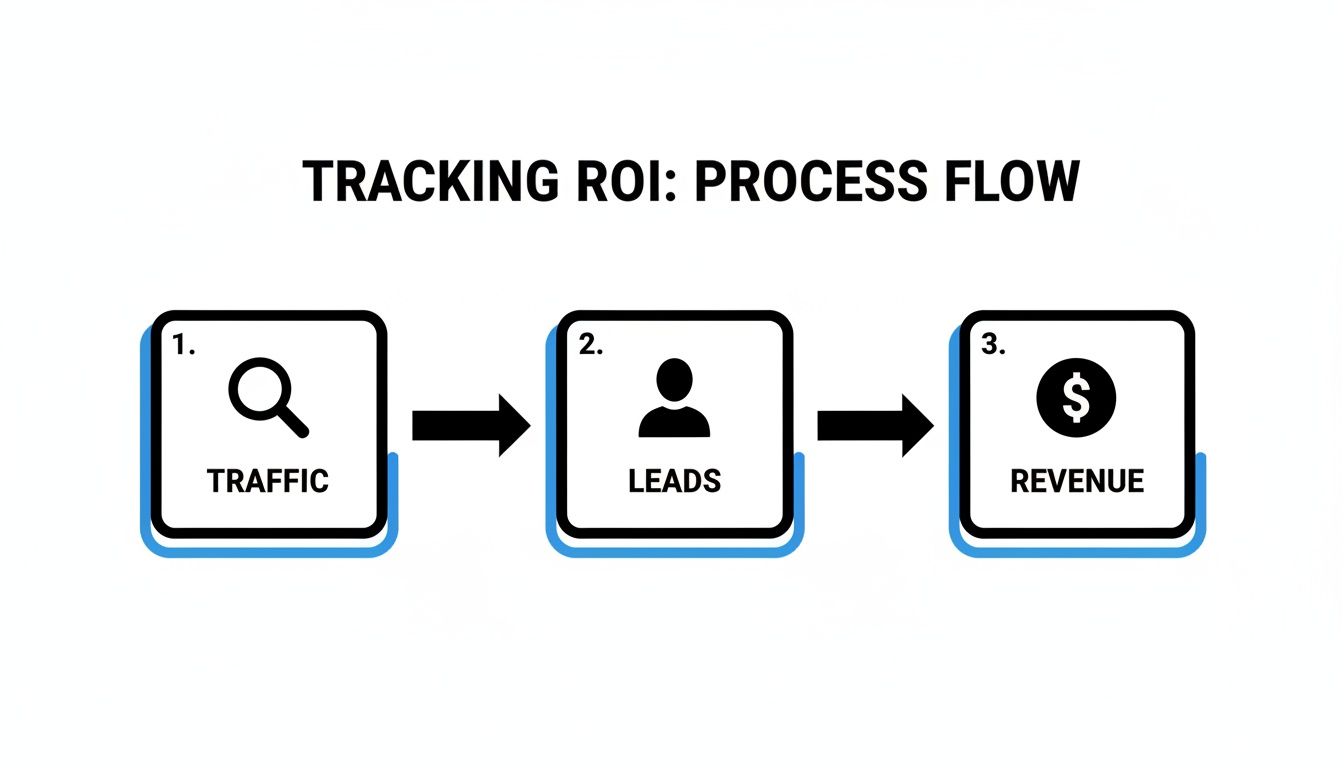
This flow shows a clear progression, hammering home the point that revenue doesn't just materialize out of thin air—it’s the final step in a journey that starts by attracting the right people.
Without a solid attribution model in place, you’re flying blind. You risk misreading your data and cutting the budget for top-of-funnel content that’s critical for building awareness, all because it didn't get the "last click" before a conversion.
Common Attribution Models Explained
Picking the right attribution model really comes down to your sales cycle and what you’re trying to achieve. There’s no single "best" option; the right one is simply the one that gives you the clearest picture of how your customers actually behave.
Let’s break down the most common models you'll encounter:
- First-Touch Attribution: This model gives 100% of the credit to the very first piece of content a customer ever saw. It’s simple and fantastic for figuring out which content is doing the heavy lifting in generating initial awareness and pulling new prospects into your orbit.
- Last-Touch Attribution: The polar opposite of first-touch, this model assigns all the credit to the final interaction right before a conversion. It's the default in a lot of analytics platforms and is helpful for spotting which content is a closer. The downside? It completely ignores every touchpoint that came before it.
- Multi-Touch Attribution: This is a much more balanced approach that spreads the credit across multiple touchpoints. Models like Linear (where credit is split evenly) or Time-Decay (where touchpoints closer to the sale get more weight) offer a more complete view of the entire customer journey.
The biggest mistake in measuring content marketing ROI is relying solely on last-touch attribution. It's like giving all the credit for a championship win to the person who scored the final point, ignoring the contributions of the entire team that got them there.
Choosing the Right Model for Your Business
So, how do you actually choose one? The decision usually boils down to the complexity of your sales process.
- For Short Sales Cycles: If your customers tend to buy quickly after discovering you (think e-commerce), a Last-Touch model might be all you need. The final interaction is often the most influential one.
- For Long Sales Cycles: For B2B companies or businesses selling high-ticket items, customers can take weeks or even months to make a decision. In these cases, a Multi-Touch model is far more insightful. It properly acknowledges the crucial role that awareness-building and nurturing content plays over time. You can learn more about how to implement these advanced tracking methods in our guide on AI attribution tracking methods.
Ultimately, the goal is to move past a simplistic view and adopt a model that reflects the true, often messy, path your customers take. Setting this up properly in your analytics platform will give you the clarity you need to invest wisely across your entire funnel—ensuring you’re funding not just the "scorers," but the "playmakers" too.
How AI Is Transforming Content ROI Measurement

Let's be honest, manual ROI tracking is quickly becoming a relic. The world of content analytics is in the middle of a massive shift, and artificial intelligence is at the helm, making the entire process of calculating content marketing ROI smarter and more predictive than ever before.
AI isn't just automating the old, tedious tasks. It's unlocking entirely new layers of insight that were impossible to see before. If traditional analytics is like a rearview mirror showing you where you’ve been, think of AI as a sophisticated GPS, constantly analyzing real-time data to map out the most direct path to your revenue goals.
This fundamental change is supercharging the whole content lifecycle. Modern AI platforms can dig through mountains of data to find high-value content ideas your team might have overlooked, predict the potential return of new topics before you write a single word, and even automate the content production itself.
Beyond Search Engines to AI Chatbots
One of the biggest changes happening right now is the move beyond just thinking about traditional SEO. While ranking on Google is still absolutely critical, a whole new frontier has opened up: getting your brand seen inside AI chatbots like ChatGPT, Gemini, and Perplexity.
Having your brand mentioned and cited in these AI conversations is the next stage of brand discovery. This is where platforms like Sight AI are writing a new playbook. They monitor how these AI models talk about your brand, your competitors, and your entire industry, all from a single dashboard that tracks:
- Prompts and Mentions: You get to see the actual questions people are asking and how your brand is being framed in the AI's answers.
- Citations and Sentiment: The platform shows you which sources the AI trusts and whether the conversation around your brand is positive or negative.
- Visibility Gaps: It pinpoints topics where your competitors are getting recommended, but you’re nowhere to be found.
By pulling all this data together, these platforms create a direct line from market intelligence to provable ROI. We dive deeper into this in our guide on how to measure AI recommendation ROI.
From Insights Directly to Content Creation
The real magic happens when you can connect those insights directly to action. The best platforms don't just hand you a report on opportunities; they help you act on them immediately. This closes the loop between analytics and execution, radically shortening the time it takes to see a return.
For instance, after Sight AI identifies a high-value content gap where a competitor is winning, its specialized AI agents can jump into action. They can automatically research, outline, and produce a fully optimized, long-form article to capture that opportunity. It creates a powerful, self-improving cycle.
Insight: Your biggest competitor is constantly cited by AI for "B2B lead generation tactics." Action: An AI agent writes a comprehensive, 3,000-word guide on that exact topic, complete with GEO-specific examples and images. Result: You start capturing that visibility, driving highly targeted traffic and leads, and directly boosting your content ROI.
This automated workflow turns insights into revenue-generating assets in a matter of days, not months.
The Accelerating Growth of AI in Content
This AI-driven approach is happening right as the content marketing industry is exploding. The global market is set to grow 33% from $72 billion in 2023 to over $107 billion by 2026, largely because of proven ROI and AI-powered enhancements.
Marketers are clearly all-in, with 68% reporting higher ROI from creating faster, more personalized content. You can explore the full content marketing statistics to see just how big these trends are.
Platforms like Sight AI, which uses over 13 AI agents to produce SEO-optimized articles daily based on these visibility insights, fit perfectly into this new reality. They find and fill the content gaps that competitors are missing, mirroring the strategies of top marketers, 43% of whom are already spending over $5,000 every month on content.
By connecting brand visibility in AI conversations directly to automated content creation, these platforms give modern marketers a powerful new edge in proving and improving their content marketing ROI.
Actionable Strategies to Maximize Your Content ROI
Knowing your numbers is just the starting line. The real race is won by actively improving your content marketing ROI with smart, repeatable strategies. Instead of constantly chasing new ideas, the fastest path to better returns often lies in optimizing the assets you already have and building a scalable system for growth.
Let’s move beyond theory and into proven tactics that will turn your content from a cost center into a powerful revenue engine. These strategies focus on long-term value, ensuring your efforts compound over time rather than disappearing after a single campaign.
Refresh and Republish Your Best Content
One of the most effective, high-impact strategies is to find your "almost famous" content—those articles hanging out on page two or three of Google for valuable keywords. These pieces have already proven their potential. With a strategic update, you can often give them the final push they need to land on the first page, unlocking a huge new wave of organic traffic.
Here’s how it works:
- Update Statistics: Swap out any outdated data with current numbers and fresh research.
- Add New Insights: Beef up the content by adding new examples, better visuals, or deeper explanations.
- Optimize for SEO: Sharpen your headings, meta descriptions, and internal links to better match what people are searching for right now.
Once you republish the article with a new date, you’re sending a clear signal to search engines that it's fresh and more relevant than ever, which often leads to a quick boost in rankings.
Build Topic Clusters for Authority
Stop publishing random, disconnected blog posts. Instead, start building topic clusters. This is where you create a central, in-depth "pillar page" on a broad topic, then surround it with several related "cluster" articles that dive deep into specific subtopics, all linking back to the pillar.
This structure is a game-changer for two reasons:
- It Improves SEO: It shows Google you’re an authority on the subject, which helps lift the rankings for every single page within the cluster.
- It Enhances User Experience: It keeps people on your site longer by making it incredibly easy for them to explore related information, guiding them deeper into your content ecosystem.
By strategically organizing your content, you create a powerful flywheel effect. Each new piece of content you add to a cluster strengthens the authority of the entire group, making your ROI greater than the sum of its parts.
Strategically Optimize for Conversions
Even the best content on the planet won't deliver ROI if it doesn't guide readers toward taking a specific action. Every article needs a clear purpose within your marketing funnel. A top-of-funnel blog post might just aim for a newsletter signup, while a bottom-of-funnel case study should be driving demo requests.
Make sure your calls-to-action (CTAs) are clear, relevant, and compelling. Don't just slap a generic "Contact Us" button at the end of everything. Instead, offer a valuable next step that actually aligns with the content, like a downloadable checklist, a free template, or a related guide. For more ideas on breathing new life into your existing assets, check out our guide on content repurposing strategies.
Content is a long-term investment, and its value scales dramatically over time. Unlike paid ads that vanish the second you stop spending, great content builds equity. The compounding effect is staggering across industries; professional services firms see an average 844% ROI over three years, while SaaS companies can hit a massive 1,433% ROI in the same timeframe. You can discover more about these powerful industry ROI statistics to see how this long-game approach pays off. These numbers prove that consistent, strategic content creation isn't just a tactic—it's one of the most reliable paths to sustainable business growth.
Common Questions About Content Marketing ROI
Even with a killer strategy in place, you’re bound to run into some tricky questions when it’s time to measure content marketing ROI. Let's tackle the most common ones head-on, giving you clear, practical answers to prove your content's worth without the fluff.
How Long Does It Take To See Positive ROI?
This is the big one, isn't it? The honest answer: content marketing is a long game, not a lottery ticket. Think of it like planting a tree. You won't get a shady spot to relax under overnight. It needs time to grow roots and mature before it starts bearing fruit.
While you might spot some early green shoots—like a bump in organic traffic—within 3-6 months, a real, measurable financial return often takes 6-12 months to kick in. Sometimes longer. This isn't a sign of failure; it's a sign of compounding value. As your articles climb the search rankings and pull in steady organic traffic, their power to generate leads and sales grows exponentially over time.
Patience is the secret weapon here. The goal isn't a temporary spike from one campaign. It's about building a sustainable asset that pays you back for years to come.
What Is a Good Content Marketing ROI Benchmark?
Everyone wants a magic number, but the truth is, "good" ROI can look wildly different depending on your industry, business model, and profit margins. That said, a widely cited benchmark to aim for is a 5:1 ratio. In simple terms, that’s generating $5 in revenue for every $1 you spend on content.
But don't get fixated on that specific number. It’s just a starting point. We've seen highly effective B2B and SaaS content strategies pull in returns of 700% or more over the long haul. Instead of chasing an industry average, your main focus should be on achieving steady, consistent improvement in your own ROI, month after month.
How Do I Measure ROI for Top-of-Funnel Content?
Okay, so how do you prove the value of a blog post that doesn't have a "buy now" button? It’s all about connecting the dots. Measuring the return on top-of-funnel, non-gated content means tracking the user’s entire journey from that first touchpoint to a final conversion down the line.
Your analytics tools are your best friend here. Dig into the data to see how many people who read a specific blog post eventually take another valuable action, like:
- Signing up for your newsletter.
- Downloading a gated e-book or whitepaper.
- Visiting a product or pricing page.
By assigning a monetary value to each of these "micro-conversions," you can start attributing downstream revenue back to the original article that kicked off the entire customer relationship. It’s about proving that the blog post wasn't just a one-off read; it was the first step toward a sale.
Ready to stop guessing and start measuring? Sight AI gives you the visibility and automation tools to connect your content directly to business growth. Discover high-value content opportunities and prove your ROI with a unified dashboard that tracks brand mentions across AI and search. Learn more at https://www.trysight.ai.