
Trying to shoehorn your SEO workflow into a standard project management tool is a constant battle. It just doesn't quite fit, right? The disconnect is glaring: generic platforms are built to track tasks, but real SEO success hinges on tracking performance. This gap is exactly why so many teams spin their wheels, struggling to connect their day-to-day grind to the results that actually matter, like rankings and traffic.
Why Generic Project Management Tools Fail SEO Teams

Standard project management software is designed for universal business needs—it's all about tracking deadlines, assigning owners, and shuffling cards across a digital board. While that’s fine for some departments, these tools completely lack the specialized context that SEO lives and breathes. They treat a "write blog post" task the same as a "fix 404 error" task, failing to see the unique dependencies and performance metrics tied to each one.
This mismatch creates some all-too-familiar frustrations. A content writer might mark their task as "complete" the second an article goes live, but for the SEO team, the real work is just getting started. What about checking for indexation, building internal links, or monitoring those crucial initial ranking signals? In a generic system, these critical follow-ups often get lost in the shuffle.
The Problem of Disconnected Data
The biggest failure of these one-size-fits-all tools is their inability to tie tasks directly to SEO outcomes. An SEO manager is left manually piecing everything together, constantly flipping between their project board and a dozen tabs of Google Search Console, Ahrefs, and rank trackers.
All this back-and-forth just to answer a simple question: "Did the work we just did move the needle?"
This disconnect creates a cascade of workflow bottlenecks:
- Delayed Handoffs: The content team publishes a brilliant article, but there’s no automated trigger to let the technical team know it's ready for schema markup.
- Lost Accountability: A developer closes a ticket for a site speed fix, but without integrated performance data, nobody knows if the Core Web Vitals score actually improved.
- Unclear ROI: Come reporting time, you're stuck stitching together spreadsheets and screenshots, trying to manually build a case for your team's value.
The core issue is that generic tools manage inputs (tasks), whereas effective SEO project management requires managing outputs (performance). Without a native connection between the two, teams operate in a reactive loop instead of a proactive, data-driven cycle.
How Workflow Inefficiency Stalls Growth
In the fast-paced world of SEO, this kind of inefficiency is more than just an annoyance—it's a massive competitive disadvantage. Great project management is the linchpin that turns strategy into results. In fact, teams using specialized tools report up to 40% faster campaign delivery times compared to those wrestling with generic platforms.
Standard software just can't keep up. It lacks native features like rank tracking and the ability to link a task directly to a metric. This leads to fragmented efforts where writers wait endlessly for briefs and developers miss crucial optimization deadlines.
Ultimately, a tool that can’t speak the language of SEO—keywords, backlinks, traffic, and rankings—will always feel clunky. It forces your team to contort their process to fit the software's limitations. For a deeper dive into structuring these processes, you might find our guide on how to create workflows helpful. This is the fundamental reason a specialized approach to project management for seo is non-negotiable for any team that's serious about scalable growth.
Crafting Your SEO Project Blueprint

A winning SEO campaign doesn't just happen. It's meticulously planned long before the first task is ever assigned. The real work starts with the project blueprint—turning abstract goals into a concrete, actionable plan that gets everyone on the same page from day one.
Without this foundational document, teams end up drifting. They chase vanity metrics or work on disconnected tasks that never add up to real, meaningful results. You have to think of the blueprint as the architectural plans for your SEO success.
It defines the "why" behind every action, making sure every piece of content, technical fix, and backlink serves a bigger strategic purpose. It's the difference between just being busy and actually being productive. A solid blueprint is also your single source of truth, breaking down the silos that often form between the content, technical, and outreach teams.
Defining Concrete Objectives and Deliverables
First things first, you need to get specific. Vague goals like "increase traffic" are a recipe for failure because they're impossible to measure. A solid blueprint demands SMART goals—specific, measurable, achievable, relevant, and time-bound.
For instance, a weak goal is "Improve our blog's SEO." A powerful, blueprint-worthy objective sounds more like this: "Increase non-branded organic traffic to our blog by 25% over the next six months."
See the difference? That specificity instantly clarifies the scope and gives you a clear finish line. Once you've locked in your main objective, you can break it down into tangible deliverables.
These might include things like:
- A technical audit report that identifies and prioritizes all site health issues.
- Twelve new long-form blog posts, each targeting specific high-intent keywords.
- A backlink acquisition plan aiming for 20 new referring domains from industry-relevant sites.
- An on-page optimization overhaul for the top 25 existing service pages.
Each deliverable is a clear, tangible output. Everyone knows what "done" looks like.
Clarifying Team Roles and Responsibilities
With clear goals and deliverables set, it's time to assign ownership. I've seen more projects stall because of confusion over who's responsible for what than for any other reason. Effective project management for seo requires absolute clarity here.
You need to define who is the:
- Strategist: The person mapping out the overall plan, handling keyword research, and analyzing performance.
- Content Creator: The writer or team producing the articles, landing pages, and other assets.
- Technical Lead: The developer or specialist tasked with implementing site fixes, schema, and performance tweaks.
- Outreach Specialist: The person focused on building links and promoting the content.
A project blueprint isn't just a task list; it’s a commitment contract. It ensures every team member understands their specific contribution to the project’s success and how their work impacts others down the line.
Structuring Your SEO Project Brief
Finally, pull all of this information together into a simple but effective SEO project brief. This document is the culmination of your blueprinting and serves as the official kickoff guide for every stakeholder involved. A key piece of any blueprint is a well-structured content plan, and you can learn how to create a content calendar that actually drives growth with this fantastic resource.
Your brief doesn't need to be a novel, but it absolutely must contain the essentials to get everyone aligned. For a deeper dive into this specific document, check out our guide on creating an SEO content brief template to make sure your writers have everything they need to succeed.
By creating this shared vision before any work begins, you're building the foundation for a focused, efficient, and ultimately successful SEO campaign.
How to Prioritize SEO Tasks for Maximum Impact
In the world of SEO, being busy doesn't guarantee results. It's easy to fill up a to-do list with dozens of tasks, but if they aren't the right tasks, you're just spinning your wheels. The key to effective SEO project management is ruthless prioritization—focusing your team's limited time and resources on the activities that will actually move the needle.
But how do you decide what to tackle first? Should you fix a dozen minor technical errors, or should you pour everything into building one massive content cluster? This is where a structured prioritization framework becomes your most valuable asset.
Adopting a Scoring Model for Clarity
Instead of just going with your gut, data-driven scoring models like ICE or RICE bring much-needed objectivity to your planning. These frameworks force you to evaluate every potential task against the same set of criteria, making it much easier to compare apples to oranges.
The ICE model is one of the simplest and most effective. It scores tasks based on just three factors:
- Impact: How much will this task actually contribute to our main goals, like traffic, rankings, or conversions?
- Confidence: How certain are we that this task will deliver the impact we're hoping for?
- Ease: How much effort or how many resources will this really take to implement?
By scoring each factor from 1 to 10 and calculating the average, you get a clear, comparable number for everything on your backlog. A task with a high score is an obvious winner, while a low score tells you it can probably wait.
Categorizing Your SEO Backlog
Once you start scoring your tasks, you'll see them naturally fall into a few distinct buckets. Organizing your backlog this way helps you balance your team's efforts between short-term gains and long-term strategic growth. It's a disciplined approach that's absolutely essential for sustainable success.
Your backlog can be sorted into three main categories:
Quick Wins: These are the high-impact, low-effort tasks you love to find. Think optimizing meta descriptions for pages already ranking on page two, adding internal links from your high-authority pages, or implementing FAQ schema to snag some rich snippets.
Long-Term Investments: These are the big, high-impact projects that require significant resources but promise substantial returns down the road. This could be building a programmatic SEO engine, launching a comprehensive topic cluster, or undertaking a major site migration.
Essential Maintenance: These tasks might not always have a dramatic, immediate impact, but they are absolutely critical for protecting your existing rankings. This bucket includes activities like monitoring for broken backlinks, performing regular site health checks, and disavowing toxic links.
A well-managed SEO project isn't just a list of tasks—it's a balanced portfolio of initiatives. By allocating resources across quick wins, investments, and maintenance, you ensure consistent forward momentum while protecting your hard-earned results.
Putting Prioritization into Practice
Let's say your backlog has two competing tasks: updating the title tags for 50 blog posts versus building out a new service page for an emerging keyword.
Using the ICE model, you might score them like this:
- Title Tag Updates: Impact (6), Confidence (9), Ease (8) = ICE Score 7.7
- New Service Page: Impact (9), Confidence (7), Ease (4) = ICE Score 6.7
In this scenario, the title tag updates are the clear priority. They're a classic "quick win" that can deliver a measurable lift with minimal effort, freeing up your team to tackle the larger service page project next. For more advanced strategies, you can learn more about how to leverage ranking data for SEO to make even sharper decisions.
Here is a sample table showing how to apply the ICE model to score and prioritize common SEO tasks, enabling data-informed decisions on where to focus your team's efforts.
SEO Task Prioritization With The ICE Model
| SEO Task | Impact (1-10) | Confidence (1-10) | Ease (1-10) | ICE Score | Priority |
|---|---|---|---|---|---|
| Optimize Title Tags for Page 2 Keywords | 7 | 9 | 8 | 8.0 | High |
| Build a New Topic Cluster | 9 | 7 | 3 | 6.3 | Medium |
| Fix 100 Broken Internal Links | 5 | 10 | 9 | 8.0 | High |
| Conduct a Full Site Content Audit | 8 | 8 | 4 | 6.7 | Medium |
| Disavow 50 Toxic Backlinks | 4 | 6 | 7 | 5.7 | Low |
| Add FAQ Schema to Service Pages | 6 | 8 | 8 | 7.3 | High |
This simple scoring process makes it easy to see where your efforts will have the biggest payoff.
This level of discipline is what separates successful SEO teams from the rest. Project management in SEO excels with prioritization frameworks like RICE or ICE scoring, which have helped teams rank competing initiatives more effectively, resulting in a 25-35% improvement in on-time project completion rates. Smart teams often split their efforts, dedicating 60–70% of their time to quick wins like meta optimizations that can deliver immediate ranking lifts. One case even showed average positions jumping significantly after implementing structured data. Read the full analysis on how SEO discipline meets results on Search Engine Land. This strategic approach ensures your team's energy is always directed toward high-impact activities that drive measurable growth.
Building Your SEO Project Management Tech Stack
Picking the right tools for your SEO workflow is a huge strategic decision, one that has a direct line to your team's efficiency and the results you can deliver. A solid tech stack isn't just a list of software subscriptions; it's the central nervous system for your entire SEO operation. It should create a single source of truth that connects high-level strategy to the day-to-day grind.
Without it, you’re stuck wrestling with scattered spreadsheets, drowning in endless email chains, and trying to connect dots between completely disconnected data. Let's be honest, that's no way to run a campaign.
The goal here is to move past generic to-do list apps and build a system that actually speaks the language of SEO. This means finding a project management tool that can shake hands with the platforms you use to track performance. When your task board knows what your rank tracker is saying, you finally close the loop between the work you're doing and the results you're chasing.
Core Components of an SEO Tech Stack
An effective tech stack for project management for seo really only needs a few essential pillars. The specific brands you choose can vary, but these core functions are pretty much non-negotiable for any team that wants to scale without descending into chaos.
Your stack should always have:
- A Project Management Hub: This is your command center. Tools like Asana, Trello, or Monday.com are popular for a reason—they're flexible enough to let you build custom workflows, assign tasks, and see progress move from "To Do" to "Done." In fact, a 2021 Search Engine Journal poll found that 41% of SEO pros still rely on Trello to keep their projects on track.
- An All-in-One SEO Platform: Think of this as your data engine. You absolutely need a platform like Semrush or Ahrefs for the heavy lifting of keyword research, competitor analysis, site audits, and rank tracking. The whole point is to have a tool that gives you the deep insights needed to inform what tasks actually go into your project plan.
- Communication & Collaboration Tools: This is where your team actually connects. A platform like Slack is critical for real-time discussions and quick updates. It keeps conversations organized by project or client, preventing crucial details from getting lost in someone's inbox.
Must-Have Features for SEO-Centric Software
When you're looking at different tools, you have to dig deeper than the flashy marketing features. The best software is built to handle the unique, often messy, complexities of SEO campaigns. And to really manage your projects well, you might need more than just software; resources like these Actionable SEO Worksheets, Templates, and Spreadsheets can be a lifesaver.
Make sure any tool you consider has these capabilities:
- Task Dependencies: This feature is a game-changer. It means a content writer literally can't start writing until the keyword research task is marked complete. A developer won't even get a notification to check for indexation until the "Publish" task is checked off. It builds the process right into the platform.
- Automated Reporting Dashboards: Your project management tool needs to either have native reporting or play nicely with your data sources. You need to be able to spin up live dashboards that pull in metrics directly from Google Analytics and Search Console, connecting a completed task to a real-world jump in traffic or rankings.
- Seamless Integrations: The real power of a tech stack is how well the pieces click together. Look for tools with strong integrations for the platforms you already use—from your CMS and Google Drive to your SEO data tools. This kind of interconnectedness is the bedrock of a modern SEO automation platform.
The ideal tech stack makes manual data entry obsolete. When a task gets done, it should automatically kick off the next step and update the performance dashboards—all without anyone having to copy and paste a single number.
Ultimately, the right tools bridge that all-important gap between your strategic blueprint and the daily work. They provide the structure to manage complex campaigns, the visibility to track progress in real-time, and the automation to free up your team for what they do best: driving real, measurable organic growth.
Running Agile SEO Sprints That Actually Work
This is where the rubber meets the road. All the planning in the world doesn't mean much until you start shipping work. This is where a solid project management system proves its worth, and where agile principles can turn a chaotic workflow into a predictable, high-output engine for SEO.
When you break massive SEO projects into manageable two-week sprints, you create a rhythm. It’s a cadence that naturally fosters collaboration, transparency, and most importantly, consistent progress.
Agile SEO is more than just moving cards on a Kanban board; it's a completely different way of thinking. Instead of locking into a rigid, six-month plan that a single algorithm update could derail, sprints keep your team light on their feet. You can react to performance data, pivot based on what competitors are doing, and regularly push out impactful optimizations without getting stuck in endless planning meetings.
The Anatomy of an Effective SEO Sprint
A solid sprint cycle runs on structure and clear communication. It’s not a free-for-all. It's a focused burst of activity where everyone knows exactly what they need to get done, which eliminates the guesswork and keeps the entire team pointed in the same direction.
A typical two-week sprint follows a simple but powerful pattern:
- Sprint Planning: This is the kickoff. The team huddles up and pulls a realistic number of prioritized tasks from the backlog to define the sprint's scope. The goal is to commit only to what can actually be completed within that two-week window.
- Daily Stand-ups: Keep these short and sweet—15 minutes, max. Each team member shares what they did yesterday, what they’re tackling today, and any roadblocks they've hit. This isn't a status report for managers; it's a daily commitment to each other.
- Sprint Review: At the end of the sprint, the team shows off what they’ve completed. This is where you might demo a new content cluster that just went live or walk through the performance uplift from a technical fix.
- Sprint Retrospective: Honestly, this might be the most important meeting of them all. The team gets real about what went well, what was a mess, and how to make the next sprint even better. This continuous feedback loop is the real engine of agile improvement.
An agile approach essentially turns your SEO project into a series of focused experiments. Every sprint is a new chance to execute, measure, learn, and iterate. You start compounding wins over time instead of waiting months to find out if a grand strategy actually paid off.
This process flow shows how a unified tech stack supports the key stages of an SEO campaign, from initial research all the way through to final reporting.
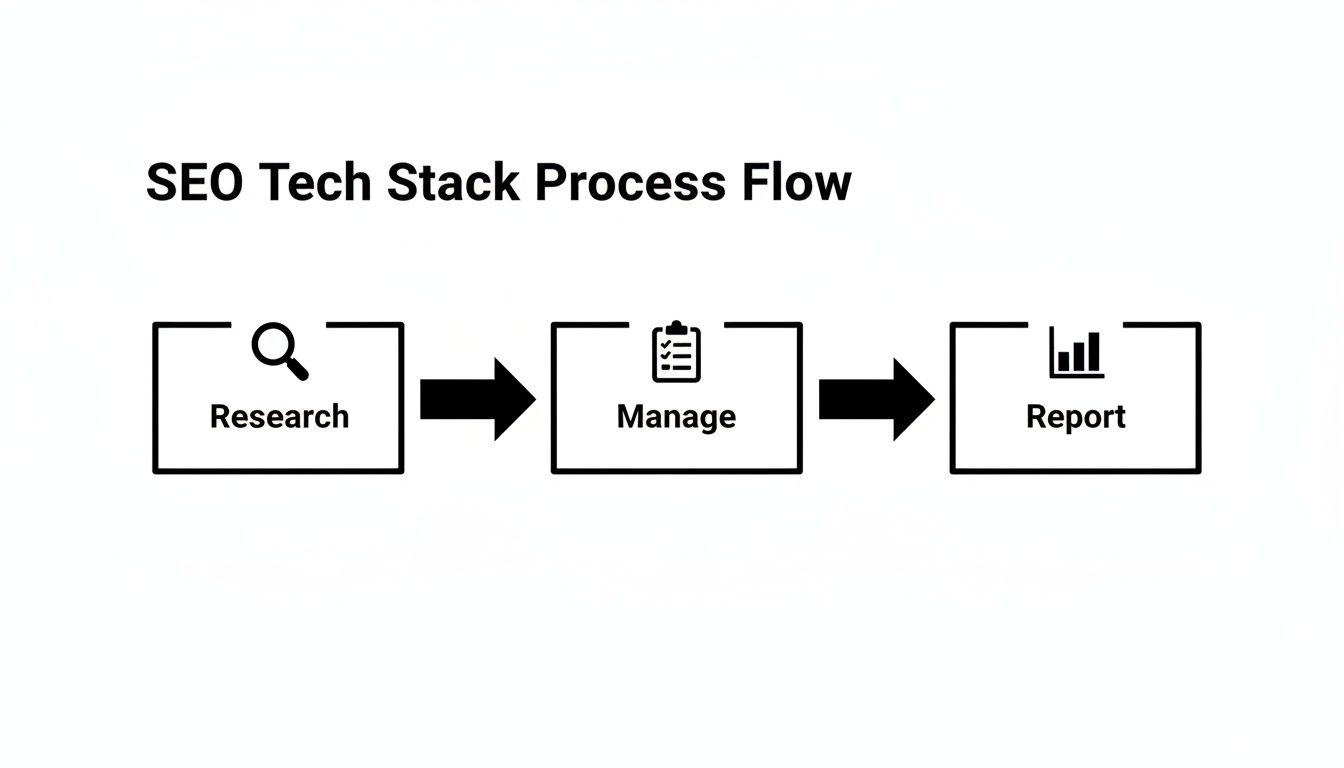
This kind of visualization really drives home how an integrated system helps teams move seamlessly from insight to action—a core principle of effective agile SEO.
Eliminating Silos With a Unified Platform
The real magic of agile SEO happens when you run it on a unified platform. Imagine a strategist uncovering a high-potential keyword during research. They can instantly create a task for a writer without leaving the tool. Once that writer publishes the article, the system can automatically ping the technical team to check for proper indexing. A well-structured content calendar can be the glue that holds these sprints together.
By 2026, this kind of cross-team collaboration is expected to lead to a 45% reduction in execution delays for content campaigns. And it's needed. With organic CTR dropping to 40.3% in US Google searches, teams can't afford to focus on vanity traffic metrics anymore. They have to shift to intent-focused KPIs, bringing UX, CRO, and content under one project management roof. You can find more SEO stats and insights on these evolving team dynamics from Incremys.
This kind of integration is what allows teams to scale their output without getting buried in manual coordination and endless Slack threads.
Common Questions About SEO Project Management
So, you’re thinking about moving to a more structured way of running SEO projects. This is where the rubber meets the road, and it’s natural for some questions to pop up. Adopting a real project management framework isn't just about buying new software; it's a fundamental shift in how your team thinks and operates.
Let's walk through some of the most common questions and hurdles I see teams face. Getting clear, straightforward answers here is what helps the new process actually stick.
How Should We Start Implementing a Project Management System?
The biggest mistake you can make is trying to change everything at once. A massive, overnight overhaul is almost always doomed to fail because it creates way too much friction for your team.
The best way to start is by taking a hard look at your current workflow. Where are the biggest bottlenecks? What drives everyone crazy? Start there.
Introduce a single, central tool for managing tasks and just focus on getting everyone to communicate in that one place. Once that becomes a habit, you can start to formalize your most common processes.
For instance, you could begin with one of these:
- Content Brief Creation: Build a solid template and a clear, repeatable workflow. This ensures every writer gets the same high-quality input, every single time. We actually dive deep into this in our guide on improving your SEO content workflow automation.
- Technical Fix Requests: Create a standardized form for flagging technical SEO issues. This way, your developers get all the information they need right from the start, which means fewer back-and-forth emails.
- Publishing Checklists: A simple checklist for the "go-live" process is a lifesaver. It can cover everything from checking meta descriptions to adding internal links, making sure nothing gets missed.
The key is to roll things out gradually. Solve one real problem at a time. This approach builds momentum and shows the team the value of the new system with each small win, making them much more open to the next change.
How Can We Measure the ROI of New Software?
Justifying the cost of new project management software means looking at it from two different angles: efficiency gains and performance growth. One tells you how much faster you’re getting things done, and the other tells you how much better your results are.
First, let's talk efficiency. Before you make any changes, you need to benchmark where you are right now.
Get some baseline numbers on metrics like:
- The average time it takes to get a new piece of content from an idea to published.
- How many deadlines are missed each month.
- How much time the project manager spends manually pulling together reports.
After the new system has been running for a few months, measure these exact same things again. If you see a big drop in time spent or deadlines missed, that's a clear ROI on the efficiency front.
A great system doesn’t just help you do more work; it helps you get better results in less time. It’s about making your work more impactful and shipping it faster.
For the performance side of things, you’ll be looking at your core SEO KPIs—the numbers the business really cares about. Compare the three months before you implemented the software to the three months after. You're looking for obvious upward trends in organic traffic, keyword ranking improvements, and most importantly, conversions coming from organic search.
When you see both your internal efficiency and your external performance metrics moving up and to the right, the ROI is impossible to argue with.
How Often Should We Review and Adjust Our Plan?
An SEO project plan should never be a static document you create once and then forget about. The search world moves way too fast for a "set it and forget it" mindset. Your plan needs to be a living, breathing thing that you adjust regularly.
I like to think about it as a multi-layered review cycle:
- Bi-Weekly Sprint Reviews: At the end of every two-week sprint, the team gets together to review what was accomplished. This is your moment for quick, tactical adjustments. Based on what you just learned, what needs to change for the next sprint?
- Monthly Performance Reviews: Once a month, it's time to zoom out a little. Pull up your analytics and compare your performance against the goals you laid out in your project blueprint. Are you on pace to hit your quarterly numbers? This is where you might decide to shift focus from one content cluster to another if you're seeing promising early ranking signals.
- Quarterly Strategy Reviews: Every quarter, you need to have a big-picture strategy meeting. This is where you reassess your main priorities. Have there been major algorithm updates? Have competitors made significant moves? Have the business's goals shifted? This review ensures that all the daily work you're doing is still perfectly aligned with your highest-level objectives.
This consistent rhythm of reviews keeps your team agile. It allows you to jump on new opportunities and tackle risks before they turn into major headaches.
Ready to turn AI and search insights into a predictable growth engine? Sight AI provides a unified platform to monitor your brand's visibility across models like ChatGPT and Gemini, identify high-value content gaps, and automate the creation of SEO-optimized articles. Discover how leading teams are scaling their content and rankings by visiting https://www.trysight.ai.