Something significant is happening in how B2B buyers research their next software purchase, choose a consulting firm, or shortlist vendors for a major procurement decision. Instead of typing a query into Google and scrolling through ten blue links, they're asking ChatGPT, Claude, or Perplexity: "What are the best platforms for enterprise data integration?" or "Which CRM tools work best for mid-market SaaS companies?" And they're acting on the answers they get.
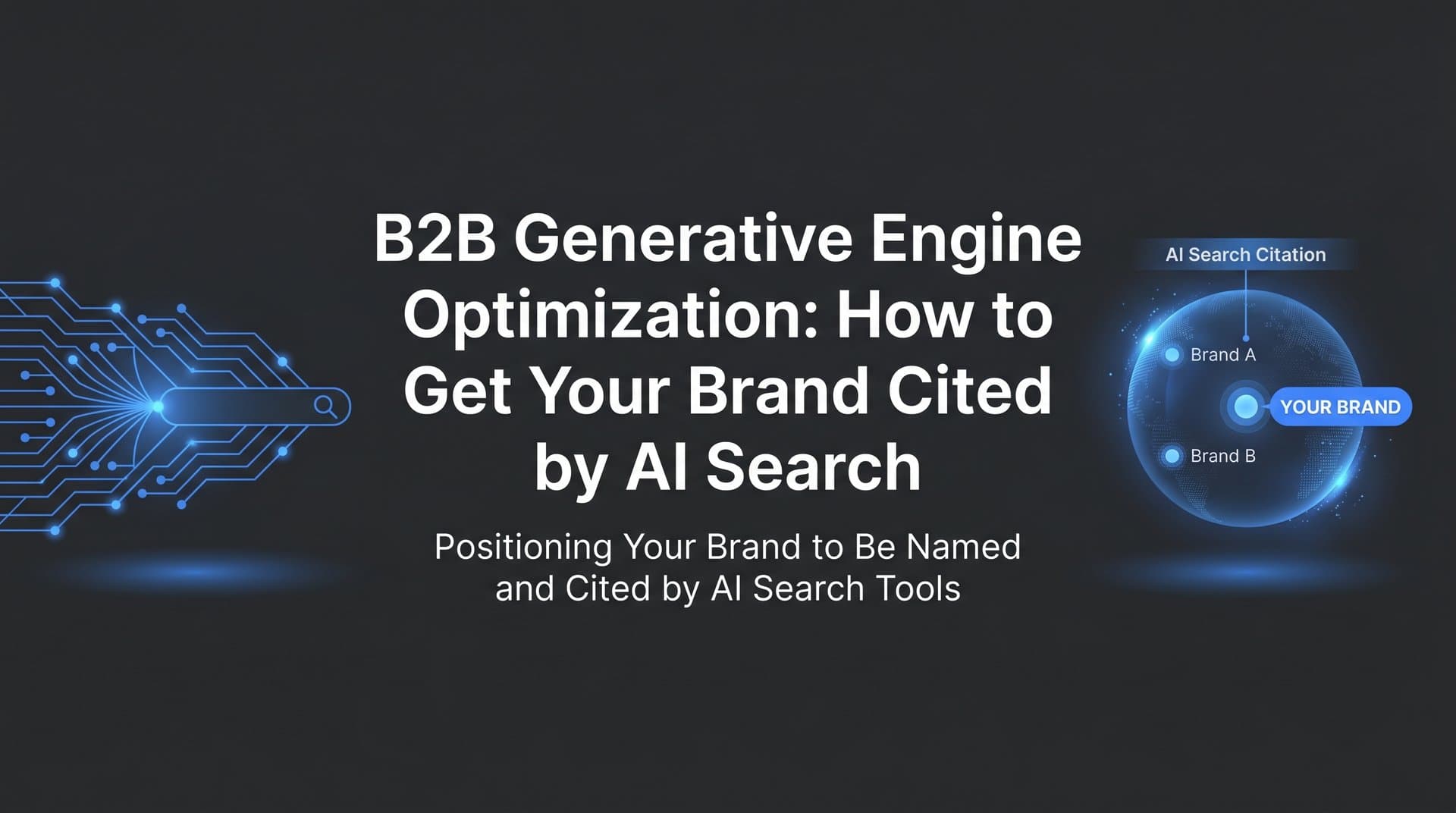
This shift has created a new competitive surface that most B2B brands haven't fully reckoned with yet. Traditional SEO was about earning a spot on page one. B2B generative engine optimization is about something more concentrated: getting your brand named, cited, and accurately described when an AI model answers the exact questions your buyers are asking. The difference matters enormously because AI-generated answers don't surface ten options. They surface two or three.
If your competitors are showing up in those answers and you're not, you're not losing ground slowly. You're simply invisible during one of the most influential stages of the modern B2B buyer journey. This article breaks down what B2B generative engine optimization actually involves, the tactical shifts that make your content AI-citable, how to measure your AI visibility, and how to build a sustainable GEO workflow from audit to ongoing optimization. Let's get into it.
Why AI Search Is Reshaping the B2B Buyer Journey
The B2B buying process has always been research-heavy. Longer sales cycles, multiple stakeholders, significant budget commitments, and real organizational risk mean buyers don't make decisions lightly. They compare, validate, and triangulate before they ever engage with a sales team. What's changed is where that research now begins.
AI assistants have become a natural starting point for vendor discovery. A procurement manager evaluating project management tools might ask Perplexity to compare the top options for distributed engineering teams. A CFO exploring spend management software might ask Claude to explain the key differences between two shortlisted platforms. These conversations happen before any website visit, before any demo request, and often before any human sales interaction.
This matters for B2B brands because the trust dynamic in AI-generated answers is fundamentally different from a list of search results. When a buyer sees your brand appear in a Google SERP, they understand they're looking at ranked links. When an AI model names your product as a recommended solution to their specific problem, it carries a different weight. It feels like a recommendation from a knowledgeable advisor, not an algorithm. That implicit endorsement influences how buyers frame their shortlists and how they perceive your credibility before they've ever spoken to your team. Understanding the AI search engine ranking factors behind these recommendations is essential for any B2B brand serious about visibility.
The competitive math is also unforgiving. Traditional search results give you ten positions on page one and multiple pages beyond. AI-generated answers typically cite two to five sources, sometimes fewer. This isn't a channel where a strong SEO foundation guarantees proportional visibility. It's winner-take-most. The brands that get cited consistently in AI responses to high-intent B2B queries accumulate compounding advantages: more awareness, more consideration, more inbound pipeline.
There's also the multi-stakeholder dimension unique to B2B. Different members of a buying committee may be running their own AI-assisted research independently. The technical evaluator, the business champion, and the economic buyer might each be asking AI tools slightly different questions about the same category. If your brand appears consistently and accurately across all those query types, you're building recognition at every level of the committee. If you're absent, you're starting from a deficit even when a champion tries to advocate for you internally.
The shift isn't coming. It's here. And B2B brands that treat AI search as a secondary concern are ceding ground to competitors who understand what's at stake.
The Core Mechanics of B2B Generative Engine Optimization
Generative engine optimization, as a discipline, emerged from a straightforward observation: the systems that generate AI answers don't work the same way search engine ranking algorithms do. Optimizing for Google means earning backlinks, building domain authority, and satisfying ranking signals. Optimizing for AI-generated answers means something different. It means making your content parseable, trustworthy, and extractable by large language models. If you're new to the concept, our guide on what is generative engine optimization provides a thorough foundation.
At its core, B2B GEO is the practice of structuring your content so that AI models can accurately parse your brand, understand what you do, identify who you serve, and cite you confidently when answering relevant queries. It's not about keyword density or meta descriptions. It's about clarity, authority, and cross-source consistency.
Three pillars underpin a solid B2B GEO strategy.
Structured authority content: AI models favor sources that demonstrate genuine expertise. For B2B brands, this means publishing substantive content: detailed guides, comparison pages, use-case explainers, technical whitepapers, and category definitions. These aren't thin blog posts optimized for a single keyword. They're comprehensive resources that AI models can draw from when assembling an answer. The goal is to become a source worth citing, not just a page worth ranking.
Entity clarity: AI models build understanding of brands as entities. If your company name, product names, and descriptions are inconsistent across your website, your partner pages, your G2 profile, your press mentions, and your social presence, you're fragmenting your entity identity. AI models struggle to form a coherent picture of who you are, which leads to absent or confused mentions. Consistent naming, consistent positioning language, and consistent category framing across all web properties are foundational to GEO.
Citation-worthy formatting: AI models extract specific types of content particularly well: clear definitions, direct-answer paragraphs, explicit claims with supporting logic, and structured comparisons. Content written in dense, jargon-heavy prose with buried key points is hard for models to parse and extract accurately. Content written with direct, scannable clarity gives AI systems the extractable material they need to cite you accurately.
One important clarification: GEO doesn't replace SEO. It layers on top of it. Many AI models, particularly those with web browsing capabilities like Perplexity and ChatGPT with search, pull from indexed web content. Strong domain authority, quality backlinks, and well-indexed pages amplify your GEO results because they make your content more likely to surface in the retrieval layer that feeds AI responses. Think of SEO as the foundation and GEO as the structure you build on top of it.
Five Tactical Shifts That Make B2B Content AI-Citable
Understanding the principles of GEO is one thing. Translating them into content decisions is another. Here are five specific tactical shifts that meaningfully improve your brand's chances of being cited in AI-generated B2B answers.
Write with explicit entity relationships: AI models are very good at extracting structured statements about what something is and what it does. A sentence like "Acme Platform is a revenue intelligence tool that helps enterprise sales teams identify pipeline risk before it becomes churn" gives an AI model everything it needs: the entity name, the category, the audience, and the outcome. Contrast that with vague positioning like "a powerful solution for modern revenue teams" and you can see the difference. Audit your homepage, your product pages, and your pillar content. Make sure every key page contains at least one clear, extractable entity statement.
Build topical authority clusters: AI models don't just look at individual pages. They assess the depth and consistency of expertise across a domain. A brand that has published twenty substantive, interconnected pieces of content about enterprise procurement software signals deeper authority than a brand with one good page on the topic. Map your core B2B use cases and build content clusters around each one: a pillar guide, supporting explainers, comparison content, and real-world application articles. Applying proven semantic search optimization techniques to these clusters further strengthens how AI models interpret your topical depth.
Earn third-party mentions across authoritative sources: AI models cross-reference multiple sources before recommending a brand. If your product is mentioned positively on G2, Capterra, industry publications, partner blogs, and analyst content, the AI has multiple validation signals pointing to your brand. If you only appear on your own website, the model has limited cross-referencing material. A deliberate approach to earning mentions in industry roundups, contributing expert quotes to trade publications, and maintaining active review site profiles is a GEO strategy, not just a PR strategy.
Use direct-answer paragraph structures: Within longer content pieces, include paragraphs that directly answer the question posed in the headline. If your guide is titled "How to Choose a B2B Data Enrichment Platform," include a paragraph that starts with something like "Choosing a B2B data enrichment platform involves evaluating three core factors..." This direct-answer format is highly extractable by AI models and increases the likelihood that your content becomes the source cited when someone asks that question to an AI assistant. Our deep dive into GEO optimization for content covers these formatting strategies in detail.
Keep your highest-value content ungated: This connects to a mistake covered later in the article, but it's worth framing as a positive tactical choice here. Every piece of substantive content you publish publicly is an asset that AI models can parse and potentially cite. Every insight you lock behind a form is invisible to generative engines. For B2B brands accustomed to gating everything, this requires a strategic rethink about which content earns leads directly and which content earns AI visibility that generates leads indirectly.
Measuring Your AI Visibility: Tracking What Matters
Here's the challenge with B2B GEO measurement: your existing analytics stack wasn't built for it. Rank tracking tools tell you where you appear in Google search results. They tell you nothing about whether ChatGPT mentions your brand when a buyer asks about your category. Traffic analytics tell you who visited your site, but not how many buyers encountered your brand in an AI-generated answer and never clicked through. The measurement gap is real, and it's one of the reasons many B2B brands underestimate how much AI search is already influencing their pipeline.
Effective GEO measurement starts with understanding what you actually need to track. The core questions are: Does your brand appear in AI-generated answers to your target B2B prompts? How does the AI describe your brand when it does appear? What sentiment does the model express about your product? And critically, which prompts are returning your competitors instead of you? Dedicated AI visibility optimization tools are purpose-built to answer these questions at scale.
This is where the concept of an AI Visibility Score becomes useful. Rather than tracking a single ranking position, an AI visibility framework monitors your brand's presence across multiple AI platforms, including ChatGPT, Claude, Perplexity, and Gemini, in response to a defined set of target prompts. You're building a picture of your share of voice in AI-generated answers across the queries that matter most to your B2B buyers.
Sentiment tracking adds another layer. It's not enough to know you're mentioned. You want to know how you're described. An AI model that mentions your brand but frames it as "a smaller player with limited enterprise features" is doing you different work than one that describes you as "a purpose-built solution for mid-market operations teams." Monitoring the language AI models use about your brand lets you identify positioning gaps and respond with targeted content.
The most actionable output of AI visibility monitoring is the content gap analysis. When you systematically query AI models with your target prompts and document which brands get cited and which don't, you build a map of opportunity. Prompts where competitors consistently appear and you don't represent your highest-priority content creation opportunities. Prompts where no brand gets a clear citation represent category-level opportunities where the first brand to publish authoritative content can own the AI answer.
This feedback loop between measurement and content creation is what separates a reactive GEO approach from a systematic one. Tools like Sight AI's AI Visibility tracking platform are built specifically for this workflow, monitoring brand mentions across AI platforms, tracking sentiment, and surfacing the prompt-level gaps that should drive your content calendar.
Building a B2B GEO Workflow: From Audit to Autopilot
Knowing the principles of GEO and having a measurement framework are necessary but not sufficient. You need an operational workflow that takes you from current state to ongoing optimization. Here's how to structure it.
Step 1: Run your AI visibility audit. Before you create anything new, understand where you stand. Query the major AI platforms with the twenty to thirty prompts that represent your highest-value B2B buyer questions. Include category queries ("What are the best tools for X?"), comparison queries ("How does [your product] compare to [competitor]?"), and problem-solution queries ("How do I solve [specific B2B challenge]?"). Document every result: where your brand appears, how it's described, where competitors appear, and where no brand gets a clear citation. This audit is your baseline and your strategic roadmap.
Step 2: Prioritize and create GEO-optimized content. Use your audit results to rank content opportunities by potential impact. High-value prompts where competitors appear and you don't should be addressed first. For each gap, create content in formats that AI models extract well: comparison guides with clear entity statements, use-case explainers with direct-answer paragraphs, and category definition pages that establish your brand's position within the landscape. Leveraging the right generative engine optimization tools can streamline this content creation and structuring process significantly.
Step 3: Accelerate indexing and discovery. New content that isn't indexed quickly doesn't help you. AI models that use web retrieval need to find your content before they can cite it. This is where technical infrastructure matters. Tools with IndexNow integration push new URLs to search engines immediately upon publication, rather than waiting for the next crawl cycle. Automated sitemap updates ensure search engines always have a current picture of your content inventory. Our guide on search engine indexing optimization explains how to accelerate this critical step.
Step 4: Establish a continuous publishing and monitoring cadence. GEO isn't a campaign. It's an ongoing practice. AI models update their knowledge regularly, and the competitive landscape shifts as more brands invest in their own GEO strategies. Build a content calendar that consistently publishes new GEO-optimized content targeting your priority prompts. Run your AI visibility monitoring on a regular schedule to track progress, catch sentiment shifts, and identify new gaps as they emerge. Platforms like Sight AI can automate much of this monitoring, surfacing changes in your AI visibility without requiring manual querying across multiple platforms.
Common B2B GEO Mistakes That Keep Brands Out of AI Answers
Even brands that understand GEO conceptually often undermine their own efforts through a handful of consistent mistakes. Recognizing these patterns early saves significant time and resources.
Gating your best content: This is the single most common GEO mistake in B2B. Marketing teams have spent years building gated content strategies because downloadable assets generate leads. That logic is sound for direct lead generation. But it creates a significant blind spot: AI models cannot parse content behind a form. Every whitepaper, research report, and in-depth guide that lives exclusively behind a gate is completely invisible to generative engines. The fix isn't to abandon gating entirely. It's to publish ungated versions of your core insights, whether as long-form blog posts, publicly accessible landing pages, or summary articles that capture the key claims AI models need to cite you.
Inconsistent brand and product naming: AI models build entity understanding by aggregating information across multiple sources. If your website calls your product "Acme Revenue Cloud," your G2 profile calls it "Acme RC," your press releases call it "the Acme Platform," and your partners reference it as "Acme's solution," you're fragmenting your entity identity. The model can't form a coherent picture of what your product is, which leads to absent mentions, confused descriptions, or incorrect categorization. Conduct a naming audit across all your web properties and establish consistent terminology that every channel uses. If you suspect fragmented identity is already causing problems, our article on why AI search engines are missing your website walks through the diagnostic process.
Treating GEO as a one-time project: Some brands run a GEO audit, publish a batch of optimized content, and consider the work done. This misunderstands how AI models work. Their knowledge is updated through ongoing training and, for retrieval-augmented models, through continuous web indexing. The competitive landscape also evolves as other brands invest in GEO. A brand that was well-cited six months ago may find its visibility eroding if it stops publishing and monitoring. GEO requires the same continuous investment mindset as SEO: consistent content production, regular performance monitoring, and iterative optimization based on what the data shows.
Ignoring third-party validation: Some B2B brands focus all their GEO effort on their own website content and neglect the external citation ecosystem. AI models are more likely to cite brands that appear across multiple authoritative sources, not just their own properties. If your brand isn't appearing in industry publications, analyst content, review platforms, and partner ecosystems, you're missing a critical validation layer that AI models use to assess credibility before making a recommendation. Developing a comprehensive AI recommendation optimization strategy that includes third-party signals is essential for sustained visibility.
Your Next Move in the AI Search Era
B2B generative engine optimization isn't a trend to monitor from a distance. It's a present-tense competitive dynamic that's already influencing how buyers discover, evaluate, and shortlist vendors. The brands building AI visibility now are compounding advantages that will be significantly harder to close later, as AI adoption among B2B buyers continues to accelerate.
The path forward is clear even if the execution requires sustained effort. Start with an honest audit of where your brand appears, or doesn't appear, in AI-generated answers to your most valuable buyer prompts. Use that data to prioritize content creation that fills the gaps. Structure that content for AI extractability with clear entity statements, direct-answer paragraphs, and topical depth. Ensure it gets indexed quickly and monitored continuously.
The brands that win in AI search aren't necessarily the ones with the biggest budgets. They're the ones that understand the new rules of visibility and build systematic workflows around them. GEO is learnable, executable, and measurable. The only thing missing for most B2B brands is the decision to start.
Start tracking your AI visibility today and see exactly where your brand appears across ChatGPT, Claude, Perplexity, and other top AI platforms. Sight AI gives you the visibility data, content gap analysis, and publishing infrastructure to turn your B2B GEO strategy from a concept into a compounding competitive advantage.