Generative Engine Optimization (GEO) is the art and science of making your content the go-to source for AI answer engines like ChatGPT, Gemini, and Perplexity. It’s all about creating and structuring your content so that when these AI tools synthesize an answer, they pull directly from your work, citing you in the process.
You can think of it as SEO for this new era of AI-driven information.
Understanding Generative Engine Optimization
Let's use an analogy. Imagine your content is a product on a shelf. Traditional SEO is like making sure your store is on a busy street and shows up on Google Maps so people can find it.
Generative Engine Optimization, or GEO, takes it a step further. It’s about ensuring that when a customer asks an expert store clerk—in this case, the AI—for a recommendation, your product is the one they not only suggest but also explain in detail, pointing back to you as the definitive authority.
This isn't some far-off future; it's happening right now. People are shifting from typing keywords into a search bar to asking complex, conversational questions to their AI assistants. This creates a whole new world of "zero-click" answers, where the AI delivers a perfect summary, and your entire goal is to be the source of that summary.
The impact on traditional traffic is already being felt. As AI search adoption hit 38% globally by early 2025, organic click-through rates for informational queries plummeted by a staggering 54% whenever an AI answer was present.
How GEO Differs from Traditional SEO
While both GEO and SEO are about boosting visibility, they play by different rules and aim for different prizes. Getting a handle on these differences is the first step to building a content strategy that actually works today. In this new landscape, creating high-quality, deeply insightful resources—like the kind you'll find in these thought leadership content examples—is absolutely essential for building the kind of authority that AI engines reward.
The most critical difference is the end goal. SEO is a game of clicks and traffic, driven by a high rank on a list of links. GEO, on the other hand, is a game of citations and brand mentions within a generated answer. You can dive deeper into this evolving field in our detailed guide to AI search engine optimization.
To make the distinction crystal clear, here’s a side-by-side look at how these two disciplines stack up.
Generative Engine Optimization vs Traditional SEO
This table breaks down the core differences between GEO and traditional SEO, highlighting their distinct goals, tactics, and target platforms.
| Aspect | Traditional SEO | Generative Engine Optimization (GEO) |
|---|---|---|
| Primary Goal | Rank high in SERPs to drive clicks and website traffic. | Become a cited source in AI-generated answers to build brand authority. |
| Target Platform | Search engine crawlers like Googlebot. | Data ingestion systems of LLMs (e.g., ChatGPT, Gemini). |
| User Interaction | User sees a list of links, clicks one, and visits a webpage. | User asks a question and gets a direct, synthesized answer from the AI. |
| Key Metric | Organic traffic, click-through rate (CTR), keyword rankings. | Citations, brand mentions, inclusion in AI-generated knowledge. |
| Content Focus | Well-structured, keyword-optimized articles for crawlers and readers. | "Prompt-aware" content with clear, citable facts and structured data. |
As you can see, while SEO is focused on getting users to your site, GEO is focused on getting your knowledge into the AI's answer. The two aren't mutually exclusive; in fact, a strong GEO strategy often builds upon a solid SEO foundation. But the mindset and tactics are fundamentally different.
How AI Engines Actually Find Your Content
If you really want to get a handle on generative engine optimization, you need to pull back the curtain and see how AI engines like ChatGPT and Gemini actually find and use information. It’s a totally different game than traditional search. Google crawlers index and rank pages; these AI models are more like researchers. They actively read, synthesize, and cite sources to build a brand-new answer for every single question.
They don't just find your content; they interpret it.
It all starts with their foundational training data—a colossal, static library of books, articles, and websites they've "read" to understand language, facts, and context. The catch? This knowledge has a cutoff date, meaning it gets stale pretty fast.
To stay current, modern AI systems use a slick technique called Retrieval-Augmented Generation (RAG). Think of RAG as an open-book exam. When you ask a question, the AI doesn't just rely on what it memorized months ago. It performs a real-time web search to find fresh, relevant documents to inform its answer.
The Role of Retrieval-Augmented Generation
RAG is the critical link between an AI's static knowledge and the live, breathing internet. It’s a multi-step dance that determines whether your content gets picked for the final answer.
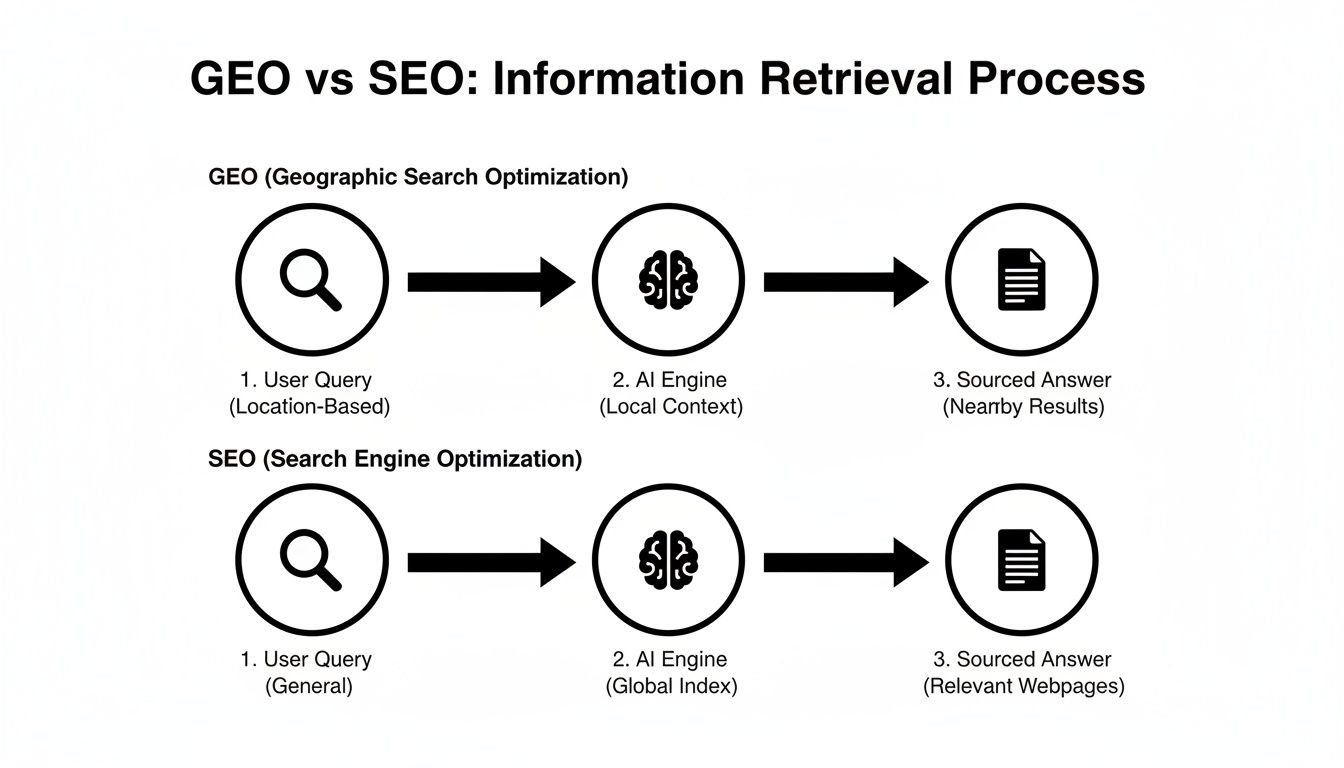
- Step 1: Query Understanding: First, the AI breaks down your conversational prompt to figure out what you really mean, looking past simple keywords to grasp the underlying intent.
- Step 2: Information Retrieval: Next, it scours its web index for articles and snippets that are semantically related to your question. It's looking for a conceptual match, not just a keyword match.
- Step 3: Ranking and Synthesis: The AI then sizes up the documents it found, weighing signals like authority, clarity, and how recent they are. It pulls the best bits of information from multiple sources and weaves them into a single, cohesive answer.
- Step 4: Citation: Finally, it gives credit where credit is due by citing the sources it used. Getting that citation is the entire goal of a good GEO strategy.
This whole process shows the journey from a user's prompt to an AI-generated answer that's sourced directly from your content.
This new reality makes one thing crystal clear: creating content that’s easy for an AI to digest is now just as important as writing for a human.
Signals That Matter to AI Engines
So, what makes an AI trust one piece of content over another? While the exact algorithms are a black box, some key signals consistently pop up as being critical for getting cited. To really get it, it helps to understand the basics of conversational AI.
These AI systems are looking for:
- Clarity and Structure: Clean, organized content wins. Think logical hierarchy, clear headings (H2s, H3s), bullet points, and short paragraphs. This structure makes it a breeze for an AI to parse your article and pull out specific facts.
- Authority and Trust: E-E-A-T (Experience, Expertise, Authoritativeness, Trustworthiness) is huge here. AI models lean on well-known sources, but you can build this authority yourself with a strong backlink profile and citations from other reputable sites.
- Factual Density and Specificity: Fluffy, vague statements get ignored. The AI is hunting for content that’s rich with specific data, hard numbers, and citable facts. This is the raw material for its answers.
- Recency: For tons of topics, especially in fast-moving industries, fresh information is king. This is where a solid content update strategy becomes a non-negotiable. Making sure search engines know about your updates quickly can give you an edge; our IndexNow implementation guide can show you how.
You can't get comfortable, either. The sources these AI engines prefer can change on a dime.
One analysis found that in late 2024, ChatGPT's citations of Wikipedia shot up from almost 0% to 13%, only to plummet back down to 4% a few months later. This volatility proves no single source is safe, which actually creates a massive opportunity for high-quality, specialized content to break through and earn citations.
At the end of the day, you’re no longer just optimizing for a keyword. You're optimizing for a machine that reads, comprehends, and references your work. This fundamental shift makes the quality, structure, and factual accuracy of your content more critical than ever.
Practical Strategies to Win at GEO

Knowing how AI engines work is one thing. Actually putting that knowledge into practice is what gets results.
Let's move from theory to action. Here’s a playbook of on-page tactics that will make your content the go-to source for AI-generated answers. These are the concrete steps you can take today to start winning at generative engine optimization.
The core idea is simple but incredibly powerful: make your content as clear and digestible for a machine as it is for a human. This means thinking ahead, anticipating the kinds of questions people will ask, and crafting your content to answer them directly and with authority.
Craft Prompt-Aware Content
The single most effective GEO strategy is creating "prompt-aware" content. Forget just targeting keywords; you're now targeting entire lines of inquiry. This means you’re actively thinking about the conversational questions and prompts users will type into an AI engine.
Think about the specific, detailed questions your audience has. Structure your articles around them. Use those questions as subheadings and then answer them clearly and concisely right underneath. This creates a natural Q&A format that AI engines love because it makes extracting precise information a piece of cake.
For example, a traditional SEO heading might be "Benefits of Content Marketing." A much stronger, GEO-friendly heading would be, "What Are the Main Benefits of Content Marketing?" That tiny shift directly mirrors how a real person asks a question, making your content a perfect match for the AI’s retrieval system. You can explore more tactics like this in our guide on how to optimize for AI search.
Leverage the Power of Structured Data
Structured data, also known as schema markup, is like a secret language you can use to speak directly to search engines and AI models. It’s a bit of code you add to your site that explicitly defines your content, making it ridiculously easy for machines to understand what they're looking at.
When you use schema, you remove all the guesswork. You’re not just hoping the AI figures out your page; you are literally telling it what each element is. That kind of technical clarity gives you a massive advantage.
For GEO, two types of schema are especially crucial:
- FAQPage Schema: Use this for any frequently asked questions section. It clearly labels each question and its corresponding answer, creating perfect, bite-sized snippets for an AI to pull from.
- HowTo Schema: If you're explaining a step-by-step process, this schema breaks it down into a clear, sequential format that is highly valuable for generated answers that provide instructions.
By implementing structured data, clear FAQs, and rich media, one agency saw an industrial client's AI referral traffic increase by an incredible 2,300%. This same approach also helped them secure 90 AI Overview keywords, proving that technical optimization pays huge dividends in the world of GEO.
Create Citable Snippets and Citation Signals
AI models don't just read your entire article from top to bottom. They hunt for specific, citable facts, stats, and definitions they can use to build their answers. Your job is to make these little nuggets of information easy for them to find and reference.
Break down complex ideas into short, self-contained paragraphs—just one to three sentences is perfect. Each one should be a potential citation, a standalone piece of information. Think of your article as a collection of individually valuable facts that an AI can cherry-pick. When you include data or a specific claim, make it sharp and direct.
Beyond the content itself, you need to build strong citation signals. These are the clues that tell an AI your content is authoritative and well-connected. You can strengthen these signals by:
- Smart Internal Linking: Link to other relevant, in-depth articles on your site. This shows the AI how your pages relate to one another and establishes your site as a comprehensive resource on a subject.
- Authoritative External Linking: When you cite a statistic or study, link directly to the primary source. Linking out to reputable domains like universities, government sites, or well-known research institutions boosts your content's credibility in the eyes of the AI.
The results of these tweaks can be profound. Another GEO case study showed that targeted content adjustments led to 25% more AI-driven sessions and a 300% lift in conversions from AI channels.
Choosing Your Tools and Measuring Success

If you can’t measure your generative engine optimization efforts, you can’t improve them. The strategies are powerful, but proving their value means shifting away from comfortable, old-school metrics like keyword rankings and organic traffic. In the world of GEO, success is measured by influence, not just clicks.
This creates a brand-new challenge. How do you possibly track performance when the goal is getting a citation inside a generated answer on a platform you don’t own? Nailing this is the key to demonstrating ROI and getting everyone on board with your GEO strategy.
The New Metrics That Matter for GEO
Your standard analytics tools weren't built for this new ecosystem. To measure GEO performance, you have to adopt a fresh set of key performance indicators (KPIs) that directly map to your visibility inside AI-driven answers.
Here are the primary metrics you need to be tracking:
- Citation Frequency: This is the most direct measure of GEO success. It simply tracks how often your content is cited as a source in AI responses for your target queries.
- Brand Mentions: This KPI monitors how often your brand name pops up within generated answers, even without a direct link. It’s a powerful signal of your growing authority.
- Answer Position: When multiple sources are cited, your position is everything. Being the first or primary source in an AI answer carries far more weight than being listed as a secondary citation.
- Sentiment Analysis: This metric gauges the context surrounding your brand mentions. Are they positive, neutral, or negative? Understanding the sentiment helps you see how AI models perceive your brand's authority.
Specialized Tools for a New Challenge
As GEO becomes more critical, a new category of specialized platforms is emerging to deliver the insights you need. These tools are built to monitor your visibility across different large language models—like ChatGPT, Gemini, and Claude—all from a single dashboard.
These platforms work by systematically hitting AI engines with thousands of relevant prompts and analyzing the answers they spit out. They then crunch this data to give you a clear picture of your performance, answering critical questions that traditional analytics can't touch. For example, these tools can pinpoint exactly where competitors are getting cited for high-value topics, showing you exactly where your biggest content gaps are.
Of course, while these specialized tools are essential, a solid foundation in traditional SEO rank tracking is still incredibly valuable for maintaining a complete view of your digital presence.
The real power of GEO measurement tools is their ability to connect your day-to-day work with real business impact. By turning abstract concepts like "brand mentions in AI" into hard data, they empower you to prove the ROI of your efforts and justify continued investment in your content strategy.
Essential GEO Metrics and Tools
Measuring GEO effectively requires a specific set of metrics and the right tools to capture them. This table breaks down what you need to track and the type of platform you'll need to do it.
| Metric | What It Measures | Tooling Example |
|---|---|---|
| Citation Frequency | How often your domain is cited in AI answers for key queries. | Specialized GEO Monitoring Platform |
| Brand Mentions | How often your brand name appears, with or without a link. | Specialized GEO Monitoring Platform |
| Answer Share of Voice | Your percentage of total citations versus competitors for a topic. | Specialized GEO Monitoring Platform |
| AI-Referred Traffic | Clicks to your site from users on generative answer platforms. | Web Analytics (e.g., Google Analytics) |
| Sentiment Analysis | The positive, neutral, or negative context of brand mentions. | Specialized GEO Monitoring Platform |
Ultimately, a combination of these new GEO platforms and your existing web analytics will give you the most complete picture of your performance.
A Practical Measurement Workflow
To build a GEO program that lasts, you need a repeatable process for tracking and reporting. It's all about combining data from both new and existing tools to get a full view of your performance.
Here’s a simple but effective workflow to get you started:
- Establish Baseline Metrics: Before you launch any new GEO initiatives, use a specialized tool to audit your current citation frequency and brand mentions for a core set of 20-30 target queries. This is your starting line.
- Monitor Key Queries Weekly: Regularly check your performance on your most important prompts. Look for changes in citation frequency, your position in the answer, and which competitors are showing up.
- Track AI-Driven Traffic: In your web analytics, create a segment for traffic coming from known AI user agents (like
ChatGPT-UserorPerplexityBot). It’s not a perfect measure, but it gives you a directional sense of how AI crawlers are interacting with your site. - Connect to Business Goals: Look for correlations between a rise in citations and brand mentions and your downstream business metrics, like branded search volume and direct traffic. This is how you connect top-of-funnel GEO visibility to bottom-line results.
What's Next? GEO Trends and Inescapable Risks
Looking ahead, the world of generative engine optimization isn't just growing—it's accelerating at a breakneck pace. To stay in front, you need to get a handle on the trends that will shape the next wave of AI-driven search and be brutally honest about the real risks that come with it. The strategies working today will need to evolve for a future that’s far more personal, dynamic, and frankly, a bit unpredictable.
The fundamentals of what makes generative engine optimization work will shift as AI models get smarter. The end goal will always be the same—get your content cited as the source—but how you get there is about to change.
The Rise of Hyper-Personalization and UGC
One of the biggest shifts on the horizon is the move toward hyper-personalized AI answers. Soon, generative engines will likely customize responses based on a user’s search history, location, and known interests. This means two people could ask the exact same question and get completely different answers, pulled from entirely different sources.
This trend makes broad, one-size-fits-all content a losing bet. Success will come from building a deep, diverse library of content that speaks to countless niche intents and user profiles.
At the same time, AI is increasingly digging into user-generated content (UGC) for authentic, real-world experience. Platforms like Reddit and Quora are becoming go-to sources for answers that need a genuine human touch. This isn't a minor trend; it's a seismic shift in how information is sourced, and it's already happening.
The rise of GEO is fueled by skyrocketing AI content in search results. Google's AI Overviews exploded from 6.49% of queries in January 2025 to 13.14% by March—doubling in just two months. During this same period, Reddit's traffic surged 603% and Quora's 379% as AI engines prioritized user-generated content. You can discover more insights about AI's impact on SEO on seomator.com.
Navigating the Inherent Risks of GEO
While the opportunities are massive, the world of GEO is also riddled with unique challenges that demand a careful, strategic hand. Going all-in on AI-driven visibility is a huge gamble if you don’t understand the potential landmines. These risks aren't just hypotheticals; they can hit your brand's reputation and content performance where it hurts.
A few key challenges stand out:
- AI 'Hallucinations' and Misinformation: Generative models can still "hallucinate"—they literally invent facts or completely misrepresent information from a source. If an AI misinterprets your content and cites it incorrectly, it can tie your brand to bad information, damaging your credibility through no fault of your own.
- Copyright and Fair Use Headaches: The legal ground around AI and content is still shaky, to say the least. There are fierce debates about whether an AI summarizing your work is fair use or straight-up copyright infringement. As a creator, you currently have very little say in how your work is chopped up and presented.
- Unpredictable Source Preferences: We’ve seen it happen with platforms like Wikipedia—an AI’s favorite sources can change overnight. An algorithm update could suddenly demote a content format you’ve poured resources into, making your citations disappear without a trace.
To stay on top of these rapid changes, it’s vital to follow the latest trends in AI content generation.
Ultimately, future-proofing your GEO strategy means building a content program that’s both resilient and adaptable. Diversify your content formats, build authority across multiple platforms (including UGC sites), and never, ever get too comfortable relying on a single AI engine for your visibility. By embracing the trends and preparing for the risks, you can build a lasting presence in this new era of search.
Common Questions About GEO, Answered
As you start digging into generative engine optimization, you're bound to run into some practical questions. It's a new field, which means new quirks and a bit of confusion. Let’s clear the air and tackle some of the most common sticking points so you can move forward with confidence.
I’ve designed each answer to be quick, actionable, and to build on what we’ve already covered.
How Is GEO Different from Optimizing for AI Overviews?
This one comes up a lot, and it’s an important distinction. Think of it like this: optimizing for Google's AI Overviews is a specific play, while Generative Engine Optimization (GEO) is the entire playbook.
GEO is the big-picture strategy. It’s about making your content the go-to source for a whole range of AI models—ChatGPT, Perplexity, Claude, you name it. AI Overviews, on the other hand, are just one feature inside of Google Search.
Here’s the simplest way to break it down:
- GEO is platform-agnostic. The goal is for any AI engine crawling the web to see you as an authority.
- Optimizing for AI Overviews is Google-centric. It depends heavily on classic SEO signals (like being in the top 10 results) but uses GEO tactics like structured data to get there.
A solid GEO strategy will naturally boost your chances of showing up in AI Overviews. But if you only focus on Google's feature, you're leaving a ton of visibility on the table with other fast-growing AI platforms.
Can Small Businesses Still Implement GEO Effectively?
Absolutely. In fact, GEO might just be the great equalizer for small businesses that have struggled to keep up with traditional SEO. Big companies often dominate competitive keywords with massive budgets and domain authority. But GEO rewards something different: true expertise, clarity, and niche authority.
An AI engine’s prime directive is to find the most accurate answer, not just the answer from the biggest website. A small business that is a genuine expert in its field can create hyper-detailed, fact-rich content that AI models will prefer over a generic article from a huge brand.
For smaller businesses, the winning move is to go deep, not wide. Focus on:
- Niche Expertise: Write about the specific topics you know inside and out.
- Answering Customer Questions: Use your firsthand knowledge of what customers struggle with to build out detailed FAQ-style content.
- Building Topical Authority: Become the undisputed source for a very specific subject. Make your site the most logical place an AI could possibly go for reliable info on that topic.
What Is the Most Important First Step for GEO?
If you're wondering where to even begin, the single most impactful thing you can do is create or update a comprehensive FAQ page on your site. This one move perfectly aligns with the core principles of what generative engine optimization is all about.
An FAQ page is already in a question-and-answer format—exactly how AI models are built to process information. It lets you address user prompts head-on, create concise snippets that are easy to cite, and implement powerful FAQPage schema.
By 2023, 13 million US adults were already using AI for search, a number projected to skyrocket to 90 million by 2027. With 80% of consumers relying on AI-written results and 63% of websites already receiving AI-driven traffic, establishing a foothold now is critical. Discover more about the rapid adoption of AI in search on seomator.com.
Building this page forces you to think like an AI. You'll have to anticipate questions, write direct answers, and organize your knowledge in a way that’s easy for a machine to read. This isn't just a minor tweak; it's a foundational exercise that builds the right mindset and content to win in this new arena. Start there, and you'll have a strong base to build on.
Ready to turn AI visibility into a measurable growth channel? Sight AI is the all-in-one platform that monitors your brand's presence across leading AI models and gives you the tools to dominate the conversation. From tracking citations and sentiment to generating GEO-optimized articles with a single click, Sight AI helps you stop guessing and start ranking.